

Advanced social media content creation services for ecommerce
TL;DR:
- Specialized social media content creation enhances engagement, scalability, and ROI for ecommerce brands.
- Effective content formats include product showcases, user-generated content, tutorials, testimonials, and behind-the-scenes videos.
- Integrating social media content with email strategies boosts retention, conversion, and overall brand performance.
Most ecommerce marketing managers assume their in-house team can handle social media. And honestly, for a while, that belief holds. But as feeds grow more competitive and consumer expectations rise, the gap between “good enough” and “brand-building” content widens fast. Advanced social media content creation services aren’t just about pretty visuals. They’re about data-driven storytelling, platform-specific production, and creative systems that scale with your brand. If you’re running retention campaigns through email flows and wondering why social isn’t converting at the same rate, this guide breaks down exactly why specialized content services change the equation.
Table of Contents
- How social media content creation services work for ecommerce brands
- Key components of effective ecommerce social media content
- integrating content services with your email and retention strategy
- choosing the right social media content creation partner
- Why most ecommerce brands underestimate the power of advanced content services
- supercharge your ecommerce growth with expert content creation
- frequently asked questions
Key Takeaways
| Point | Details |
|---|---|
| Specialization drives results | Advanced content creation services consistently outperform in-house efforts for ecommerce growth. |
| Content types matter | Mixing product showcases, UGC, video, and storytelling maximizes engagement and retention. |
| Integrated strategy wins | Aligning social content with Klaviyo and email campaigns creates a powerful retention engine. |
| Choose the right partner | Assess agency experience, creative quality, and platform expertise to find your best fit. |
How social media content creation services work for ecommerce brands
Specialized content creation services go well beyond writing captions and scheduling posts. For ecommerce brands, the scope is far more structured. It typically covers content planning, asset production (photos, graphics, short-form video), scheduling, and ongoing performance analysis. Every deliverable connects back to your brand goals, whether that’s increasing product discovery, reducing return rates, or building post-purchase loyalty.
Here’s what a standard workflow looks like with a professional content partner:
- Brand alignment session: Deep dive into your visual identity, tone of voice, and target audience personas
- Content calendar development: Monthly or quarterly planning tied to launches, promotions, and seasonal moments
- Asset production: Photography, video, design, and copywriting executed at scale
- Review and revision cycles: Your team approves before anything goes live
- Publishing and scheduling: Platform-native posting with optimal timing strategies
- Analytics reporting: Regular performance breakdowns with actionable insights
For ecommerce specifically, content gets built around your product catalog. That means product-centric visuals, promotional integration timed to your campaign windows, and platform-specific approaches since what works on TikTok rarely works on Pinterest without adaptation. Understanding the role of social media in apparel shows just how differently audiences engage depending on category and platform.
| Factor | DIY / in-house | Agency-produced content** |
|---|---|---|
| Production speed | Variable, often slow | Fast, scheduled delivery |
| Creative range | Limited by team skill | Access to specialists |
| Analytics depth | Basic platform metrics | Multi-platform, actionable |
| Cost per asset | Higher over time | More efficient at scale |
| Brand consistency | High risk of drift | Process-enforced consistency |
Brands that leverage ecommerce content strategy through dedicated services consistently see higher engagement rates compared to brands running production entirely in-house. The data supports it, and so does the creative output.
Pro tip: Before signing with any content service, clarify ownership of all assets produced. You want full commercial rights to every image, video, and graphic so you can repurpose across email, paid ads, and your website without restrictions.
Key components of effective ecommerce social media content
Not all content performs equally. For ecommerce brands, certain formats reliably outperform others when the goal is conversion and retention. Understanding what those formats are and why they work helps you prioritize your investment.
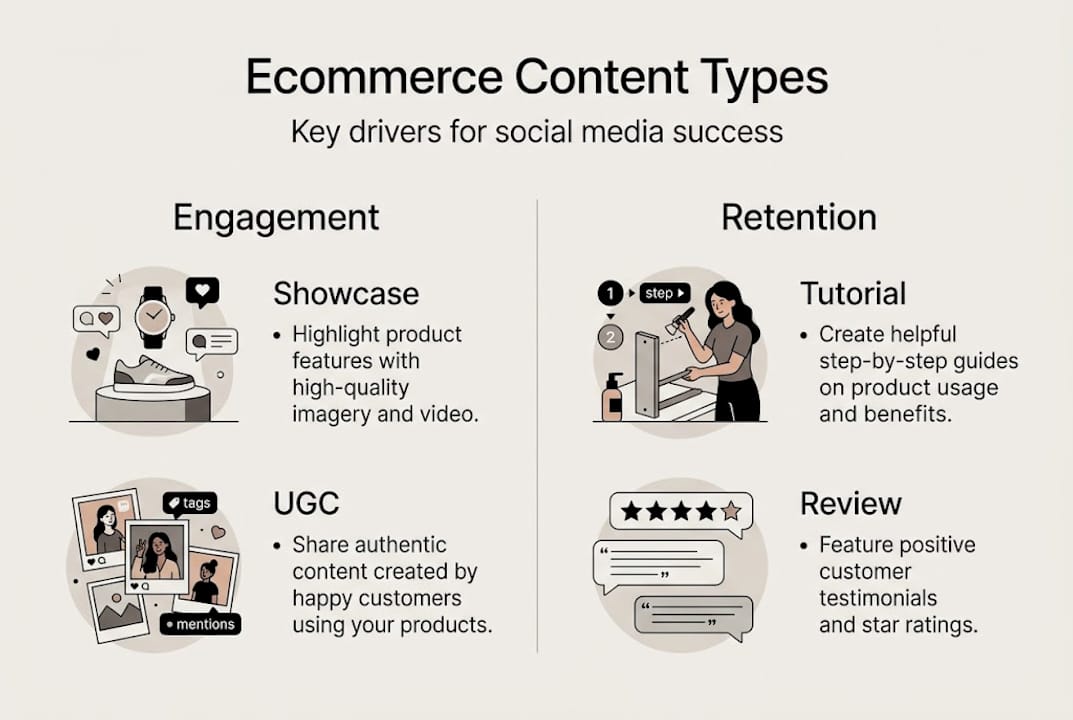
The top five most effective content formats for ecommerce conversions are:
- Product showcases with context: Show products in real-life use scenarios, not just on white backgrounds
- User-generated content (UGC): Real customers using real products. It builds trust instantly
- Tutorial and how-to content: Educational posts that highlight product value and drive repeat use
- Customer testimonials (video): Short-form video reviews convert significantly better than text alone
- Behind-the-scenes content: Brand story and production transparency build emotional connection
UGC increases purchase likelihood because shoppers trust peer reviews more than brand messaging. It’s not a new insight, but most brands still underinvest in systematically collecting and repurposing it.
| Content type | Primary engagement driver | Impact on retention |
|---|---|---|
| Product showcase | Discovery, awareness | Low to moderate |
| UGC | Trust, social proof | High |
| Tutorial / how-to | Education, repeat use | High |
| Behind-the-scenes | Brand affinity | High |
| influencer collab | reach, new acquisition | moderate |
Visual production quality matters more than most brands admit. Low-quality photography doesn’t just hurt engagement. It undermines brand perception, especially at the moment someone is considering a purchase. Good streetwear photography demonstrates how production choices directly shape audience response, regardless of product category.

Klaviyo gives you a competitive advantage here. Your email data tells you which products get the most post-purchase engagement, which segments browse but don’t buy, and which categories drive repeat purchases. Feed that data into your content planning so that your social calendar reflects what actually resonates with your customer base. This is where most in-house teams leave performance on the table. They plan content based on gut feel instead of behavioral data they already have access to. Video marketing tactics layered on top of these insights amplify reach even further.
integrating content services with your email and retention strategy
Great content on social only takes you so far if it’s disconnected from your email flows. The real lift comes when both channels reinforce each other. Here’s a process for aligning them effectively:
- Map your email flows first. Know what messages your customers receive at each lifecycle stage: welcome, post-purchase, winback, and VIP.
- Mirror those themes on social. If your post-purchase flow emphasizes product care and community, your Instagram content should do the same.
- Create channel-specific assets from shared content pillars. A single content pillar, say “sustainability,” can become an email series and a social campaign simultaneously.
- Use social engagement data to trigger smarter email flows. When someone clicks a product video on Instagram and visits your site, that’s a signal. Use it in your segmentation.
- Report on both channels together. Don’t evaluate social and email in silos. Look at combined lift on conversion and retention metrics.
“The brands scaling fastest aren’t choosing between social and email. They’re using each channel to make the other more effective.”
Consider a real scenario. You’re launching a new apparel line. Your Instagram Stories tease the drop with countdown content. Meanwhile, your social content strategy for email feeds customers who clicked the Stories link into a dedicated email sequence with early access and styling tips. By the time launch day arrives, those customers have seen the product multiple times, across multiple touchpoints, and they convert at a significantly higher rate.
Content pillars for retention used alongside email campaigns increase overall engagement, giving you a measurable reason to align both channels under a unified strategy.
Pro tip: Set up a shared reporting dashboard that pulls social engagement data and email click-through rates side by side. Even a simple Google Data Studio setup can show you patterns that would otherwise stay invisible.
choosing the right social media content creation partner
Picking the wrong partner wastes budget and time. The right one becomes a genuine growth lever. Here’s how to screen and shortlist effectively.
Steps for evaluating content creation partners:
- Define your content needs before outreach (volume, platform, format mix)
- Filter by ecommerce specialization. Generic content studios rarely understand conversion-focused creative
- Review portfolios for brands in adjacent categories, not just your exact vertical
- Ask for sample analytics reports from past campaigns
- Run a paid pilot project before committing to a long-term contract
Key questions to ask on sales calls:
- Who actually produces the work (in-house team or subcontractors)?
- How do you handle content that underperforms?
- What’s your revision policy and turnaround time?
- Can your workflow integrate with our tech stack, including tools like klaviyo?
- How do you measure success, and what does a standard report look like?
Red flags to watch out for:
- No case studies or verifiable performance data
- One-size-fits-all packages with no customization options
- No clear point of contact or account manager
- Long lock-in contracts with no performance benchmarks
- Portfolio that looks impressive but can’t be tied to business outcomes
Agencies with ecommerce specialization consistently deliver better ROI than generalist providers. That specialization translates into creative decisions that are rooted in purchase behavior, not just aesthetic preference.
Why most ecommerce brands underestimate the power of advanced content services
Here’s an uncomfortable truth: most brands don’t know what “good” looks like until they see it working. In-house teams are often capable and hardworking, but they’re also stretched thin, constrained by internal politics, and rarely exposed to the cross-industry insights that specialist agencies carry.
External content partners see what works across dozens of brands simultaneously. They bring speed, creative diversity, and pattern recognition that’s genuinely hard to build inside a single brand team. Advanced digital media strategies developed by specialists routinely outperform even experienced internal teams not because internal teams lack talent, but because they lack the volume of cross-brand data that informs those strategies.
The mindset shift is this: content isn’t a task to check off. It’s a performance channel. And performance channels deserve specialist operators. Once brands start seeing sustained lifts in retention metrics and engagement rates from externally driven content, they rarely go back.
supercharge your ecommerce growth with expert content creation
You’ve seen how advanced content services work, what formats drive results, and how to connect social content with your email retention strategy. The missing piece for most ecommerce brands isn’t budget. It’s the right partner.
Take Action works with ecommerce and DTC brands to build retention-first marketing systems that connect social content with high-performing email flows built on Take Action for ecommerce brands. From content strategy alignment to automated lifecycle campaigns, we help brands grow revenue without just throwing more money at paid ads. If you’re ready to see what a fully integrated, data-driven approach looks like for your brand, let’s talk.
frequently asked questions
How do social media content creation services benefit ecommerce brands compared to in-house efforts?
Specialized services provide expert strategy, creative assets, and analytics that typically deliver higher engagement, greater scalability, and better ROI. External content expertise consistently drives more measurable sales impact than most internal teams operating alone.
What types of social content work best for ecommerce conversion and retention?
Product demos, user-generated content, testimonials, and educational posts are consistently the highest performers. UGC in particular increases purchase likelihood because it delivers peer-level social proof at scale.
How should content creation services be integrated with klaviyo email campaigns?
Align social content themes with your active email flows and report on both channels together to spot cross-platform patterns. Content pillars boost engagement most when they’re running consistently across both social and email simultaneously.
What criteria should I use to choose a content creation partner for my ecommerce brand?
Prioritize proven ecommerce experience, a verifiable portfolio, workflow transparency, and platform compatibility, especially with tools like ecommerce content marketing specialists who understand the full purchase lifecycle.
Recommended
- Blog - Email Marketing Insights | Take Action | Take Action
- Content Creation Agencies: Driving Retention Growth | Take Action Blog | Take Action
- User generated content agency guide for e-commerce 2026 | Take Action Blog | Take Action
- Role of Social Media in Apparel: Driving Fashion Trends – Smoked Times