

Audience Targeting Strategies: Complete Expert Guide
Over 85 percent of american marketers now use data-driven audience targeting to craft personalized campaigns that actually resonate. This matters because with so much noise online, connecting with the right people is harder than ever. Understanding the smartest audience targeting strategies can help brands avoid wasted effort and reach their most valuable customers with precision and relevance.
Table of Contents
- Understanding Audience Targeting Strategies
- Segmentation Types And Key Approaches
- Leveraging Data And Behavioral Insights
- Automation Tools For Precise Targeting
- Common Pitfalls And How To Avoid Them
Key Takeaways
| Point | Details |
|---|---|
| Audience Targeting Importance | Precise audience targeting enhances brand connections with valuable customers through effective segmentation and personalized communication. |
| Segmentation Types | Combining multiple segmentation types—demographic, psychographic, behavioral, and more—yields more nuanced and effective marketing strategies. |
| Data-Driven Insights | Leveraging data and behavioral insights transforms target strategies, allowing brands to create meaningful connections with consumers. |
| Avoiding Common Pitfalls | Brands must remain vigilant against overgeneralization and data stagnation to maintain effective and relevant audience targeting. |
Understanding Audience Targeting Strategies
Audience targeting strategies represent a sophisticated approach to connecting brands with their most valuable potential customers through precise segmentation and personalized communication. According to research from arxiv, these strategies involve optimizing marketing policies that effectively match brand offerings with specific audience characteristics and behavioral patterns.
At its core, audience targeting is about understanding and categorizing potential customers based on multiple dimensions. Wikipedia highlights several critical segmentation criteria that marketers can leverage:
- Demographic Segmentation: Categorizing audiences by age, gender, income, education level
- Psychographic Segmentation: Understanding personality traits, values, interests, lifestyle choices
- Behavioral Segmentation: Analyzing purchasing habits, brand interactions, engagement patterns
Successful audience targeting goes beyond basic demographic information. It requires a nuanced understanding of how different customer segments think, behave, and make purchasing decisions. By developing detailed customer personas and mapping their journey, brands can create hyper-targeted marketing experiences that resonate on a deeply personal level. This approach transforms generic messaging into compelling, individualized communication that speaks directly to each audience segment’s unique needs and preferences.
The strategic implementation of audience targeting allows businesses to maximize their marketing efficiency, reduce wasted advertising spend, and dramatically improve conversion rates. When done correctly, these strategies enable brands to deliver the right message, to the right person, at precisely the right moment in their customer journey.
Segmentation Types and Key Approaches
Audience segmentation represents a sophisticated strategy for breaking down potential customer bases into meaningful, actionable groups. According to segmentationstudyguide, marketers can leverage multiple segmentation approaches to create targeted, personalized marketing strategies.
The primary segmentation types include:
- Geographic Segmentation: Categorizing audiences by location, region, or climate
- Demographic Segmentation: Analyzing audiences by age, income, gender, education
- Psychographic Segmentation: Understanding lifestyle, personality, values, and interests
- Behavioral Segmentation: Evaluating purchasing patterns, brand interactions, and customer loyalty
- Benefit Segmentation: Grouping customers by specific product or service benefits they seek
Psychographic segmentation offers particularly nuanced insights into customer behavior. As Wikipedia explains, this approach goes beyond surface-level demographics to explore the underlying psychological attributes that drive consumer decisions. By mapping complex psychological profiles, brands can create deeply resonant marketing messages that speak directly to individual motivations and aspirations.

Effective segmentation is not about creating rigid categories but developing flexible, dynamic understanding of customer groups. The most successful strategies combine multiple segmentation types, creating multi-dimensional customer personas that evolve with changing market conditions.
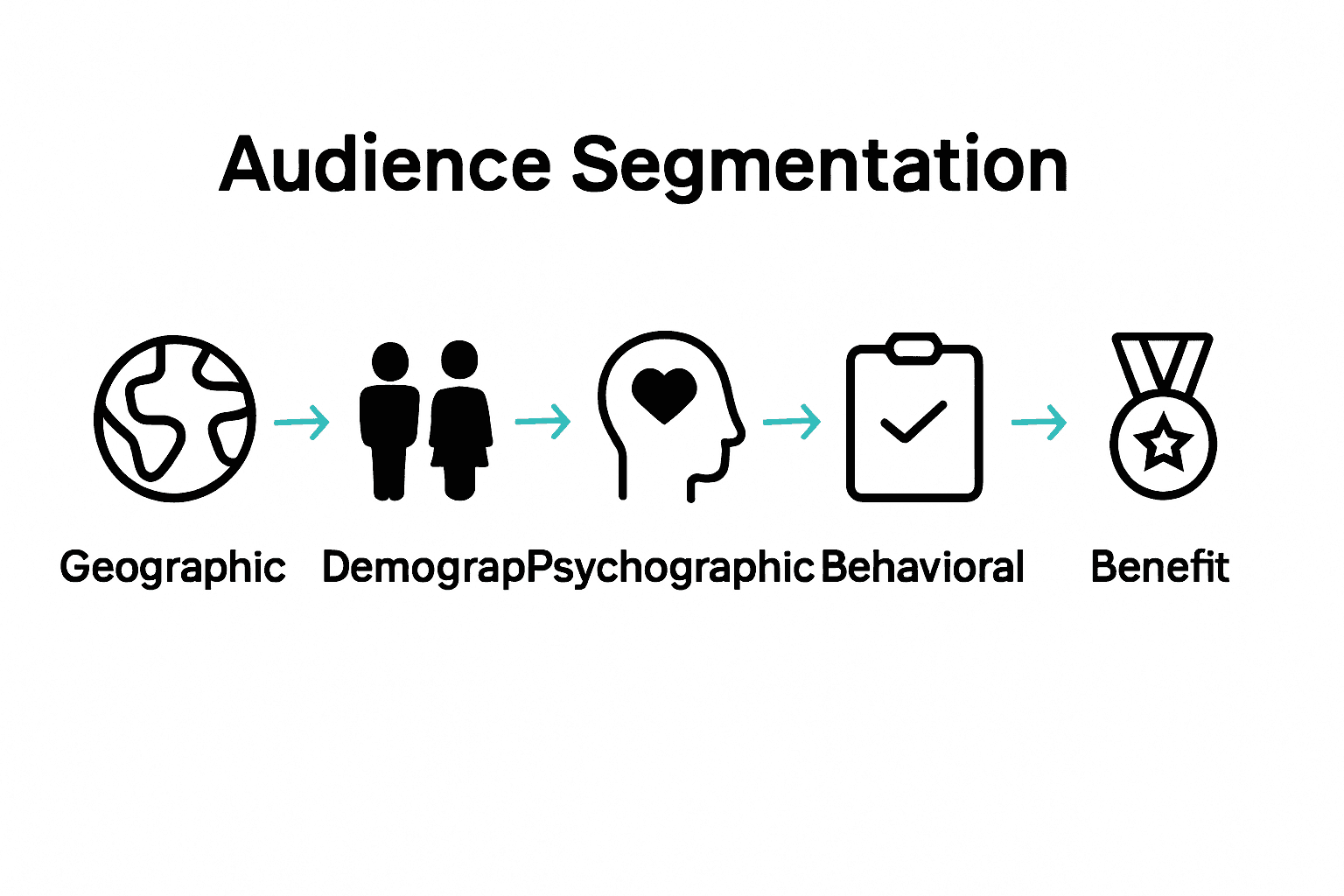 This approach allows businesses to craft more sophisticated, empathetic marketing strategies that feel personal and relevant to each unique audience segment.
Leveraging Data and Behavioral Insights
Data and behavioral insights have transformed audience targeting from a guessing game into a precise scientific approach. Arxiv research highlights the critical importance of understanding consumer engagement patterns on digital platforms, revealing how advanced data analysis can unlock deep insights into audience preferences and behaviors.
Key strategies for leveraging behavioral insights include:
- Digital Footprint Analysis: Tracking online interactions, browsing history, and engagement metrics
- Attitudinal Mapping: Understanding psychological motivations behind consumer decisions
- Predictive Behavior Modeling: Forecasting future actions based on historical data patterns
- Real-Time Intent Tracking: Capturing immediate signals of consumer interest and intent
- Cross-Channel Behavior Synthesis: Integrating insights from multiple digital touchpoints
Attitudinal targeting provides a nuanced approach to understanding consumer psychology. As Wikipedia explains, this method goes beyond traditional demographic segmentation by exploring the qualitative aspects of consumer attitudes. By examining underlying beliefs, values, and emotional triggers, brands can create more resonant and personalized marketing experiences that connect on a deeper level.
Successful data-driven targeting requires a holistic approach that balances quantitative metrics with qualitative insights.
The most effective strategies combine advanced analytics with human empathy, transforming raw data into meaningful connections that feel authentic and personally relevant to each individual consumer.
Automation Tools for Precise Targeting
Automation tools have revolutionized audience targeting by enabling unprecedented levels of precision and personalization. Arxiv research highlights an advanced algorithm demonstrating how sophisticated marketing technologies can optimize targeting policies with remarkable accuracy.
Key automation capabilities for precise targeting include:
- Real-Time Data Processing: Instantly analyzing user interactions and behaviors
- Predictive Segmentation: Automatically creating dynamic audience clusters
- Machine Learning Adaptation: Continuously refining targeting strategies
- Cross-Platform Integration: Synchronizing insights across multiple digital channels
- Intelligent Trigger Mechanisms: Activating personalized campaigns based on specific user signals
Microsegmentation represents the cutting edge of automated targeting strategies. As Wikipedia explains, this technique uses advanced data analysis to create hyper-specific audience segments that go far beyond traditional demographic categorizations. By breaking down audience groups into granular, highly contextualized clusters, brands can deliver extraordinarily personalized experiences that feel uniquely tailored to individual preferences.
The most effective automation tools don’t just collect data they transform it into actionable intelligence. Successful targeting requires a strategic blend of technological sophistication and human insight, where machine learning algorithms work in concert with nuanced marketing expertise to create truly resonant customer experiences.
Common Pitfalls and How to Avoid Them
Audience targeting strategies can quickly derail without careful planning and execution. Wikipedia highlights critical limitations that can undermine even the most well-intentioned marketing efforts, emphasizing the importance of strategic awareness and proactive problem prevention.
Common pitfalls in audience targeting include:
- Overgeneralization: Creating segments too broad to be meaningful
- Data Stagnation: Failing to continuously update and refresh audience insights
- Confirmation Bias: Seeking only data that confirms existing assumptions
- Neglecting Qualitative Insights: Relying exclusively on quantitative metrics
- Technological Over-Reliance: Assuming algorithms can replace human understanding
Psychographic segmentation presents unique challenges in maintaining accuracy and depth. As Wikipedia explains, marketers must be vigilant about avoiding oversimplification and ensuring robust, nuanced data collection. The risk of creating superficial or stereotypical audience personas can significantly undermine targeting effectiveness.
Avoiding these pitfalls requires a holistic approach that balances technological capabilities with human intuition. Successful targeting demands continuous learning, adaptive strategies, and a willingness to challenge existing assumptions. By maintaining a critical and dynamic perspective, brands can transform potential limitations into opportunities for more meaningful audience engagement.
Elevate Your Audience Targeting with Expert Email Strategies
Understanding your audience is the first step to successful marketing but putting that knowledge into precise, actionable campaigns is where many brands struggle. The article highlights key challenges like avoiding overgeneralization, leveraging psychographic and behavioral segmentation, and integrating automation without losing the human touch. These are exactly the pain points we address at Take Action by turning complex audience insights into clear, data-driven email marketing strategies using Klaviyo automation.
Key benefits you gain include:
- Automating personalized customer journeys such as welcome flows and abandoned cart recovery
- Increasing engagement by aligning email messages with nuanced customer segments
- Reducing wasted ad spend by focusing on retention and value-based marketing
Ready to transform detailed audience targeting into measurable growth? Visit Take Action to discover how our tailored campaign strategies and advanced segmentation expertise can unlock the full potential of your email marketing. Don’t let your data sit idle. Take the next step today and start converting your insights into sustained revenue with easy-to-implement automation and ongoing strategic support. Learn more about how we optimize customer retention and scale ecommerce businesses through personalized automation and targeted email flows.
Frequently Asked Questions
What are audience targeting strategies?
Audience targeting strategies involve segmenting and personalizing communication to connect brands with their most valuable potential customers. These strategies optimize marketing policies to match brand offerings with specific audience characteristics and behavioral patterns.
How can I effectively segment my audience?
Effective audience segmentation can be achieved by using multiple criteria, such as demographics, psychographics, behavior, and geography. Combining several segmentation types allows for a more comprehensive understanding of customer personas, enabling the creation of targeted marketing strategies that resonate with distinct groups.
What data insights are necessary for successful audience targeting?
Key data insights for successful audience targeting include digital footprint analysis, behavioral patterns, predictive modeling, and attitudinal mapping. These insights help brands understand audience preferences and motivations, leading to more effective engagement.
What common pitfalls should I avoid in audience targeting?
Common pitfalls in audience targeting include overgeneralization of audience segments, neglecting to update data regularly, and relying too heavily on quantitative metrics without considering qualitative insights. It is essential to maintain a balanced approach for effective targeting.
Recommended
- What is Audience Segmentation? Understanding Its Importance | Take Action Blog | Take Action
- Influencer Marketing Explained: 2025 Guide for Business Growth | Take Action Blog | Take Action
- Personalized Email Campaigns: A Growth Guide for 2025 | Take Action Blog | Take Action
- Email Campaign Best Practices for 2025 Success | Take Action Blog | Take Action