

Blogging for service businesses: win leads in 2026
Most service business owners assume blogging is a tactic reserved for e-commerce stores selling physical products. That assumption is costing them real revenue. A skincare brand generated a 151% increase in organic sales in just five months through strategic SEO-driven blogging, and those same principles apply directly to service businesses. When you publish content that answers real questions, builds genuine trust, and guides readers toward a decision, your blog becomes one of the most reliable lead generation and retention tools you own.
Table of Contents
- Why blogging works for service businesses
- Key components of a high-impact service business blog
- Lead generation and monetization strategies
- Customer retention: Turning readers into loyal clients
- Common pitfalls and advanced tactics in 2026
- Ready to turn your blog into a retention engine?
- Frequently asked questions
Key Takeaways
| Point | Details |
|---|---|
| Compounding ROI | Consistent blogging delivers growing traffic, leads, and repeat customers over time. |
| Quality over quantity | Publishing deeper, founder-led insights monthly outperforms frequent, generic posts. |
| Integrated lead generation | Tactics like lead magnets and scheduler links turn blog visitors into high-value clients. |
| Retention through education | Educational blog content nurtures relationships, boosts loyalty, and prompts referrals. |
Why blogging works for service businesses
Service businesses often compete on reputation and trust, and blogging is one of the fastest ways to build both at scale. Every post you publish is a permanent asset that works around the clock, pulling in qualified readers who are already searching for what you offer. Unlike paid ads that stop the moment you cut the budget, blog content compounds over time.
The numbers back this up. Businesses that blog consistently are 13x more likely to see positive ROI, and B2B companies using content marketing report a 54% increase in revenue alongside a 2.4x return on investment. Those are not vanity metrics. That is pipeline growth.
Real-world results reinforce the data. Bloom & Wild achieved 472% year-over-year traffic growth with their blog driving 96% of organic visits. You can explore more ecommerce blog content case studies to see how content strategy translates into measurable business outcomes.
Here are four core benefits blogging delivers for service businesses:
- Organic traffic: Targeted posts rank for the exact terms your ideal clients search, bringing inbound leads without ad spend.
- Trust and authority: Educational content positions you as the expert before a prospect ever contacts you.
- Customer retention: Ongoing content keeps existing clients engaged, informed, and less likely to look elsewhere.
- Lifetime value: Readers who consume multiple posts convert at higher rates and refer others more often.
“Businesses that blog consistently are 13x more likely to achieve positive ROI, and B2B content marketing delivers a 2.4x return on investment compared to outbound tactics.”
Strong digital branding tips paired with consistent blogging create a compounding effect that paid channels simply cannot replicate.
Key components of a high-impact service business blog
Knowing why blogging works sets the stage for what actually drives your blog’s success. The biggest mistake service businesses make is treating their blog like a news feed, posting frequently but without depth or strategy. One well-researched, genuinely useful post per month outperforms four shallow updates every time.
Google’s E-E-A-T framework, which stands for Experience, Expertise, Authoritativeness, and Trust, is now a core ranking signal. Founder-led content that shares real perspectives, client outcomes, and hard-won lessons consistently outranks generic industry summaries. Your personal experience is a competitive advantage, not just a nice touch.

The best blog post formats for service businesses combine pillar content with supporting FAQ posts, case studies, and process breakdowns. Here is a practical checklist:
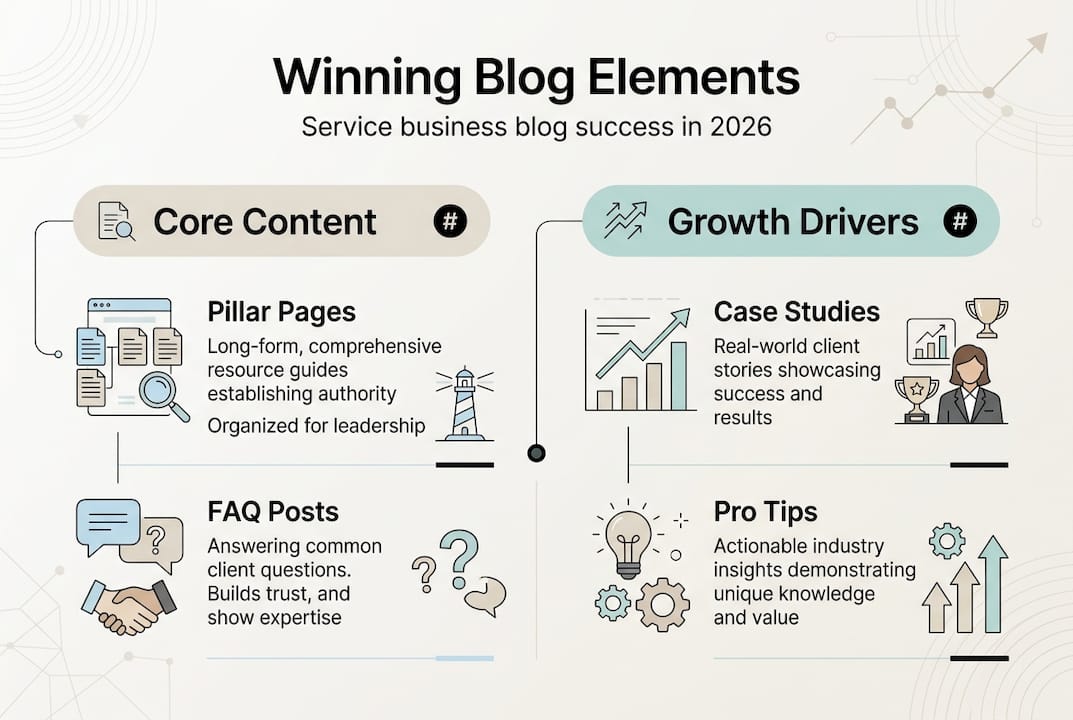
| Component | Purpose | Refresh frequency |
|---|---|---|
| Pillar pages | Cover core service topics in depth | Every 6-12 months |
| FAQ posts | Target long-tail search queries | Annually or as needed |
| Founder insights | Build E-E-A-T and personal trust | Ongoing |
| Clear CTAs | Convert readers to leads | Review quarterly |
| Internal links | Guide readers deeper into your site | With every new post |
Pro Tip: Set a recurring calendar reminder to audit your top five posts every six months. Updating outdated stats, adding new examples, and refreshing CTAs can recover lost rankings and double the leads a post generates without writing anything new.
Lead generation and monetization strategies
Now let’s translate structure into action. How do you drive true business results from your blog? The answer lies in building deliberate conversion pathways into every post you publish.
Blog monetization for service businesses works best when you layer multiple strategies rather than relying on a single tactic. Here are five core approaches:
- Lead magnets: Offer a free checklist, template, or mini-guide in exchange for an email address. This builds your list and starts a nurture sequence automatically.
- Scheduler links: Embed a Calendly or booking link directly inside posts that address high-intent topics. Readers who are ready to act should never have to search for a way to reach you.
- Digital products: Package your expertise into paid guides, templates, or mini-courses. These generate revenue passively while reinforcing your authority.
- Affiliate recommendations: Recommend tools and platforms you genuinely use. When readers trust your advice, affiliate conversions follow naturally.
- Retainer and subscription offers: Use blog content to introduce ongoing service packages. Readers who consume your content regularly are already pre-sold on your value.
The ratio that drives the highest conversions is roughly 80% pure value to 20% promotion within any given post. Readers tolerate and even welcome a CTA when the surrounding content has genuinely helped them. Momentum typically builds within 2 to 6 months of consistent, targeted publishing.
Explore digital marketing services for growth to see how content strategy integrates with broader acquisition channels for compounding results.
Customer retention: Turning readers into loyal clients
Lead generation is only half the story. The service businesses that grow fastest are the ones that use their blog to keep existing clients engaged long after the first sale.
Your blog is a perpetual nurture sequence. Every new post you publish is an opportunity to re-engage a past client, remind them of a service they have not used yet, or simply stay top of mind. When you integrate blog content with email, you create a system where educational value flows automatically to the people most likely to buy again.
Three retention mechanisms that work particularly well for service businesses:
- Email reminders: Send new posts to your list segmented by service interest. A client who hired you for one service may not know you offer three others.
- Personalized article suggestions: Use behavioral triggers or simple tagging in your email platform to recommend posts based on what a client has previously read or purchased.
- Loyalty program integration: Feature exclusive content or early access to new posts as a benefit of your loyalty or VIP program, giving clients a reason to stay subscribed and engaged.
Pro Tip: Write a seasonal or maintenance-focused post for each of your core services. Then automate an email that sends that post to relevant clients at the right time of year. It feels personal, delivers real value, and keeps your business in the conversation without any manual effort.
For more ideas on amplifying your content’s reach, check out these blog post promotion strategies built specifically for growth-focused brands.
Common pitfalls and advanced tactics in 2026
To maximize your blog’s impact, avoid these missteps and embrace what’s working now. Even well-intentioned blogs fail when they fall into predictable traps.
Four pitfalls that quietly kill blog performance:
- Inconsistent posting: Gaps of two or three months signal to both Google and your audience that the site is not actively maintained. Consistency matters more than volume.
- Weak or missing CTAs: Every post needs a clear next step. If a reader finishes your article and has no obvious action to take, you have lost the conversion.
- Neglecting content updates: A post ranking on page one with outdated information will eventually drop. Schedule regular reviews and treat updates as new content opportunities.
- Impersonal voice: Generic, committee-written content does not build trust. Readers can tell the difference between a real perspective and a recycled industry summary.
The most effective blogs in 2026 pair written content with short-form video and social cross-promotion. Social media amplification ranks as the top impact driver for blog distribution, boosting reach by 32% compared to organic search alone. A 60-second video summarizing your latest post, shared on LinkedIn or Instagram, can double the traffic that post receives in its first week.
“Social media amplification is the number one impact driver for blog content distribution, increasing reach by 32% over organic search alone.”
Pairing your blog with influencer or creator partnerships is another underused tactic. Understanding the ROI from influencer marketing can help you decide where to invest for the highest return on your content promotion budget.
Ready to turn your blog into a retention engine?
If you have been publishing content without seeing it translate into leads, bookings, or repeat clients, the gap is usually in the system connecting your blog to your audience. At Take Action, we specialize in building the email infrastructure that makes your content work harder.
We set up automated flows that deliver your best blog posts to the right subscribers at exactly the right moment, using Klaviyo segmentation and behavioral triggers to personalize every touchpoint. Whether you need a welcome sequence that introduces new readers to your top content, or a post-purchase flow that keeps clients engaged between projects, we build the systems that turn one-time readers into long-term revenue. Explore our email marketing services and see how we connect content strategy to measurable retention growth.
Frequently asked questions
How long does it take to see results from a service business blog?
Most businesses see measurable growth in leads and sales within 2 to 6 months when they publish high-quality, targeted blog content consistently. Early wins often come from long-tail keyword posts that attract high-intent readers.
What type of blog content performs best for service businesses?
Educational posts, case studies, and founder-led insights generate the most trust, leads, and repeat client actions. Content that reflects real experience consistently outranks generic industry overviews.
How do I convert blog readers into paying clients?
Use lead magnets, embed booking links, promote digital products, and maintain an 80/20 value-to-promotion ratio. Direct service CTAs placed inside high-intent posts convert best when the surrounding content has already answered the reader’s core question.
Should service businesses prioritize blog quality or quantity?
Quality and consistency beat volume every time. One insightful post per month that demonstrates real expertise will outperform four shallow updates and build stronger long-term rankings.
Recommended
- How to build an email list for ecommerce success in 2026 | Take Action Blog | Take Action
- Blog - Email Marketing Insights | Take Action | Take Action
- 7 Service Business Marketing Ideas for Ecommerce Growth | Take Action Blog | Take Action
- Blog Post Promotion Strategies for Ecommerce Growth | Take Action Blog | Take Action