

Boost email marketing ROI: proven tactics for DTC brands
TL;DR:
- Email marketing ROI varies greatly, driven primarily by automation, segmentation, and measurement sophistication.
- Brands achieving higher returns implement advanced strategies like behavioral targeting, automated flows, and proper deliverability practices.
Reported email ROI commonly falls in the 10:1 to 36:1 range, yet only a small fraction of brands ever push past 50:1. Most DTC marketing managers look at those numbers and assume they’re either on track or hopelessly behind. The truth is messier. Average ROI figures mask enormous variation driven by how well a brand executes on automation, segmentation, and measurement. This article cuts through the noise, shows you exactly which levers move the needle, and gives you a practical framework to build email into a reliable, scalable revenue channel.
Table of Contents
- What drives email marketing ROI in ecommerce?
- Harnessing automation for scalable ROI
- Segmentation tactics that multiply returns
- Getting measurement right: ROI vs. vanity metrics
- Deliverability: The gateway to ROI
- Why ambitious ROI targets often mislead DTC brands
- Ready to maximize your email ROI?
- Frequently asked questions
Key Takeaways
| Point | Details |
|---|---|
| Automate for scale | Automated flows boost revenue per recipient far beyond manual campaigns. |
| Segment smartly | Advanced segmentation strategies like RFM deliver higher targeting power and ROI. |
| Measure what matters | Focus on revenue per recipient and conversion, not open rates or server stats. |
| Prioritize deliverability | If emails don’t reach the inbox, they can’t generate results—test and fix deliverability issues. |
| Benchmark realistically | Use benchmarks to guide strategy, but validate with your own attribution and data. |
What drives email marketing ROI in ecommerce?
Understanding why ROI varies so wildly is the starting point. Two brands with similar list sizes can produce radically different returns, and the gap almost always comes down to how sophisticated their email program is, not how large their audience is.
The data tells a clear story. Segmentation, personalization, and analytics practices are consistently associated with higher reported ROI. Brands that layer behavioral data, purchase history, and predictive analytics into their email strategy simply outperform those blasting the same message to everyone.
Here’s a rough breakdown of where brands tend to land:
| ROI range | Approximate share of brands | Typical program maturity |
|---|---|---|
| Less than 10:1 | ~15% | Basic batch-and-blast, no automation |
| 10:1 to 20:1 | ~35% | Some automation, minimal segmentation |
| 20:1 to 36:1 | ~35% | Solid flows, moderate segmentation |
| Over 36:1 | ~15% | Advanced automation, RFM, analytics |
The core levers driving movement up that table are:
- Segmentation: Splitting your list based on behavior, purchase history, or engagement stage
- Personalization: Tailoring subject lines, product recommendations, and timing to individual signals
- Automation: Behavior-triggered flows that respond to customer actions in real time
- Deliverability: Ensuring your emails actually land in the primary inbox, not spam
- Analytics: Measuring revenue per recipient, not just opens, and acting on the data
“The highest-performing email programs don’t treat segmentation as a nice-to-have. They build their entire strategy around knowing exactly who they’re talking to and why.”
The segmentation benefits for ecommerce email are compounding. Better targeting leads to higher engagement, which improves sender reputation, which improves deliverability, which increases revenue. Every lever reinforces the others. If you’re not using personalization strategies built around real behavioral data, you’re leaving significant revenue untouched. Combining these with AI-driven personalization tools makes the feedback loop even faster, especially as product catalogs and customer bases scale.
Harnessing automation for scalable ROI
Automation is the single fastest path to improving email ROI in ecommerce. The reason is simple: automated emails respond to exactly what a customer just did. A shopper who abandoned a cart five minutes ago is orders of magnitude more ready to convert than someone who opened a newsletter last Tuesday.
Automated emails drive over 16x higher revenue per recipient compared to standard batch campaigns. That stat deserves to sink in. You’re not talking about a marginal improvement. You’re talking about a fundamental difference in how email works when it’s tied to behavior rather than a calendar.
| Email type | Average revenue per recipient | Typical conversion rate |
|---|---|---|
| Batch newsletter | $0.04 to $0.08 | 0.5% to 1.2% |
| Promotional blast | $0.06 to $0.12 | 0.8% to 1.8% |
| Abandoned cart flow | $0.50 to $2.00 | 5% to 15% |
| Welcome series | $0.30 to $1.20 | 3% to 10% |
| Post-purchase flow | $0.20 to $0.80 | 2% to 8% |
| Winback flow | $0.15 to $0.60 | 1.5% to 6% |
The numbers make the case for automation better than any opinion can. Here’s the core sequence every DTC brand should build:
- Welcome series: Set expectations, introduce your brand story, and deliver a first-purchase incentive within the first 24 to 48 hours of signup.
- Browse abandonment: Catch high-intent visitors who viewed products but didn’t add to cart. Timing matters here. Send within one to two hours.
- Cart abandonment: Your highest-converting flow. Send the first email within 30 to 60 minutes, follow up at 12 hours, and again at 24 hours.
- Post-purchase: Reduce buyer’s remorse, cross-sell complementary products, and begin building loyalty within 48 hours of purchase.
- Replenishment: For consumable products, trigger a reorder reminder before the typical usage window closes.
- Winback: Target customers who haven’t purchased in 90 to 180 days with a compelling reason to come back, not just a discount.
Pro Tip: Don’t rely just on top-of-funnel flows. A brand’s biggest revenue opportunity is often in post-purchase retention, where automation tools can multiply lifetime value quietly in the background.
Real results back this up. Harney & Sons, the premium tea brand, achieved a staggering 114x ROI through disciplined Klaviyo automation and segmentation, as outlined in this Klaviyo automation case study. That kind of return isn’t luck. It’s the result of systematically building every stage of the customer journey into automated email logic. Understanding how AI and automation in retail are converging also shows that these gains will only accelerate as predictive tools become more accessible.

Segmentation tactics that multiply returns
If automation is the engine, segmentation is the steering wheel. Automation fires the right message at the right moment. Segmentation makes sure it goes to the right person with content that actually resonates with where they are in their relationship with your brand.
Here’s a pattern that tracks consistently across Klaviyo data: list segmentation depth increases with store revenue, and brands with higher segment counts achieve better targeting precision and higher returns.
| Annual revenue tier | Average number of active segments |
|---|---|
| Under $1M | 3 to 7 |
| $1M to $5M | 8 to 20 |
| $5M to $20M | 20 to 50 |
| Over $20M | 50 or more |
That’s not a coincidence. As brands grow, they learn that generic messaging kills performance. The three most effective segmentation models for DTC ecommerce are:
- Engagement-based: Separate subscribers by how recently and frequently they’ve engaged. Your highly engaged segment deserves different content and cadence than a dormant one.
- RFM (Recency, Frequency, Monetary): This model scores customers on how recently they bought, how often they buy, and how much they spend. It’s the clearest map of customer lifetime value you can build inside your ESP (email service provider).
- Behavioral: Go beyond clicks and opens. Track product category affinity, average order value, channel of acquisition, and seasonal purchase patterns.
The ecommerce segmentation framework built around “message by moment” principles is especially powerful for DTC brands. Instead of organizing your list purely by demographics, you organize it around where each customer is in their buying journey and what they most need to hear right now.
Key moments worth building segments around:
- First-time buyers within the last 30 days
- Customers who’ve purchased exactly once and never returned
- High-value customers who haven’t engaged in 60 or more days
- Subscribers who’ve opened but never purchased
- Repeat buyers who purchase every 30 to 60 days
Pro Tip: Stop using opens and clicks alone to judge engagement. Start segmenting based on how and when people buy. A customer who opens every email but never purchases is a fundamentally different segment from someone who rarely opens but converts every time they do.
The practical implication is that your segmentation strategies should feed directly into your automation logic. When a customer moves from “one-time buyer” to “loyal,” their flow experience should change automatically. That’s where list segmentation tactics and automation become genuinely powerful together. You can also pair this with advanced personalization tools to dynamically adjust email content based on real-time browsing and purchase signals.
Getting measurement right: ROI vs. vanity metrics
You could build great automation and tight segmentation, and still report misleading ROI. That happens when teams measure the wrong things, and it’s more common than most want to admit. Many teams struggle with measuring true email ROI and regularly confuse activity metrics with revenue impact.
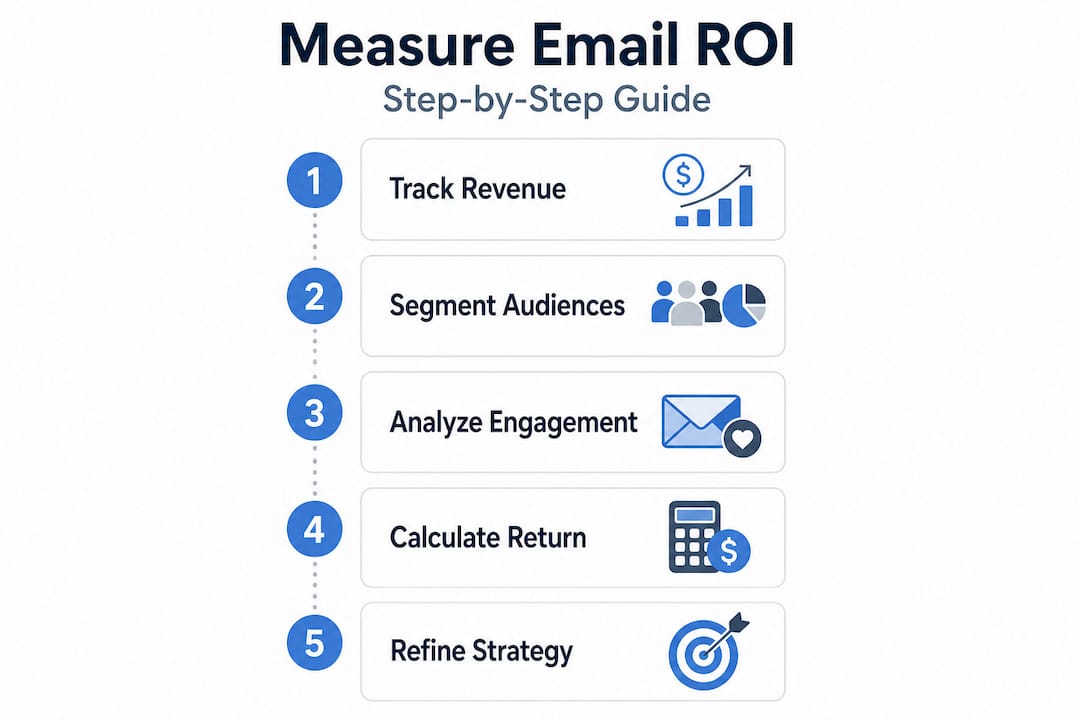
The biggest measurement trap in email marketing is treating open rate as a leading performance indicator. It’s not. Open rate is increasingly unreliable due to Apple’s Mail Privacy Protection and bot activity inflating numbers. A 45% open rate on a campaign that generated zero incremental revenue is worthless data.
The three KPIs that genuinely map to ROI are:
- Revenue per recipient (RPR): Total email-attributed revenue divided by the number of emails sent. This normalizes performance across different list sizes and send frequencies.
- Conversion rate by flow: Measures what percentage of recipients in a given automated flow actually make a purchase. Compare flows against each other, not against industry averages.
- Inbox placement rate: The percentage of your emails landing in the primary inbox rather than spam or promotions folders. This is your upstream health metric.
Here’s a practical checklist for accurate ROI measurement:
- Set a clear attribution window (7-day click and 1-day open is standard in Klaviyo) and apply it consistently.
- Track RPR separately for automated flows versus manual campaigns. They should never be averaged together.
- Run A/B tests on subject lines, send times, and offer structures with statistical significance thresholds above 90%.
- Use incremental lift tests to separate email’s true contribution from organic behavior. This is rarely done but critically important.
- Audit your inbox placement rate monthly, not quarterly. Placement issues compound fast.
“Only a small minority of email teams regularly run inbox placement tests, even though declining placement rates are often the first sign that a program is losing effectiveness.”
This connects directly to email marketing tips that mature programs use to stay accountable. And if you’re serious about clean attribution, the practices outlined in email attribution can save you from a very common reporting mistake. Looking at cost-saving campaign analysis approaches also shows how tightening measurement processes benefits overall marketing efficiency.
Deliverability: The gateway to ROI
The most sophisticated automation and the tightest segmentation can’t save you if your emails are landing in spam. Deliverability is the upstream constraint that many DTC brands overlook until something goes catastrophically wrong.
Deliverability is a first-order constraint on email ROI. An email that lands in spam earns zero revenue regardless of how good the copy is or how perfectly timed the flow logic is. A 10% drop in inbox placement rate can mean a 10% or greater drop in email revenue, almost overnight.
Here’s what a solid deliverability diagnostic process looks like:
- Spam testing: Before every major campaign, use tools like Litmus or GlockApps to simulate how your email renders across providers and check spam filter scores.
- Inbox placement testing: Go beyond delivery rate (the percentage of emails not bounced) and measure where emails actually land. Gmail, Outlook, and Yahoo all categorize differently.
- List hygiene: Remove hard bounces immediately. Suppress unengaged subscribers (no opens or clicks in 180-plus days) before large sends. Never import cold lists.
- Authentication setup: Make sure SPF, DKIM, and DMARC records are properly configured. This is table stakes, but a surprising number of brands still have gaps.
- Send cadence management: Sudden volume spikes trigger spam filters. Warm up new sending domains gradually and keep weekly cadence consistent.
Pro Tip: Run inbox placement tests before every major campaign. If you see placement dropping below 85% in Gmail’s primary folder, pause and diagnose before you send more volume. More email to a broken sender reputation means a worse problem, not more revenue.
For brands working on ecommerce growth performance, deliverability hygiene should be part of every quarterly review. It’s not glamorous work, but it’s what separates programs that sustain strong ROI from those that see sudden, unexplained drops in performance.
Why ambitious ROI targets often mislead DTC brands
Here’s an opinion that tends to make marketers uncomfortable: chasing a 36:1 or 50:1 ROI target based on industry benchmarks can actively harm your program if your measurement isn’t disciplined.
The problem is attribution. Most DTC brands over-attribute revenue to email because their attribution windows are too wide, their last-click models don’t account for view-through behavior, and they never run true incremental lift tests. When you measure email against a 30-day view window, you’re claiming credit for customers who would have purchased anyway. Your email program looks heroic in the report. It’s a fiction.
ROI benchmarks can be overconfident when measurement is imprecise. What looks like a 40:1 return might be a 15:1 return once you strip out organic behavior and multi-touch credit overlap.
The mature brands we’ve seen build genuinely sustainable email programs don’t obsess over maximizing their reported ROI number. They focus on incremental lift: what additional revenue did email generate beyond what would have happened anyway? That number is always smaller and much more honest. It’s also the only number that actually guides smart investment decisions.
There’s also a practical reason to care about this beyond accuracy. When teams inflate ROI through loose attribution, they make bad decisions. They send more frequently to chase numbers. They suppress fewer segments. They skip A/B testing because “it’s already working.” These habits eventually destroy deliverability and kill the very revenue they were claiming credit for.
The better framework is to set realistic, incrementally measured targets, invest in process-driven optimization, and build productivity-boosting approaches into your team’s workflow so that discipline becomes default behavior. A steady, accurately measured 20:1 ROI that compounds over 24 months is worth far more than a headline 50:1 that masks deteriorating fundamentals.
Ready to maximize your email ROI?
Understanding the levers is one thing. Building, optimizing, and sustaining a high-performing email program while running everything else your DTC brand demands is another challenge entirely.
At Take Action, we specialize in exactly this work. As a dedicated email marketing and retention agency, we help DTC brands build automation flows, precision segmentation, and deliverability systems inside Klaviyo that generate measurable, attributable revenue. We don’t chase benchmark numbers. We build programs that produce consistent, compounding returns your team can stand behind. Whether you’re starting from scratch or scaling an existing program, we bring the strategy, the execution, and the measurement discipline to make email your most reliable growth channel.
Frequently asked questions
What is a good ROI for email marketing in ecommerce?
A typical range is $10 to $36 for every $1 spent, but top DTC brands with advanced automation and segmentation can push well above that consistently.
How does segmentation improve email marketing ROI?
Segmentation lets you match messaging to where each customer is in their buying journey, which drives higher relevance and conversions across every send.
Why is email deliverability crucial for ROI?
An email that lands in spam can’t generate revenue, making inbox placement a direct constraint on how much your email program can earn.
What is the fastest way to increase email ROI?
Launching automated behavior-triggered flows like cart abandonment, welcome, and post-purchase sequences typically delivers the biggest immediate lift with minimal ongoing resource cost.
Which metric best predicts email ROI improvement?
Revenue per recipient and inbox placement rate are the most actionable indicators because they directly reflect deliverability and conversion performance rather than just surface-level engagement.