

Build a brand content strategy that retains customers
TL;DR:
- Most DTC brands rely on generic content calendars that treat every customer the same, limiting retention. Implementing lifecycle marketing with personalized, behavior-based touchpoints significantly improves repeat purchases and customer loyalty. Success depends on disciplined segmentation, timely automation, and ongoing performance measurement to adjust strategies effectively.
Most DTC brands run some version of a content calendar. They plan emails around product launches, holidays, and seasonal promos, then wonder why repeat purchase rates stay flat. The problem isn’t the content itself. It’s that generic calendars treat every subscriber the same, regardless of where they are in their relationship with your brand. Lifecycle marketing connects customers at every stage using timely, personalized touchpoints, and Klaviyo gives you the infrastructure to actually execute that system at scale.
Table of Contents
- Why traditional content calendars fall short for DTC retention
- Lifecycle brand content: The modern framework for ecommerce
- Personalization unlocked: Segmentation and dynamic content with Klaviyo
- Retention content: Timing and types that drive repeat purchase
- Balancing storytelling and intent: Brand voice with measurable impact
- The uncomfortable truth: Why most DTC content strategies break down
- Partner with experts for next-level content strategy
- Frequently asked questions
Key Takeaways
| Point | Details |
|---|---|
| Lifecycle, not calendar | Lifecycle-driven content outperforms one-size-fits-all calendars for DTC retention. |
| Personalization matters | Segmentation and dynamic content in Klaviyo drive higher engagement and conversions. |
| Retention needs timing | Send winback and retention flows promptly after purchase to avoid losing momentum. |
| Blend brand and ROI | Combine storytelling with segmented, trackable content to maximize impact. |
Why traditional content calendars fall short for DTC retention
A promotional calendar is easy to manage. You pick holidays, schedule a few product spotlights, plan a sale or two, and call it a strategy. The problem is that this approach treats your entire list as one audience with one level of intent, and that assumption silently destroys retention.
When a first-time buyer gets the same Black Friday email as your most loyal VIP customer, you’re missing two opportunities at once. The new buyer needed product education and reassurance. The loyal customer needed recognition and early access. Sending the same message to both tells each of them that you don’t really know them.
Blending discovery, purchase, and retention content in a single calendar creates another problem: message fatigue. When customers receive promotional offers before they’ve even tried your product, trust erodes fast. Strong brand content planning separates these moments deliberately.
Here’s what’s actually missing from most promotional calendars:
- Intent mapping: Content isn’t matched to what the customer needs right now
- Behavioral triggers: Sends are based on dates, not actions
- Audience segmentation: Everyone gets the same message regardless of purchase history
- Journey continuity: There’s no narrative thread from first touch to loyal repeat buyer
“One-size-fits-all promotional calendars can’t match customer lifecycle needs.” — Klaviyo
The shift from calendar-driven to lifecycle-driven isn’t just a tactical upgrade. It’s a fundamentally different way of thinking about branded content marketing — one that maps messages to where customers are, not what month it is.
Lifecycle brand content: The modern framework for ecommerce
Lifecycle-driven content systems replace the calendar-first mindset with a journey-first mindset. Instead of asking “what should we send this week,” you ask “what does this specific customer need to hear right now to move forward?”

The difference in outcomes is significant. Here’s how the two models compare:
| Factor | Calendar-driven model | Lifecycle content system |
|---|---|---|
| Timing | Based on dates and promotions | Based on customer behavior and milestones |
| Segmentation | Broad list segments (if any) | Behavioral, purchase-based, intent-driven |
| Content type | Mostly promotional | Educational, relational, and promotional |
| Retention impact | Low to moderate | Consistently higher repeat purchase |
| Personalization | Minimal | Deep, dynamic, and scalable |
| Measurement | Open/click rates | Lifetime value and repeat purchase rate |
Lifecycle content maps to five core stages that every DTC customer moves through. Understanding each stage is what separates brands with strong retention from those constantly chasing new traffic.
- Discovery: Customers are learning about your brand. Content here should educate, inspire trust, and introduce your brand values without pushing a hard sell.
- First purchase: The customer has just converted. Now is the time for welcome flows, product onboarding, and early education on getting the most from what they bought.
- Post-purchase: This is the most underused stage. How-to guides, care tips, usage tutorials, and check-ins drive satisfaction and reduce returns.
- Repeat purchase: Customers who buy again need recognition, loyalty rewards, and exclusive access. This is where your most profitable relationships live.
- Winback and loyalty: Customers who’ve gone quiet need a reason to return, but the content has to feel earned and relevant, not desperate.
Pro Tip: Map three to five content topics to each lifecycle stage before building any flows. Ask what a customer actually needs to know at each milestone, not what you want to sell them.
Lifecycle marketing connects with customers at every stage using timely, personalized touchpoints, and the most successful brands treat these stages as a content brief, not just an email sequence. This framework also supports your goal to increase brand awareness over time by giving every stage its own voice and purpose.
Personalization unlocked: Segmentation and dynamic content with Klaviyo
Segmentation is the engine behind lifecycle content. Without it, personalization is just a theory. Klaviyo lets you build segments based on purchase history, browsing behavior, engagement levels, predictive analytics, and more. This means your content reaches the right person at the right moment, not just the right list.
Most DTC teams use basic demographics to segment. That’s a starting point, not a strategy. Real segmentation in Klaviyo uses behavioral triggers like “viewed a product but didn’t buy,” purchase frequency, time since last order, and average order value. These signals tell you far more about intent than age or location ever could.
Here’s how to match segments to the right content:
| Segment | Content type | Tone | Offer strategy |
|---|---|---|---|
| First-time buyers | Product education, welcome series | Warm and informative | Low-friction upsell or cross-sell |
| Active repeat buyers | Loyalty recognition, early access | Exclusive and appreciative | VIP perks, early product drops |
| High-value customers | Premium storytelling, personalized recs | Premium, personal | High-margin bundles |
| Lapsed customers (30–60 days) | Winback content, re-engagement | Curious, not desperate | Soft incentive or new arrivals |
| Lapsed customers (90+ days) | Last-chance or sunset flows | Honest, low-pressure | Strong offer or removal |
| Browse-only subscribers | Discovery content, social proof | Engaging and educational | First-purchase incentive |
Dynamic content in Klaviyo takes this further. Instead of building six separate emails for six segments, you build one email with dynamic content blocks that show different content to different people. A returning VIP sees a loyalty reward. A browse-only subscriber sees a first-purchase offer. The email sends once, but each person receives a customized version.
Brand content personalization in Klaviyo means matching offers, content, and messaging to audience preferences and behaviors, not just swapping in a first name. It’s the difference between feeling known and feeling marketed to.
Key behaviors to build segments around:
- Purchase frequency: How often has this customer bought in the last 90 and 180 days?
- Product category: What categories has the customer purchased from? Use this for cross-category education.
- Email engagement: Are they clicking, opening occasionally, or going dark? Each group needs a different approach.
- Time since last purchase: This is your most powerful retention timing signal.
Pro Tip: Keep your segment definitions clean and documented. Overlapping or undefined segments create inconsistent messaging and inflate your “engaged” numbers. Review your segmentation strategies quarterly to account for list growth and behavioral shifts.
Good Klaviyo personalization strategies always start with the data architecture: make sure your product catalog, purchase events, and customer properties are properly synced before you build complex flows. And if you’re working with email list segmentation for the first time, start with three to four clear segments and expand from there.
Retention content: Timing and types that drive repeat purchase
Here’s a mistake that costs brands thousands in recoverable revenue: waiting 90 days to send a winback email. By the time that message lands, most customers have already found an alternative. They’ve moved on, and your email feels like a reminder of how long it’s been since you showed up.
Retention strategy in Klaviyo should be timed around the repeat-purchase window. Most brands wait too long to act, missing the natural momentum a customer builds right after a positive first experience.
“Likelihood of a second purchase drops sharply after 30–60 days; most brands wait too long.” — Klaviyo
The optimal window for retention content is the 7 to 45-day period after a first purchase. This is when the product is fresh, the experience is recent, and the customer is most open to building a habit around your brand.
Here are the critical retention content types for each stage, ordered by timing:
- Post-purchase onboarding (days 1–7): Product setup guides, care tips, or usage tutorials. This reduces buyer’s remorse and increases satisfaction scores.
- Social proof and community content (days 7–14): Customer reviews, user-generated content, and real-world use cases. Reinforce the decision to buy.
- Complementary product education (days 14–21): Introduce related products naturally, framed as “what pairs well with what you bought,” not a pure upsell.
- Early loyalty and reward introduction (days 21–35): If you have a loyalty program, introduce it here. Don’t wait until the customer is already lapsing.
- Review request (days 28–42): Ask for a review when the experience is still fresh. Reviews also become content assets for future discovery-stage customers.
- Re-engagement if no second purchase (days 45–60): Send a gentle check-in with new arrivals or a soft incentive. This is your retention save moment.
Beyond open and click rates, the metrics that actually tell you if retention content is working include: repeat purchase rate within 60 days, customer lifetime value at 90 and 180 days, and flow revenue per recipient. These tell you whether content is moving behavior, not just inboxes. Klaviyo engagement automation makes tracking these outcomes easier when flows are set up with proper conversion events.
Balancing storytelling and intent: Brand voice with measurable impact
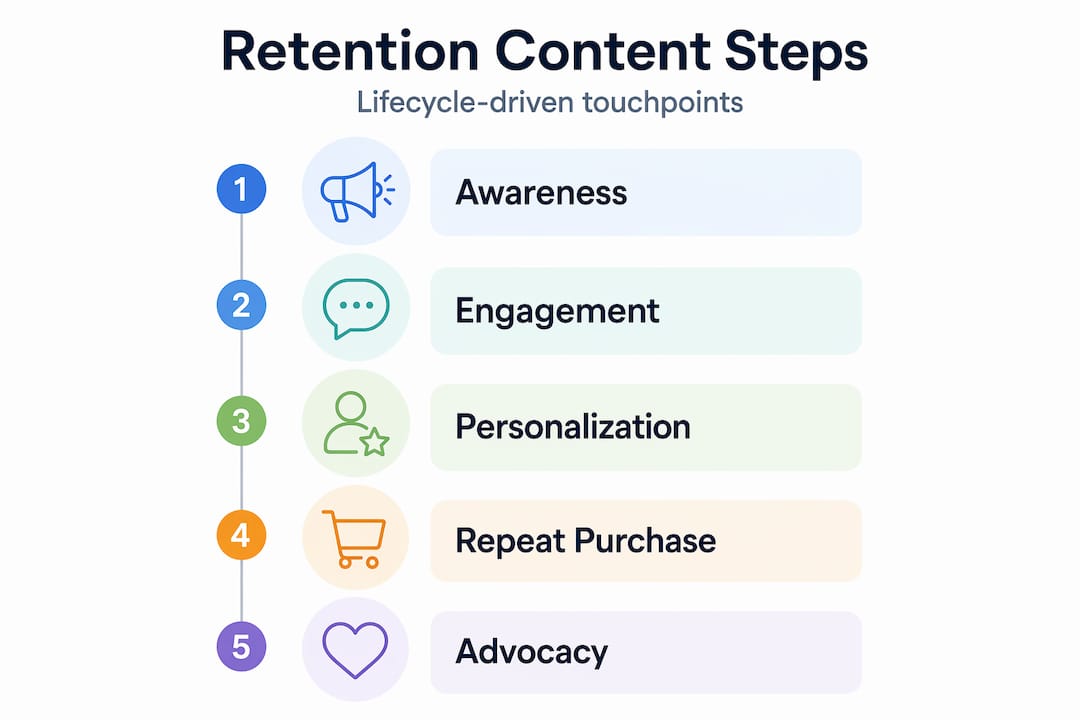
The best retention content doesn’t read like a CRM sequence. It reads like a message from a brand that knows its customer. That’s the creative challenge: building lifecycle-mapped content that still sounds human, genuine, and on-brand.
The pitfall most DTC teams fall into is letting creative inspiration take over without tethering it to lifecycle logic. A beautiful brand story email sent to a lapsed customer on day 90 might win awards internally but barely moves the needle on repurchase rates. Timing and relevance matter more than creative quality when they’re in conflict.
Balancing retention incentives with segmented, intent-based content delivers the most sustainable growth. Here’s how to keep both working together:
- Anchor every piece of creative to a stage: Before writing a single word, ask which lifecycle stage this email serves and what the customer needs to feel or know.
- Use brand voice as a layer, not a foundation: Your tone and aesthetic can stay consistent across all stages, but the purpose of each message must match the customer’s current relationship with you.
- Blend inspiration and performance in every flow: Even a post-purchase how-to email can include a stunning product photo and on-brand copy. These aren’t mutually exclusive.
- Measure lifetime value, not just campaign metrics: A storytelling email that generates low clicks but drives a 12% increase in 90-day repeat purchase rate is more valuable than a promotional email with a 35% open rate and low conversion.
If you want to build this kind of integrated approach, a clearly defined content strategy for ecommerce is the starting point. It forces you to decide, in advance, how brand voice and lifecycle logic will coexist across every stage of the customer journey.
The uncomfortable truth: Why most DTC content strategies break down
We’ve seen this pattern repeatedly: a DTC team invests in Klaviyo, builds out a welcome flow, and feels good about their content strategy. Six months later, retention numbers are still flat, and the team is convinced they need better creative.
They don’t. They need operational discipline.
Lifecycle content systems succeed when there is regular measurement, clearly defined audience segments, and the organizational courage to pivot when something isn’t working. Most teams skip the measurement part entirely. They build flows, forget about them, and assume they’re running on autopilot. A neglected flow is often worse than no flow, because it sends stale, mismatched content to customers whose behavior has shifted.
The deeper issue is how DTC teams define their audiences. Weak segment definitions, like “all subscribers” or “customers who bought once,” are too blunt to drive meaningful personalization. And when content teams work in silos from the email team, the brand voice is inconsistent across stages and the lifecycle logic disappears. Why segmentation matters isn’t just a technical argument. It’s a business argument: brands with clean, well-maintained segments consistently outperform those without them on repeat purchase rate and customer lifetime value.
The hardest part of a real lifecycle content strategy isn’t the creative. It’s committing resources to post-purchase engagement when it’s so much easier to just ship another promotional email. Don’t confuse activity with impact. Sending 12 campaigns a month doesn’t mean your retention is healthy. The brands that win long-term are the ones that send fewer, smarter messages to the right segments at the right moments.
Partner with experts for next-level content strategy
Building a lifecycle-driven brand content strategy requires more than a good template. It takes a clear data architecture, disciplined segmentation, well-timed flows, and the kind of ongoing optimization that in-house teams rarely have capacity for.
Take Action agency specializes in exactly this kind of work: building custom content systems in Klaviyo that are designed around your customer journey, not a generic calendar. From post-purchase flows to advanced segmentation and dynamic content builds, our team of email marketing experts helps DTC brands turn retention into a measurable, scalable growth channel. If you’re ready to move beyond promotional calendars and build a content system that actually keeps customers coming back, we’d love to show you what’s possible.
Frequently asked questions
What is a brand content strategy for DTC ecommerce?
A brand content strategy for DTC ecommerce means mapping personalized content and offers to the stages of a customer’s journey to drive retention and engagement. Lifecycle marketing uses segmentation and journey-mapped content instead of generic content calendars.
How does Klaviyo help with content personalization?
Klaviyo enables advanced content personalization by letting you segment customers based on behavior and intent, then dynamically customize messaging and offers for each segment. Klaviyo defines content personalization as matching strategies to customer preferences and behaviors using segmentation and dynamic content.
When should you send retention and winback flows?
Send winback and retention content within 30 to 60 days, not 90 days, to avoid missing the repeat purchase window. Likelihood of a second purchase drops sharply after 30 to 60 days, and most brands wait far too long to act.
What content types work best for retention?
Product education, post-purchase guidance, early loyalty incentives, and review requests drive repeat engagement and lifetime value. Lifecycle marketing guidance emphasizes product education and post-purchase messages, not only incentives, as the highest-impact retention content types.
Recommended
- Boost Customer Retention with Personal Branding in Email | Take Action Blog | Take Action
- Build a winning social media content strategy for DTC | Take Action Blog | Take Action
- Ecommerce email content creation that drives real retention | Take Action Blog | Take Action
- Content creation for coaches: engage clients and boost retention | Take Action Blog | Take Action