

Build brand awareness with Klaviyo email strategies
TL;DR:
- True brand awareness involves customer recognition and recall, not just exposure metrics.
- Measuring awareness combines surveys and proxy signals like branded search and direct traffic.
- Consistent email marketing builds brand recall, which is essential for long-term customer retention.
Most e-commerce brands treat brand awareness as a numbers game: more impressions, more reach, more logo placements. But exposure and awareness are not the same thing. True brand awareness is the degree to which customers recognize and recall your brand when they are ready to buy. Getting your ad in front of someone once means nothing if they cannot remember your name a week later. In this guide, we break down what brand awareness really means, how to measure it accurately, and how to use Klaviyo email marketing to build the kind of recognition that drives retention and long-term revenue.
Table of Contents
- Defining brand awareness: More than visibility
- How to measure brand awareness: Metrics and methods
- Using email marketing to build brand awareness
- Putting it all together: Building retention through awareness
- A fresh perspective: Why brand awareness is only the first step
- Level up your brand retention with expert email strategies
- Frequently asked questions
Key Takeaways
| Point | Details |
|---|---|
| True awareness is recall | Brand awareness requires more than exposure—it’s about what customers remember and prefer. |
| Measurement is multi-faceted | Combining surveys, proxy metrics, and long-term tracking gives a clearer view of brand awareness. |
| Email builds retention | Strategic email marketing with Klaviyo boosts both customer recall and loyalty over time. |
| Consistent monitoring matters | Regular tracking with proper benchmarks ensures improvement and actionable insights. |
Defining brand awareness: More than visibility
Brand awareness gets misunderstood constantly in e-commerce circles. Teams celebrate reach metrics, applaud follower counts, and obsess over ad impressions. But none of those numbers tell you whether a customer will actually think of your brand the next time they need what you sell.
True brand awareness comes in two forms: recognition and recall. Recognition means a customer can identify your brand when they see it. Recall means they can bring your brand to mind unprompted, without seeing a logo or ad. Both matter, but recall is the more powerful driver of purchasing behavior. When someone opens a browser and types your brand name directly into the search bar, that is recall doing its job.
“Brand awareness is not just seeing a logo. It is the mental shortcut a customer takes when your category comes to mind and your name is already there.”
For e-commerce specifically, awareness is the foundation of every retention strategy. A customer who does not remember your brand after a first purchase will not return. They will find a competitor who stayed top of mind. That is why brands investing in paid ads without pairing them with retention email flows are essentially paying for awareness they will never convert into loyalty.

A common pitfall is treating email opens or social impressions as proof of strong brand awareness. These are exposure signals, not memory signals. A customer can open an email and forget the brand name by the end of the day. Real awareness shows up in behavior over time, and it is tied closely to your broader ecommerce retention strategy.
Here is how customers actually demonstrate brand awareness in the real world:
- Typing your brand name directly into Google or a browser (branded search)
- Recommending your brand by name to a friend or colleague
- Returning to purchase without being retargeted by ads
- Recognizing your email in a crowded inbox before opening it
- Associating your brand with a specific feeling, value, or product category
Strong brand identity best practices tell us consistency matters enormously here. Customers build recall through repeated, coherent exposures across channels. That means every email you send, every campaign you launch, and every post-purchase touchpoint you create either reinforces your brand identity or dilutes it.
The brands that win on retention are not always the ones with the biggest budgets. They are the ones who show up consistently, communicate in a recognizable voice, and make customers feel something memorable every time they interact. Awareness built that way becomes an asset, not a media spend line item.
How to measure brand awareness: Metrics and methods
Once you understand what brand awareness really is, measuring it becomes a much clearer task. The challenge is that many e-commerce teams skip measurement entirely, relying on gut feel or vanity metrics that do not reflect actual recall or recognition.
Brand awareness is not one single metric. It is best captured through a combination of survey-based methods and proxy signals, each giving you a different angle on how well your brand lives in customer memory.
Survey-based methods are the most direct. Unaided recall surveys ask customers to name brands in a category without prompting. Aided recall surveys show them a list and ask which brands they recognize. Unaided recall is harder to score well on, but it is the metric most closely tied to actual buying behavior. Aided recall tells you whether you are in the consideration set at all.
Proxy signals are behavioral data points that suggest awareness without directly measuring memory. These include branded search volume (people searching your brand name), direct website traffic (people who type your URL directly), and email engagement metrics like open rates from cold or dormant segments.
Here is a comparison of the three measurement approaches:
| Metric type | What it measures | Strength | Limitation |
|---|---|---|---|
| Unaided recall survey | True brand recall | Most direct awareness signal | Expensive and time-consuming |
| Aided recall survey | Brand recognition in lineup | Easy to run at scale | Can overstate real awareness |
| Branded search volume | Memory-driven search behavior | Affordable, ongoing data | Does not explain sentiment |
| Direct traffic | URL recall and loyalty | Shows strong top-of-mind | Skewed by repeat buyers |
| Email open rate | Inbox-level recognition | Trackable inside Klaviyo | Reflects engagement, not pure recall |
Here is how to set up a practical measurement plan using Klaviyo:
- Establish a baseline. Pull your Klaviyo email marketing tips data and look at open rates segmented by new subscribers versus returning customers. New subscriber open rates are a proxy for initial recognition.
- Segment by customer lifecycle. Create segments in Klaviyo for first-time buyers, repeat buyers, and lapsed customers. Compare engagement rates across those groups to see where recognition drops off.
- Pair email data with branded search. Connect Google Search Console to track branded queries alongside your Klaviyo send cycles. If branded searches rise after campaign pushes, that is a signal your emails are reinforcing recall.
- Run a quarterly recall survey. Use a simple two-question survey sent to a sample of your list: one unaided question, one aided. Track changes over time rather than obsessing over a single data point.
- Compare against DTC email strategies benchmarks. Use Klaviyo’s built-in benchmark tool to contextualize your open and click rates against peer brands in your category.
Pro Tip: A single survey snapshot can mislead you into thinking awareness is higher or lower than it actually is. Run your recall surveys on a consistent schedule, every quarter at minimum, and always compare them to your Klaviyo engagement data from the same period to spot real trends.
Using email marketing to build brand awareness
Now that measurement is covered, let’s explore how email marketing actively raises brand awareness. Email is one of the most underrated channels for building recall because it reaches customers directly, repeatedly, and in a context they control. Unlike social ads that interrupt, emails are invited into the inbox.
The key to building brand awareness through email is consistency, not volume. Sending more emails does not create more recall. Sending consistently branded, high-value emails does. Every email should feel instantly recognizable, from the subject line tone to the visual layout to the way you sign off.
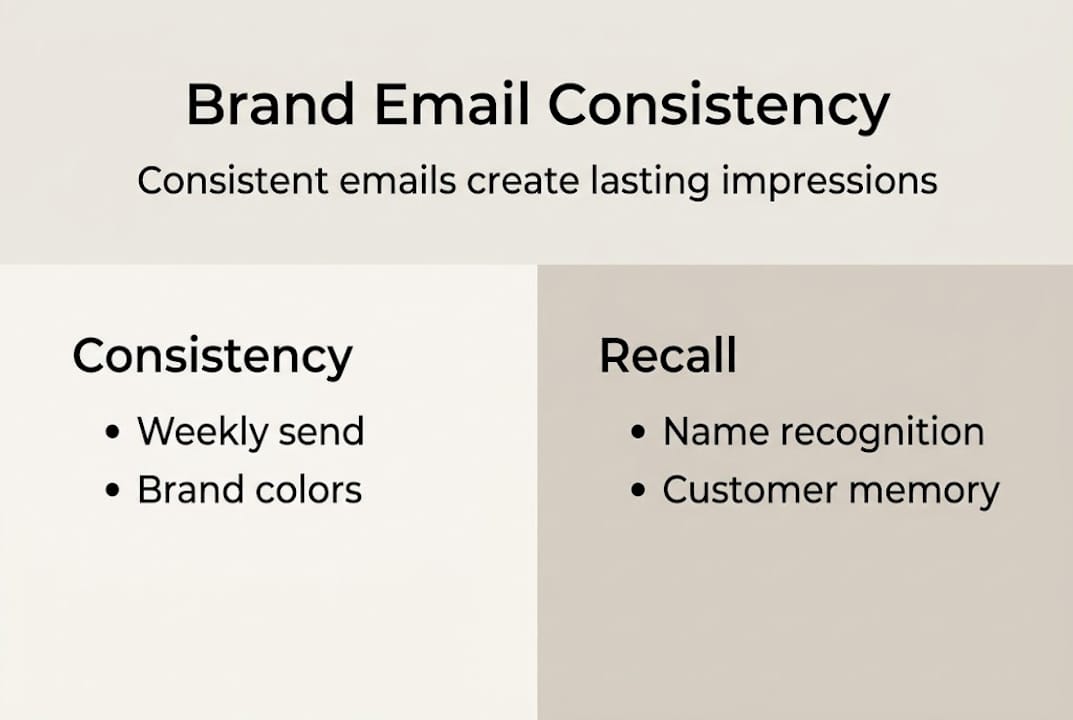
Klaviyo benchmarks are based on performance data from eligible accounts and reported industry datasets, giving you a real-world standard to measure your email execution quality against. Brands that send at consistent intervals and maintain visual and tonal consistency tend to outperform peers on engagement metrics, which in turn reinforces customer recall. Klaviyo accounts must have sent at least 25 emails in the last six months to access benchmarks, and those benchmarks are updated monthly.
Here are the email content types that do the most work for brand recall:
- Welcome series: The first three to five emails after a signup set the tone for how customers remember your brand. Lead with your story, your values, and what makes you different.
- Post-purchase follow-up: Customers are most receptive right after buying. A branded, personalized sequence here reinforces positive associations and increases the odds of a second purchase.
- Curated newsletters: Regular ecommerce newsletter ideas that mix product content with brand storytelling keep you top of mind between purchase cycles.
- Re-engagement campaigns: Lapsed customers who open a re-engagement email and recognize your brand immediately are showing strong recall. That moment is worth designing for.
- Educational content: Emails that teach something useful tied to your product category build authority and positive brand associations simultaneously.
One smart tactic is repurposing content for email from other channels. Blog posts, social content, and video scripts can be adapted into email formats quickly, ensuring your brand voice stays consistent across every touchpoint your customer encounters.
Pro Tip: Segmentation dramatically amplifies email recall impact. A personalized subject line that references a past purchase or category preference gets opened more often, and getting opened is step one in building recognition. Use Klaviyo’s behavioral segments to send the right message to the right customer at the right moment rather than blasting your whole list.
The visual layer matters just as much as the copy. Your color palette, font choices, header image style, and button design should be so consistent that a customer could identify your email before they read a single word. That instant visual recognition is one of the clearest signals of strong brand awareness in action.
Putting it all together: Building retention through awareness
Let’s synthesize the lessons into a step-by-step approach for e-commerce brands who want to turn awareness into lasting retention. Brand recall, as HBS Online notes, measures how familiar and recognizable a brand is to a target audience, and it is directly tied to unaided awareness. The brands that dominate retention are the ones customers think of first.
Here is a practical data table showing how Klaviyo engagement metrics connect to recall and retention outcomes:
| Klaviyo metric | Awareness signal it reflects | Retention outcome tied to it |
|---|---|---|
| Open rate (new subscribers) | Initial brand recognition | Higher first-to-second purchase rate |
| Open rate (lapsed segment) | Prompted recall after time away | Re-engagement and win-back success |
| Click-to-open rate | Active interest and memory depth | Stronger average order value over time |
| Unsubscribe rate | Recall without positive association | Signals need for brand story refresh |
| Revenue per recipient | Full-funnel awareness to action | Direct retention and LTV indicator |
Here is a numbered sequence to integrate awareness-building into your campaign planning:
- Set your baseline benchmarks. Pull 90 days of Klaviyo data. Identify your open rate, click rate, and unsubscribe rate by segment type. This is your starting awareness footprint.
- Define your awareness-focused segments. Create three core segments: new subscribers (awareness building phase), active customers (recall reinforcement phase), and lapsed customers (re-awareness phase). Each needs a different message approach.
- Build flows that reinforce brand memory. Welcome series, post-purchase sequences, and browse abandonment flows should all carry a consistent brand voice and visual system. Use Klaviyo’s email automation tools to set these up as evergreen assets.
- Pair email sends with quarterly recall surveys. Send a short recall survey to a sample of your list every three months. Track the unaided and aided recall scores alongside your Klaviyo open data from the same period.
- Analyze and adjust monthly. Review your benchmark comparisons inside Klaviyo. If open rates are dropping among your active segment, that is an early signal that brand recall is weakening. Adjust cadence, subject line style, or visual identity before the problem compounds.
Sustainable retention requires more than great products. It requires that customers remember you, feel something positive when they do, and find your communications worth opening. Awareness-building through email is not a one-time project. It is an ongoing operational practice that compounds over time.
A fresh perspective: Why brand awareness is only the first step
Here is the uncomfortable truth that most awareness-focused marketing advice skips: awareness without a retention strategy behind it is an expensive habit, not an investment.
We have worked with brands that ran impressive awareness campaigns, saw branded search tick up, and watched open rates climb after a big launch. Then, three months later, those numbers slid back because there was nothing holding customers in place. Awareness got them through the door. There was no system to keep them there.
The Merren research on brand measurement makes an important point: aided recall and headline survey metrics can mislead in isolation. A customer might recognize your brand name in a lineup but have zero intention of buying from you again. That is recognition without consideration, and it converts into nothing.
The brands that build lasting value pair awareness measurement with consideration tracking and retention email flows. They do not just ask “do customers know us?” They ask “do customers choose us, and keep choosing us?” That second question is where ethical email practices and long-term engagement strategy start to matter most.
“Awareness without retention equals wasted opportunity.”
Build the awareness. Then build the system that converts that awareness into loyal, repeat customers. One without the other is just incomplete marketing.
Level up your brand retention with expert email strategies
Building brand awareness through email is a long-term game, and it is one that rewards brands who get the strategy right from the start. Getting the flows built, the segments structured, and the benchmarks tracked takes expertise and ongoing optimization that most in-house teams simply do not have time for.
That is exactly what we do at Take Action. As a specialized email marketing retention agency, we help e-commerce brands build Klaviyo systems that turn awareness into retention, and retention into measurable revenue. From welcome flow strategy to post-purchase sequences and quarterly benchmark reviews, our team handles the technical and creative work so you can focus on your brand. If you are ready to stop leaving retention on the table, explore our expert Klaviyo solutions and let’s build something that actually sticks.
Frequently asked questions
How is brand awareness different from brand recognition?
Brand awareness covers overall familiarity and both recognition and recall, while brand recognition specifically refers to a customer’s ability to identify a brand when they encounter it, as defined by Investopedia’s brand awareness definition.
What is the best way to measure brand awareness for e-commerce?
The most accurate approach combines quarterly recall surveys with proxy signals like branded search volume and direct traffic, giving you both memory data and behavioral confirmation, consistent with best practice brand measurement methodology.
Can Klaviyo data help track brand awareness?
Yes. Klaviyo benchmarks and engagement metrics serve as useful proxy signals for awareness, especially when you segment by customer lifecycle stage and pair the data with direct recall surveys.
Why do impressions or reach not fully capture brand awareness?
High impressions show that content was displayed, but only recognition and recall confirm that a customer actually remembered your brand after the fact. Exposure and memory are two entirely different outcomes.
Recommended
- Master branding with Klaviyo email automation for growth | Take Action Blog | Take Action
- 7 Smart Newsletter Ideas for Brands Using Klaviyo | Take Action Blog | Take Action
- Engage Customers with Klaviyo: Boost Open Rates 40% in 2026 | Take Action Blog | Take Action
- Master Target Audience Research for Higher Email ROI | Take Action Blog | Take Action