

Build a distinctive brand voice in Klaviyo to boost retention
TL;DR:
- Consistent brand voice drives significant revenue growth and long-term customer loyalty.
- Klaviyo provides AI tools to analyze and automate maintaining your brand’s tone across channels.
- Defining clear descriptors, auditing content, and tailoring tone per channel are key for effective brand voice.
A brand that sounds different in every email is a brand customers quietly stop trusting. Revenue grows 23 to 33% when ecommerce brands maintain a consistent voice across channels, and the compounding effect on customer lifetime value is even more dramatic. Yet most brands treat brand voice as a design problem, something solved with a color palette and a logo. The real opportunity lives in your copy, your tone, and how every Klaviyo flow sounds when it lands in someone’s inbox. This guide breaks down exactly how to define, build, and automate a brand voice that drives retention and revenue.
Table of Contents
- What is a brand voice in ecommerce email?
- How Klaviyo supports brand voice: Tools and frameworks
- 7 steps to build a distinctive email brand voice in Klaviyo
- Channel and context adaptation: Nuances for ecommerce brands
- Measuring and optimizing brand voice for retention and growth
- What most ecommerce brands get wrong about brand voice in Klaviyo
- How to put your brand voice strategy into action
- Frequently asked questions
Key Takeaways
| Point | Details |
|---|---|
| Brand voice matters | A clear, consistent brand voice can increase engagement and ecommerce revenue by over 20 percent. |
| Klaviyo enables automation | Built-in tools in Klaviyo help define, enforce, and scale your unique voice across all email marketing. |
| Adapt by context | Adjust tone and messaging for each channel and situation while maintaining a unified core personality. |
| Measure and iterate | Regularly test, audit, and refine your voice for best results in retention and customer lifetime value. |
What is a brand voice in ecommerce email?
Brand voice is the personality your business expresses through words. It is not your logo, your font choice, or your product photography. It is the way you write a subject line, open an abandoned cart email, or follow up after a purchase. Think of it as the character your brand plays in every conversation with a customer.
For ecommerce, email is the highest-leverage channel for expressing that character. Social media posts are fleeting. Product pages are functional. But an email lands in a personal inbox, sits there, and gets read at a quiet moment. That intimacy makes tone and voice far more powerful than most brands realize.
Voice descriptors are the building blocks. You might describe your brand as playful, direct, and warm or authoritative, precise, and confident. These are not adjectives for a mood board. They are filters for every sentence your team writes.
Here is why this matters financially:
- Consistent brand voice drives 23 to 33% revenue growth and up to 2x long-term profit gains
- Higher click-through rates and open rates follow recognizable, trusted communication styles
- Customers who feel a brand “gets them” show dramatically stronger retention behavior
- Brand voice benefits extend to social engagement, with consistent brands earning 23% more interaction
“Brands with a consistent voice see up to 2x profit gains long-term and significantly higher customer lifetime value compared to brands with fragmented communication.”
Strong digital branding tips always start with voice before visuals, because voice shapes how every other element of your brand is perceived.
How Klaviyo supports brand voice: Tools and frameworks
Klaviyo is not just an email sending platform. It is increasingly a brand voice infrastructure tool, especially with its AI-powered features built for exactly this challenge.
Klaviyo’s Brand Brain feature is the standout capability here. Klaviyo analyzes past emails to infer your tone, vocabulary, and patterns, then applies that voice automatically to new AI-generated drafts. Instead of starting from a blank page every time, your team gets a draft that already sounds like you.

Beyond Brand Brain, Klaviyo offers structured tone settings that let you select a baseline style for AI-generated content:
| Tone setting | Best for | Example use case |
|---|---|---|
| Neutral | Transactional emails | Order confirmations, shipping updates |
| Professional | B2B or premium brands | High-ticket product launches |
| Friendly | Lifestyle and DTC brands | Welcome series, post-purchase follow-ups |
| Playful | Youth-oriented or fun brands | Seasonal campaigns, referral programs |
These settings are a starting point, not a finish line. The real power comes from layering your own descriptors on top.
Here is how to set up your voice in Klaviyo effectively:
- Navigate to your account’s AI settings and input your brand personality descriptors
- Upload or reference past high-performing emails as voice examples
- Set a “Say This, Not That” reference list in your internal guidelines
- Use AI tone customization in Klaviyo to fine-tune outputs before publishing
- Review AI drafts against your voice checklist before sending
Pro Tip: Vague descriptors like “friendly” or “professional” produce generic output. Instead, use specific phrases: “sounds like a knowledgeable friend, not a salesperson” or “uses short sentences and never uses corporate jargon.”
For brands already working on branding with Klaviyo automation, these settings become the foundation for every flow and campaign you build.
7 steps to build a distinctive email brand voice in Klaviyo
Having the tools is one thing. Knowing the process is another. Here is the structured methodology that actually works for ecommerce brands building their voice inside Klaviyo.
- Define your tone and personality. Choose 3 to 5 descriptors that capture your brand character. Approachable, witty, bold, and direct are strong examples. Avoid generic terms.
- Audit your existing content. Pull your last 20 emails and read them aloud. Do they sound like one brand or five different writers? Note the gaps.
- Create a “Say This, Not That” guide. This is the most practical tool you can build. See the table below for examples.
- Adapt voice by channel. Email allows for storytelling and warmth. SMS must be concise and punchy. Your core personality stays constant; the expression changes.
- Embed voice in templates and flows. Every Klaviyo flow, from welcome to post-purchase, should have voice-approved placeholder copy baked in.
- Use AI tools for consistency. Klaviyo’s Brand Brain and tone settings help maintain voice at scale, especially when your team grows.
- Train your team with living guidelines. A brand voice methodology only works if everyone who touches copy understands and uses it.
| Say this | Not that |
|---|---|
| “Your order is on its way!” | “Your order has been dispatched.” |
| “We think you’ll love this” | “We recommend the following product.” |
| “Something went wrong, let’s fix it” | “An error has occurred. Please contact support.” |
| “You’ve got great taste” | “Thank you for your purchase.” |
Pro Tip: Treat your brand voice guide as a living document. Every quarter, add new examples from real campaigns and flag copy that drifted off-brand. This keeps your content ideas for Klaviyo fresh and aligned.
Channel and context adaptation: Nuances for ecommerce brands
One of the biggest mistakes brands make is treating brand voice as a single setting that applies everywhere equally. Your voice is consistent; your expression of it is not.
Think about how a person behaves. You are the same person at a dinner party and in a job interview, but you adjust your language, energy, and detail level. Your brand should do the same.
Here is how voice should shift by channel while keeping the core personality intact:
- Marketing emails: Warmer, more narrative, storytelling-driven. Room to breathe and build emotion.
- Transactional emails: Efficient and reassuring. The personality shows in small moments, like a subject line or a closing line.
- Customer support emails: Empathetic and solution-focused. Drop the wit if someone is frustrated.
- SMS: Short, direct, and high-energy. One idea per message. No filler.
- Social captions: Conversational and reactive. Slightly more casual than email.
The risk of ignoring this nuance is real. AI needs detailed rules and guardrails, not vague prompts, or it will default to generic output that sounds like every other brand in your category.
“A brand that sounds the same in a shipping confirmation as it does in a promotional campaign is not consistent, it is tone-deaf. Consistency means the personality is always present, not that the volume never changes.”
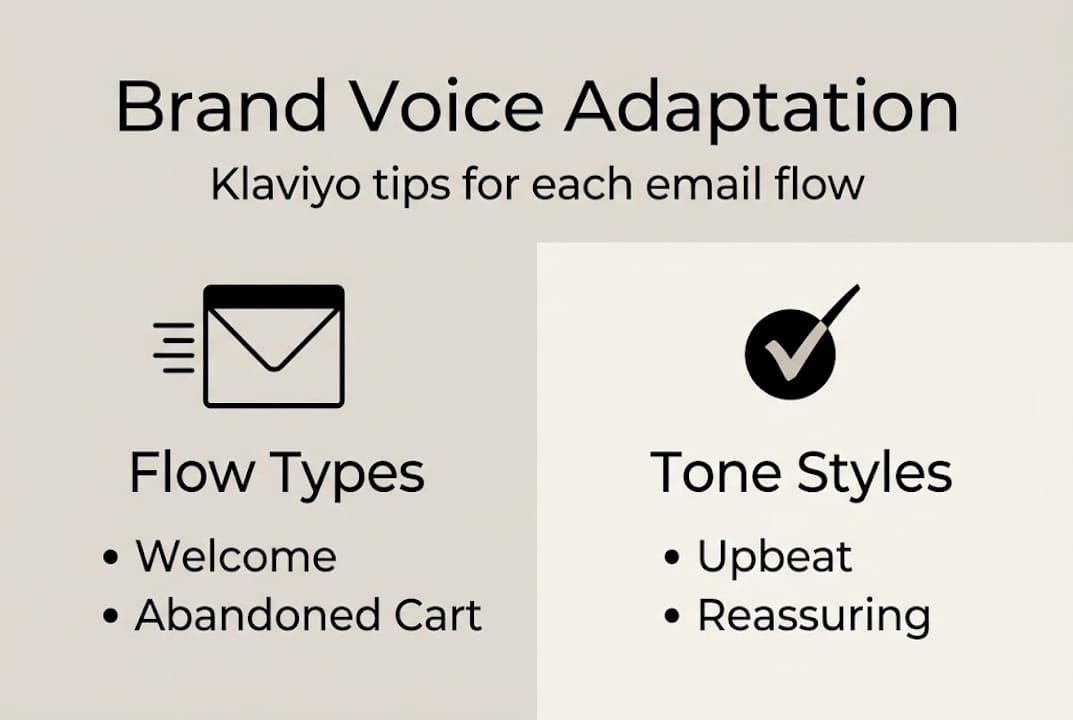
In Klaviyo, you can set different tone instructions for different flow types. Your abandoned cart flow can have a more urgent, direct tone. Your post-purchase flow can be warm and celebratory. Both are still your brand.
Building ecommerce growth with automation depends on this kind of nuance. Brands that nail context-aware voice see stronger improving engagement in Klaviyo metrics across every flow. And omnichannel brand voice consistency adds up to 90% higher purchase probability per additional channel.
Measuring and optimizing brand voice for retention and growth
Building a brand voice without measuring its impact is guesswork. Klaviyo gives you the data to know whether your voice is actually working.
Start with these primary metrics:
- Open rate: Subject line voice is the first test. Are your subject lines recognizable and compelling?
- Click-through rate: Does your body copy motivate action?
- Revenue per recipient: The ultimate measure of whether your emails are driving purchases
- Unsubscribe rate: A rising unsubscribe rate often signals a voice mismatch with audience expectations
- Customer lifetime value: The long-term proof that your voice builds loyalty
Here is a practical optimization cycle:
- Segment by engagement level. Test voice variations on warm versus cold segments separately.
- Run A/B tests on tone. Test a warmer, more personal version of a subject line against a direct, benefit-led version.
- Audit quarterly. Pull your top and bottom-performing emails and identify voice patterns. Audit quarterly to track 23%+ engagement and revenue uplifts tied to voice consistency.
- Adjust your Klaviyo voice rules. Update your Brand Brain inputs and tone settings based on what the data shows.
For Klaviyo email personalization, voice and personalization work together. A personalized email that sounds off-brand still underperforms. When both are aligned, the results compound.
The brands that win at retention are not just sending more emails. They are sending emails that feel like they come from a brand worth staying loyal to.
What most ecommerce brands get wrong about brand voice in Klaviyo
Here is the uncomfortable truth: most brands focus on what they say and almost completely ignore how it lands. They write a voice guide, pick some adjectives, and call it done. Then they wonder why their Klaviyo flows feel flat.
Brand voice is not a style guide exercise. It is a trust-building mechanism. Every email that sounds like your brand reinforces a signal to the customer: “This company knows who they are, and they know who I am.” That signal is what drives repeat purchases, not discounts.
The brands that outperform in retention treat voice as a customer signal, not a creative preference. They test it, measure it, and refine it like any other conversion lever. They also understand that Klaviyo’s AI tools are only as good as the inputs you give them. Generic prompts produce generic emails.
The real edge comes from specificity. Specific descriptors, specific examples, specific guardrails. Brands that invest in content creation strategies with this level of rigor see their Klaviyo metrics reflect it within a single quarter.
How to put your brand voice strategy into action
You now have the framework: define your voice, embed it in Klaviyo, adapt it by channel, and measure what works. The next step is execution, and that is where most brands stall.
At Take Action Agency, we specialize in building Klaviyo-driven email strategies that are rooted in your brand’s unique voice and wired for retention. From auditing your existing flows to setting up AI-powered voice guidelines and building campaigns that convert, we handle the strategy and execution so you can focus on growth. If you are ready to turn your email channel into a real retention engine, connect with our team and let’s build something that sounds unmistakably like you.
Frequently asked questions
What are the key steps to building a brand voice in Klaviyo?
Start by defining tone, auditing content, creating guidelines, adapting by channel, embedding in templates, using AI for consistency, and training your team. This 7-step methodology gives your entire team a repeatable process for staying on-brand.
How does a consistent brand voice boost ecommerce revenue?
Consistent brand voice increases engagement, CLV, and retention, resulting in up to 33% higher revenue and 2x higher profits long term. Beauty brands with consistent voice have seen 306% higher customer lifetime value.
Can Klaviyo’s AI features help maintain brand voice?
Yes. Klaviyo analyzes past emails, infers your brand voice, and applies it to new drafts, supporting consistent tone and style at scale without manual rewriting every time.
How often should you audit your brand voice?
Quarterly content and performance audits help keep your brand voice consistent and effective as your audience or offerings evolve. Quarterly audits also help you catch AI-generated drift before it affects your metrics.
What mistakes should brands avoid when setting up voice in Klaviyo?
Avoid vague descriptors and ignoring context. AI needs detailed rules and channel-specific guardrails to avoid generic or off-tone messaging that erodes customer trust over time.
Recommended
- Master branding with Klaviyo email automation for growth | Take Action Blog | Take Action
- How Klaviyo content marketing agencies boost retention 321% | Take Action Blog | Take Action
- Top marketing funnels for Klaviyo in 2026: Boost retention | Take Action Blog | Take Action
- Boost ecommerce retention with content pillars in 2026 | Take Action Blog | Take Action
- Brand Voice Article – BcardsCreation
- How to Build Brand Identity for Business Growth