

Content idea generation for Klaviyo email marketing
Fresh email content keeps your audience engaged, but constant ideation drains time and creativity. You need a systematic approach that leverages customer data and AI tools within Klaviyo to generate personalized, high-converting content consistently. This guide walks you through five practical steps to transform your content creation from guesswork into a repeatable, data-driven process that boosts engagement and revenue.
Table of Contents
- Prerequisites: Setting Up For Effective Content Ideation
- Step 1: Identify Content Themes Using Customer Insights
- Step 2: Leverage AI For Dynamic Content Idea Generation
- Step 3: Utilize Behavioral Segmentation To Target Content
- Step 4: Integrate Content Ideas Into Automation Flows
- Step 5: Test And Refine Content Ideas
- Common Mistakes And Troubleshooting
- Expected Outcomes And Benchmarks
- Boost Your Ecommerce Email Marketing With Take Action
- FAQ
Key takeaways
| Point | Details |
|---|---|
| Foundation matters | Clean data and proper Klaviyo setup enable effective content generation and prevent deliverability issues. |
| Data drives themes | Customer insights and AI tools reveal personalized content opportunities aligned with buyer behavior. |
| Segmentation multiplies impact | Behavioral targeting tailors messages for specific customer groups, increasing relevance and conversions. |
| Automation scales success | Embedding content ideas into flows creates consistent touchpoints that drive retention and revenue. |
| Testing optimizes performance | Continuous A/B testing and data analysis refine content elements for maximum engagement. |
Prerequisites: setting up for effective content ideation
You cannot generate impactful content ideas without a solid foundation. Your Klaviyo account needs clean data, proper integrations, and basic automations before you start ideating.
Start by verifying your email lists. Clean, verified lists reduce bounce rates by 30% and protect your sender reputation. Remove inactive subscribers and validate new signups to maintain high deliverability.
Next, integrate Klaviyo fully with your ecommerce platform. Shopify, WooCommerce, or Magento connections sync customer data automatically, giving you real-time insights for content planning. Without this integration, you lose crucial behavioral signals that inform your content strategy.
Set up authentication protocols now. SPF and DKIM records verify your sender identity and keep your emails out of spam folders. These technical steps take 15 minutes but determine whether your carefully crafted content ever reaches inboxes.
Build foundational automation flows before generating advanced content ideas:
- Welcome series introducing new subscribers to your brand
- Abandoned cart reminders recovering lost sales
- Post-purchase sequences building loyalty
- Browse abandonment flows capturing interest
Establish brand-aligned email templates that maintain consistent visual identity across campaigns. Templates save hours while ensuring every message reinforces your brand voice and aesthetic.
Pro Tip: Create a simple customer lifecycle map showing key touchpoints from awareness to loyalty. This visual guide ensures your content ideas align with specific journey stages and prevents random, disconnected messaging that confuses subscribers.
Master basic segmentation concepts now. Understanding how to group customers by behavior, purchase history, and engagement level prepares you for advanced content targeting in later steps.
Step 1: identify content themes using customer insights
Your Klaviyo dashboard contains goldmine data that reveals exactly what content your audience wants. Stop guessing and start analyzing.
Predictive analytics forecast customer needs before they articulate them. Klaviyo’s predictive models identify who’s likely to purchase next, churn, or become high-value customers. These predictions guide content themes that address specific lifecycle stages.
Zero-party data comes directly from customers through preferences, surveys, and profile updates. First-party data tracks behavior like browsing patterns, purchase history, and email engagement. Combine both to build detailed segments revealing content opportunities.
Focus on high-value segments first. Not all customers deserve equal content attention. Identify your top 20% by lifetime value and create premium content addressing their specific interests and pain points. This approach maximizes ROI from your content efforts.
Map content themes to journey stages systematically. New subscribers need educational content building trust and explaining your value proposition. Active browsers respond to product showcases and social proof. Repeat buyers engage with loyalty rewards and exclusive previews. Lapsed customers require re-engagement campaigns highlighting what’s changed since their last purchase.
Dig into behavioral patterns revealing untapped themes. Which product categories drive highest engagement? What time of day generates most clicks? Which subject line formulas perform best? These insights suggest specific content angles.
Leverage target audience research for higher email ROI to understand psychographic factors beyond basic demographics. Knowing why customers buy, not just what they buy, unlocks emotional content themes that resonate deeply.
Create a content theme library organized by:
- Customer lifecycle stage
- Product category interest
- Engagement level
- Purchase frequency
- Seasonal relevance
Apply email segmentation strategies ecommerce growth principles to ensure each theme targets a clearly defined audience segment. Generic themes waste your time and bore subscribers.
Step 2: leverage AI for dynamic content idea generation
Klaviyo’s AI transforms hours of brainstorming into minutes of strategic input. You provide direction, AI handles the heavy lifting.

Input descriptive prompts telling AI exactly what you need. Specify tone, length, product focus, and audience segment. The more detailed your prompt, the better AI outputs match your brand voice. Test multiple prompt variations until you find formulas that consistently generate usable content.
AI-driven product recommendations personalize every email automatically. The algorithm analyzes individual browsing history, purchase patterns, and similar customer behaviors to suggest items each subscriber most likely wants. This removes guesswork from product selection while increasing relevance.
Customize AI outputs rigorously. Raw AI content needs human editing to maintain brand consistency and emotional connection. Use AI as your first draft writer, then refine messaging to match your unique voice and strategic goals.
Dynamic subject lines and CTAs multiply engagement without manual effort. AI generates dozens of variations targeting different segments, testing what resonates with each audience slice. Open rates climb when every subscriber sees subject lines tailored to their preferences.
Follow this AI content generation workflow:
- Define your content goal and target segment clearly
- Write a detailed prompt specifying tone, length, and key points
- Generate multiple AI variations for comparison
- Select the strongest output and customize for brand voice
- Test AI content against human-written baselines to validate performance
Monitor performance metrics obsessively. Track which AI-generated elements drive highest engagement and conversion rates. Feed these insights back into your prompts, continuously training the system to produce better results.
Pro Tip: Build a swipe file of your best-performing AI prompts. Document exactly what inputs generated winning subject lines, body copy, and CTAs. This reference library speeds future ideation and ensures consistent quality across campaigns.
Explore ways to find inspiration for email campaigns to supplement AI tools with creative techniques that spark fresh angles and prevent content repetition.
Step 3: utilize behavioral segmentation to target content
AI generates ideas, but segmentation ensures those ideas reach the right people. Generic content converts 20-30% worse than targeted messages.
Segment customers by multiple behavioral dimensions simultaneously. Purchase frequency, average order value, product category preferences, email engagement levels, and website activity all reveal different facets of customer intent. Layering these creates micro-segments receiving hyper-relevant content.
Create distinct content tracks for lifecycle stages. New customers need onboarding and education. Active customers respond to product launches and trend content. Loyal customers engage with exclusive perks and community building. At-risk customers require win-back campaigns addressing specific objections.
Personalized campaigns using AI-driven segmentation outperform generic campaigns by 20-30% in conversion rates. This performance gap grows as you refine segmentation criteria based on results.
Interactive content boosts engagement metrics dramatically. Polls asking preference questions, quizzes recommending products, and surveys gathering feedback all increase click rates while providing valuable zero-party data for future segmentation.
Compare performance systematically:
| Approach | Open Rate | Click Rate | Conversion Rate | Revenue per Email |
|---|---|---|---|---|
| Generic broadcast | 18% | 2.1% | 0.8% | $0.32 |
| Basic segmentation | 24% | 3.4% | 1.4% | $0.58 |
| Behavioral micro-segments | 31% | 5.2% | 2.3% | $0.94 |
| AI-powered dynamic segments | 37% | 6.8% | 3.1% | $1.26 |
Align content variants precisely with segment preferences revealed by past behavior. If a segment consistently clicks product videos but ignores blog links, emphasize video content in their emails. Data tells you exactly what works.
Apply list segmentation ecommerce email best practices to avoid over-segmentation that fragments your audience into unmanageable pieces. Balance personalization with operational efficiency.
Step 4: integrate content ideas into automation flows
Brilliant content ideas mean nothing sitting in a document. Embedding them into Klaviyo’s automation flows scales impact without constant manual effort.
Refresh automated flows quarterly with new content angles. Welcome series grow stale when every new subscriber receives identical messages for years. Rotate educational content, social proof examples, and product highlights to maintain freshness while preserving proven structure.
Abandoned cart flows deserve constant content innovation. Test different urgency tactics, social proof elements, incentive structures, and product recommendation strategies. Small changes compound into significant revenue gains across thousands of automated sends.
Integrating email with SMS and push notifications in omnichannel flows enhances engagement by 18%. Coordinate content themes across channels so customers receive consistent messaging regardless of touchpoint. This unified experience builds trust and recognition.
AI recommendations trigger timely, relevant messages automatically. When browsing behavior signals strong purchase intent, flows send targeted content addressing likely objections or highlighting key benefits. This real-time responsiveness converts fence-sitters into buyers.
Measure retention and revenue metrics religiously:
- Repeat purchase rate from post-purchase flows
- Cart recovery percentage from abandonment series
- Customer lifetime value influenced by loyalty flows
- Engagement score changes correlated with flow touchpoints
Ensure flows adapt dynamically. Customers moving between lifecycle stages should automatically shift into appropriate content tracks. Someone making their third purchase exits new customer flows and enters loyalty programming seamlessly.
Combine email segmentation strategies ecommerce growth with automation to create self-optimizing systems that improve over time without manual intervention.
Step 5: test and refine content ideas
Every content element presents a testing opportunity. Systematic experimentation separates good campaigns from great ones.
Run focused A/B tests on single variables:
- Subject lines comparing different benefit angles or urgency levels
- Preview text reinforcing or contrasting with subject lines
- Email body length testing concise versus comprehensive approaches
- CTA copy and button color driving different action rates
- Send time optimization finding peak engagement windows
- Sender name variations building personal connection
Analyze multiple metrics, not just opens. A subject line boosting opens by 15% matters little if click-through rate drops 30%. Evaluate full funnel impact including revenue per recipient and unsubscribe rates.
Test frequency and cadence systematically. Some segments tolerate daily emails while others disengage after three weekly messages. Find each segment’s sweet spot through gradual experimentation.
Iterate based on empirical results, not opinions. Your personal preferences about content often differ dramatically from subscriber behavior. Trust the data, even when results surprise you.
Maintain a testing calendar preventing ad hoc experiments that muddy results. Schedule tests sequentially so each runs to statistical significance before starting the next. Document learnings in a centralized knowledge base informing future content decisions.
Monitor email engagement measurement strategies beyond basic opens and clicks. Track scroll depth, time spent reading, forward rates, and reply rates for deeper engagement insights.
Common mistakes and troubleshooting
Even experienced marketers fall into predictable traps that undermine content performance.
Generic templates kill engagement. Relying on one-size-fits-all templates and ignoring customer data drops engagement 15-20%. Every email should reflect subscriber-specific data, preferences, and behaviors.
List hygiene failures destroy deliverability. Neglecting to clean contact lists drops open rates by 15% as ISPs flag your domain for sending to invalid addresses. Verify new signups immediately and remove bounces after every send.
Ignoring available data wastes your biggest asset. Klaviyo captures rich behavioral signals most marketers never examine. Surface these insights regularly through dashboard reviews and custom reports informing content strategy.
Over-automation creates robotic experiences that repel subscribers. Balance efficiency with genuine human touch through:
- Personal replies to email responses
- Timely manual sends around breaking news or trends
- Surprise-and-delight campaigns outside automated flows
- User-generated content featuring real customers
“The best email marketing blends automation efficiency with authentic human connection. Let systems handle repetitive tasks so you can focus energy on creative storytelling and relationship building.”
Regular campaign audits catch problems before they compound. Monthly reviews identify declining metrics, segment drift, content fatigue, and technical issues requiring immediate attention. Fix small problems quickly rather than ignoring them until performance crashes.
Avoid email marketing mistakes ecommerce brands commonly make by learning from others’ failures and implementing preventive systems.
Expected outcomes and benchmarks
Realistic expectations guide strategy and prevent premature course corrections when results need time to materialize.
AI-personalized emails typically deliver 15-30% higher conversion rates than generic broadcasts. This range depends on segmentation sophistication, content quality, and audience maturity. Newer lists see smaller gains initially, compounding as data accumulates.
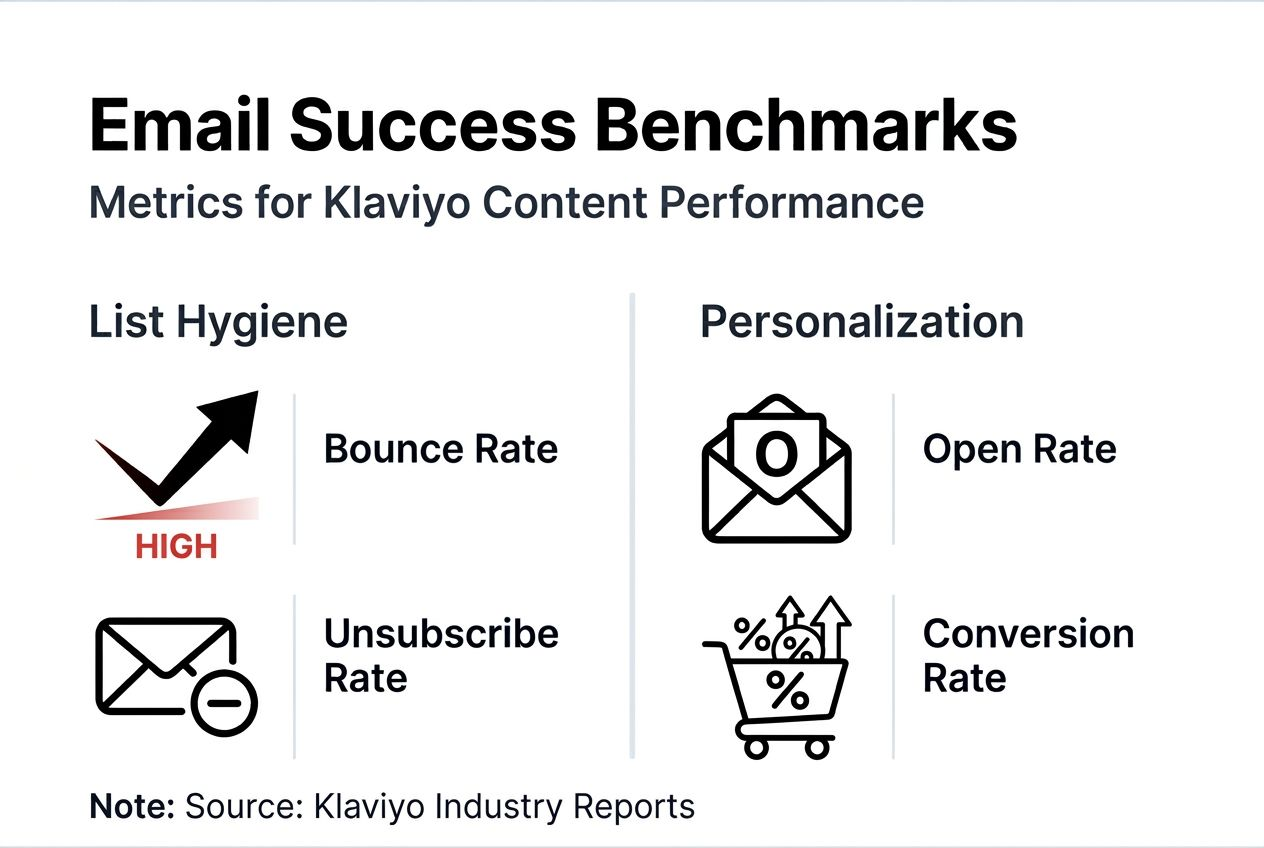
Clean lists and tailored content reduce bounce rates up to 20% while cutting unsubscribe rates by similar margins. Subscribers receiving relevant content stay engaged longer and tolerate higher email frequency.
Automation and segmented flows improve retention rates up to 25% by maintaining consistent, relevant touchpoints throughout the customer lifecycle. This retention gain directly impacts lifetime value and overall profitability.
AI product recommendations boost click-through rates as much as 18% by showing items each subscriber actually wants to see. This personalization removes friction from the buying decision.
| Metric | Baseline (Generic) | Good (Segmented) | Excellent (AI-Powered) | Target Improvement |
|---|---|---|---|---|
| Open Rate | 18-22% | 25-30% | 32-38% | +60-75% |
| Click Rate | 2.0-2.5% | 3.5-4.5% | 5.5-7.0% | +150-180% |
| Conversion Rate | 0.8-1.2% | 1.5-2.0% | 2.5-3.5% | +180-210% |
| Bounce Rate | 3-5% | 1.5-2.5% | <1.0% | -65-80% |
| Unsubscribe Rate | 0.3-0.5% | 0.15-0.25% | <0.15% | -60-70% |
Use these benchmarks to measure success and identify underperforming elements needing optimization. Track progress monthly, allowing enough time for statistical significance before making major changes.
Boost your ecommerce email marketing with Take Action
Generating fresh content ideas consistently requires expertise, time, and sophisticated tool knowledge most ecommerce teams lack internally.
Take Action specializes in Klaviyo-powered email marketing that transforms subscribers into loyal, high-value customers. We combine AI-driven content generation with human strategic oversight, ensuring every campaign delivers measurable revenue growth.
Our team handles everything from segmentation strategy to automation flow management, freeing you to focus on product and customer experience. We’ve helped dozens of ecommerce brands boost retention rates, recover abandoned carts, and build email into their primary growth channel. Partner with Take Action to elevate your email marketing without expanding your internal team or learning complex platforms from scratch.
FAQ
What is content idea generation in Klaviyo email marketing?
Content idea generation is the systematic process of creating fresh, relevant email content using customer data and AI tools within Klaviyo. It produces personalized elements like subject lines, product recommendations, and CTAs aligned to specific audience segments, dramatically improving engagement and conversion rates compared to generic messaging.
How can AI help with content idea generation in Klaviyo?
AI accelerates ideation by generating personalized email elements automatically based on customer behavioral data and purchase history. It creates dozens of subject line variations, dynamic product recommendations, and targeted CTAs in minutes, increasing message relevance while reducing manual brainstorming time and enhancing both open and conversion rates.
What are common mistakes to avoid when generating email content ideas?
Avoid using generic templates that ignore personalization opportunities and subscriber-specific data. Neglecting email list hygiene causes deliverability problems that undermine even great content. Over-automation creates robotic experiences that disengage subscribers, while ignoring available behavioral insights wastes your most valuable strategic asset.
How do I measure success from new content ideas in email campaigns?
Track open rates, click-through rates, and conversion rates for each content variation to identify winners. Monitor bounce and unsubscribe rates as indicators of list health and content relevance. Evaluate retention improvements through repeat purchase rates and automation flow performance metrics. Use email engagement measurement strategies to gain deeper insights beyond surface metrics.
Recommended
- 7 Proven Ways to Find Inspiration for Email Campaigns | Take Action Blog | Take Action
- Content Creation Marketing Agency: Impact for Ecommerce | Take Action Blog | Take Action
- Creating Evergreen Content to Boost Email Impact | Take Action Blog | Take Action
- Social Content Strategy: Driving Email Engagement Growth | Take Action Blog | Take Action
- Email Segmentation Tutorial for eCommerce Conversions