

Content marketing for e-commerce: real ROI and retention
TL;DR:
- Content marketing offers a high ROI, with $7.65 earned per dollar and email even higher at $42.
- Strategic content and automation build long-term assets, reducing customer acquisition costs over time.
- Prioritize revenue-focused content like product pages and automated email flows to maximize conversions and loyalty.
Content marketing earns an average of $7.65 for every $1 spent, while email delivers an extraordinary $42 return on that same dollar. Yet most e-commerce brands treat content as an afterthought, something to fill a blog or post on social media when the team has extra bandwidth. That mindset is expensive. Strategic content combined with smart email automation is one of the most durable growth engines available to online retailers. This guide walks you through the real numbers, the right content types, and the automation plays that turn browsers into buyers and one-time shoppers into loyal customers.
Table of Contents
- The business case: Content marketing ROI by the numbers
- Content vs paid media: What compounds and what plateaus
- The content that converts: What really drives revenue in e-commerce
- The role of email automation: Turning content into predictable revenue
- Why most content marketing strategies underdeliver: A hard-won perspective
- Ready to turn your content into an e-commerce growth engine?
- Frequently asked questions
Key Takeaways
| Point | Details |
|---|---|
| ROI outpaces trends | Content marketing and email automation deliver the highest returns for e-commerce growth and retention. |
| Content powers compounding growth | Strategic content efforts may start slow, but their effects multiply and sustain momentum over time. |
| Focus on high-impact assets | Revenue-driving content like PDPs, sizing guides, and lifecycle emails outperform generic blogs. |
| Automate for predictable revenue | Integrating email automation transforms content into a repeatable, scalable sales engine. |
The business case: Content marketing ROI by the numbers
Let’s break down the hard numbers that explain why content marketing commands so much attention in e-commerce.
The data is harder to ignore than most marketing stats. Businesses that publish consistent, strategic content generate 55% more traffic and 67% more leads than those that don’t. These aren’t vanity metrics. More qualified traffic means more purchase opportunities, and more leads mean a bigger pool of potential customers to move through your retention funnel.
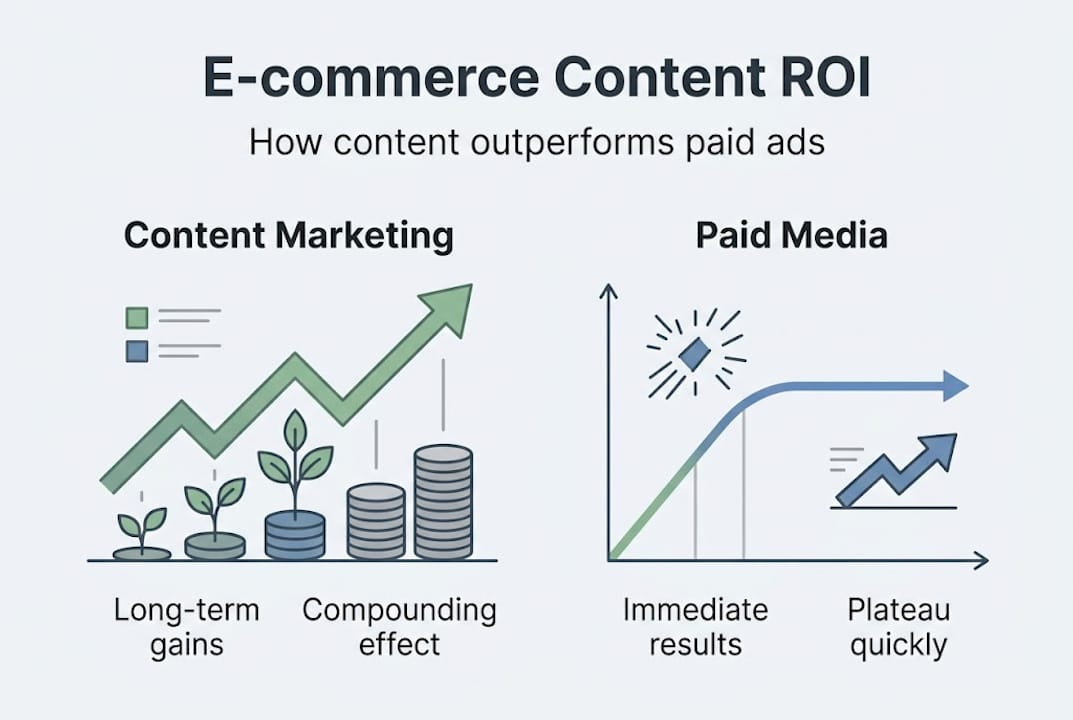
For context, display advertising typically returns around $2 for every $1 spent. Social media paid campaigns often land between $3 and $5. Content marketing’s $7.65 average return already beats those figures, and email sits even higher at $42 per dollar. That gap is not a coincidence. It reflects the nature of owned versus rented channels.
| Marketing channel | Average ROI per $1 spent |
|---|---|
| Display advertising | ~$2.00 |
| Social media ads | ~$3.00 to $5.00 |
| Content marketing | ~$7.65 |
| Email marketing | ~$42.00 |
“Email marketing consistently outperforms every other digital channel on ROI, making it the single most important content distribution lever for e-commerce brands.”
For online retailers specifically, these numbers hit differently. Your average customer acquisition cost (CAC) on paid channels is rising every year as more brands compete for the same ad slots. Content and email, by contrast, build audiences you own. Once a shopper is on your list or finds your site through organic search, you’re not paying for every single impression again.
The ecommerce content growth effect compounds over time. A well-optimized product guide written today might drive traffic and conversions for three or four years. A paid ad disappears the moment you stop funding it. That fundamental difference shapes every budget decision you make going forward.
What does this mean practically for your store? Every dollar you invest in strategic content and email automation is a dollar building an asset, not renting attention. The brands outperforming their competitors on margins aren’t necessarily spending more on ads. They’re building content libraries and email sequences that work around the clock without additional spend.
Content vs paid media: What compounds and what plateaus
Understanding the impressive ROI is one thing, but how does content marketing actually stack up against the tried-and-true world of paid ads, especially when it comes to long-term growth?
Paid advertising delivers results fast. You turn on the budget, you see traffic, and you see sales. That speed is genuinely useful, especially when you’re launching a new product or testing an audience. No one should completely walk away from paid media. But the math over a longer window tells a different story.
Research on the 36-month content compounding effect shows that paid ads plateau while content accelerates. In months one through six, paid ads win on volume. By month twelve, content has typically broken even on CAC. By month thirty-six, content generates significantly cheaper customer acquisition than paid, because you’re not starting from zero every campaign cycle.
| Factor | Paid media | Content marketing |
|---|---|---|
| Speed to first results | Days | Three to six months |
| Long-term CAC trend | Increases over time | Decreases over time |
| What happens when you stop | Traffic drops immediately | Traffic continues |
| Compounding effect | None | Strong |
| Channel ownership | Rented | Owned |
Here’s why the compounding effect matters so much for retention specifically. Every piece of content that earns organic traffic also feeds your email list, your retargeting audiences, and your brand authority. The more quality content you publish, the stronger each of those downstream channels becomes. It’s a flywheel, not a funnel.
Most brands hesitate on content because the early months look underwhelming compared to paid results. That’s a trap. The slow start is normal and expected. Customer retention in ecommerce research consistently shows that loyal customers spend more, refer more, and cost less to service. Content builds that loyalty in a way that paid ads simply cannot.
Key actions to balance both channels effectively:
- Start with a 70/30 split, favoring paid media early on
- Reinvest a portion of content-driven revenue into more content production
- Track CAC separately for paid and organic content channels
- Gradually shift budget toward content as organic rankings and email list size grow
- Never pause content creation during slow sales periods because that’s when the compounding engine needs fuel
Pro Tip: Don’t pull back on content during Q4 or peak ad seasons just because paid is working harder. Your content assets are quietly building equity that will reduce your paid dependency in Q1 and Q2 when ad costs spike again.
The content that converts: What really drives revenue in e-commerce
With the differences between paid and organic investments clear, it’s crucial to focus on the types of content that produce true ROI rather than spreading efforts thin.
Generic blog posts have a reputation problem. Most e-commerce brands publish broad articles targeting keywords that have nothing to do with their actual products or customer needs. Those posts might get traffic, but they rarely convert because they attract the wrong visitor at the wrong stage of the buying journey.

Revenue-focused content follows a completely different logic. It focuses on assets directly tied to purchase decisions: product description pages (PDPs), sizing guides, comparison articles, use-case tutorials, and post-purchase email sequences. These are the content types that directly reduce friction between a visitor and a completed order.
Here’s a ranked breakdown of the highest-converting content assets for e-commerce:
- Product description pages (PDPs): A strong PDP does more than list features. It answers objections, tells a story about the product’s value, and guides the shopper toward adding to cart. Weak PDPs kill conversions even when your traffic is excellent.
- Buying guides and comparison content: Shoppers researching high-ticket items want to compare options. A well-written guide that honestly evaluates your product versus alternatives builds trust and captures purchase-intent traffic.
- Sizing, fit, and how-to guides: Returns are one of the biggest margin killers in e-commerce. Sizing guides and setup tutorials reduce return rates and customer service load while increasing satisfaction.
- Post-purchase email sequences: The moment after a purchase is underutilized by most brands. A thoughtful post-purchase email series builds loyalty, encourages repeat purchases, and generates reviews and referrals.
- Strategic blog posts tied to product categories: Not generic posts, but articles written to capture traffic at key decision points and funnel readers toward specific product pages.
The content trends in ecommerce landscape is moving toward more personalized, lifecycle-aware content. That means the same product shouldn’t be presented the same way to a first-time visitor and a returning customer who’s already bought twice. Segmented content, particularly in email, is where this personalization pays off most.
Understanding which content marketing channels to prioritize also matters enormously. Email, organic search, and on-site content form the core trio for e-commerce retention. Social is useful for awareness but rarely closes the deal on its own.
Pro Tip: Identify your top five highest-traffic pages and top five highest-revenue pages. If they’re not the same pages, that’s your immediate content optimization priority. Close that gap by refreshing underperforming high-traffic pages with stronger calls to action and richer product content.
Refreshing existing content monthly pays off faster than most brands expect. Search engines reward freshness, and updated pages convert better because they reflect current product information, pricing, and customer questions.
The role of email automation: Turning content into predictable revenue
Building high-impact content is just the beginning. Channeling it through automated emails can amplify every dollar of your investment.
Email is still the most direct line between your brand and your customer. Unlike social media, you’re not subject to algorithm changes. Unlike paid ads, you’re not bidding against competitors for visibility. With email generating $42 per $1 spent, it’s the highest-leverage distribution channel you have for every piece of content you create.
The real power comes from automation. A single well-built email flow can run indefinitely, delivering personalized, timely content to customers at every stage of the lifecycle without manual effort every time. The best email automation tools for e-commerce make this setup relatively straightforward, but the strategy behind the flows is what actually determines results.
Here are the core automated flows every e-commerce brand should have running:
- Welcome series: First impressions matter. A three to five email welcome sequence introduces your brand story, your best products, and a compelling first-time offer. This is where new subscribers convert at the highest rate.
- Abandoned cart recovery: Between 70% and 80% of online shoppers abandon their cart before purchasing. An automated abandoned cart sequence, typically two to three emails over 24 to 48 hours, recovers a significant portion of that lost revenue.
- Browse abandonment: Shoppers who view a product page but don’t add to cart are warm leads. A targeted email reminding them of what they viewed, combined with social proof or a relevant guide, brings many back to purchase.
- Post-purchase sequence: Thank the customer, set expectations for delivery, introduce complementary products, and ask for a review. This sequence builds the repeat purchase habit that drives lifetime value (LTV).
- Win-back campaigns: For customers who haven’t purchased in 60 to 120 days, a re-engagement sequence with a personalized offer and relevant content pulls many back before they’re truly lost.
“Automated email flows aren’t a ‘set and forget’ system. The brands generating the highest returns review and optimize their flows quarterly to match evolving customer behavior and product catalogs.”
Content makes all of these flows significantly more effective. Instead of a bare promotional email in your abandoned cart sequence, include a product guide link, a review highlight, or a comparison snippet. That content element answers the objection that stopped the customer from checking out in the first place.
It’s also worth noting that email automation compares favorably to influencer marketing ROI in terms of predictability and control. Influencer campaigns can spike traffic but rarely build the sustained retention that automated email sequences deliver month after month.
Why most content marketing strategies underdeliver: A hard-won perspective
You’ve seen the frameworks and the data. So why do so many e-commerce brands still struggle to get meaningful returns from content marketing?
The honest answer is that most brands invest in the wrong things. They chase traffic through generic blog posts, publish content marketing trends roundups that have no connection to their actual products, and measure success by pageviews instead of revenue. That’s a vanity metrics trap that keeps marketing teams busy without moving the business forward.
The brands consistently generating strong content ROI do three things differently. First, they tie every content asset directly to a business outcome, whether that’s increasing conversion rate on a specific product category, reducing returns, or improving email click rates. Second, they refresh and optimize their top performers instead of always chasing new topics. A page already ranking on page two of search results takes far less effort to push to page one than building a brand new page from scratch. Third, they track the full attribution path. Content often influences a purchase without being the last click. If you only measure last-click attribution, you’ll consistently undervalue content and over-invest in paid media.
The uncomfortable truth is that content marketing rewards patience and precision. It doesn’t reward volume for its own sake.
Ready to turn your content into an e-commerce growth engine?
If the ROI data and strategic framework in this article have made one thing clear, it’s that content and email automation are not optional for brands serious about scaling beyond paid ads.
At Take Action, we work with e-commerce brands to build and optimize the email automation systems and content strategies that drive predictable, compounding revenue. From welcome flows and abandoned cart sequences to full lifecycle email programs, our team handles the strategy, copywriting, and Klaviyo setup so you can focus on running your business. If you’re ready to stop renting attention and start building an audience that converts on your terms, explore what we do and let’s talk about what that looks like for your store.
Frequently asked questions
How quickly can e-commerce see ROI from content marketing?
Content marketing typically takes three to six months to show meaningful results, but the compounding returns over 24 to 36 months consistently outperform paid media on customer acquisition cost. The brands that stick with it past the early slow period are the ones who benefit most.
What type of content leads to the highest e-commerce conversions?
Revenue-focused assets like detailed product description pages, sizing guides, and post-purchase email sequences consistently outperform generic blog content because they reduce purchase friction at the moment it matters most.
Is email still the most profitable channel for content marketing?
Yes. Email delivers an average $42 return per $1 spent, making it the highest-ROI channel available to e-commerce brands and the most effective way to distribute content to engaged, purchase-ready audiences.
How do I balance content creation and paid ads for my online store?
A practical starting point is a 70/30 paid to content split, gradually shifting toward content-dominant investment as your organic traffic and email list grow and your content’s compounding returns become measurable.
Recommended
- Blog - Email Marketing Insights | Take Action | Take Action
- Content Creation Agencies: Driving Retention Growth | Take Action Blog | Take Action
- ROI Influencer Marketing: Boosting Ecommerce Growth | Take Action Blog | Take Action
- Online Marketing Strategy: Driving Ecommerce Retention | Take Action Blog | Take Action