

Master Content Pillar Strategy for Ecommerce Emails
Finding what truly frustrates customers can feel like searching for clues in every corner of your business. For Ecommerce brands using Klaviyo, tackling core pain points like hidden shipping costs, unclear product information, and a complicated checkout is the first step toward lasting retention. This approach delivers customer-centered email campaigns rooted in well-defined content pillars, giving you a practical blueprint to turn frustration into loyalty and actionable strategy.
Table of Contents
- Step 1: Identify Core Customer Pain Points
- Step 2: Define Thematic Content Pillars
- Step 3: Map Email Flows To Pillars
- Step 4: Optimize Messaging With Segmentation
- Step 5: Verify Pillar Performance And Refine
Quick Summary
| Key Insight | Explanation |
|---|---|
| 1. Identify Core Pain Points | Gather customer feedback through surveys and support conversations to uncover specific frustrations affecting purchases. |
| 2. Define Content Pillars | Organize email strategy around 3 to 5 core themes addressing customer pain points, enhancing relevance and engagement. |
| 3. Map Email Flows to Pillars | Align automated email sequences with defined content pillars to ensure consistent messaging and reinforce brand values. |
| 4. Optimize Messaging with Segmentation | Use segmentation strategies to deliver tailored content to customers based on behavior, improving relevance and conversions. |
| 5. Verify Performance and Refine | Monitor key metrics for each pillar, iterating on content and strategies based on data insights to enhance effectiveness. |
Step 1: Identify core customer pain points
Finding your customers’ biggest frustrations is where email strategy begins. Without understanding what bothers them, your campaigns will miss the mark and fail to drive engagement. This step reveals the real obstacles preventing purchases, creating friction in their journey, and leaving them dissatisfied.
Start by gathering feedback directly from your customers. Send targeted surveys asking what frustrated them during their last purchase or what keeps them from buying. Ask open-ended questions like “What was the most difficult part of your experience?” or “What would make you shop with us more often?” Real quotes are gold for understanding emotional pain points.
Your support and sales teams see pain points every single day. Have conversations with them about the most common complaints, refund reasons, and objections they hear. They know which checkout issues cause cart abandonment and which product concerns lead to returns.
Monitor social media and customer reviews carefully. Customers often complain publicly on social platforms and review sites. Look for recurring themes in negative feedback. Are people frustrated about shipping delays, unclear product descriptions, or confusing return policies? These mentions reveal exactly where your experience breaks down.
Common pain points include hidden shipping costs, insufficient product information, stockouts, unprofessional support, complicated checkout, and security concerns. Review your analytics to see where visitors drop off. High cart abandonment rates on the shipping step? That’s a pain point. Lots of returns within the first week? That suggests a product information issue.
Grouping pain points into categories helps you organize findings:
Here is a quick reference for categorizing and identifying core customer pain points:
| Pain Point Type | Typical Symptoms | Business Impact |
|---|---|---|
| Service | Slow support, tough returns | Increased churn, negative reviews |
| Product | Poor quality, vague descriptions | High returns, lost trust |
| Process | Confusing checkout, unclear terms | Cart abandonment, fewer conversions |
| Emotional | Low trust, impersonal experience | Lower loyalty, reduced engagement |
- Service pain points: slow response times, unhelpful support, difficult returns
- Product pain points: misleading descriptions, quality issues, limited selection
- Process pain points: complex checkout, confusing website navigation, unclear policies
- Emotional pain points: lack of trust, feeling undervalued, poor brand communication
Once you’ve collected data from surveys, team conversations, reviews, and analytics, look for patterns. Which issues appear across multiple sources? Those are your core pain points worth addressing immediately in your email strategy.
Pro tip: Use exit-intent surveys on your website checkout page to capture feedback from customers abandoning their carts in real time. This reveals exactly which friction points are causing losses before they happen.
Step 2: Define thematic content pillars
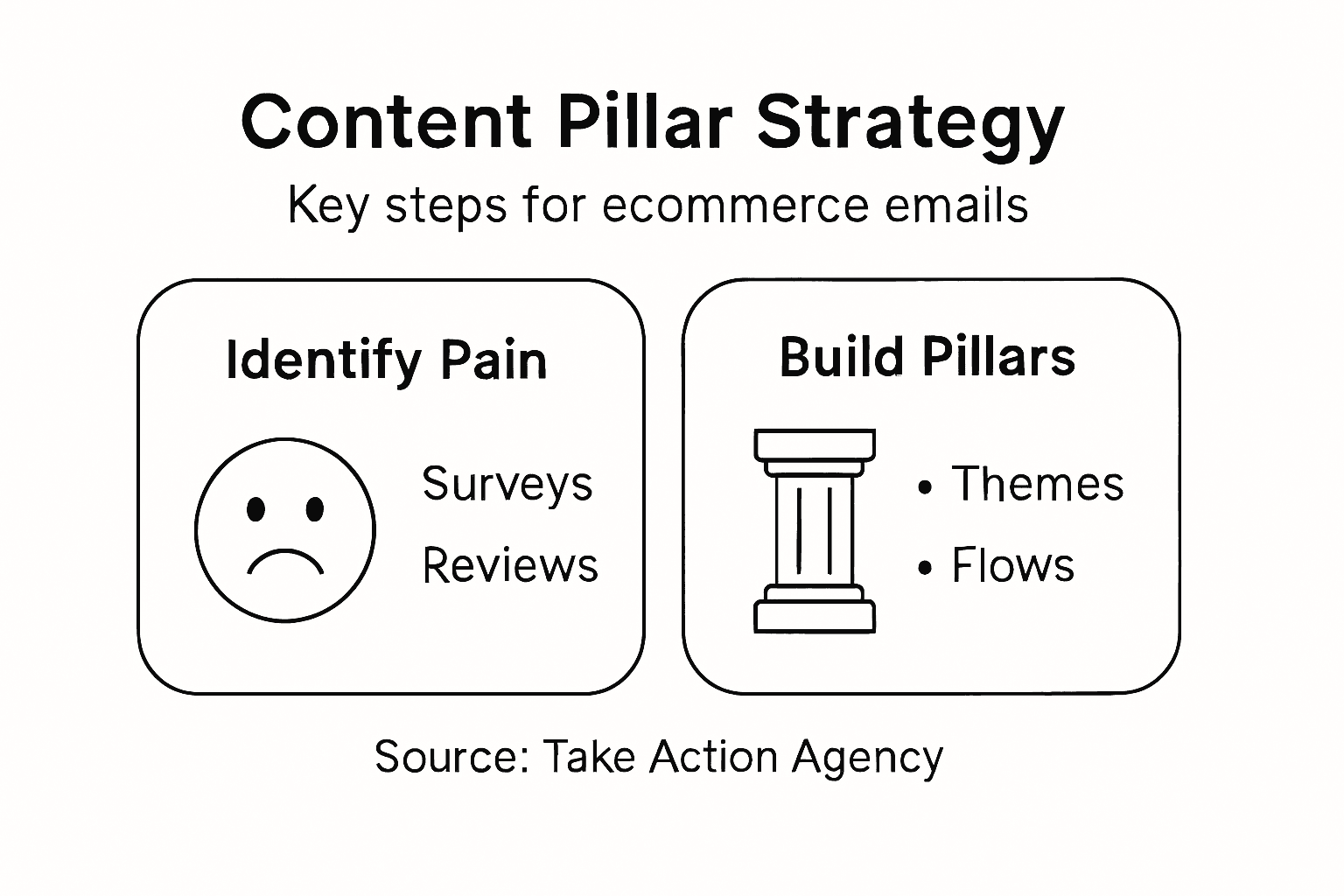
Content pillars organize your email strategy around a few core themes that matter to your customers. Instead of sending random messages, you create a structured approach that builds authority and keeps your brand top-of-mind. This step transforms your pain points into actionable messaging themes.
Start by reviewing the pain points you identified. Each major pain point becomes an opportunity for a content pillar. If customers struggle with product selection, create a pillar around “How to Choose the Right Product.” If shipping costs frustrate them, build a pillar on “Smart Shipping and Delivery Options.” Your pillars should directly address what keeps customers from buying or returning.

Think about what your brand does better than anyone else. Your expertise, unique processes, and company values all deserve their own pillar. Content pillars are strategic thematic areas that form the foundation of your marketing. They reflect your brand’s mission while catering to audience interests.
Aim for 3 to 5 pillars maximum. Too many dilutes your message. Too few limits your content options. Here’s how to structure them:
- Education pillar: Teaches customers how to use products, solve problems, or get maximum value
- Social proof pillar: Shares customer stories, reviews, testimonials, and success examples
- Brand story pillar: Reveals your values, mission, company culture, and what makes you different
- Product pillar: Highlights new releases, features, use cases, and product benefits
- Community pillar: Builds belonging through exclusive offers, member spotlights, or customer events
Your hub and spoke model organizes pillars as central themes with subtopics to build authority. Each pillar gets multiple email campaigns under it. Your “Education” pillar might include emails about sizing guides, care instructions, and styling tips. Your “Brand Story” pillar covers company milestones, team introductions, and behind-the-scenes content.
Write out your pillars clearly. Describe what each pillar covers and why it matters to your customers. This keeps your team aligned when creating campaigns and ensures consistent messaging across your Klaviyo automations.
Your pillars should speak directly to customer pain points while showcasing your unique expertise and values.
Pro tip: Map each pillar to specific Klaviyo email flows so every campaign reinforces your core themes. This consistency builds trust and makes customers more responsive to your messaging over time.
Step 3: Map email flows to pillars
Now you connect your content pillars to actual email sequences in Klaviyo. This alignment ensures every automated email reinforces your core themes and delivers consistent value. Mapping flows to pillars transforms your strategy from theory into action.
Start by listing all your current email flows. Include welcome sequences, abandoned cart emails, post-purchase follow-ups, win-back campaigns, and any other automated series. Next to each flow, write down which content pillar it aligns with. Your welcome series probably serves your “Brand Story” pillar by introducing who you are and what you stand for.
Automated email flows deliver personalized, timely messages triggered by customer behavior. Each trigger point is an opportunity to deliver pillar content. When a customer abandons their cart, that email addresses pain points around shipping, product information, or trust. When they complete a purchase, your post-purchase sequence educates them on product use and care.
Create a mapping document that shows each flow and its pillar assignment:
- Welcome flow maps to “Brand Story” pillar
- Abandoned cart flow maps to “Education” and “Social Proof” pillars
- Post-purchase flow maps to “Education” pillar
- Browse abandonment flow maps to “Product” pillar
- Re-engagement flow maps to “Community” and “Social Proof” pillars
Check for gaps. Are any pillars getting neglected? If your “Community” pillar never appears in automated emails, customers miss out on that messaging. Add new flows or adjust existing ones to cover all pillars across the customer journey.
Mapping email flows to customer journeys tailors automated sequences that address specific customer needs at different stages. This increases relevance and improves conversions. Review your flow timing too. Space out emails so customers receive pillar content naturally, not all at once.
Every flow should strengthen at least one pillar and move customers closer to loyalty.
Pro tip: Use Klaviyo’s segment and conditional split features to deliver different pillar content based on customer behavior. A new customer sees different education emails than a repeat buyer, maximizing relevance at every stage.
Step 4: Optimize messaging with segmentation
Segmentation takes your content pillars and delivers them to the right customers at the right time. Without it, everyone gets the same generic message. With segmentation, each customer receives pillar content tailored to their needs, behavior, and stage in your relationship.
Start by identifying your primary segmentation variables. Customer segmentation uses methods like RFM analysis to understand diverse customer needs and behaviors. RFM stands for Recency, Frequency, and Monetary value. Recent customers, frequent buyers, and high-value customers all deserve different messaging strategies.
Beyond RFM, segment by behavior and characteristics:
Below is a summary comparing the most common segmentation strategies for email campaigns:
| Segmentation Type | Key Benefit | Example Use Case |
|---|---|---|
| RFM Analysis | Optimizes timing & value | High-value buyer upsell |
| Purchase Behavior | Personalizes recommendations | Category-based emails |
| Engagement Level | Targets active/inactive users | Win-back campaigns |
| Location | Localizes offers & messaging | Regional promotions |
- Purchase history: First-time buyers versus repeat customers
- Product category: Customers who buy skincare versus those who buy supplements
- Engagement level: Active openers versus inactive subscribers
- Customer lifecycle stage: New, active, at-risk, and lapsed customers
- Geographic location: Regional customers with different shipping or seasonal needs
In Klaviyo, create segments within each of your flows. Your “Education” pillar content about product care goes to customers who actually purchased that product. Your “Social Proof” pillar content reaches customers showing buying signals. Your “Community” pillar appeals to loyal, repeat buyers most likely to engage.
Enhanced segmentation enables personalized marketing campaigns that optimize content relevance. You can leverage email segmentation strategies to ensure pillar messaging lands with people who care about it most. A customer who abandoned their cart gets different messaging than someone browsing your best sellers.
Test different segment combinations. Does your “Product” pillar content perform better with recent buyers or repeat customers? Track open rates, click rates, and conversion rates by segment to refine your approach continuously.
The more relevant your pillar content feels to each segment, the higher your engagement and conversion rates climb.
Pro tip: Set up dynamic segments in Klaviyo that automatically update based on customer behavior. This ensures your messaging stays relevant as customers move through different lifecycle stages without manual list management.
Step 5: Verify pillar performance and refine
You’ve built your pillars, mapped your flows, and segmented your audience. Now comes the critical work of measuring what actually works. Performance data reveals which pillars drive engagement, conversions, and customer loyalty so you can double down on what matters.
Open Klaviyo and pull reports on each content pillar’s performance. Look at open rates, click rates, conversion rates, and revenue per email for each pillar across your flows. Some pillars will outperform others. Your “Education” pillar might drive higher engagement than your “Community” pillar. That’s valuable information.
Track these metrics by pillar:
- Open rate: What percentage of recipients opened emails from this pillar
- Click-through rate: How many people clicked links in pillar content
- Conversion rate: What percentage converted to a purchase after pillar content
- Revenue generated: Total revenue attributed to this pillar
- Unsubscribe rate: Are people leaving your list because of this pillar
Compare performance across segments too. Does your “Social Proof” pillar convert better with first-time buyers or repeat customers? Does your “Education” pillar engage higher-value segments more effectively? These insights guide where you allocate more resources.
Watch for trends over time. Give each pillar at least 4 to 6 weeks of data before drawing conclusions. Some pillars need time to build momentum and demonstrate their value. Others might reveal immediate problems you need to fix.
Refined pillars perform better than rigid ones. If your “Product” pillar consistently underperforms, test different angles. Instead of just listing features, focus on use cases or seasonal relevance. Adjust email copy, design, timing, and frequency based on data, not assumptions.
Document your findings and share them with your team. What worked? What flopped? Why do you think that happened? This creates institutional knowledge about what your specific audience values.
Data beats assumptions every single time. Let your pillar performance guide strategy decisions, not guesses.
Pro tip: Use Klaviyo’s cohort analysis to compare how different customer segments respond to the same pillar content over time. This reveals whether your messaging needs to shift for different audiences or if one pillar truly resonates universally.
Transform Your Ecommerce Email Strategy with Expert Content Pillar Alignment
Mastering content pillars is essential to conquering the common ecommerce email challenges like low engagement, inconsistent messaging, and missed revenue opportunities. This article uncovers how defining thematic content pillars and mapping them precisely to automated flows can eliminate confusion, boost customer trust, and deliver timely, relevant messages that convert. If navigating segmentation, flow mapping, and pillar performance optimization feels overwhelming, you are not alone. Many ecommerce brands struggle to turn complex email data into scalable growth.
At Take Action, we specialize in empowering ecommerce businesses with Klaviyo automation and data-driven strategies that align perfectly with your content pillar goals. By partnering with us, you will benefit from customized email flow setup including welcome sequences, abandoned cart recovery, and post-purchase education designed to address your customers’ core pain points. Harness our expertise to automate retention, increase open and click rates, and build brand loyalty through segmentation tailored messaging that speaks directly to your audience’s needs.
Ready to stop guessing and start growing with a content pillar strategy that truly converts? Visit Take Action Agency today and discover how our hands-on approach combines human insight with AI-driven optimization. Let us help you map out your Klaviyo flows, refine your messaging, and deliver emails your customers actually want to open and click. Take control of your ecommerce email success now and watch your revenue streams diversify beyond paid ads. Learn more at Take Action and start transforming your email marketing today.
Frequently Asked Questions
How do I identify my customers’ core pain points for email marketing?
To identify core pain points, gather direct feedback from your customers through surveys asking about their frustrations. Analyze patterns in customer support conversations and reviews to pinpoint recurring issues that impact their experience, such as complicated checkout processes or unclear product descriptions.
What are content pillars, and how do I create them for my email campaigns?
Content pillars are central themes that structure your email marketing strategy around key customer pain points. Review your identified issues and create 3 to 5 pillars that directly address these pain points, such as educational content or product highlights, to organize your messaging effectively.
How can I map my email flows to the content pillars I’ve created?
You can map your email flows by assigning each automated sequence to one of your content pillars, ensuring alignment between customer journeys and the themes you want to address. For example, your welcome series might align with your
Recommended
- Blog - Email Marketing Insights | Take Action | Take Action
- How to Repurpose Content for Ecommerce Email Success | Take Action Blog | Take Action
- Digital Media Strategy: Unlocking Ecommerce Growth | Take Action Blog | Take Action
- How to Plan Content for Scalable Ecommerce Growth | Take Action Blog | Take Action
- Luxury Fashion E-Commerce: Real Value and True Access