

Digital Marketing Services: Driving Ecommerce Growth
Scaling an ecommerce brand often means facing a maze of disconnected tools, inconsistent messaging, and scattered data that slows growth. For brands using platforms like Klaviyo, mastering dynamic interconnected systems is now the key to customer retention and revenue expansion. Whether you’re streamlining abandoned cart flows or maximizing post-purchase engagement, the focus shifts to building seamless, data-driven automation that strengthens relationships at every digital touchpoint.
Table of Contents
- Defining Digital Marketing Services Today
- Major Types of Digital Marketing Services
- How Email Marketing Powers Ecommerce Growth
- Key Features of Automated Campaign Strategies
- Common Pitfalls and How to Avoid Them
Key Takeaways
| Point | Details |
|---|---|
| Holistic Approach to Digital Marketing | Modern digital marketing integrates various channels to create a cohesive customer experience, moving beyond isolated campaigns. |
| Importance of Email Marketing | Email remains a high-ROI channel, enabling personalized communication and automation that drives ecommerce growth. |
| Automation is Key | Automated strategies can handle repetitive tasks and data-driven personalization, allowing for scalable engagement without expanding the team. |
| Avoid Common Pitfalls | Focus on targeted segmentation, data analysis, and mobile optimization to improve campaign effectiveness and avoid wasted resources. |
Defining Digital Marketing Services Today
Digital marketing services have shifted dramatically from what they were even five years ago. Today, they’re not just about running ads online or sending emails. They represent a complete reframing of how brands connect with customers across every touchpoint, using integrated technologies that work together seamlessly.
At its core, digital marketing services encompass all the strategies, tools, and tactics you use to reach, engage, and convert customers through digital channels. This includes email marketing, social media management, search engine marketing, content creation, and customer data analysis. But here’s what makes modern digital marketing different: it’s built on dynamic interconnected systems that share data and insights constantly.
For ecommerce brands specifically, this means digital marketing services must work in concert. Your email marketing automation feeds customer data back into your segmentation. Your post-purchase campaigns inform your product recommendations. Your abandoned cart recovery flows influence your retargeting strategy. None of these exist in isolation anymore.
The real value comes from treating digital marketing as a unified ecosystem rather than separate campaigns. When you adopt strategic digital transformation approaches, your entire customer lifecycle becomes more sophisticated. Customers see consistent messaging across channels because the underlying data infrastructure supports it.
This shift matters for your bottom line. Brands using integrated digital marketing services see higher customer lifetime value, better retention rates, and stronger margins. You’re not just acquiring customers anymore—you’re building relationships through strategic, automated touchpoints that respond to actual customer behavior.
The tools enabling this transformation—platforms like Klaviyo, analytics systems, and automation frameworks—allow you to scale personalization without scaling your team proportionally. That’s the real power of modern digital marketing services.
Pro tip: Start by mapping your current customer journey across all digital channels, then identify where data silos prevent seamless communication between systems; closing even one gap typically unlocks 15-20% improvements in engagement metrics.
Major Types of Digital Marketing Services
Digital marketing services break down into distinct categories, each serving a specific purpose in your customer acquisition and retention strategy. Understanding what each type does helps you build a cohesive marketing approach rather than picking random tactics and hoping they stick.
Email Marketing and Automation
Email remains one of the highest-ROI channels for ecommerce brands, and modern email marketing services go far beyond sending promotional blasts. Platforms like Klaviyo allow you to build sophisticated automation sequences that respond to customer behavior in real time. Welcome flows, abandoned cart recovery, post-purchase nurturing, and win-back campaigns work behind the scenes while you focus on growing your business. The data flowing back from these campaigns informs your broader strategy.

Search Engine Marketing
Search engine marketing strategies combine both paid search ads and organic search optimization. Paid search gets your products in front of high-intent customers actively searching for solutions. Organic search builds long-term visibility so customers find you without paying for every click. Together, they capture demand at different stages of the customer journey.
Social Media and Content Marketing
Social platforms let you build community and showcase your brand personality. Content marketing—blogs, videos, guides—establishes authority and provides value beyond just selling. These services work together to attract customers before they’re ready to buy, building familiarity and trust.
Mobile and Affiliate Marketing
Mobile marketing recognizes that most customers browse and purchase on phones. Affiliate marketing leverages partners to promote your products, paying commission only for actual sales. Both expand your reach without heavy upfront investment.
The Integration Factor
The most successful ecommerce brands don’t treat these services as separate silos. Your social content drives traffic to email signup forms. Your email campaigns promote your best content. Your search ads capture customers abandoning carts via email. When your digital media strategy ties these elements together, each channel amplifies the others.
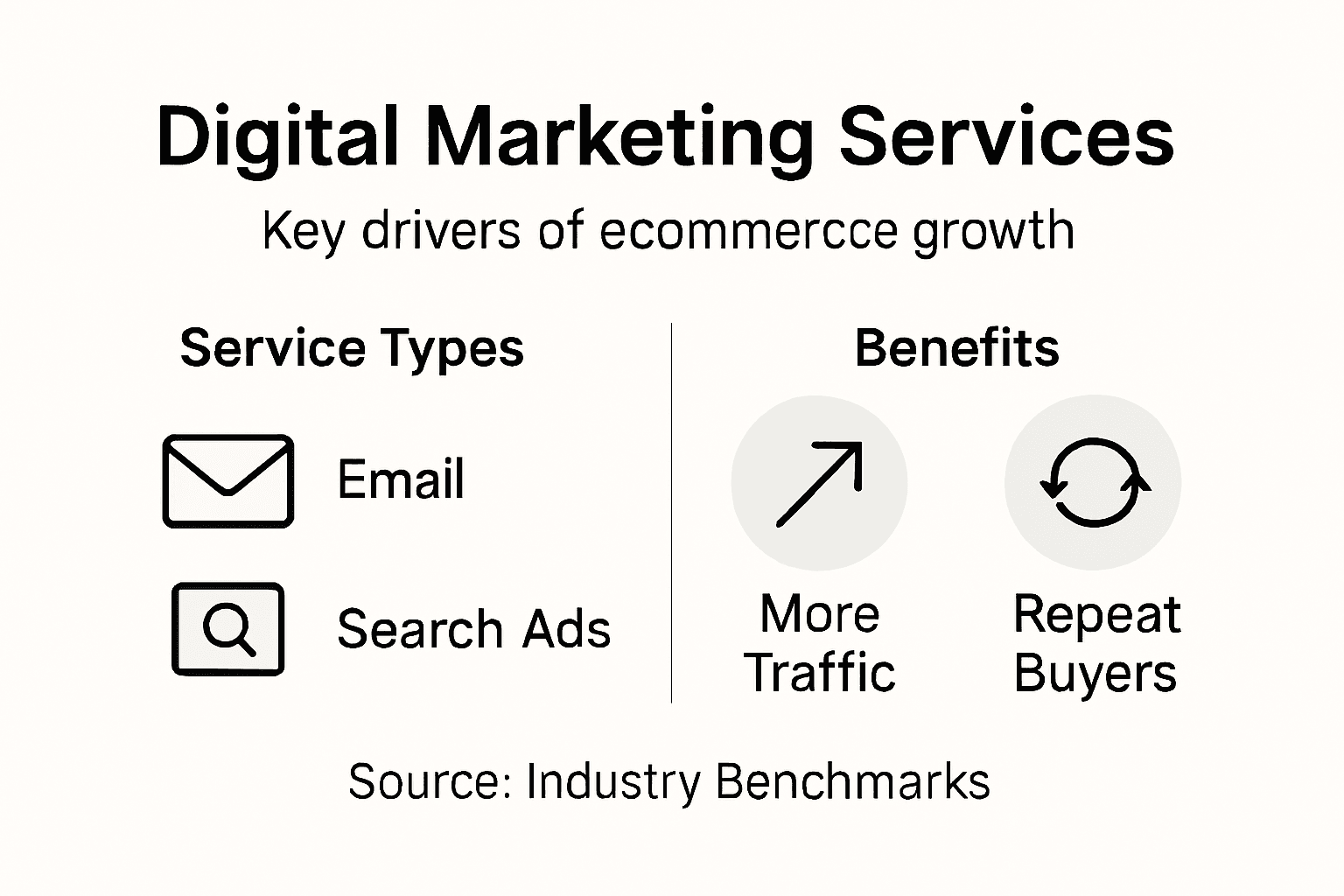
Here’s a comparison of major digital marketing service types and their unique advantages for ecommerce brands:
| Service Type | Main Focus | Key Advantage |
|---|---|---|
| Email Marketing | Direct customer communication | Highest ROI, automation |
| Search Engine Marketing | Paid & organic search visibility | Captures active demand |
| Social Media Marketing | Community & brand awareness | Builds trust and engagement |
| Content Marketing | Authority through valuable info | Attracts pre-purchase leads |
| Mobile Marketing | Reaching users on smartphones | High accessibility and speed |
| Affiliate Marketing | Sales via partner promotion | Low upfront investment |
Pro tip: Start with the two channels that align with your current strengths—perhaps email and organic search—then layer in paid advertising only once you have proven messaging and automation in place.
How Email Marketing Powers Ecommerce Growth
Email marketing stands out as one of the most direct and measurable channels for driving ecommerce revenue. Unlike social media where algorithm changes can tank your reach overnight, email goes straight to customers who already know your brand. You own that relationship. No platform gatekeeping. No feed competition.
The power lies in what email does best: delivering personalized messages to the right person at the exact right moment. When a customer abandons their cart, you can send a recovery email within hours with the exact products they were considering. When someone completes a purchase, you can trigger a post-purchase sequence that encourages repeat buying and builds loyalty. These aren’t guesses. They’re responses to actual behavior.
Segmentation and personalization strategies dramatically improve how email performs. Rather than blasting the same message to your entire list, you send tailored content based on customer behavior, purchase history, and preferences. A first-time buyer gets different messaging than someone in their fifth year with your brand. High-value customers see premium offers. Dormant customers get reactivation campaigns. This level of targeting converts.
Automation multiplies the impact. You build workflows once, then they run continuously for every new customer. Welcome sequences introduce your brand. Abandoned cart flows recover lost sales. Post-purchase campaigns nurture repeat business. These automations work around the clock, nurturing relationships while you sleep.
The numbers back this up. Email generates exceptional ROI compared to other digital channels because the cost is minimal while the potential revenue is substantial. You’re reaching people who actively opted in to hear from you, not interrupting strangers with ads. That consent translates to better engagement and higher conversion rates.
For ecommerce brands, email becomes your most profitable channel when driven by data-informed strategy and segmentation. You track opens, clicks, conversions, and revenue per email. You test subject lines, content, send times, and offers. You optimize continuously based on what your actual customers respond to, not industry guesses.
Pro tip: Start by implementing three core automation workflows (welcome series, abandoned cart, and post-purchase) before worrying about complex segmentation; these three alone typically generate 30-40% of total email revenue for new programs.
Key Features of Automated Campaign Strategies
Automated campaign strategies separate high-performing ecommerce brands from those stuck manually managing campaigns. The right automation handles repetitive tasks, learns from customer behavior, and adjusts messaging in real time. You focus on strategy while the system does the execution work.
Trigger-Based Messaging
Trigger-based automation sends messages based on specific customer actions rather than a calendar date. Someone abandons a cart? An email goes out immediately. A customer completes a purchase? A thank you sequence starts automatically. Someone hasn’t opened an email in 60 days? A reactivation campaign begins. These aren’t batch and blast campaigns. They’re intelligent responses to actual behavior.
Real-Time Data Integration and Segmentation
Multi-channel campaign management powered by real-time analytics allows you to segment audiences with precision. Your automation system tracks purchase history, browsing behavior, engagement patterns, and customer lifecycle stage. It builds dynamic segments that shift as customer behavior changes. This means the right message reaches the right segment automatically, without manual list management.
Personalization at Scale
Automation enables personalization that would be impossible manually. Each customer sees product recommendations based on their purchase history. Email subject lines change based on engagement levels. Send times optimize to when individual customers most likely open emails. High-value customers get premium content and exclusive offers. New customers see educational sequences. One system, infinite variations.
Performance Monitoring and Optimization
Automated systems continuously track performance metrics. Open rates, click rates, conversion rates, revenue per email, unsubscribe rates, all tracked in real time. You see which workflows drive revenue and which need adjustment. Many platforms suggest optimizations automatically or flag underperforming campaigns for your review.
Scalability Without Adding Team
You can grow your customer list from 1,000 to 100,000 subscribers without proportionally expanding your marketing team. The automation handles all the volume. Each new customer flows through the same workflows that worked for your first customers. Your cost per email stays consistent regardless of scale.
Pro tip: Map your current customer journey and identify the five biggest manual tasks your team handles monthly, then prioritize automating those first before building new workflows from scratch.
Common Pitfalls and How to Avoid Them
Even well-intentioned ecommerce brands stumble into predictable mistakes that tank their digital marketing results. The good news? Most of these pitfalls are entirely avoidable once you know what to watch for.
Poor Targeting and Segmentation
Sending the same email to your entire list is like shouting at a crowd instead of having individual conversations. Generic campaigns perform poorly because they don’t speak to anyone specifically. The fix is straightforward: segment your audience and tailor messaging to each group. Your recent purchasers need different content than people who browsed but never bought. New subscribers need onboarding while loyal customers need VIP treatment.
Ignoring Data and Analytics
Many brands set up campaigns then never look at the numbers. They hope things are working rather than knowing they are. Continuous data analysis and customer segmentation reveal what actually drives results. Without this insight, you make decisions based on guesses. Track your open rates, click rates, conversion rates, and revenue per email. These metrics tell you exactly what works and what needs adjustment.
Expecting Overnight Results
Digital marketing is not a sprint. Brands that abandon strategies after two weeks miss the compound growth that builds over months. Email marketing takes time to show full potential as your list grows and customers move through lifecycle stages. Set realistic timelines. Give campaigns at least 30 days before evaluating success.
Neglecting Mobile Optimization
More than half of emails are opened on mobile devices. If your emails look terrible on phones, you lose engagement immediately. Test every campaign on mobile before sending. Use responsive design that adapts to screen size. Keep subject lines short. Make buttons large enough to tap easily.
Underutilizing Your Best Channel
Email gets overlooked while brands chase shiny new platforms. Email marketing fundamentals remain underutilized despite proven effectiveness across industries. Email is where you own the relationship. It converts. It builds loyalty. Brands that master email before layering in other channels outperform those spreading resources too thin.
To help avoid common digital marketing pitfalls, here is a summary of mistakes and recommended solutions:
| Common Mistake | Why It Hurts Results | How to Fix It |
|---|---|---|
| Poor segmentation | Generic, low engagement | Use behavior-based segments |
| Ignoring analytics | Missed optimization | Monitor and analyze metrics |
| Expecting fast results | Early abandonment | Set realistic timelines |
| Skipping mobile optimization | Lost mobile customers | Test and adapt for mobile |
| Overlooking email marketing | Missed sales growth | Prioritize owned channels |
Pro tip: Audit your last 10 campaigns and identify which one had the lowest engagement rate, then reverse-engineer why it underperformed before launching anything new.
Elevate Your Ecommerce Growth with Expert Email Automation
The article highlights a common challenge faced by ecommerce brands: integrating digital marketing channels to create a seamless, automated customer journey that drives sustained growth. If you struggle with fragmented data, manual campaign management, or underperforming email flows like abandoned cart recovery and post-purchase nurturing, you are not alone. The key pain points include ineffective segmentation, missed revenue opportunities, and difficulty scaling personalization efficiently.
At Take Action, we specialize in turning these pain points into growth engines by leveraging Klaviyo-powered automation and data-driven strategies. Our approach transforms your email marketing into a strategic, revenue-driving ecosystem that nurtures customer relationships 24/7 without increasing your team’s workload. With customized automation workflows, precise segmentation, and continuous optimization you can expect measurable improvements in open and click rates, increased customer lifetime value, and consistent sales growth beyond paid ads. Discover the difference our dedicated expertise can make in aligning your email marketing with your brand voice and business goals.
Ready to turn your email channel into your most profitable asset now
Visit Take Action today to explore how our campaign strategy and email automation services give you powerful control over your ecommerce growth. Don’t wait until your competitors outpace you with smarter campaigns. Act now and unlock the full potential of integrated digital marketing services through effective email marketing.
Frequently Asked Questions
What are the key types of digital marketing services?
The key types of digital marketing services include email marketing and automation, search engine marketing, social media and content marketing, mobile marketing, and affiliate marketing. Each type serves a specific purpose in customer acquisition and retention strategies.
How does email marketing contribute to ecommerce growth?
Email marketing drives ecommerce growth by delivering personalized messages directly to customers, thereby enhancing engagement and conversion rates. Automation allows for targeted campaigns based on customer behavior, resulting in higher ROI compared to other channels.
What is the significance of automation in digital marketing strategies?
Automation streamlines repetitive tasks, allowing for personalized messaging at scale. It enables trigger-based messaging, real-time data integration, and dynamic segmentation, facilitating efficient customer engagement without overwhelming your marketing team.
What common mistakes should be avoided in digital marketing?
Common mistakes include poor targeting and segmentation, ignoring data and analytics, expecting overnight results, neglecting mobile optimization, and underutilizing email marketing. Avoiding these pitfalls can lead to more effective marketing campaigns.
Recommended
- Increasing Website Visibility for Ecommerce Growth Success | Take Action Blog | Take Action
- Digital Media Buying Agency Impact on Ecommerce | Take Action Blog | Take Action
- SEO Matters: Complete Guide for Ecommerce Brands | Take Action Blog | Take Action
- 7 Essential Ecommerce Marketing Strategies for Growth | Take Action Blog | Take Action