
Email automation for course creators: engage and retain
TL;DR:
- Automated email flows generate 41% of revenue with only 5.3% of total sends.
- Building and optimizing core sequences like welcome, onboarding, and re-engagement increases engagement and retention.
- Segmentation and personalization significantly improve email performance and student conversion rates.
Most course creators pour energy into one-off newsletters, hoping a single broadcast will move students to action. What they miss is that automated flows generate 41% of email revenue from just 5.3% of total sends. That single stat should reframe how you think about your email strategy. Automated sequences, triggered by real student behavior, consistently outperform manual campaigns on every metric that matters: open rates, click rates, and revenue per recipient. This guide breaks down the core flows, personalization tactics, measurement frameworks, and common pitfalls so you can turn email into your most reliable student engagement engine.
Table of Contents
- Why email automation beats traditional campaigns for course engagement
- The essential email sequences for online courses
- Segmentation and personalization: The multiplier effect in email marketing
- Benchmarks, measurement, and common pitfalls for course email automation
- Going beyond the templates: Real-world lessons on automation for course creators
- Accelerate your course growth with expert email strategy
- Frequently asked questions
Key Takeaways
| Point | Details |
|---|---|
| Automation drives results | Personalized email flows generate higher engagement and up to 50% of revenue for course creators. |
| Core flows matter most | Welcome series, onboarding, celebration, and re-engagement flows are essential for course retention. |
| Segmentation boosts ROI | Tagging and behavioral personalizations make every message relevant to each learner. |
| Benchmarks guide, not dictate | Track your own open rates, clicks, and revenue per recipient to measure real success. |
Why email automation beats traditional campaigns for course engagement
Let’s start with a clear definition. An email campaign is a one-time broadcast you send to a list on a specific date. An email flow (also called an automation) is a sequence of emails triggered automatically by a subscriber’s behavior, like signing up for your course, completing a lesson, or going inactive for two weeks. Klaviyo’s automation basics define flows as behavior-triggered sequences designed to send the right message at the right moment, boosting engagement and retention for course creators.
The performance gap between these two approaches is striking. Flows outperform campaigns with click rates of 5.58% versus 1.69%, nearly three times higher. Open rates for flows sit around 48%, compared to lower averages for standard campaigns. In the education sector specifically, open rates average 35.6% with a 3.0% click rate. Email revenue per subscriber (EPS) runs $1 to $2 per month, and for course businesses, email can account for 20 to 50% of total revenue when flows are fully built out.
| Metric | Campaigns | Flows |
|---|---|---|
| Average open rate | ~25% | ~48% |
| Average click rate | 1.69% | 5.58% |
| Revenue share | Varies | Up to 41% of total |
| Send volume required | High | Low (5.3% of sends) |
“Automated flows deliver a disproportionate share of revenue because they meet students exactly where they are in their journey, not where you assume they are.”
The core mechanics that make automation so effective include:
- Time savings: Flows run 24/7 without manual input once built
- Personalization at scale: Every student receives messages relevant to their specific actions
- Consistent retention: Students who disengage get targeted re-engagement without you noticing manually
- Revenue compounding: Each triggered touchpoint adds to lifetime value without additional ad spend
For improving customer engagement with Klaviyo, the real leverage comes from shifting your effort from writing campaigns to building flows that run in the background.
Pro Tip: Stop measuring success by open rates alone. Track revenue per recipient (RPR) for each flow. A flow with a 30% open rate but high RPR is worth more than one with 50% opens and no conversions.
To learn more about boosting open rates with Klaviyo, the strategy starts before you hit send. List health and segmentation are foundational.
The essential email sequences for online courses
Not all flows are created equal. Some sequences have an outsized impact on conversion and retention for course businesses specifically. Core sequences for course creators include the welcome series, lead nurture, onboarding, milestone celebrations, and re-engagement flows.
Here are the five you need to build first:
- Welcome series: Triggered when someone joins your list or registers for a free resource. Goal: build trust, set expectations, and introduce your teaching style.
- Lead nurture (AIDA): Guides cold leads through awareness, interest, desire, and action toward enrolling. Effective lead nurture sequences move subscribers from curious to committed.
- Onboarding: Triggered at enrollment. Goal: reduce early dropout by helping students start strong and feel supported.
- Milestone celebration: Triggered by lesson completions, quiz passes, or module finishes. Goal: reinforce momentum and emotional investment in the course.
- Re-engagement: Triggered by inactivity (for example, no logins in 14 days). Goal: bring at-risk students back before they churn.
| Flow | Trigger | Content example | Best send time |
|---|---|---|---|
| Welcome | List sign-up | Founder story, free resource | Immediately |
| Lead nurture | Opt-in | Value emails, social proof | Day 1, 3, 7 |
| Onboarding | Purchase/enrollment | Getting started guide | Day 0 to 3 |
| Milestone | Lesson completion | Congratulations, next step | Within 1 hour |
| Re-engagement | 14-day inactivity | Check-in, resource offer | Morning send |
For newsletter ideas for student retention, milestone-based emails consistently outperform generic check-ins because they feel personal even when fully automated.
Course creators who deploy all five flows consistently outperform those relying on manual emails. The difference compounds over time: better onboarding means fewer early dropouts, which means more testimonials, more referrals, and better course completion metrics for your sales page.

Insights from humanized automation insights show that flows work best when they mirror the rhythm of how students actually learn, not just when it is convenient to send.
Pro Tip: Use micro-engagement triggers, not just major milestones. A student completing their first quiz, watching a bonus video, or clicking a resource link are all signals worth responding to with a targeted follow-up email.
Segmentation and personalization: The multiplier effect in email marketing
Building flows is step one. Making them feel personal is what separates a 3% click rate from a 9% one. Segmentation means dividing your list into groups based on shared characteristics or behaviors so you send the most relevant message to each group.
Segmentation by tags and behavioral data are the key mechanics for targeted messaging. Useful tags for course creators include:
- Course purchased: Separate buyers from leads at every step
- Engagement level: Active, at-risk, or churned students need different messages
- Behavior patterns: Recent login, lesson completion percentage, quiz scores
- Milestones reached: Module 1 complete, halfway through, course finished
- Traffic source: Organic, paid, or referral leads often have different expectations
Personalization goes beyond using someone’s first name. Reference the specific course they bought, the module they just finished, or the goal they said they had when they signed up. These details lift open and click rates because they signal that you are paying attention.
A/B testing within your flows is how you move from guessing to knowing. Test one variable at a time: subject line, send time, email length, or call-to-action phrasing. Run each variant for at least two weeks before drawing conclusions.
“Humanized automation balances scale with intimacy via behavioral segmentation and narrative copy—separating overachievers from struggling students and speaking to each with empathy.”
For personalization strategies with Klaviyo, behavioral branching is one of the highest-leverage tactics available. Create separate flow paths for students who complete modules ahead of schedule versus those who fall behind. Each group needs a different tone, pacing, and offer.
Deeper email segmentation strategies show that even simple two-segment splits can increase revenue meaningfully within a single quarter.
Pro Tip: Build a “struggling student” segment triggered by below-average quiz scores or lesson skips. A short, empathetic email offering office hours or a help resource can dramatically improve completion rates and reduce refund requests.
Benchmarks, measurement, and common pitfalls for course email automation
Knowing what good looks like matters. Here are the key benchmarks for course creators using email automation in 2026:
| Metric | Education sector benchmark |
|---|---|
| Open rate | ~35.6% |
| Click rate | ~3.0% |
| Revenue per subscriber (EPS) | $1 to $2 per month |
| Email revenue share | 20% to 50% of total |
| Recommended send frequency | 1 to 2 emails per week |
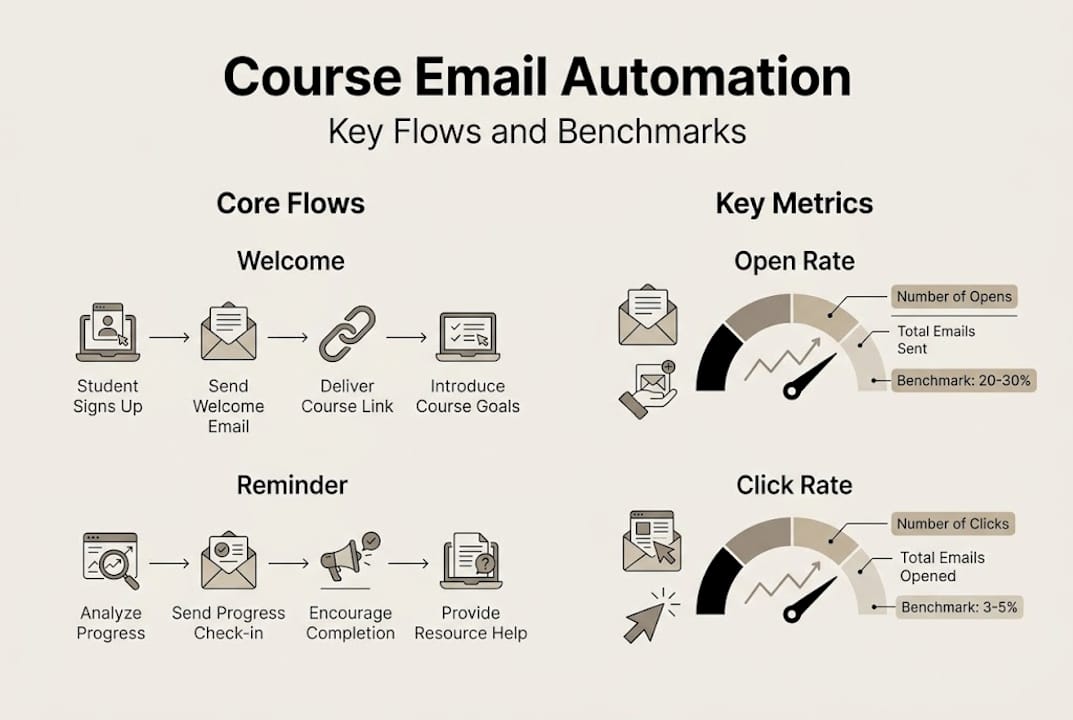
According to Klaviyo’s benchmarks, these figures reflect real averages across the education sector. But treat them as orientation, not targets. Your list is unique. A highly engaged niche audience might see 55% open rates. A broad general audience might sit at 28%. Neither is wrong.
20 to 50% of course revenue can come directly from automated flows when they are properly built and maintained. That is not a marginal contribution. That is a primary channel.
Prioritize your own data over broad benchmarks. RPR (revenue per recipient) tells you more about flow health than open rate alone. A flow that earns $4 per recipient is performing better than one with double the opens but no conversions.
The most common mistakes course creators make with email automation:
- Over-emailing: More than two emails per week without strong segmentation leads to fatigue and unsubscribes
- Ignoring segmentation: Sending the same message to buyers and cold leads wastes both
- Neglecting list hygiene: Unengaged subscribers hurt deliverability for everyone on your list
- Using static sequences forever: Event-triggered flows outperform list-triggered ones, especially for students who buy multiple courses
- Skipping audits: A flow built 18 months ago may no longer reflect your course content or brand voice
The fundamentals of email marketing reinforce that deliverability is not optional. Clean your list every 90 days. Remove or suppress contacts who have not engaged in six months.
For branding through automation, consistency of tone across every flow builds the trust that converts students into repeat buyers and referrers.
Pro Tip: Schedule a quarterly flow audit. Review RPR, click rates, and unsubscribe rates for each active flow. Update content, subject lines, and triggers to match where your course business is today, not where it was when you first built the sequence.
Going beyond the templates: Real-world lessons on automation for course creators
Templates give you a starting point. They do not give you a strategy. Every high-performing course creator we work with eventually reaches a point where their results plateau because they are running the same flows they set up on day one. The flows that worked at 500 students do not automatically scale to 5,000.
Here is the uncomfortable truth: industry benchmarks describe average behavior. Your students are not average. They have specific learning rhythms, content preferences, and engagement patterns that only your data can reveal. Obsessing over whether your open rate matches the 35.6% education sector figure is less valuable than understanding why your Module 3 completion email gets three times the clicks of your Module 1 email.
The course creators who grow fastest treat automation as a living system. They A/B test subject lines monthly. They create new flow branches when they notice a pattern in student behavior. They write emails in a genuine voice, not a template voice. Real empathy cannot be fully automated, but it can be built into the copy and logic of a well-designed flow.
‘Audit flows regularly, A/B test, and use AI personalization, but never lose your authentic voice.’ That principle is what separates retention-focused course businesses from those churning through paid ads to replace students they keep losing.
For practical email marketing tips for boosting results, the biggest gains almost always come from small, consistent improvements rather than one dramatic overhaul.
Accelerate your course growth with expert email strategy
Building flows is learnable. Building flows that consistently convert, retain, and grow your course revenue is where most creators stall. The strategy, segmentation logic, and ongoing optimization require time and expertise that takes years to develop from scratch.
Take Action specializes in setting up, auditing, and scaling email automation for online businesses using Klaviyo. From welcome sequences to advanced behavioral segmentation, the team combines hands-on strategy with conversion-focused copy to build systems that work while you teach. If you are ready to stop guessing and start growing, the email marketing experts at Take Action are the right partner to help you get there. Schedule a free consultation and find out what your email channel is actually capable of.
Frequently asked questions
What is the most important email flow for course creators to start with?
The welcome series is the single most impactful sequence because it sets expectations and nurtures new leads from day one. Starting with this flow gives you the highest immediate return before you build out the rest of your automation stack.
How often should I email my students without overwhelming them?
Aim for one to two emails per week and adjust based on engagement signals to protect deliverability and reduce unsubscribes. Sending more than twice per week without strong segmentation is one of the fastest ways to erode list health.
Should I use industry benchmarks to evaluate my email results?
Use benchmarks as a reference point, but your own list’s data will always be more actionable than sector averages for making real optimization decisions.
How can I personalize emails for hundreds of students automatically?
Use behavioral tags and segmentation in Klaviyo to automatically route students into the right flow based on their actions. Tagging by course progress and engagement level lets you deliver personalized messages at scale without manual effort.
Recommended
- Content Creation in Marketing: Driving Email Engagement | Take Action Blog | Take Action
- Managing Business Growth with Automated Email Retention | Take Action Blog | Take Action
- 7 Innovative Ecommerce Newsletter Ideas for Higher Retention | Take Action Blog | Take Action
- What is online marketing: mastering email automation | Take Action Blog | Take Action
- Email marketing how to: boost engagement and sales in 2026 – Lind Creative
- Email Marketing Automation Tutorial 2025: Step-by-Step Success - Go Online Now