

How to build a personal brand with Klaviyo email marketing
TL;DR:
- Building a personal brand with email requires a compelling story, proper infrastructure, and consistent voice.
- Founder-driven welcome series and personalized automations significantly increase engagement and revenue.
- Long-term success depends on authentic content, regular list hygiene, and advanced segmentation based on customer data.
Most e-commerce brands look identical in the inbox. Same discount codes, same “don’t miss out” subject lines, same forgettable sender names. But a growing group of founders is doing something radically different: they’re putting their story front and center, using Klaviyo to automate that personal connection at scale, and watching their revenue numbers climb well above industry averages. This guide walks you through the exact approach, from setting up the right technical foundation to designing flows that feel handwritten, even when they’re fully automated.
Table of Contents
- What you need to get started with personal brand email marketing
- Designing your first founder-driven Klaviyo flows
- Personalization and advanced segmentation for standout engagement
- Best practices for maintaining engagement and long-term brand equity
- The uncomfortable truth about building a personal brand with email
- Want expert support building your email-driven brand?
- Frequently asked questions
Key Takeaways
| Point | Details |
|---|---|
| Founder-driven emails stand out | Embedding your founder’s story in Klaviyo flows boosts engagement and conversions. |
| Personalization drives results | Using zero- and first-party data in Klaviyo segmentation yields up to 7x higher revenue per recipient. |
| Focus on value, not just promotion | Value-first, educational content maintains engagement and primes your audience for high-impact sales. |
| Automation doesn’t mean losing authenticity | Smart Klaviyo flows let you scale one-to-one connection while staying true to your own voice. |
What you need to get started with personal brand email marketing
Once you understand the need for a personal approach, it’s critical to gather the right assets and infrastructure to effectively launch your brand-driven email strategy.
Before you build a single flow in Klaviyo, you need three things in place: a compelling story, the right technical setup, and a clear sense of your brand voice. Skipping any one of these is like building a storefront with no sign. Customers arrive, look around, and leave without remembering you.
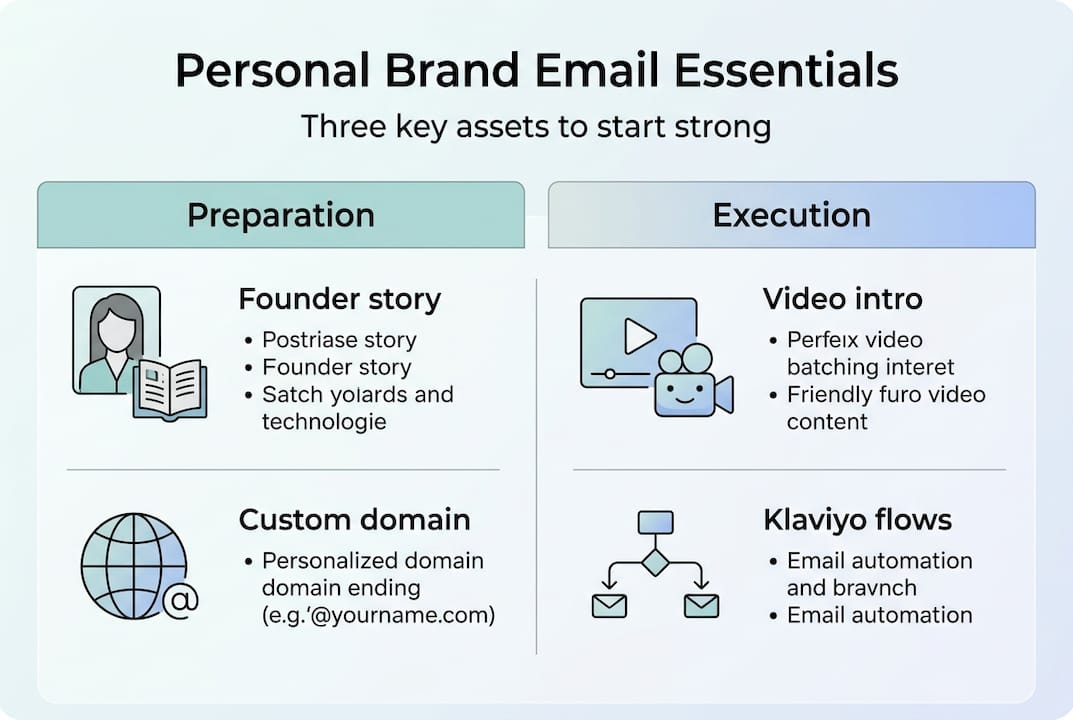
Start with your founder story assets. Your audience doesn’t just want products. They want to know why you built this brand, what problem you were solving, and what you believe in. Concrete assets that work well include a short founder video (even a simple iPhone recording), a written origin story under 300 words, and behind-the-scenes photos of your team, workspace, or production process. These assets become the raw material for your welcome series, your broadcast emails, and your ongoing narrative.
Build your essential Klaviyo infrastructure. Here’s a quick preparation checklist:
- Create and verify a Klaviyo branding essentials setup including custom fonts and brand colors in your email templates
- Connect your e-commerce platform (Shopify, WooCommerce, or BigCommerce) to sync product and behavioral data
- Set up your automations dashboard and confirm your list segmentation is active
- Write a clear brand voice guide: Are you warm and conversational? Bold and direct? Funny but informative?
Set up a custom sending domain immediately. This is non-negotiable. Configuring a custom sending domain in Klaviyo removes the “via klaviyomail.com” tag from your emails, which improves brand credibility, deliverability, and open rates for professional personal branding. When subscribers see your actual domain in the sender field, trust goes up and spam folder rates go down.
Pro Tip: Before your first campaign goes live, send yourself a test email and check every detail: does the sender name read as you, the founder? Does the reply-to address actually work? Small friction points here erode the personal brand impression fast.
| Asset | Why it matters | Priority |
|---|---|---|
| Founder video (60 to 90 seconds) | Drives connection and authenticity | High |
| Brand voice guide | Ensures consistency across flows | High |
| Custom sending domain | Improves deliverability and trust | Critical |
| Behind-the-scenes photos | Creates relatability and warmth | Medium |
| Origin story copy | Powers welcome series narrative | High |
Designing your first founder-driven Klaviyo flows
With your foundation set, you can now create dynamic flows that put your founder’s story front and center, here’s exactly how.
The welcome series is where your personal brand either clicks or disappears. Most brands waste it with a generic “thanks for subscribing” email and a 10% discount. The brands winning right now are using it to build a genuine relationship before they ask for anything.
Build your welcome series in this sequence:
- Email 1 (Day 0): Send immediately after signup. Lead with your founder’s story. Include the short video or a personal photo. Write the email in first person, as if you’re writing directly to a new friend. Skip the discount for now.
- Email 2 (Day 2): Share the problem your brand was built to solve. Use a real example from your own experience. This is the “why this matters” email.
- Email 3 (Day 4): Introduce your best-selling product, but frame it around the story you’ve been telling. Now you can include a soft offer.
- Email 4 (Day 7): Social proof and community. Show real customer results, reviews, or user-generated content. End with a stronger call to action.
- Email 5 (Day 10): Final value-add before transitioning to your regular email cadence. Share a tip, resource, or exclusive insight that only your list gets.
This sequencing works. A real-world example: beauty brand Rae Morris used founder videos and personal stories in their welcome series to humanize the brand and build authentic engagement, achieving a 158% increase in welcome series conversion rate with exclusive video tips from the founder.

The abandoned cart flow should intertwine with, not interrupt, your welcome series. If someone enters the welcome flow and abandons a cart on Day 3, your Klaviyo setup should pause the welcome series and prioritize the cart recovery sequence. Once the cart flow completes (recovered or not), the welcome series resumes. This behavioral logic is what creates a seamless customer journey rather than an overwhelming inbox experience. Leveraging personalized automations that intertwine welcome and abandoned cart flows using behavioral data drove 38% quarter-over-quarter e-commerce revenue growth for Rae Morris.
Explore what well-designed automated Klaviyo workflows look like in practice to see how sequencing decisions affect revenue at scale.
| Metric | Flows | Campaigns |
|---|---|---|
| Revenue per recipient (RPR) | Up to 18x higher | Lower baseline |
| Send volume | 5.3% of total sends | 94.7% of total sends |
| Revenue share | 41% of email revenue | 59% of email revenue |
| Timing | Behavioral triggers | Manual scheduling |
Pro Tip: In Klaviyo, use the “flow filter” feature to suppress active welcome series subscribers from cart abandonment flows unless they’ve been in the welcome series for more than 72 hours. This one setting prevents the overlap problem that kills subscriber trust.
Personalization and advanced segmentation for standout engagement
Once your core flows are in place, the next leap comes from tailoring each message to your audience using advanced segmentation.
Generic personalization, like using a first name in a subject line, stopped moving the needle years ago. What actually drives results in 2026 is segmentation built on behavioral signals and data your customers have actively shared with you.
Understanding your data types:
- Zero-party data: Information customers voluntarily give you, like quiz answers, survey responses, or preference selections. This is gold because it’s accurate and consent-based.
- First-party data: Data collected through your own channels, purchase history, browse behavior, email engagement patterns.
- Third-party data: Data sourced externally. Less reliable, harder to act on, and increasingly restricted by privacy regulations.
Focus your Klaviyo segmentation almost entirely on zero and first-party data. A practical way to collect zero-party data is through a post-purchase survey (embed it in your Klaviyo post-purchase flow) or a preference center where subscribers tell you how often they want to hear from you and which product categories they care about.
The numbers here are striking. Segmented campaigns earn 3x more revenue per recipient than unsegmented ones ($0.19 vs. $0.06). That gap exists because behavioral and zero-party segments reach people when they’re actually ready to engage, not just when it’s convenient for you to send.
Klaviyo’s AI-powered product recommendations take this further. When you enable predictive product suggestions in your flows, you’re matching subscribers to items based on their purchase patterns, not just what’s popular store-wide. The results compound: top 10% personalized campaigns deliver 5x higher order rates and 7x higher revenue per recipient, and AI recommendations push average click rates to 3.75%.
You can also see a fuller breakdown of the benefits of personalization across customer touchpoints to understand how personalization compounds across the full customer journey.
High-performing personalization tactics in Klaviyo:
- Build a “VIP” segment for customers who have purchased three or more times and send them early access or founder-exclusive content
- Create a “browse abandonment” segment for subscribers who viewed specific product categories but didn’t purchase, then send them content that addresses their likely hesitation
- Use Klaviyo’s predictive analytics to identify customers approaching their expected next purchase date, then send a timely, personalized prompt
- Segment by geographic region if your founder’s story has local relevance, regional customers often respond well to “made in” or “based in” messaging
- Read our guide on Klaviyo personalization strategies for deeper tactical breakdowns
The mistake most brands make is over-segmenting without enough subscribers to support it. If a segment has fewer than 500 contacts, you’ll get unreliable data and poor deliverability signals. Build your segments to scale.
Best practices for maintaining engagement and long-term brand equity
After building sophisticated segmentation, focus turns to sustaining engagement and trust over the long term.
Launching strong flows and smart segments is the easy part. Keeping subscribers engaged six, twelve, and eighteen months later is where most brands drop the ball. The inbox is a long game, and the brands that win it treat their email list like a community, not a customer database.
A sustainable email content rhythm looks like this:
- Week 1: Educational or founder-driven tip email. No pitch. Just value.
- Week 2: Product-focused campaign, tied back to the brand’s story or a customer outcome.
- Week 3: Behind-the-scenes or company update. Share what’s new in the business, a challenge you’re working through, or a team milestone.
- Week 4: Promotional or sales-focused email for customers who have shown purchase intent (segmented).
Educational, non-promotional content works harder than most brands expect. Incorporating “tip of the month” emails featuring founder expertise maintained high engagement averaging 42% open rates, reaching up to 76% in some sends, and primed the audience for high-impact sales events that drove 70% revenue growth.
That figure deserves emphasis: 70% revenue growth, largely attributed to building an engaged, educated audience before making the ask.
“The brands that earn the most from email aren’t the ones sending the most promotions. They’re the ones their subscribers actually look forward to hearing from.”
Behind-the-scenes content is underused and highly effective. Founder newsletters sharing company journey updates, investor milestones, and product development stories foster a genuine sense of investment in your brand’s success, particularly powerful for startups and growing e-commerce brands where the founder’s journey is still unfolding.
List hygiene is not optional. Here’s what to do to protect your sender reputation:
- Segment your list every 6 to 12 months and suppress subscribers who haven’t opened in 180 days
- Run a re-engagement flow before suppressing anyone. Give them a clear “stay or go” choice
- Remove hard bounces immediately. Klaviyo does this automatically, but verify your suppression list quarterly
- Monitor your spam complaint rate. If it exceeds 0.1%, investigate your content and sending frequency immediately
Track these key metrics monthly to catch problems before they become crises: open rate (benchmark 35 to 45% for engaged lists), click rate (benchmark 1.5 to 3%), revenue per recipient, unsubscribe rate, and list growth rate. These give you an accurate, real-time picture of your brand equity in the inbox.
For a complete framework on keeping subscribers active and loyal, the email engagement best practices guide breaks down content strategy, frequency, and list management in practical detail.
The uncomfortable truth about building a personal brand with email
Here’s something most marketing advice won’t say directly: automation has a reputation problem it doesn’t deserve. The prevailing assumption is that automated emails are impersonal by definition, and that “real” connection requires manually written, one-off messages. That’s simply not how it works in practice.
The truth is that a well-designed Klaviyo flow, built around a founder’s genuine story and real customer behaviors, can feel more personal than a batch-and-blast newsletter written in ten minutes on a Tuesday morning. The personal nature of email doesn’t come from whether it was scheduled in advance. It comes from whether the message is relevant, honest, and human in tone.
What actually kills authenticity is hiding behind promotions. Brands that email their list only when they have something to sell train their subscribers to disengage. Every promotional blast without a relational deposit in between is a withdrawal from the trust account you’ve been building.
The brands generating real long-term equity through email are the ones willing to share the journey, including the setbacks. A founder email that says “we made a mistake with our last product launch and here’s what we learned” generates more loyalty than any perfectly polished campaign. Vulnerability, used appropriately, is a brand asset.
Careful automation design is how you optimize e-commerce growth without sacrificing the human element. Build your flows to sound like you. Write them when you’re in the right headspace. Then let the system deliver them at the right moment for each subscriber. That’s not impersonal. That’s thoughtful at scale.
Want expert support building your email-driven brand?
Building a recognizable, revenue-generating personal brand through Klaviyo takes more than good intentions. It takes precise flow architecture, smart segmentation, and a content strategy that actually sounds like you, not a template.
At Take Action, we specialize in exactly this. As a dedicated email marketing agency, we’ve helped e-commerce brands set up founder-driven welcome series, abandoned cart flows, and long-term engagement programs that convert. Whether you’re starting from zero or optimizing an existing setup, our team of personal branding experts can build the systems that make your story your strongest sales asset. Reach out for a free strategy consultation and let’s map out what’s possible for your brand.
Frequently asked questions
What is the most effective way to use Klaviyo for personal branding?
Center your founder’s story in your welcome flows and use personalized automations to drive authentic engagement and revenue. Brands that used founder videos in welcome series have seen up to 158% increases in welcome series conversion rates.
How often should I email my list to keep my brand memorable but not annoying?
A rhythm of one to two emails per week, mixing educational and promotional content, keeps engagement high without fatiguing subscribers. Cleaning your list every 6 to 12 months prevents inactive contacts from dragging down your deliverability metrics.
What kind of content gets the highest open and conversion rates in branded emails?
Educational, founder-driven content consistently outperforms promotional emails on open rates. Educational “tip of the month” emails featuring founder expertise have delivered average open rates of 42 to 76% and contributed to 70% revenue growth events.
Should I use flows or campaigns to drive personal brand revenue with Klaviyo?
Flows should be your primary revenue engine. Automated email flows outperform campaigns significantly, generating 41% of revenue from just 5.3% of total sends, with up to 18x higher revenue per recipient than campaign emails.
Recommended
- Master branding with Klaviyo email automation for growth | Take Action Blog | Take Action
- 7 Smart Newsletter Ideas for Brands Using Klaviyo | Take Action Blog | Take Action
- Master Target Audience Research for Higher Email ROI | Take Action Blog | Take Action
- Engage Customers with Klaviyo: Boost Open Rates 40% in 2026 | Take Action Blog | Take Action