

How to Build a Scalable Marketing Budget Plan for Ecommerce
TL;DR:
- Most ecommerce brands overfund acquisition and underinvest in email and retention strategies.
- Allocating 10-15% of the total marketing budget to email/SMS drives significant revenue.
- Prioritizing automated email flows offers scalable, long-term growth compared to paid advertising.
Most ecommerce marketing managers know the frustration: you pour money into paid ads, watch your customer acquisition cost (CAC) climb every quarter, and still struggle to hit growth targets. The problem is rarely the product. It’s the budget allocation. Too many brands default to acquisition-heavy spending while leaving email and retention chronically underfunded, which means they keep paying to win customers they then fail to keep. This guide gives you a practical, data-backed framework for building a marketing budget plan that actually scales, with email at its center and customer lifetime value (CLV) as its north star.
Table of Contents
- Assessing your starting point: Where your budget really goes
- Setting budget goals: Revenue targets, ROI, and must-track metrics
- Prioritizing channels: Why email drives scalable growth
- Step-by-step: Building and allocating your marketing budget
- Why most brands get marketing budget planning wrong—and what actually works
- Unlock retention-led growth with expert email budget planning
- Frequently asked questions
Key Takeaways
| Point | Details |
|---|---|
| Prioritize retention spends | Direct more of your budget to retention and email marketing for sustainable growth. |
| Set data-driven goals | Align marketing spend with proven revenue and ROI benchmarks for your business size. |
| Automate high-impact flows | Invest in Klaviyo-powered automations to maximize email revenue and customer lifetime value. |
| Track and optimize | Continuously measure results by channel and adjust allocations to stay ROI-positive. |
Assessing your starting point: Where your budget really goes
Before reworking your budget, let’s pinpoint exactly where your spend is concentrated versus top-performing peers.
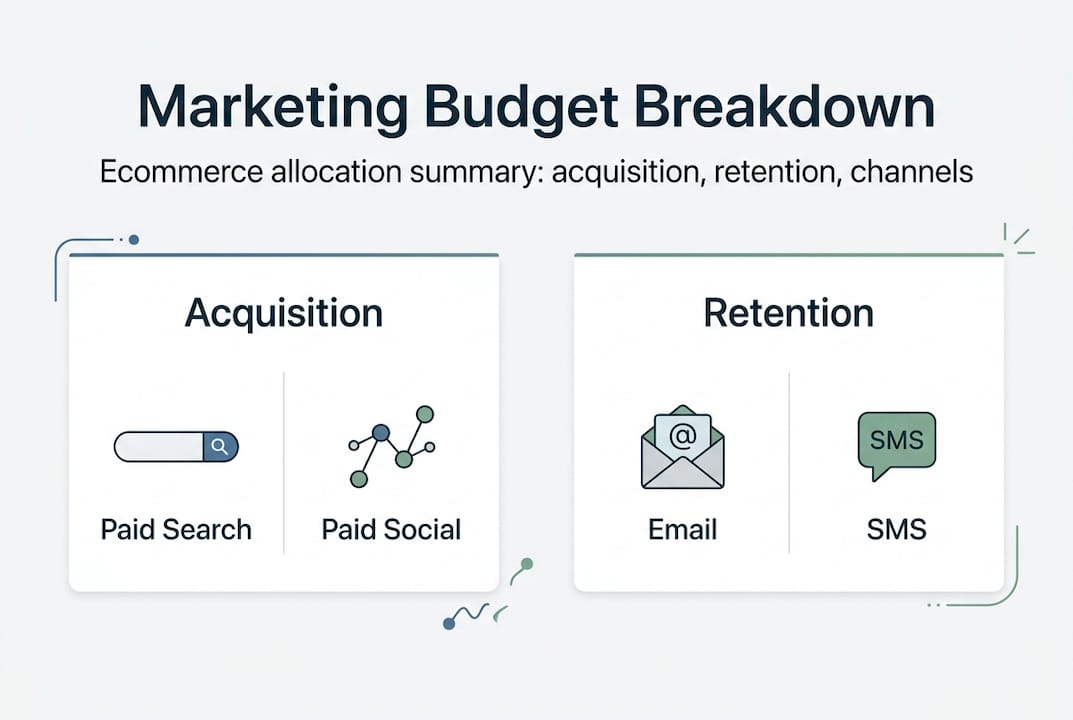
Start by pulling your last 12 months of marketing spend and breaking it into three categories: acquisition (paid search, paid social, influencer, affiliate), retention (email, SMS, loyalty programs, re-engagement), and mixed or equal allocation (content, SEO, brand). Most teams find this exercise uncomfortable because the numbers tell an inconvenient story.
According to ecommerce budget research, brands allocate 55.75% of their total marketing budget to acquisition, 29.87% to retention, and just 14.38% equally across both. The split gets more extreme for smaller brands. SMBs are acquisition-heavy at 58.80%, while mid-market brands have shifted toward retention at 36.36%. That mid-market behavior change is not accidental. It reflects hard-won experience with diminishing returns from paid channels.
| Business segment | Acquisition | Retention | Equal allocation |
|---|---|---|---|
| Overall average | 55.75% | 29.87% | 14.38% |
| SMB | 58.80% | ~28% | ~13% |
| Mid-market | ~45% | 36.36% | ~19% |
Here’s what that data reveals for your planning process:
- Paid channels eat the majority of budgets across all segments, yet their ROI frequently declines as competition increases and ad costs rise.
- Retention is under-indexed relative to its revenue contribution, especially for brands that have been operating for two or more years with an established customer base.
- Mid-market brands have already made the shift. If you’re still running an SMB-style acquisition-heavy budget as your brand grows, you’re likely leaving compounding revenue on the table.
The retention importance in ecommerce case has never been stronger. Returning customers spend more per order, convert at higher rates, and cost a fraction of what it takes to acquire a new shopper. When your budget map doesn’t reflect that reality, every dollar you spend is working harder than it needs to.
Pro Tip: Run this audit quarterly, not just at annual planning time. Channel costs shift fast in paid media, and your allocation should respond to real-time data, not last year’s assumptions.
The overlooked opportunity for most ecommerce teams sits in the middle ground: email and SMS. These channels receive a fraction of budget compared to paid social, yet they consistently outperform on ROI. Identifying that gap in your own spend is the first step toward a smarter plan.
Setting budget goals: Revenue targets, ROI, and must-track metrics
Next, clarify your goals: what does effective, ROI-driven spending actually look like for brands like yours?
Budget planning without clear targets is just guessing. Before you move a single dollar between channels, you need a baseline for what healthy allocation looks like at your revenue tier. Generic advice like “spend what you can afford” doesn’t help you defend decisions to leadership or optimize over time.
Here’s a revenue-tiered framework that gives you a starting point:
| Annual revenue | Total marketing budget | Email and SMS allocation |
|---|---|---|
| Under $500K | 15–25% of revenue | 10–15% of marketing budget |
| $500K to $2M | 12–18% of revenue | 10–15% of marketing budget |
| $2M to $10M | 10–15% of revenue | 10–15% of marketing budget |
| $10M+ | 8–12% of revenue | 10–15% of marketing budget |
These marketing budget benchmarks are consistent across growth stages because email scales differently from paid channels. As your revenue grows, paid channel budgets need to grow proportionally to maintain volume, but email costs stay relatively flat while revenue output compounds.
Once you have a target budget range, you need metrics that tell you whether it’s working. Here are the non-negotiables to track:
- Email and SMS attributed revenue as a percentage of total revenue. A well-optimized program should drive 20–40% of ecommerce revenue, with top-performing brands exceeding 50% once flows and campaigns are fully tuned.
- Flow revenue vs. campaign revenue split. Flows (automated sequences like welcome series, abandoned cart, post-purchase) should generate 40–60% of email revenue. Campaigns handle the rest.
- Email open rate. Healthy benchmark is 30–45%. Below 25% signals deliverability or list quality issues that are quietly draining your ROI.
- Click-through rate (CTR). Target 2–5%. Low CTR despite solid open rates usually points to content or offer misalignment.
- ROI by channel. Break this down monthly. Email ROI should be measurably higher than paid social and often rivals or beats paid search.
- Customer retention rate and repeat purchase rate (RPR). These are the downstream metrics that prove your retention investment is working.
Your ecommerce marketing strategy should connect every budget line item to one of these KPIs. If a spend category can’t be tied to a measurable outcome, question whether it belongs in the plan.
Pro Tip: Set a 90-day review checkpoint when you launch new budget allocations. Email programs take 60–90 days to stabilize as list quality, deliverability, and flow performance settle. Don’t judge results in week two.
Prioritizing channels: Why email drives scalable growth
Armed with goals, the next move is to double down on what’s proven most effective: channels that truly scale with your growth.

Not all channels are created equal. Paid social can spike revenue fast, but it turns off the moment you stop spending. SEO builds slowly. Influencer performance is unpredictable. Email, particularly through a platform like Klaviyo, is different. It compounds. Every subscriber you add, every flow you build, and every segment you refine makes the entire system more effective over time.
The data backs this up decisively. Email marketing ranks first for usage, investment, and ROI across ecommerce segments. Among mid-market brands, 72.73% actively use it as a primary channel. Even among SMBs where acquisition dominates, email consistently lands in the top three for ROI.
What makes Klaviyo flows particularly powerful is their efficiency. Consider this:
“Klaviyo flows generate 41% of email revenue from just 5.3% of total sends, delivering 18x the revenue per recipient (RPR) compared to standard campaigns. Top 10% performers achieve a flow RPR of $7.79.”
That ratio is the case for shifting budget priority toward automation setup and maintenance. You’re generating nearly half your email revenue from a tiny fraction of your sends, all on autopilot. Campaigns matter, but flows are where the leverage lives.
Here’s what a retention-first channel strategy looks like in practice:
- Lead with flows. Welcome series, Klaviyo flows for retention like post-purchase and browse abandonment, and win-back sequences should be fully built and optimized before you scale campaign volume.
- Treat campaigns as amplifiers. Weekly or biweekly campaigns maintain engagement and drive campaign revenue, but they require constant creative investment. Use them strategically around promotions, launches, and seasonal moments.
- Invest in list growth. A healthy email list is the asset that makes everything else work. Mobile-optimized popups and on-site capture tools feed the top of your funnel continuously.
- Segment before you send. Untargeted blasts kill deliverability and suppress engagement. Proper segmentation, particularly RFM (Recency, Frequency, Monetary) segmentation, is what separates brands generating 20% email revenue from those generating 50%.
- Use ecommerce newsletter tactics to keep engaged segments active between purchase cycles, reducing churn without heavy discounting.
The comparison to paid channels is stark. A Facebook ad generates revenue only while the budget runs. A well-built abandoned cart flow generates revenue every single day, for every customer who doesn’t complete a purchase, indefinitely. That’s the compounding dynamic that makes email the highest-leverage line item in your marketing budget.
Step-by-step: Building and allocating your marketing budget
Now let’s put the insights into action with a practical, numbers-driven framework you can use this budget cycle.
Budget planning is not a one-time event. It’s a structured process that should run on a quarterly rhythm with annual anchoring. Here’s how to approach it:
-
Audit current spend and performance. Pull channel-level spend and revenue attribution for the past 90 days. Identify your cost per acquisition across paid channels and compare it to CLV. If CAC is within 60 days of first-order value, your paid channels are underperforming.
-
Set your total budget as a percentage of revenue. Use the tiered benchmarks above. Lock in a number that leadership can defend and that gives you room to test and optimize.
-
Allocate 10–15% of total marketing budget to email and SMS from the start. This is not optional. Email’s ROI makes this the highest-certainty investment in your plan. Budget for platform costs, creative, copywriting, and strategy.
-
Prioritize flow buildout before campaign scaling. The Klaviyo benchmark data is clear: abandoned cart, welcome, and post-purchase flows deliver 18x the RPR of campaigns. Build and optimize these first, because every week they’re not running is revenue you’re not capturing.
-
Incorporate high-intent behavioral triggers. Price-drop alerts and low-inventory notifications are underused flows that drive incremental revenue with minimal creative lift. Set them up as part of your flow infrastructure, not as afterthoughts.
-
Set aside a test budget. Reserve 10–15% of your email and SMS budget for testing: subject line experiments, creative variations, new segment definitions, and emerging tactics like two-step mobile popups that can hit 5%+ conversion rates.
-
Exclude flow recipients from campaign sends. This is a deliverability and experience best practice that most teams skip. Sending campaigns to users already mid-flow creates overlap, inflates unsubscribes, and muddies attribution.
Common mistakes that derail even well-planned budgets:
- Overfunding paid acquisition at the expense of retention infrastructure. Paid drives new customers in. Email keeps them. Without both, you’re filling a leaky bucket.
- Treating email as a cost center rather than a revenue channel. If email isn’t tracked against a revenue target, it gets cut when budgets tighten. Assign it a revenue goal and measure it like any other channel.
- Skipping retention content pillars. One-dimensional discount emails wear out audiences fast. Educational content, product storytelling, and community-building keep subscribers engaged between purchase cycles.
- Ignoring Klaviyo revenue integration with your wider marketing stack. Disconnected tools create attribution gaps that make your email ROI look lower than it actually is.
Pro Tip: Build your budget in a shared spreadsheet with columns for planned spend, actual spend, attributed revenue, and ROI by channel. Review it monthly with your team. Visibility drives accountability, and accountability drives better allocation decisions over time.
Why most brands get marketing budget planning wrong—and what actually works
Stepping back from the tactical steps, here’s our real-world take on why brands struggle to get marketing budget right, and what most guides don’t tell you.
Most budget planning processes are backward. Teams start with what they spent last year, add a percentage increase, and distribute it roughly the same way. Acquisition gets the lion’s share because it’s visible, trackable in real time, and has a clear narrative: spend X, get Y customers. Retention gets whatever’s left over.
The problem is that this habit is rooted in familiarity, not results. Acquisition still dominates at 55% of budgets despite email’s superior ROI, and SMBs are the worst offenders. When economic conditions tighten and CAC spikes, these brands have no retention infrastructure to fall back on. Their revenue is entirely dependent on continued ad spend.
Brands that invest 30% or more in retention, and that automate their core email flows before scaling campaigns, see something different: compounding, increasingly stable revenue that doesn’t disappear when ad costs spike or platform algorithms change. Their CAC becomes less important over time because they’re monetizing existing customers more effectively.
The retention-focused content guide approach isn’t just a tactical shift. It’s a structural one. Email’s compounding returns, where a better list, better segments, and more refined flows all reinforce each other, create a revenue base that grows without proportional spend increases. That’s the kind of scalability that paid channels simply cannot offer.
The uncomfortable truth is that most brands know this. They’ve read the data. They’ve seen the benchmarks. But changing a budget structure requires challenging assumptions that have been baked into planning cycles for years. The brands that make the shift do it deliberately, with a specific revenue target attached to retention, and they don’t look back.
Unlock retention-led growth with expert email budget planning
If you’re serious about compounding retention revenue, expert support can turn insights into real-world results.
Building a high-performance email program takes more than budget. It takes strategy, technical setup, and ongoing optimization that most in-house teams don’t have bandwidth to execute alone. That’s where a dedicated partner makes the difference.
At Take Action, we specialize in helping ecommerce brands transform their marketing budgets into retention-led growth engines using Klaviyo. From auditing your current spend to building and optimizing the flows that drive compounding revenue, our team has the expertise to help you move faster and smarter. Whether you’re setting up your first automated flows or scaling a mature program, we build email strategies that align with your brand, your revenue targets, and your long-term growth goals.
Frequently asked questions
What percentage of my ecommerce marketing budget should go to email marketing?
Aim to allocate 10–15% of your total marketing budget to email and SMS, regardless of your revenue tier, given the channel’s consistent ROI advantage over paid alternatives.
How much revenue should a well-optimized email program generate for my brand?
A well-run email strategy consistently drives 20–40% of total ecommerce revenue, and brands with fully optimized flows and segmentation frequently exceed 50%.
What are the critical metrics for evaluating email marketing ROI?
Monitor email-attributed revenue share alongside open rates of 30–45% and click rates of 2–5% as your core performance benchmarks for evaluating ROI accurately.
Should I invest more in acquisition or retention marketing?
Most brands already overspend on acquisition at 55% of budget, and the evidence shows that shifting investment toward retention, specifically email automation, delivers more stable and scalable long-term revenue growth.