

Improving Email Open Rates: Proven Strategies for Growth
Struggling to turn email contacts into real connections can be frustrating for any Ecommerce manager using Klaviyo. Busy inboxes, outdated lists, and generic messaging often sabotage engagement, leaving open rates and customer loyalty below expectations. By focusing on systematic email list auditing and using advanced segmentation, you will uncover practical techniques proven to drive stronger results and build lasting relationships with your global audience.
Table of Contents
- Step 1: Audit Existing Email List And Data
- Step 2: Segment Audience For Personalized Targeting
- Step 3: Craft Compelling Subject Lines And Preview Text
- Step 4: Schedule And Automate Timing For Maximum Impact
- Step 5: Test And Analyze Open Rate Performance
Quick Summary
| Key Insight | Explanation |
|---|---|
| 1. Regularly Audit Email Lists | Conduct audits to enhance data quality and identify issues affecting engagement rates. |
| 2. Implement Audience Segmentation | Use segmentation to tailor campaigns, improving relevance and engagement among different groups. |
| 3. Craft Compelling Subject Lines | Create enticing subject lines and preview texts to boost email open rates significantly. |
| 4. Optimize Email Timing | Schedule emails for optimal engagement by considering the best days and times for your audience. |
| 5. Analyze Performance Metrics | Regularly test and analyze results to understand audience behavior and improve future email campaigns. |
Step 1: Audit Existing Email List and Data
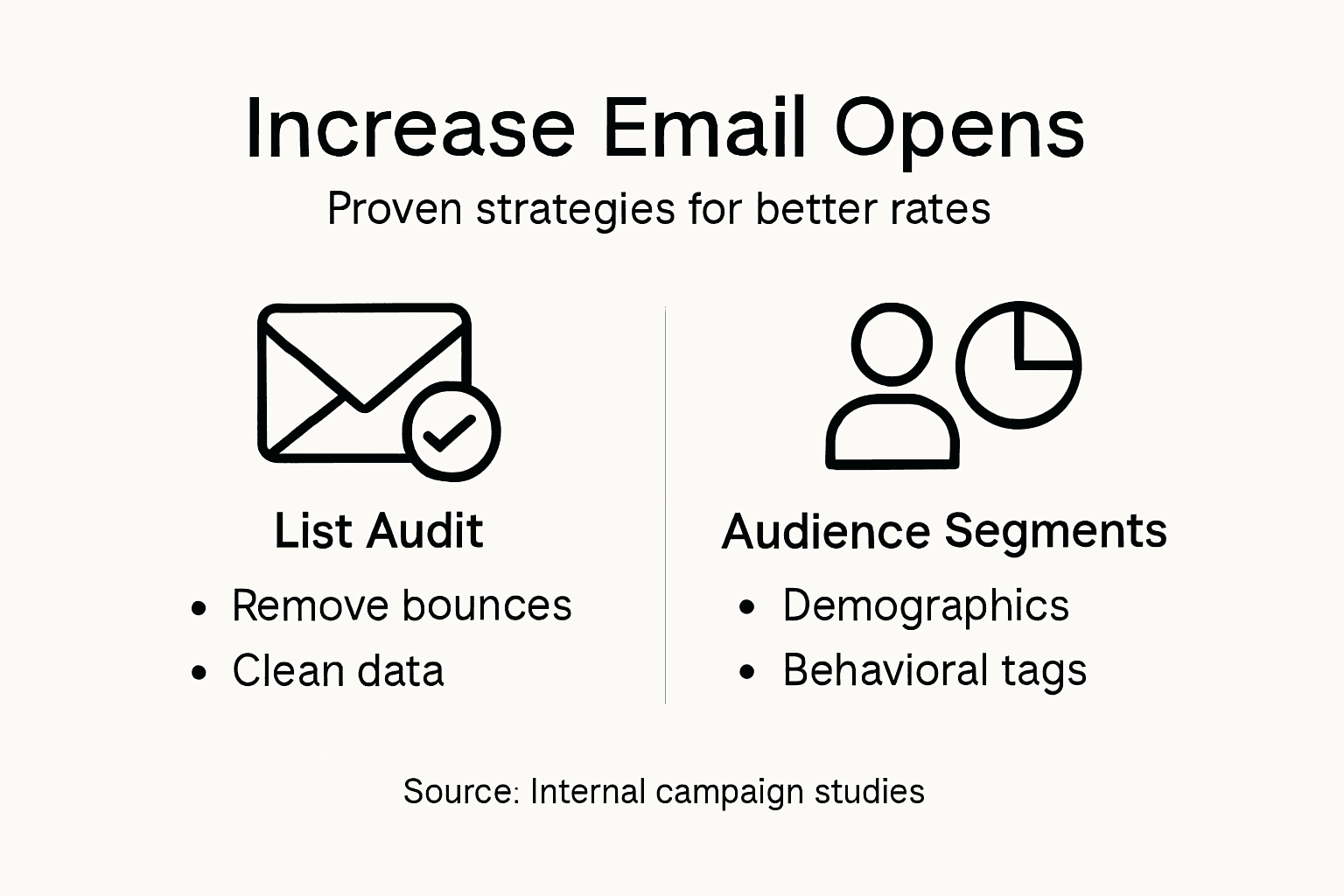
Conducting a thorough email list audit is essential for improving your marketing performance and maintaining data quality. This process helps identify potential issues that could be sabotaging your open rates and overall email engagement.
To begin your audit, focus on several critical aspects of your email database. Comprehensive email marketing analysis requires a systematic approach:
- Review subscriber acquisition methods: Verify how and when contacts were added to your list
- Check email permission status: Confirm each subscriber genuinely opted in
- Analyze engagement metrics: Identify inactive or unresponsive contacts
- Validate email address quality: Remove invalid, bounced, or fake email addresses
- Segment your list: Organize contacts based on engagement levels and characteristics
Start by exporting your entire email list and creating a detailed spreadsheet. Remove duplicates, hard bounces, and email addresses that have consistently shown zero engagement over the past six months. Most email service providers offer tools to help streamline this cleanup process.

Pay special attention to data privacy regulations and ensure your list meets current compliance standards. This might involve documenting consent, storing opt-in dates, and maintaining clear records of subscriber permissions.
Here’s a quick reference comparing key compliance considerations during an email list audit:
| Compliance Requirement | Why It’s Critical | Example Actions |
|---|---|---|
| Documented Consent | Proves legitimate opt-in | Save consent forms and timestamps |
| Opt-In Date Tracking | Aligns with regulations | Store opt-in dates in database |
| Permission Record Keeping | Protects against legal claims | Archive permission history |
| Data Privacy Standards | Avoids penalties | Follow GDPR or CCPA guidelines |
A clean, engaged email list is far more valuable than a large, unresponsive database.
Pro tip: Consider setting up an automated re-engagement campaign to win back inactive subscribers before permanently removing them from your list.
Step 2: Segment Audience for Personalized Targeting
Audience segmentation transforms generic email campaigns into powerful, targeted communication strategies that dramatically improve engagement and conversion rates. Customer segmentation methods enable you to create laser-focused messaging that resonates with specific audience groups.
To effectively segment your audience, consider multiple strategic dimensions:
- Demographic segmentation: Age, gender, location, income level
- Behavioral segmentation: Purchase history, website interactions, engagement frequency
- Psychographic segmentation: Interests, values, lifestyle preferences
- Technographic segmentation: Device usage, technology preferences
- Customer journey stage: New subscribers, active customers, at-risk customers
Start by analyzing your existing customer data to identify meaningful patterns. Use advanced analytics tools to create distinct audience personas that represent different segments. The goal is to develop targeted content that speaks directly to each group’s unique needs and preferences.
Personalization isn’t just about using a customer’s name - it’s about delivering precisely what they want, when they want it.
Prioritize creating dynamic segmentation strategies that can evolve with your audience. This means regularly updating your segments based on new data and changing customer behaviors.
This summary table shows how segmentation methods support personalized marketing goals:
| Segmentation Type | Primary Benefit | Typical Data Used |
|---|---|---|
| Demographic | Tailor content by customer profile | Age, location, gender |
| Behavioral | Target based on actions taken | Purchase frequency, clicks |
| Psychographic | Align with values and interests | Lifestyle, hobbies |
| Technographic | Optimize for tech preferences | Device, operating system |
| Customer Journey | Match messaging to sales funnel | Stage, activity level |
Pro tip: Utilize machine learning algorithms to automatically refine and update your audience segments, ensuring your targeting remains precise and relevant over time.
Step 3: Craft Compelling Subject Lines and Preview Text
Crafting irresistible email subject lines and preview text is a critical skill that can dramatically increase your open rates and engage your audience from the moment they see your email in their inbox. Effective subject line strategies can transform your email marketing performance.
To create powerful subject lines and preview text, focus on these key principles:
- Create urgency: Use time-sensitive language that prompts immediate action
- Personalize content: Incorporate recipient’s name or specific details
- Keep it concise: Aim for 40-50 characters in subject lines
- Ask intriguing questions: Spark curiosity without being clickbaity
- Avoid spam triggers: Steer clear of all-caps and excessive punctuation
Develop a strategic approach to preview text that complements your subject line. This additional snippet should provide just enough context to entice readers without revealing everything. Think of it as a movie trailer for your email content - give them a glimpse that makes them want to know more.
Your subject line is your first and sometimes only chance to capture a reader’s attention.
Consider implementing an A/B testing framework to continuously refine your approach. Track open rates, experiment with different styles, and use data to inform your strategy.
Pro tip: Create a swipe file of subject lines that have caught your attention, analyzing what makes them compelling and adapting those insights to your own email marketing efforts.
Step 4: Schedule and Automate Timing for Maximum Impact
Timing can make or break your email marketing strategy. Optimal email scheduling techniques are critical for ensuring your messages reach subscribers when they are most likely to engage.
To maximize your email impact, consider these strategic timing recommendations:
- Midweek sweet spot: Focus on Tuesday through Thursday for highest open rates
- Morning optimization: Target 10 AM to 2 PM in your subscribers’ local time zones
- Segment-specific scheduling: Customize send times based on audience behavior
- Time zone awareness: Adjust delivery times for international audiences
- Avoid peak competition times: Steer clear of early morning and late evening hours
Implement automated scheduling tools that intelligently distribute emails based on individual recipient behaviors. These advanced systems analyze historical engagement data to determine the most effective delivery times for each subscriber.
Not all times are created equal - the right moment can transform an overlooked email into a conversion opportunity.
Consider developing a dynamic scheduling strategy that continuously learns and adapts to your audience’s evolving preferences. This means regularly analyzing performance metrics and adjusting your automation rules accordingly.
Pro tip: Leverage machine learning algorithms within your email automation platform to dynamically optimize send times, taking the guesswork out of scheduling.
Step 5: Test and Analyze Open Rate Performance
Measuring and interpreting email performance requires a nuanced approach that goes beyond simple open rate metrics. Email performance testing strategies help you understand the true impact of your campaigns in an evolving digital landscape.
To effectively analyze your email performance, implement these comprehensive testing methods:
- A/B testing subject lines: Compare different versions to identify most engaging content
- Segment performance tracking: Analyze open rates across different audience groups
- Multivariate testing: Experiment with multiple elements simultaneously
- Privacy-aware metrics: Use composite engagement indicators
- Longitudinal performance analysis: Track trends over extended periods
Develop a systematic testing framework that captures nuanced insights beyond traditional open rates. With privacy protections like Apple Mail Privacy Protection changing tracking capabilities, focus on holistic engagement metrics that provide deeper understanding of your audience’s interactions.
Open rates are not just numbers - they’re a window into your audience’s interests and behaviors.
Establish a continuous optimization cycle where each test informs your next campaign strategy. This means regularly reviewing performance data, identifying patterns, and making incremental improvements to your email marketing approach.
Pro tip: Create a dedicated spreadsheet to track all testing variables and results, enabling data-driven decision making across your email marketing efforts.
Unlock Higher Email Open Rates With Expert Guidance
If you are feeling frustrated by low open rates despite your best efforts, you are not alone. This article highlights key challenges like audience segmentation, timing, and subject line optimization that often keep brands from reaching their full email marketing potential. At Take Action, we specialize in solving these exact pain points by transforming chaotic email lists into targeted, engaged customer segments and automating personalized campaigns for maximum engagement.
Imagine bringing the power of advanced Klaviyo automations together with human expertise to dramatically boost your open and click rates while aligning every message with your brand’s unique voice. With our data-driven strategies and long-term partnership approach, we help ecommerce businesses automate customer retention, recover abandoned carts, and diversify revenue beyond paid ads.
Take the next step now by exploring how our email marketing campaign strategies can empower your brand.
Ready to stop guessing and start growing? Visit Take Action today to learn how to leverage proven techniques including precise segmentation, smart automation, and compelling content creation that turn your emails into a primary growth channel. Don’t let your emails go unopened any longer. Get in touch with us and experience sustained revenue growth through sophisticated, personalized email marketing solutions.
Frequently Asked Questions
How can I improve my email open rates?
To improve your email open rates, focus on crafting compelling subject lines and preview text that engage your audience. Start by testing different subject lines through A/B testing to see which ones resonate most effectively with your subscribers.
What are the best times to send emails for higher open rates?
The best times to send emails for higher open rates are generally midweek, specifically on Tuesdays through Thursdays, during late morning or early afternoon. Schedule your emails to be delivered around 10 AM to 2 PM in your subscribers’ local time zones to maximize engagement.
How do I segment my audience for better email targeting?
Segment your audience by analyzing demographic, behavioral, and psychographic data to create tailored content for each group. Begin by categorizing your contacts based on their engagement levels and interests to better cater your messaging and improve open rates.
What should I include in my email subject lines?
Your email subject lines should be concise, create urgency, and spark curiosity without using spam-triggering tactics. Aim for 40-50 characters and consider incorporating personalization, such as the recipient’s name, to increase engagement.
How can I keep my email list clean and engaged?
To keep your email list clean and engaged, regularly audit your contacts to remove inactive subscribers and ensure data quality. Set up automated re-engagement campaigns to win back those who haven’t interacted within the last six months before considering unsubscribing them.
What metrics should I track to measure email performance?
To effectively measure email performance, track open rates alongside other metrics such as click-through rates and engagement over time. Establish a systematic testing framework that includes A/B testing to continuously optimize your campaigns and improve overall performance.
Recommended
- Email Campaign Best Practices for 2025 Success | Take Action Blog | Take Action
- Email Frequency Best Practices for Maximum Engagement | Take Action Blog | Take Action
- 7 Proven Ways to Find Inspiration for Email Campaigns | Take Action Blog | Take Action
- Avoid Common Email Marketing Mistakes for Higher ROI | Take Action Blog | Take Action
- How to Network at Events: Build Connections Effectively - DressMeUpNY