

How Klaviyo content marketing agencies boost retention 321%
Ecommerce brands using Klaviyo see over 321% revenue uplift from personalized automation when managed by specialized agencies. Yet many marketers struggle with DIY email campaigns, facing high unsubscribe rates and stale flows. This guide reveals how expert agencies transform Klaviyo into a primary growth engine, unlocking retention strategies that turn email subscribers into loyal customers who buy again and again.
Table of Contents
- Introduction To Content Marketing Agencies Specializing In Klaviyo
- How Klaviyo Automation And Segmentation Drive Retention
- Common Misconceptions And Pitfalls In Diy Klaviyo Management
- Comparison Of Top Klaviyo Content Marketing Agencies In The U.S.
- How To Align Email Content With Brand Voice And Goals
- Measuring Impact And Roi From Agency-Driven Klaviyo Strategies
- Conclusion: Partnering With A Klaviyo Specialist Agency For Sustainable Growth
- Frequently Asked Questions
Key takeaways
| Point | Details |
|---|---|
| Agency expertise drives measurable performance gains | Specialized agencies improve email open rates by up to 30% and click rates by 25% through advanced automation and segmentation. |
| Personalization prevents customer churn | 69% of unsubscribes result from lack of personalization, making expert segmentation crucial for retention success. |
| Email generates exceptional ROI | Top agency-managed campaigns contribute up to 38% of total revenue, with benchmarks showing $45 earned per $1 spent. |
| Strategic alignment protects brand integrity | Agencies balance automated efficiency with brand-consistent messaging to build customer trust and lifetime value. |
Introduction to content marketing agencies specializing in Klaviyo
In 2025, Klaviyo is the preferred email marketing platform for over 167,000 businesses, dominating the ecommerce email landscape. This widespread adoption reflects the platform’s sophisticated automation and segmentation capabilities. However, these powerful features create complexity that overwhelms many in-house teams.
Specialized agencies fill this gap by managing Klaviyo’s advanced features for brands seeking retention-focused growth. They transform email from a broadcast channel into a personalized revenue driver. For U.S. ecommerce brands, this shift matters because acquiring new customers costs five to seven times more than retaining existing ones.
Agencies provide value through several key services:
- Building behavior-triggered automation flows that respond to customer actions in real time
- Creating granular segmentation strategies using zero-party and behavioral data
- Designing campaign calendars aligned with product launches and seasonal trends
- Continuously optimizing flows through A/B testing and performance analysis
- Integrating Klaviyo with ecommerce platforms and customer data systems
The agency landscape has evolved rapidly. Early providers offered basic email setup, but today’s specialists deliver comprehensive retention programs. They combine technical platform mastery with strategic marketing expertise, positioning themselves as growth partners rather than service vendors.
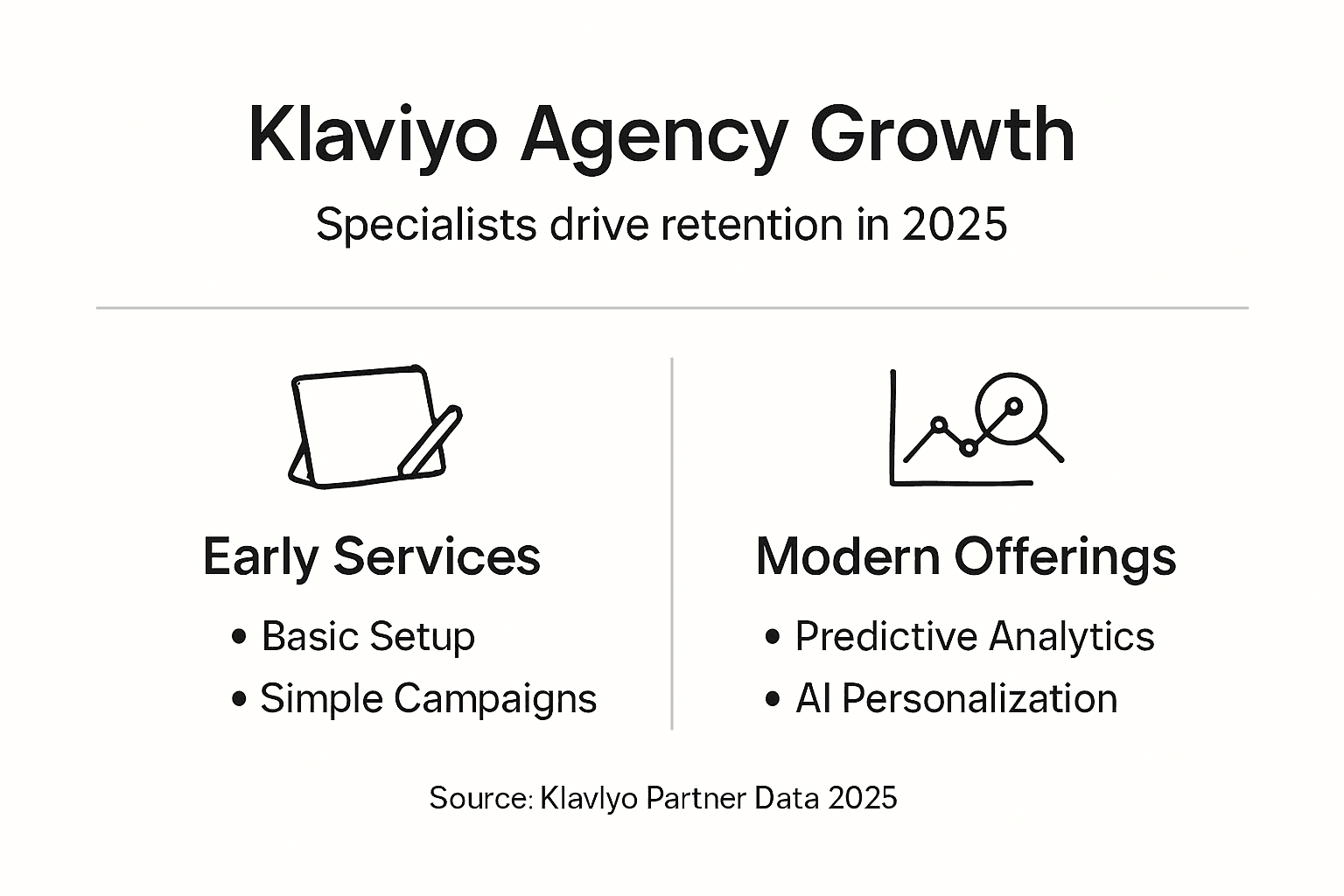
Emerging trends show agencies increasingly focus on predictive analytics and AI-driven personalization. They leverage Klaviyo’s machine learning features to forecast customer lifetime value and identify at-risk subscribers. This proactive approach helps brands intervene before customers churn, strengthening retention rates across entire customer bases.
For marketers evaluating whether to partner with an agency, understanding this ecosystem helps clarify the decision. Content creation agencies driving retention operate differently from traditional marketing firms, prioritizing measurable outcomes over vanity metrics.
How Klaviyo automation and segmentation drive retention
Automation transforms one-time buyers into repeat customers by delivering relevant messages at critical moments. Partnering with a Klaviyo specialized agency improves email open rates by up to 30% and click rates by 25% compared to DIY campaigns. This performance gap stems from sophisticated implementation strategies that most internal teams lack bandwidth to execute.

Dynamic automation responds to customer behavior in real time, creating personalized experiences at scale. When a customer browses specific product categories, automation triggers tailored recommendations. When they abandon a cart, a sequence begins that addresses common objections and incentivizes completion. These flows operate 24/7, nurturing relationships without manual intervention.
Segmentation amplifies automation effectiveness by grouping customers based on behavior, preferences, and purchase history. Email segmentation strategies enable brands to send highly targeted messages that resonate with specific audience subsets. A customer who buys athletic gear receives different content than one purchasing formal wear.
Zero-party data, information customers voluntarily share, powers the most effective segmentation. Preference centers let subscribers choose content frequency and topics. Post-purchase surveys reveal product satisfaction and future interests. Agencies excel at collecting and activating this data within Klaviyo’s segmentation engine.
Implementing retention-focused automation follows a strategic sequence:
- Audit existing customer data to identify behavioral patterns and segment opportunities
- Map the customer journey from first visit through repeat purchase cycles
- Design flow architecture with clear triggers, timing, and exit conditions
- Create message content that aligns with each journey stage and segment
- Launch flows with conservative sending frequency to avoid inbox fatigue
- Monitor performance metrics and iterate based on engagement data
- Expand complexity gradually as foundational flows prove successful
Pro Tip: Start with three core flows (welcome series, abandoned cart, post-purchase) before adding advanced sequences. Perfecting basics delivers better results than launching mediocre complex automation.
Third-party data enrichment enhances segmentation by adding demographic and psychographic dimensions. Agencies integrate data sources that reveal income levels, lifestyle preferences, and purchase propensity. This depth enables hyper-personalized messaging that feels individually crafted.
List segmentation for engagement prevents the spray-and-pray approach that drives unsubscribes. Rather than sending identical emails to entire lists, segmentation ensures each subscriber receives content matched to their interests and stage in the customer lifecycle.
The compound effect of automation and segmentation creates exponential retention improvements. Each optimized touchpoint increases the likelihood of repeat purchase. Over time, these micro-improvements accumulate into substantial lifetime value gains that transform business economics.
Common misconceptions and pitfalls in DIY Klaviyo management
Many ecommerce marketers underestimate Klaviyo’s complexity, launching campaigns that damage rather than build customer relationships. 69% of customers unsubscribe from email lists when personalization is lacking, revealing how generic messaging drives churn. This statistic highlights the cost of DIY approaches that treat email as a broadcast medium.
High unsubscribe rates signal deeper problems than content quality alone. They indicate timing issues, frequency fatigue, and relevance failures. Brands sending daily promotional emails to entire lists watch engagement plummet as subscribers tune out or opt out entirely.
Common mistakes include:
- Launching flows without proper testing, leading to broken links and rendering issues
- Setting aggressive sending cadences that overwhelm subscriber inboxes
- Neglecting mobile optimization despite 60%+ of emails opening on mobile devices
- Ignoring sunset policies that remove chronically unengaged subscribers
- Failing to segment based on engagement levels, treating active and dormant subscribers identically
Static broadcast emails represent another critical mistake. While promotional campaigns have their place, relying exclusively on one-size-fits-all messages misses automation’s power. Behavior-triggered flows outperform broadcasts because they respond to individual actions rather than calendar dates.
Analytics complexity causes many teams to abandon optimization efforts. Klaviyo provides extensive performance data, but interpreting it requires expertise. Marketers often focus on vanity metrics like opens while ignoring revenue attribution and customer lifetime value trends.
Pro Tip: If you’re sending the same email to your entire list more than twice monthly, you’re likely over-broadcasting and under-automating. Shift focus to building targeted flows.
Regular audits prevent automation decay, yet most DIY teams skip this maintenance. Flows built six months ago may reference discontinued products or outdated promotions. Without quarterly reviews, automation becomes stale and ineffective.
“The difference between effective and mediocre Klaviyo implementation isn’t platform features, it’s strategic expertise applied consistently over time.” This principle explains why agencies deliver superior results despite using the same tools available to internal teams.
Segmentation neglect stems from assuming basic demographics suffice. Age and location matter less than behavioral signals like browse abandonment, purchase frequency, and engagement patterns. Common email marketing mistakes often involve demographic over-reliance at the expense of behavioral targeting.
Agencies address these pitfalls through systematic processes. They conduct onboarding audits that identify gaps, implement governance frameworks ensuring consistent quality, and provide ongoing optimization that keeps campaigns fresh. Their value lies not in exclusive platform access but in disciplined execution that internal teams struggle to maintain amid competing priorities.
Comparison of top Klaviyo content marketing agencies in the U.S.
Selecting the right agency partner requires understanding how different providers approach Klaviyo management and retention strategy. The market includes specialists ranging from boutique firms serving emerging brands to enterprise-focused agencies managing complex multi-channel programs.
| Agency Feature | Boutique Specialists | Mid-Market Agencies | Enterprise Providers |
|---|---|---|---|
| Typical client size | $500K-$5M annual revenue | $5M-$50M annual revenue | $50M+ annual revenue |
| Service scope | Core flows and campaigns | Full retention program | Omnichannel integration |
| Monthly retainer | $2,000-$5,000 | $5,000-$15,000 | $15,000+ |
| Specialization depth | Platform execution focus | Strategy plus execution | Enterprise-level customization |
| Onboarding timeline | 2-4 weeks | 4-8 weeks | 8-12+ weeks |
Forge Digital Marketing clients see 38% or more revenue from email and SMS campaigns managed by the agency, demonstrating how specialized expertise translates to bottom-line impact. This benchmark exceeds typical ecommerce averages by substantial margins.
Agency specialization matters more than size. Some providers excel at fashion and apparel brands, understanding seasonal inventory cycles and trend-driven purchasing. Others focus on consumables with subscription models, optimizing replenishment timing and bundle offers. Matching agency expertise to your vertical improves campaign relevance.
Service models vary significantly across providers. Full-service agencies handle strategy, design, copywriting, and analytics. Others focus on technical implementation, expecting clients to provide creative assets. Clarify scope boundaries before engagement to avoid misaligned expectations.
Price transparency remains inconsistent in the agency landscape. Some providers publish clear pricing tiers, while others require discovery calls before quoting. Generally, expect monthly retainers starting at $2,000 for basic flow management, scaling to $15,000+ for comprehensive programs including SMS, customer data platform integration, and advanced analytics.
For small to mid-size brands, boutique specialists often deliver better ROI than enterprise agencies. They provide hands-on attention and faster iteration cycles. Larger brands benefit from enterprise providers’ infrastructure supporting complex tech stacks and multi-regional campaigns.
Retention marketing services comparison frameworks help evaluate agencies systematically. Key criteria include Klaviyo certification status, client portfolio relevance, case study specificity, team structure, and communication cadence.
When vetting agencies, request specific performance metrics from similar clients rather than generic success stories. Ask how they approach segmentation strategy, flow architecture, and ongoing optimization. Strong agencies articulate clear methodologies beyond platform button-pushing.
The best partnerships emerge when agencies function as extensions of internal teams. They understand brand positioning, respect operational constraints, and communicate proactively about opportunities and challenges. Chemistry matters as much as competence in long-term relationships.
How to align email content with brand voice and goals
Email automation risks creating robotic customer experiences when content lacks authentic brand voice. Agencies must balance efficiency with personality, ensuring every automated touchpoint reinforces brand identity. This alignment transforms transactional messages into relationship-building opportunities.
Brand messaging pillars provide the foundation for content alignment. These core themes communicate what the brand stands for beyond product features. An outdoor gear company might emphasize adventure, sustainability, and community. Every email should echo at least one pillar, creating consistency across customer touchpoints.
Templated automation doesn’t mean generic content. Smart agencies customize flow messages to reflect brand tone, whether playful, sophisticated, urgent, or educational. They adapt language patterns, emoji usage, and formatting choices to match how the brand speaks elsewhere.
Consistent brand aesthetics matter as much as copy. Email designs should mirror website styling through color palettes, typography, image treatments, and layout structures. Visual consistency builds recognition and trust, making subscribers immediately identify the sender.
Collaboration strategies ensure alignment:
- Conduct brand workshops capturing voice attributes, forbidden phrases, and approved messaging angles
- Create content style guides specific to email channel requirements
- Establish approval workflows balancing speed with quality control
- Schedule quarterly content audits reviewing flow performance and brand consistency
- Document customer feedback about messaging resonance and adjust accordingly
Pro Tip: Record yourself speaking about your products to a friend. Transcribe it and notice the natural phrases and rhythm. Use this conversational tone in your email content rather than formal marketing speak.
Personalization enhances rather than replaces brand voice. Dynamic content blocks insert relevant products or recommendations while maintaining consistent messaging around them. The personalization engine works within brand guardrails, never sacrificing identity for relevance.
Aligning email content with brand voice requires ongoing attention as brands evolve. What worked two years ago may feel dated today. Agencies monitoring cultural shifts and competitive positioning help brands stay fresh without losing core identity.
Customer trust grows when email experiences match expectations set by other channels. A brand promoting premium quality must deliver premium email design and copy. Discount positioning requires different content approaches. Misalignment creates cognitive dissonance that undermines retention efforts.
Lifetime value correlates with emotional connection strength. Emails reflecting authentic brand personality forge stronger bonds than purely promotional messages. Customers become advocates for brands they genuinely like, not just products they need.
Measuring impact and ROI from agency-driven Klaviyo strategies
Proving agency value requires tracking metrics that directly connect email performance to business outcomes. Vanity metrics like total sends or list size matter less than revenue attribution and customer behavior changes. Smart measurement frameworks reveal which strategies work and where optimization opportunities exist.
Critical success metrics include:
- Open rates indicating subject line effectiveness and sender reputation health
- Click-through rates showing content relevance and call-to-action strength
- Conversion rates from email clicks to completed purchases
- Revenue per recipient measuring campaign profitability
- Customer lifetime value growth tracking long-term relationship development
- Repeat purchase rate revealing retention program effectiveness
Benchmark data provides context for performance evaluation. Well-managed ecommerce email programs typically achieve 35-45% open rates and 3-5% click-through rates. Revenue benchmarks show $42-$45 earned per dollar spent on email marketing, though top performers exceed $50.
| Metric | Industry Average | Agency-Managed Target | Top Performer |
|---|---|---|---|
| Open rate | 18-22% | 35-45% | 50%+ |
| Click-through rate | 1.5-2.5% | 3-5% | 7%+ |
| Revenue per recipient | $0.08-$0.12 | $0.18-$0.25 | $0.35+ |
| Email revenue contribution | 15-20% | 25-35% | 40%+ |
| Repeat purchase rate (90 days) | 20-25% | 35-45% | 55%+ |
Real-time analytics enable agile optimization rather than waiting for monthly reports. Klaviyo dashboards surface performance trends as they emerge. Agencies monitoring these signals daily can pause underperforming campaigns, scale successful ones, and test new approaches continuously.
Revenue attribution shows which flows and campaigns drive actual sales versus engagement alone. Post-purchase flows might generate lower open rates than promotional campaigns but produce higher customer lifetime value. Understanding this nuance prevents optimizing for wrong metrics.
Retention rate improvements justify agency investment by demonstrating reduced churn. Calculate retention as the percentage of customers making repeat purchases within defined timeframes. Improvements of 5-10 percentage points translate to substantial revenue gains given customer acquisition costs.
Email marketing ROI metrics should include qualitative factors alongside quantitative data. Customer feedback, brand perception scores, and competitive positioning provide context that numbers alone miss.
Optimization frameworks guide continuous improvement:
- Weekly review of campaign performance against benchmarks
- Monthly deep dives into segment-level engagement patterns
- Quarterly flow audits assessing relevance and technical functionality
- Annual strategy refresh incorporating market changes and new platform features
Agency value compounds over time as optimizations accumulate. Initial improvements come from fixing obvious issues, but sustained gains require systematic testing and refinement. Long-term partnerships outperform project-based engagements because retention mastery develops through iterative learning.
Conclusion: partnering with a Klaviyo specialist agency for sustainable growth
Transforming email into a primary revenue channel requires expertise most internal teams lack bandwidth to develop. Specialized agencies bring proven frameworks, technical mastery, and dedicated focus that elevate Klaviyo from marketing tool to growth engine.
Long-term success depends on strategic partnerships rather than transactional vendor relationships. Agencies functioning as growth partners invest in understanding your business, customers, and competitive landscape. They proactively recommend strategies aligned with evolving market conditions.
Key partnership criteria include:
- Demonstrated expertise in your industry vertical and business model
- Transparent communication about performance, challenges, and opportunities
- Proactive optimization rather than reactive maintenance
- Clear reporting connecting email metrics to business outcomes
- Cultural fit enabling productive collaboration
Continuous optimization separates good agencies from great ones. Quarterly audits ensure flows remain current as product catalogs change and customer preferences evolve. Testing cadences introduce new approaches while protecting baseline performance.
Diversifying revenue beyond paid advertising reduces business risk and improves unit economics. Email marketing owned media generates compounding returns as lists grow and automation improves. This foundation provides stability when acquisition channels face disruption.
Evaluate potential agencies by requesting case studies showing retention metric improvements over 12+ months. Short-term wins matter less than sustained performance gains. Ask how they approach customer lifecycle management, not just campaign execution.
The decision to partner with a Klaviyo specialist represents an investment in scalable growth infrastructure. Like other business systems, email marketing requires professional management to deliver full potential. Agencies provide that expertise, transforming Klaviyo’s sophisticated platform into measurable business results.
Discover expert Klaviyo email marketing services at Take Action
You’ve learned how specialized agencies transform Klaviyo into a retention powerhouse. Now it’s time to experience these strategies firsthand. Take Action delivers data-driven email marketing that turns subscribers into loyal, repeat customers.
Our team specializes in building sophisticated automation flows, targeted segmentation strategies, and conversion-focused campaigns aligned perfectly with your brand voice. We’ve helped dozens of ecommerce brands increase repeat purchase rates and diversify revenue beyond paid acquisition channels. Every strategy we implement focuses on measurable outcomes, not vanity metrics.
Explore our specialized Klaviyo email marketing services to see how we approach retention differently. Our blog offers deep insights into email segmentation strategies and customer lifetime value optimization that you can start applying today. Ready to transform your email program? Contact Take Action and let’s build your retention growth engine together.
Frequently asked questions
What is a Klaviyo content marketing agency?
A Klaviyo content marketing agency specializes in managing and optimizing email campaigns within the Klaviyo platform to boost ecommerce retention and revenue. These agencies provide expertise in automation design, customer segmentation, personalized messaging, and strategic campaign planning. They function as growth partners focused on turning email into a primary revenue channel.
How do agencies improve Klaviyo email automation?
Agencies design dynamic, behavior-triggered flows that respond to customer actions in real time rather than following static schedules. They regularly audit and refine campaigns based on performance data, ensuring automation remains effective as customer behaviors and product catalogs evolve. This continuous optimization approach consistently outperforms set-it-and-forget-it DIY implementations.
Can I manage Klaviyo myself or do I need an agency?
DIY management is possible for basic email needs, but often leads to high unsubscribe rates and stale campaigns that underperform. Agencies bring specialized expertise, ongoing optimization, and advanced segmentation capabilities that exceed most internal teams’ capacity. The decision depends on your team’s bandwidth, technical expertise, and growth ambitions.
What metrics show ROI from agency-managed email campaigns?
Key ROI indicators include open rates, click-through rates, revenue per email dollar spent, customer lifetime value growth, and repeat purchase rates. Industry benchmarks show well-managed programs achieving 35-45% open rates and $42-$45 revenue per dollar spent. Top-performing agency partnerships deliver 30%+ improvements in these metrics compared to DIY approaches.
How do agencies align email content with my brand voice?
Agencies collaborate closely with clients to understand messaging guidelines, brand pillars, and visual identity standards. They balance automation templates with personalized creative content that reflects your brand’s unique tone and personality. Regular content audits and approval workflows ensure every automated touchpoint reinforces rather than dilutes brand identity.
Recommended
- Content Creation Agencies: Driving Retention Growth | Take Action Blog | Take Action
- Best Retention Marketing Services – Expert Comparison 2025 | Take Action Blog | Take Action
- Content Creation Marketing Agency: Impact for Ecommerce | Take Action Blog | Take Action
- Social Content Strategy: Driving Email Engagement Growth | Take Action Blog | Take Action
- How to Increase Ecommerce Retention 5% for 95% Profit