

Maximize retention and ROI with strategic Klaviyo email blasts
TL;DR:
- Automated flows generate 41% of email revenue with only 5.3% of total sends.
- Segmentation is essential to improve deliverability and increase campaign effectiveness.
- Brands should focus on building strong flows first and use campaigns to support them.
Maximize retention and ROI with strategic Klaviyo email blasts
Most ecommerce teams treat email blasts as their primary revenue lever, scheduling campaign after campaign and measuring success by volume sent. But the data tells a very different story. Automated flows generate 41% of email revenue from just 5.3% of total sends, with a revenue-per-recipient nearly 18 times higher than standard campaigns. That gap is not a minor performance difference. It is a fundamental signal about where your retention strategy should be focused and why understanding the distinction between blasts and flows in Klaviyo is one of the highest-leverage decisions you can make as an ecommerce marketing manager.
Table of Contents
- What is an email blast and how does it work in Klaviyo?
- Why segmentation is essential for effective email blasts
- Campaigns vs. flows: Which drives higher revenue and retention?
- Modern deliverability and compliance: Email blasting in 2026
- What most brands misunderstand about Klaviyo email blasts
- Level up your email results with expert strategy
- Frequently asked questions
Key Takeaways
| Point | Details |
|---|---|
| Strategic segmentation | Segmenting your list is essential to boost engagement, revenue, and sender reputation. |
| Flows drive ROI | Automated flows generate up to 18x more revenue per recipient than one-off blasts. |
| Modern deliverability rules | Sending to engaged subscribers and following authentication protocols protect your inbox placement. |
| Blasts support, not lead | Use segmented campaigns for awareness, but let targeted flows do the heavy lifting for retention and sales. |
What is an email blast and how does it work in Klaviyo?
In Klaviyo’s ecosystem, the term “email blast” refers to a campaign: a one-time send pushed to a defined segment or your full list at a scheduled time. These are mass email campaigns sent to large subscriber groups, and they are fundamentally different from automated flows, which trigger based on individual customer behavior.
The practical difference matters enormously. A campaign is a manual action. You build it, schedule it, and it fires once. A flow runs automatically in the background, responding to what each subscriber actually does, whether that is abandoning a cart, making a first purchase, or going quiet for 90 days. These two tools serve different goals, and conflating them is where most brands leave serious revenue on the table.
Here is how Klaviyo structures each:
- Campaigns (blasts): Manual sends to a static or dynamic segment; ideal for promotions, product launches, and newsletters
- Flows: Behavior-triggered automations; ideal for welcome series, post-purchase sequences, abandoned cart recovery, and win-back campaigns
- Triggers for flows: Actions like site visits, purchases, form submissions, or custom events
- Campaign scheduling: One-time sends or smart send-time optimization using Klaviyo’s AI features
That said, campaigns are not inherently bad. When used strategically, they generate awareness, drive traffic during key sales events, and keep your brand top of mind. A well-timed flash sale campaign sent to a highly engaged segment can perform exceptionally well. The issue is when blasts become the default strategy rather than a deliberate choice within a broader program.
Building smart email segmentation strategies into your campaigns immediately raises their effectiveness. And combining that with techniques that boost open rates in Klaviyo ensures your blasts actually reach and engage the right people.
The key insight: Treat campaigns as a tactical support tool within a larger automated ecosystem. Blasts amplify momentum. Flows build it.
Why segmentation is essential for effective email blasts
Not all blasts are created equal. The foundation of every high-performing campaign is audience segmentation. Sending the same message to every contact on your list is one of the fastest ways to destroy deliverability, trigger spam complaints, and shrink your engaged audience over time.

Klaviyo’s own data is direct: avoid batch-and-blast to your entire list. Segmenting to engaged users prevents spam complaints and low engagement, and using filters and exclusions in flows prevents audience overlap that confuses customers and inflates your unsubscribe rate. The benefits of segmentation go far beyond cleaner lists; they directly drive revenue and protect long-term deliverability.
Here is a breakdown of high-performance segment types and their typical use cases:
| Segment type | Definition | Best use case |
|---|---|---|
| Engaged 30-day | Opened or clicked in last 30 days | Flash sales, time-sensitive offers |
| Engaged 90-day | Opened or clicked in last 90 days | Regular newsletters, product launches |
| RFM high-value | Recent, frequent, high-spend buyers | VIP previews, loyalty rewards |
| Cart abandoners | Added to cart, no purchase in 24h | Targeted recovery campaigns |
| Lapsed customers | No purchase in 90 to 180 days | Re-engagement or win-back sends |
Klaviyo’s best practices recommend sending at least 8 segmented campaigns per month, using 30/60/90-day engagement windows, A/B testing subject lines and send times, and running on a dedicated sending domain. That combination creates a repeatable system for consistent inbox placement and engagement.
Here is what effective segmentation looks like in practice for an ecommerce brand running 2 to 3 campaigns per week:
- Week 1: New arrivals campaign sent to 90-day engaged segment only
- Week 2: Flash sale sent to 30-day engaged segment, excluding recent purchasers
- Week 3: Educational content sent to mid-funnel leads not yet converted
- Ongoing: Exclusions applied to anyone already inside a relevant active flow
Pro Tip: Use Klaviyo’s conditional split feature in flows to branch messaging based on purchase history or predicted lifetime value. This level of personalization in Klaviyo is what separates brands with 20% email revenue from those hitting 40% or more.
Getting your target audience research right before building segments is equally important. When you know your buyers deeply, your segment definitions reflect real behavior patterns, not guesswork.
Campaigns vs. flows: Which drives higher revenue and retention?
With segmentation in place, let’s zoom out: where do blasts fit versus automated flows in a revenue-driven program?
The data from over 183,000 Klaviyo customers is unambiguous. Flows generate 41% of revenue while accounting for only 5.3% of total email volume. Campaigns account for the remaining 94.7% of sends but deliver significantly lower efficiency. Flows average a 5.58% click rate compared to campaigns at 1.69%, and flows produce order rates roughly 13 times higher.
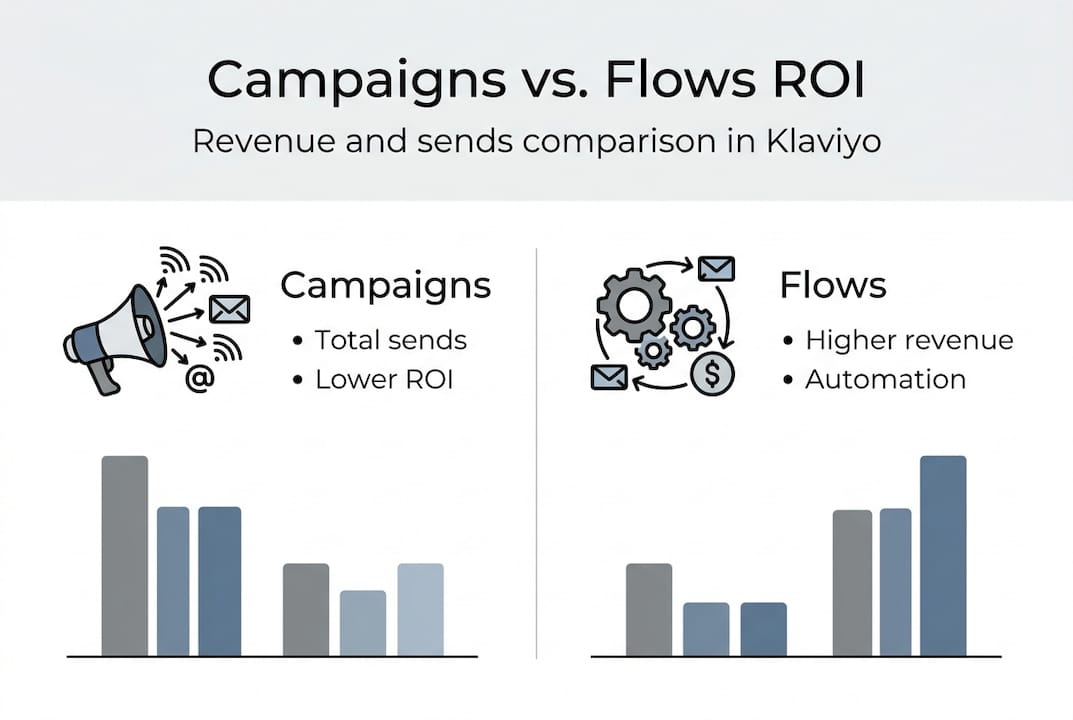
Here is a side-by-side comparison:
| Metric | Campaigns (blasts) | Automated flows |
|---|---|---|
| Share of total sends | 94.7% | 5.3% |
| Share of revenue | ~59% | ~41% |
| Average click rate | 1.69% | 5.58% |
| Revenue per recipient | Baseline | Up to 18x higher |
| Order rate | Baseline | 13x higher |
And the top performers push that even further. Top 10% of Klaviyo flows achieve a revenue per recipient of $7.79 with click rates above 10%. When AI-driven product recommendations are layered in, average click-through rates reach 3.75%, with top brands hitting 8.79%.
This does not mean campaigns are worthless. Here is a practical numbered framework for balancing both:
- Build your flow foundation first. Welcome series, abandoned cart, post-purchase, and win-back flows should be live and optimized before you invest heavily in campaign volume.
- Use campaigns for momentum. Seasonal promotions, new product launches, and brand storytelling are ideal campaign use cases.
- Measure RPR, not just opens. Revenue per recipient is the metric that reveals true performance, not open rates.
- Aim for 40 to 80% of email revenue from flows. Brands consistently hitting this ratio are building scalable, retention-focused programs.
- Suppress and exclude actively. Make sure flow subscribers are excluded from campaigns where the messaging overlaps.
Exploring Klaviyo automation engagement in depth helps you design flows that compound over time. And understanding why segmentation matters at the strategic level ensures you are not just setting up flows, but setting them up in a way that maximizes long-term retention.
The statistic that should change your strategy: If your email program currently generates less than 30% of revenue from automated flows, you have a significant untapped growth lever sitting idle in your Klaviyo account.
Modern deliverability and compliance: Email blasting in 2026
To sustain success, you also need to play by the new rules of deliverability. In 2026, inbox providers are more sophisticated than ever, and the technical requirements for maintaining healthy sender reputation have tightened considerably.
The core deliverability standards every ecommerce email program must meet include:
- SPF, DKIM, and DMARC authentication: All three records must be properly configured on your sending domain. Missing any one of them can cause inbox providers to flag or reject your sends.
- Bounce rate below 2%: Keep bounces under 2% by regularly cleaning your list and removing hard bounces immediately.
- Engagement-based sending: Only send campaigns to subscribers who have opened or clicked in the past 90 days for standard sends, 30 days for sensitive or high-volume sends.
- Double opt-in for risky sources: Any subscribers coming from giveaways, co-registration, or third-party sources should go through double opt-in to confirm intent.
- Sunset flows for inactives: Set up automated sunset flows that suppress or remove subscribers who have not engaged in 6 to 12 months.
Pro Tip: New subscribers should be ramped slowly, receiving just 1 to 2 campaigns per week during their first 30 days. Overwhelming new subscribers before trust is established is a fast path to early unsubscribes and spam reports. For high-volume senders, a dedicated sending IP with a proper warming schedule is non-negotiable.
Ignoring these standards has compounding consequences. A damaged sender reputation can take weeks or months to recover, during which your campaigns land in spam even for your most engaged subscribers. That kind of deliverability collapse can cut email revenue in half overnight.
The benefits of segmentation also connect directly to deliverability. When you send to smaller, more engaged audiences, your engagement signals improve, which tells inbox providers that recipients want your emails. That creates a positive feedback loop that protects and improves your domain reputation over time. Combining that with practical email marketing tips built around modern deliverability standards keeps your program healthy and growing.
Quick deliverability audit checklist:
- Are SPF, DKIM, and DMARC records active on your sending domain?
- Is your bounce rate tracked and kept below 2%?
- Are inactive subscribers being suppressed after 6 months of silence?
- Do your campaign segments exclude anyone currently in an active flow?
- Have you set up a sunset flow to handle long-term inactives?
If you cannot answer yes to all five, your deliverability is a risk to every campaign you send.
What most brands misunderstand about Klaviyo email blasts
Here is the uncomfortable truth we see repeatedly: most ecommerce teams treat campaigns as their primary email growth strategy and flows as a nice extra. The data shows the exact opposite should be true.
Campaigns account for 94.7% of sends but deliver far less revenue efficiency than flows. Yet brands keep scheduling blast after blast, optimizing subject lines and send times, while their flows collect dust or never get properly built in the first place. That is a fundamental misallocation of energy and budget.
The brands winning at email, those generating 70% or more of email revenue from automated flows, are not sending more. They are sending smarter. They have invested in branding automation insights that align every automated touchpoint with brand voice, so flows feel human and relevant, not robotic.
Over-blasting also carries a real cost that most teams underestimate. Every time you send to an unengaged subscriber, you risk damaging your domain reputation, increasing your spam complaint rate, and shrinking the engaged audience you worked hard to build. Sending less to the right people consistently outperforms sending more to everyone.
Our perspective: Blasts should support your automated infrastructure, not lead it. Build your flows first, make them exceptional, and then use campaigns to amplify what is already working. That sequence changes everything.
Level up your email results with expert strategy
Understanding the theory is one thing. Executing a segmented, automated, deliverability-conscious email program in Klaviyo is where most teams hit a wall.
At Take Action, we specialize in building exactly this kind of program for ecommerce brands. From architecting high-converting flows to designing segmented campaign strategies that protect your sender reputation, our team brings the technical depth and creative precision needed to make email your top revenue channel. Whether you need a full Klaviyo buildout or a strategic partner to level up what you already have, our email marketing strategy experts are ready to help. Explore our Klaviyo consulting for ecommerce and see how we turn email into a scalable growth engine for brands just like yours.
Frequently asked questions
What’s the difference between an email blast and an automated flow in Klaviyo?
An email blast is a one-time campaign sent to a large group, while a flow is an automated sequence triggered by customer behavior. The key distinction is that blasts are manual and one-directional, whereas flows respond dynamically to what each subscriber does.
Is it safe to send email blasts to my entire list in 2026?
No, blasting your full list risks serious deliverability damage and rising spam complaints. You should segment to engaged users using 30 to 90-day engagement windows and exclude anyone inactive or inside an active flow.
How often should I send segmented campaigns in Klaviyo for maximum ROI?
Aim for at least 8 segmented campaigns per month, pairing each send with A/B testing and audience-specific personalization for the strongest returns.
How do I avoid damaging deliverability with high-volume sends?
Authenticate your domain with SPF, DKIM, and DMARC, keep bounces below 2%, and use sunset flows to automatically suppress subscribers who have gone inactive.
What is the ideal revenue mix between campaigns and flows?
Top-performing ecommerce brands generate 40 to 80% of revenue from automated flows, not one-off campaigns, making flows the true engine of scalable email retention.
Recommended
- Engage Customers with Klaviyo: Boost Open Rates 40% in 2026 | Take Action Blog | Take Action
- Master Target Audience Research for Higher Email ROI | Take Action Blog | Take Action
- Master branding with Klaviyo email automation for growth | Take Action Blog | Take Action
- How Klaviyo content marketing agencies boost retention 321% | Take Action Blog | Take Action