

Performance Marketing Explained: Key Strategies for Growth
Most businesses waste thousands on marketing without knowing what actually works. Performance marketing changes that by making every dollar accountable, focusing on results like clicks, leads, or sales. This data-driven strategy has helped brands achieve impressive growth because you only pay for real outcomes, not empty promises. Whether you run a small shop or a fast-growing ecommerce business, understanding performance marketing fundamentals can turn guesswork into measurable success.
Table of Contents
- Defining Performance Marketing Fundamentals
- Major Performance Marketing Channels and Models
- Performance Marketing in Ecommerce and DTC Brands
- Tracking, Attribution, and Optimization Tactics
- Common Pitfalls and How to Avoid Them
Key Takeaways
| Point | Details |
|---|---|
| Performance Marketing Defined | Brands pay only for measurable results, moving away from traditional upfront payments towards accountability in marketing spend. |
| DTC and Ecommerce Focus | Successful ecommerce strategies revolve around data-driven targeting and optimizing customer engagement for sustained growth. |
| Tracking and Attribution Importance | Effective marketing hinges on sophisticated tracking of customer journeys to inform strategy and improve conversions. |
| Awareness of Common Pitfalls | Marketers must avoid pitfalls such as vanity metrics and inadequate audience segmentation to maximize ROI and campaign effectiveness. |
Defining Performance Marketing Fundamentals
Performance marketing represents a laser-focused approach to digital advertising where brands pay only for specific, measurable results. Unlike traditional marketing strategies that charge upfront or per impression, performance marketing operates on a direct accountability model where every dollar spent is tracked against concrete outcomes like clicks, conversions, or sales.
According to aiesus, this approach encompasses critical digital channels including search engine optimization, social media marketing, email campaigns, and online advertising. The core philosophy centers on generating quantifiable, data-driven results that directly contribute to business growth.
Key characteristics of performance marketing include:
- Precise Tracking: Measuring exact campaign performance
- Result-Based Compensation: Paying only for achieved outcomes
- Real-Time Analytics: Continuous monitoring and optimization
- Multi-Channel Approach: Leveraging diverse digital platforms
At its core, performance marketing transforms marketing from a cost center into a revenue generation engine. Brands can now systematically evaluate marketing investments, understanding precisely how each campaign contributes to overall business objectives. Learn more about marketing analytics to dive deeper into these strategic insights.
Major Performance Marketing Channels and Models
Performance marketing leverages multiple digital channels to drive measurable results, each with unique strengths and strategic applications. From search engine advertising to affiliate marketing, brands can now select and optimize channels that directly align with their specific business objectives.
According to abacademies, effective marketing channel performance hinges on critical factors like integrated policy, advanced information systems, and sophisticated inter-channel coordination. This research underscores the importance of a holistic, interconnected approach to digital marketing strategies.
Key performance marketing channels include:
- Paid Search Advertising: Google Ads, Bing Ads
- Social Media Advertising: Facebook, Instagram, LinkedIn Ads
- Affiliate Marketing: Performance-based partnerships
- Email Marketing: Targeted campaigns with measurable conversions
- Display Advertising: Programmatic and retargeting networks
- Influencer Marketing: Collaboration with content creators
Discover more about performance marketing strategies to understand how these channels can be strategically integrated for maximum business impact. The future of marketing lies in precision, accountability, and data-driven decision making.

Performance Marketing in Ecommerce and DTC Brands
Direct-to-consumer (DTC) and ecommerce brands have revolutionized performance marketing, transforming how businesses approach digital customer acquisition and retention. These agile, digitally-native companies leverage data-driven strategies to create highly targeted, measurable marketing campaigns that drive immediate, trackable results.
According to Coursera, effective marketing strategies for ecommerce brands require a comprehensive approach that integrates precise targeting, performance tracking, and continuous optimization. The most successful DTC brands view marketing not as an expense, but as a precise investment with quantifiable returns.
Key performance marketing strategies for DTC and ecommerce brands include:
- Hyper-Targeted Advertising: Leveraging detailed customer data for precision targeting
- Conversion Rate Optimization: Continuously improving landing pages and purchase flows
- Retention Marketing: Creating personalized post-purchase engagement
- Predictive Analytics: Using data to anticipate customer behavior
- Multichannel Attribution: Understanding customer journey across platforms
Explore essential ecommerce marketing strategies to unlock the full potential of performance marketing. The future of ecommerce lies in brands that can seamlessly blend data intelligence, customer experience, and agile marketing approaches.
Tracking, Attribution, and Optimization Tactics
Performance marketing demands sophisticated tracking and attribution strategies that transform raw data into actionable insights. Modern marketers must navigate complex digital landscapes, understanding precisely how each marketing touchpoint contributes to customer conversion and revenue generation.
According to Coursera, effective tracking and attribution requires a comprehensive approach that goes beyond simple conversion measurement. Marketers must develop nuanced strategies that map the entire customer journey, identifying which channels and interactions drive meaningful business outcomes.
Key tracking and optimization tactics include:
- Multi-Touch Attribution: Analyzing all customer interaction points
- Conversion Path Analysis: Understanding the sequence of interactions leading to purchase
- Advanced Analytics Tools: Leveraging machine learning for predictive insights
- Real-Time Performance Tracking: Monitoring campaign effectiveness instantly
- A/B Testing: Continuously experimenting with marketing variables
Learn how to increase conversions by implementing these sophisticated tracking and optimization strategies. Success in performance marketing hinges on your ability to transform data into intelligent, adaptive marketing approaches.
Common Pitfalls and How to Avoid Them
Performance marketing is a complex landscape riddled with potential missteps that can quickly derail marketing investments and campaign effectiveness. Successful marketers must develop a keen understanding of these common traps to maintain strategic precision and maximize return on investment.
According to Coursera, strategic marketing requires proactive identification and mitigation of potential challenges. Most performance marketing failures stem from fundamental mistakes in data interpretation, targeting, and campaign design that can be systematically addressed with the right approach.
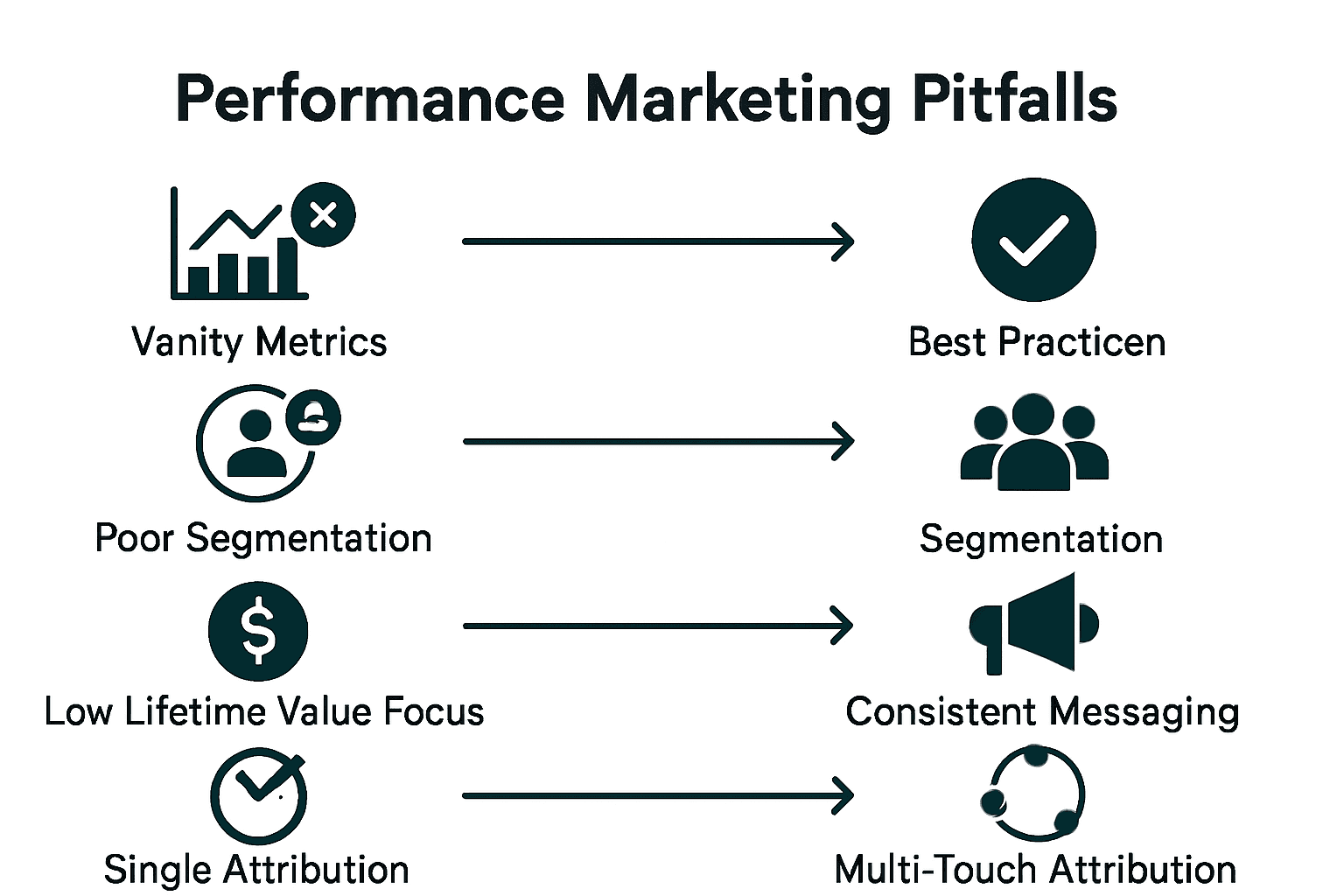
Common performance marketing pitfalls include:
- Vanity Metrics Obsession: Focusing on impressive-looking but irrelevant data points
- Inadequate Audience Segmentation: Treating all customers as a monolithic group
- Neglecting Customer Lifetime Value: Prioritizing short-term conversions over long-term relationships
- Inconsistent Cross-Channel Messaging: Creating disjointed experiences across platforms
- Overreliance on Single Attribution Models: Failing to understand complex conversion paths
Learn how to increase conversions by developing a nuanced, strategic approach that anticipates and neutralizes these potential marketing pitfalls. True performance marketing success demands continuous learning, adaptation, and strategic refinement.
Unlock Measurable Growth with Performance-Driven Email Marketing
Struggling to turn your performance marketing data into real revenue growth is a common challenge for ecommerce and DTC brands. The article highlights the need for precise tracking, multi-channel attribution, and customer retention strategies to avoid common pitfalls like focusing on vanity metrics or neglecting long-term value. If you want to move beyond just clicks and conversions to creating sustained revenue streams, email marketing powered by automation and data insights is the key solution.

At Take Action, we specialize in transforming email into your primary growth channel through Klaviyo automation, segmentation, and strategic campaigns. Our approach helps you recover abandoned carts, increase open and click rates, and build lasting customer relationships that complement your performance marketing efforts. Don’t let your marketing investments fall short of their potential. Visit us now and discover how to implement data-driven email strategies that perfectly align with your brand voice and drive scalable results.
Frequently Asked Questions
What is performance marketing?
Performance marketing is a digital advertising strategy where brands pay only for specific, measurable results like clicks, conversions, or sales, ensuring a direct accountability model for marketing investments.
What are the major channels used in performance marketing?
Key channels in performance marketing include paid search advertising, social media advertising, affiliate marketing, email marketing, display advertising, and influencer marketing, each offering unique strengths for driving measurable results.
How can performance marketing benefit ecommerce and DTC brands?
Performance marketing allows ecommerce and direct-to-consumer brands to utilize data-driven strategies for highly targeted campaigns that generate immediate and trackable results, transforming marketing into a precise investment rather than a mere expense.
What are some common pitfalls to avoid in performance marketing?
Common pitfalls in performance marketing include a focus on vanity metrics, inadequate audience segmentation, neglecting customer lifetime value, inconsistent messaging across channels, and reliance on single attribution models. Addressing these challenges can enhance campaign effectiveness.
Recommended
- What is Performance Marketing? Understanding Its Impact | Take Action Blog | Take Action
- What Is Growth Hacking? Complete Guide for Brands | Take Action Blog | Take Action
- Understanding the Importance of Marketing Analytics | Take Action Blog | Take Action
- 7 Essential Ecommerce Marketing Strategies for Growth | Take Action Blog | Take Action