

Remarketing best practices: boost ecommerce revenue with Klaviyo
TL;DR:
- Flows generate nearly 41% of total email revenue from only 5.3% of sends, highlighting their effectiveness as a high-leverage channel.
- Building, refining, and measuring remarketing flows in Klaviyo, such as welcome, cart, browse, and winback, maximizes lifecycle engagement and revenue growth.
Flows generate nearly 41% of total email revenue from just 5.3% of sends, according to Klaviyo benchmarks. That ratio should stop you in your tracks. If your team is spending most of its energy producing bulk campaigns while your automated flows run on autopilot without regular optimization, you are leaving your highest-leverage revenue channel on the table. This guide walks through every critical step for building, refining, and measuring remarketing flows in Klaviyo so your email program works harder with every trigger it fires.
Table of Contents
- Understanding the foundation of effective email remarketing
- Preparing your Klaviyo account for high-impact flows
- Executing remarketing flows: step-by-step for cart, browse, and winback
- Avoiding common pitfalls and measuring results
- What most marketers overlook about remarketing in Klaviyo
- Accelerate your revenue with expert email remarketing support
- Frequently asked questions
Key Takeaways
| Point | Details |
|---|---|
| Flows drive more revenue | Automated flows, not bulk campaigns, account for the largest share of e-commerce email revenue. |
| Segment and personalize | Target your mailing with exclusions and personalized content for higher retention and compliance. |
| Time remarketing right | Timing and sequence of emails matter for conversions—start cart emails within a few hours and winbacks at the first sign of churn. |
| Track the right metrics | Benchmarks like revenue per recipient and placed order rate offer better insight than opens alone. |
| Orchestrate, don’t blast | Lifecycle orchestration delivers repeat sales by nurturing buyers at every stage, not just with one-off messages. |
Understanding the foundation of effective email remarketing
Remarketing in email is not about blasting your list. It is about reaching the right person at exactly the right moment based on their behavior. In Klaviyo, this happens through triggered flows: automated sequences that fire when a shopper takes a specific action or stops taking one.
The four core flow types every ecommerce brand needs are:
- Welcome flows that engage new subscribers before they drift away
- Abandoned cart flows that recover revenue from high-intent shoppers who left without buying
- Browse abandonment flows that re-engage window shoppers early in the decision cycle
- Winback flows that recapture lapsed customers before they go cold for good
These are not nice-to-haves. They are the backbone of a retention system. And the performance gap between flows and bulk campaigns is stark. Flows outperform campaigns on revenue per recipient because they are sent at moments of peak intent, not at arbitrary send times chosen by a marketer.
Here is a direct comparison of how each approach performs in practice:
| Metric | Bulk campaigns | Triggered flows |
|---|---|---|
| Share of total sends | ~95% | ~5% |
| Share of email revenue | ~59% | ~41% |
| Revenue per recipient | Lower | Significantly higher |
| Personalization level | Low to medium | High (behavior-based) |
| Best use case | Promotions, announcements | Lifecycle, retention |
The numbers make a clear case. Flows deliver an outsized revenue impact relative to send volume because they respond to intent signals rather than calendar dates. If you want to explore more Klaviyo marketing ideas for building out your lifecycle strategy, the goal is always to let behavior drive the trigger, not your campaign calendar.
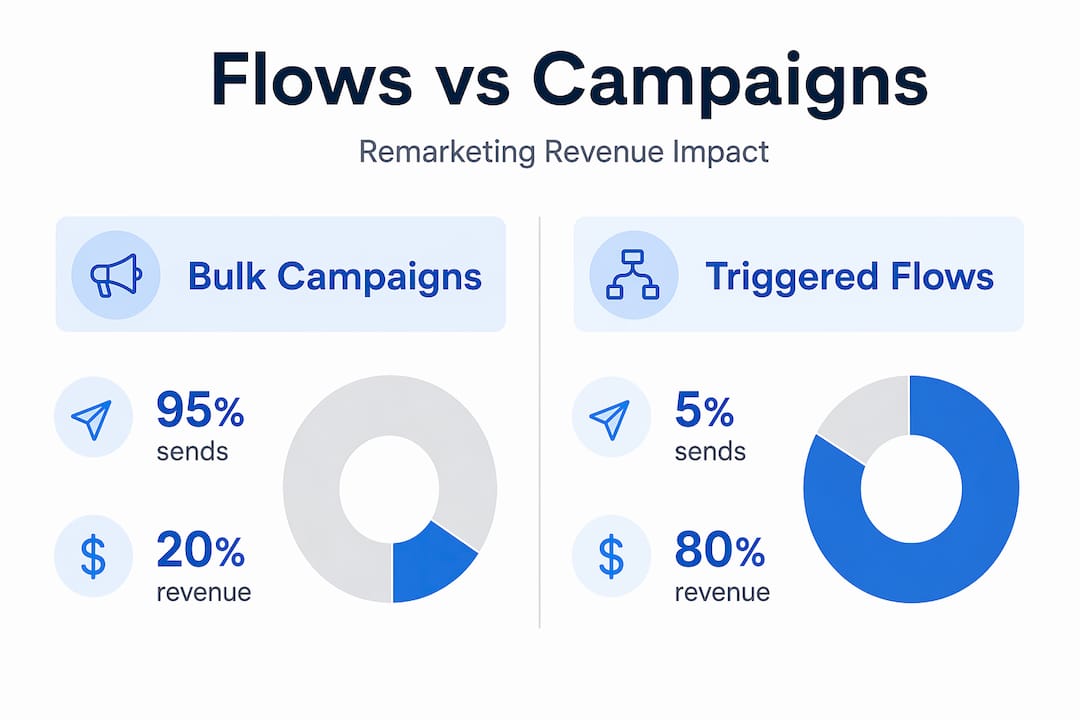
The underlying principle is that lifecycle orchestration beats promotional blasting every time. When welcome, cart, browse, and winback flows run together as a coordinated system, they cover the full customer journey and prevent revenue from slipping through the cracks at every stage. This is how you maximize email revenue over the long term.
Preparing your Klaviyo account for high-impact flows
With the mechanics in focus, preparation sets the stage for every profitable, compliant send. Before you launch a single flow, your account needs to be structured correctly. Skipping this step is one of the most common (and costly) mistakes brands make.
Here is the essential setup sequence:
- Audit your list segments. Identify which subscribers should enter which flows. A first-time visitor who browsed a product is not the same as a returning customer who abandoned a $300 cart. Segment accordingly using Klaviyo’s property filters.
- Lock down your consent management. Only contact subscribers who have explicitly opted in. For SMS flows running alongside email, verify separate consent for each channel. Klaviyo’s double opt-in and list settings make this manageable, but you need to verify it is configured correctly before any flow goes live.
- Set up suppression lists. Unsubscribed contacts, known complainers, and people who purchased during the flow window all need to be suppressed. Order-based exclusions and robust consent checks are non-negotiable for any remarketing flow.
- Configure dynamic content blocks. Your flows should pull in product images, names, and prices directly from your catalog. Test these blocks with real product data before launch to catch rendering issues.
- Test with edge cases. Run test profiles through every entry condition: someone who is already a customer, someone who has unsubscribed, someone with an empty cart. Each one should be handled by the correct suppression or exclusion rule.
The segmentation layer is especially important because it determines who gets what message at what time. Strong list segmentation basics lay the groundwork, but if you are ready to go deeper, advanced email segmentation strategies can sharpen your targeting significantly.
Here is a quick reference for key flow entry conditions and recommended exclusions:
| Flow type | Entry trigger | Key exclusions |
|---|---|---|
| Welcome | Joins list | Already placed order |
| Abandoned cart | Starts checkout, no purchase | Purchased within 24 hrs |
| Browse abandonment | Views product, no purchase | Already in cart flow |
| Winback | No purchase in X days | Active buyer, in other flow |
Pro Tip: Always run a test with a profile that should be excluded before you publish any flow. Klaviyo’s flow analytics will show if a suppression is firing correctly, but a manual edge-case test catches issues that automated checks miss.
Executing remarketing flows: step-by-step for cart, browse, and winback
With setup done, your next move is launching and refining the actual flows for maximum impact. Here is how to build each one correctly.

Abandoned cart flow
The first email should go out 2 to 4 hours post-abandonment while purchase intent is still high. A typical three-email sequence looks like this:
- Email 1 (2 to 4 hours): Simple reminder with dynamic cart contents and a clear CTA. No discount yet. Many shoppers come back without any incentive at this stage.
- Email 2 (24 hours): Add social proof, reviews, or urgency messaging. If cart value is above a threshold (say, $150), this is a reasonable place to introduce free shipping.
- Email 3 (48 to 72 hours): Last chance messaging. For high-value carts or loyalty customers, a targeted discount makes sense here. For low-value carts, skip the discount entirely.
Use conditional splits to branch the sequence by cart value. A $50 cart and a $500 cart should not receive identical treatment. Exclude anyone who purchased between sends using a flow filter checking order activity.
Browse abandonment flow
Browse abandonment flows should personalize to the viewed product, not show a generic offer. A shopper who looked at a specific pair of boots for three minutes does not need a banner showcasing your entire catalog. They need to see that exact product again, with a reason to come back.
A lean two-email sequence works well here:
- Email 1 (1 to 2 hours): Feature the specific product with imagery, benefits, and reviews. Keep it clean and direct.
- Email 2 (24 hours): Show related products alongside the original view in case the first option was not quite right.
Do not overload browse flows with too many touches. These subscribers are early in their decision cycle, and being too aggressive drives unsubscribes.
Winback flow
Winback timing should match actual repurchase cycles and include filters to eject recent purchasers automatically. If your average repurchase interval is 45 days, your at-risk window might start at 60 days. Use Klaviyo’s predictive analytics to identify each customer’s expected next order date.
A winback sequence typically runs three emails over two to four weeks:
- Email 1: “We miss you” with a curated product selection based on past purchases.
- Email 2: Highlight what is new or different since they last bought.
- Email 3: A direct incentive for lapsed high-value customers only.
The most important rule in any remarketing flow is this: if a customer buys during the sequence, they exit immediately. Every email after a purchase is a missed opportunity and an annoyance.
Pro Tip: Use conditional splits to identify churn-risk customers (e.g., no purchase in 90 days after two previous orders) and route them into a more aggressive winback branch. Pair this with Klaviyo personalization strategies to make the messaging feel tailored, not automated. For a broader look at how to boost ROI with Klaviyo, these flow mechanics are always the starting point. More ecommerce email marketing tips can help you round out your overall strategy across every touchpoint.
Avoiding common pitfalls and measuring results
With comprehensive flows in place, the final step is ongoing optimization: avoiding pitfalls and measuring what matters.
The most common mistakes that drain revenue and damage list health are:
- Failing to suppress recent purchasers. Sending a discount email to someone who just bought at full price is a guaranteed way to train your audience to wait for offers.
- Off-topic content in flow emails. An abandoned cart email that detours into a brand story blog post loses the thread. Every email in a remarketing flow should have one job.
- Misaligned timing. Sending a winback email two weeks after last purchase when your repurchase cycle is 60 days creates unnecessary urgency that feels tone deaf.
- Blanket discounting. If you discount every cart abandonment, you condition shoppers to abandon on purpose. Reserve incentives for high-value or high-churn-risk scenarios.
Suppressions and exclusions are minimum requirements, and failing them harms both revenue and customer trust in measurable ways.
For measurement, move beyond open rates. Flow-specific metrics like revenue per recipient and placed order rate deliver far more useful insight into whether your flows are actually converting. Here is a benchmark reference table:
| Flow type | Healthy placed order rate | Revenue per recipient target |
|---|---|---|
| Abandoned cart | 5% to 10% | $3 to $8+ |
| Browse abandonment | 1% to 3% | $0.50 to $2 |
| Winback | 2% to 5% | $1 to $4 |
| Welcome | 2% to 4% | $1 to $3 |
Review these numbers monthly. If a flow is underperforming on placed order rate, check your suppression logic first, then your timing, then your offer. The fix is usually simpler than it looks. For deeper guidance on interpreting performance data, Klaviyo email automation tips can point you toward the right adjustments.
What most marketers overlook about remarketing in Klaviyo
Here is the uncomfortable truth most email guides skip: open rates and deliverability are table stakes. They are the floor, not the ceiling. We see brands celebrate a 45% open rate on an abandoned cart email while their placed order rate sits at 1.2%, which means the flow sounds good on paper but is not doing its job.
The real revenue drivers are suppression discipline, offer personalization, and lifecycle orchestration. None of them are glamorous. All of them are profitable.
Incentives should be personalized by cart value, purchase history, and loyalty status, not sent to everyone who abandons. We have run A/B tests where removing a blanket discount from an abandoned cart sequence actually increased net revenue because it stopped training price-sensitive shoppers to hold out. That is a counter-intuitive result, but it shows up consistently.
Suppression failures have a real dollar cost. When a recent purchaser gets a 15% off email, you create one of two problems: you issue a discount to someone who did not need it (margin leakage), or you frustrate a happy customer (trust erosion). Both show up in your numbers eventually. Doing the audience research for ROI to understand your customer segments deeply is what separates brands that optimize their flows from brands that just run them.
The orchestration point is where most brands underinvest. Running a cart flow in isolation is good. Running welcome, cart, browse, and winback flows as a coordinated lifecycle system is significantly better because they cover different moments in the customer journey without overlapping or creating conflicting messages. That system is where the compounding revenue effect lives.
Pro Tip: Build a revenue attribution dashboard in Klaviyo that tracks revenue by flow, not just total email revenue. When you can see exactly which flow is driving the most revenue per recipient, you know exactly where to invest your optimization time next quarter.
Accelerate your revenue with expert email remarketing support
Building flows that actually convert takes more than copying a template. It takes tested suppression logic, precise timing, smart offer structures, and a clear measurement framework running in parallel.
If you are ready to stop guessing and start building remarketing flows that drive predictable revenue, working with email remarketing experts who specialize in Klaviyo can compress months of testing into weeks. At Take Action, we design and implement the full lifecycle stack, from welcome through winback, aligned with your brand voice and your revenue goals. Our Klaviyo optimization services include flow audits, segmentation strategy, and ongoing performance management so your email channel keeps improving without requiring your constant attention. The brands that scale fastest are the ones that treat email retention as a system, not a series of one-off sends.
Frequently asked questions
How many emails should be in an abandoned cart flow for best results?
Most brands see optimal results with 2 to 4 emails, starting within 2 to 4 hours of abandonment. Test the sequence length with your specific audience since some segments respond to fewer touches.
Should incentives or discounts be included in every remarketing flow?
No. Personalize incentives by cart value and customer context rather than applying blanket discounts. Discounting every flow trains your audience to wait for offers and erodes your margins over time.
What is the most important metric for measuring remarketing flow success?
Revenue per recipient and placed order rate are the metrics that matter most for remarketing flows. Open rates tell you about subject lines; these two metrics tell you about actual business impact.
How do I avoid sending remarketing emails to recent purchasers?
Set up order-based exclusions and active flow filters in Klaviyo so anyone who completes a purchase during the sequence is automatically ejected before the next send fires.
When should winback emails be sent?
Base your winback flow timing on your actual repurchase behavior, for example, flagging customers as at-risk after 60 days without an order if your average repurchase interval is 45 days.
Recommended
- Top ecommerce marketing ideas to boost retention with Klaviyo | Take Action Blog | Take Action
- How to boost ROI with Klaviyo: proven email strategies | Take Action Blog | Take Action
- Klaviyo Integration: 30x Revenue Boost from Social Media | Take Action Blog | Take Action
- Top marketing funnels for Klaviyo in 2026: Boost retention | Take Action Blog | Take Action