

UGC Benefits: Boosting Ecommerce Engagement & Retention
Finding ways to win genuine customer trust can feel like a daily challenge for ecommerce brand managers. Automated email sequences are powerful, but traditional marketing messages often miss the mark on authenticity. Integrating user-generated content created by actual customers sets your brand apart in a crowded marketplace by making every touchpoint more credible. This article explains how Klaviyo users can strategically harness UGC to deepen customer relationships, encourage repeat purchases, and gather actionable feedback for constant improvement.
Table of Contents
- Defining User-Generated Content And Core Value
- Key UGC Types In Ecommerce Email Strategy
- How UGC Drives Trust And Engagement
- Impact Of UGC On Retention And Revenue
- Risks, Legal Considerations, And Common Pitfalls
Key Takeaways
| Point | Details |
|---|---|
| User-Generated Content (UGC) Drives Trust | UGC enhances credibility as it showcases real customer experiences, significantly influencing buying decisions. |
| Integrate UGC in Email Campaigns | Adding customer reviews, testimonials, and visuals into emails at key moments enhances engagement and encourages repeat purchases. |
| Legal Considerations are Crucial | Brands must obtain explicit consent to use customer content, and ensure compliance with data privacy regulations to mitigate legal risks. |
| Focus on Retention through Community | Engaged customers who contribute UGC form a loyal community, enhancing both retention rates and revenue generation. |
Defining User-Generated Content and Core Value
User-generated content refers to any form of media, text, or action created and shared by your customers rather than your brand. This includes online reviews, social media posts, product photos, testimonials, and customer feedback. What makes UGC distinct from traditional marketing content is its origin: it comes directly from real people who have purchased and used your products. They are not professional marketers or paid influencers. They are your actual customers telling their own stories.
The core value of UGC centers on one powerful principle: authenticity. Any kind of content created by users carries inherent credibility that branded messaging simply cannot replicate. When a customer posts a photo of themselves wearing your product or leaves a detailed review about their experience, potential buyers perceive that content as trustworthy. This trust shapes purchasing decisions across multiple stages of the buyer journey. A prospective customer researching your brand will find peer reviews far more convincing than your own marketing claims. That psychological advantage translates directly into higher conversion rates and stronger customer relationships.
For ecommerce brands using Klaviyo, UGC becomes particularly valuable within your email automation workflows. When you integrate customer reviews, testimonial snippets, or product photos into your post-purchase emails, welcome series, or product recommendation flows, you are leveraging social proof at moments when customers are most receptive. These authentic voices reinforce purchasing decisions and encourage repeat orders. The data confirms this: customer reviews and peer evaluations influence purchasing behavior across different stages of the buyer journey, offering authentic consumer experiences that enhance decision-making. Beyond conversion impact, UGC also serves as a direct feedback channel. Brands that actively monitor and encourage customer content gain valuable insights about how products perform in real-world conditions, what features matter most to users, and where product improvements could happen. This customer intelligence feeds innovation and helps you stay aligned with actual market demand rather than assumptions.
Pro tip: Start collecting UGC systematically by adding a simple post-purchase email sequence within Klaviyo that requests customer photos and reviews approximately one week after delivery, when customers have had time to experience the product but the purchase is still fresh in their minds.
Key UGC Types in Ecommerce Email Strategy
Not all user-generated content serves the same purpose in your email marketing campaigns. Different types of UGC work better at different moments in the customer journey, and understanding which format to use where makes a significant difference in engagement and conversion rates. Your Klaviyo automation strategies should account for these distinctions rather than treating all customer content as interchangeable. The most impactful UGC types for ecommerce email include written reviews, photo and video content, testimonials, and social media mentions. Each brings unique psychological triggers that influence how customers perceive your brand and their likelihood of making a purchase.
Written reviews and ratings form the foundation of trust-building in ecommerce. When customers read detailed written feedback from peers who have actually used your product, they gain specific information about performance, fit, durability, and real-world application. A review that says “This jacket kept me warm in 20-degree weather and the zipper still works after two years” carries far more weight than a generic five-star rating. In your email campaigns, written reviews offer detailed feedback that directly addresses common customer objections and questions. You can extract powerful review snippets for use in post-purchase flows, abandoned cart recovery emails, or product recommendation sequences. The specificity of written reviews makes them particularly valuable in automated emails where space is limited but impact must be high.
Photo and video content transforms how customers visualize your products in actual use. A customer wearing your sweater in their living room tells a different story than your product photography shot in a studio. Videos showing how to use a skincare product or demonstrating a tech gadget’s features create engagement that static images cannot match. These formats work exceptionally well when integrated into welcome series emails or product-focused campaigns because they allow prospective customers to see real results from real people. Social media posts featuring customer photos generate organic reach while also serving as a source of authentic visual content you can repurpose in email. Many brands now create dedicated email templates that showcase customer photos with attribution, turning community members into featured contributors.
Customer testimonials and case studies tell the outcome story. Unlike reviews that focus on product features, testimonials highlight the transformation or benefit the customer experienced. A testimonial might read “This project management tool helped me reduce team meetings by 40% and improved our project delivery timeline.” These narratives resonate strongly in email because they promise specific outcomes rather than listing specifications. Testimonials work best in educational email sequences or retention campaigns targeting existing customers who want proof that the investment was worthwhile. You can also segment your email list to show testimonials from customers with similar profiles or use cases, creating a personalization layer that generic testimonials cannot achieve.
Hashtag campaigns and social media integrations create community momentum while generating scalable content. When you encourage customers to use a branded hashtag when sharing photos or reviews, you build a searchable library of content that becomes increasingly valuable over time. These campaigns work particularly well for seasonal promotions or product launches where you want rapid content accumulation. The social integration approach involves connecting your Klaviyo account to pull user-submitted social content directly into email campaigns, creating a dynamic feed that updates automatically. This reduces manual content curation while maintaining authenticity.
Pro tip: Prioritize photo and video UGC in your post-purchase email sequence by requesting visual content within the first week after delivery, then segment your product recommendation emails to show customer photos of items being used rather than studio product shots.
Here’s a quick comparison of common UGC types and their main marketing benefits:
| UGC Type | Best Email Use Case | Unique Value Provided |
|---|---|---|
| Written Review | Product recommendation | Adds detailed peer insights |
| Customer Photo | Welcome or post-purchase | Builds strong visual trust |
| Testimonial | Educational/loyalty flows | Highlights real success |
| Social Media Mention | Launch/promo announcement | Expands community presence |
| Video Demo | Feature showcase sequence | Demonstrates real-world use |
How UGC Drives Trust and Engagement
Trust is the currency of ecommerce. Without it, customers hesitate before purchasing. They compare competitors, read endless reviews, and delay decisions. User-generated content cuts through this friction because it comes from people like them rather than a faceless brand. When a prospect sees authentic photos of your product worn by real customers or reads testimonials about actual results, something shifts psychologically. The buyer perceives less risk. This is not manipulation. This is leverage of a fundamental human behavior: we trust peers more than corporations.

The trust mechanism works through several interconnected channels. First, UGC eliminates the credibility gap between what your marketing claims and what customers actually experience. Your brand messaging can claim a product is durable, but when five customers post photos of the same product still in use after two years, that claim becomes verifiable fact. This peer influence and authenticity of UGC deepen trust in ways that professional advertising simply cannot replicate. Second, UGC creates emotional resonance. When a customer sees someone who looks like them, with a similar lifestyle or problem, using your product successfully, they begin to imagine themselves in that scenario. This imaginative process is powerful. It moves the customer from abstract consideration to concrete possibility. Your Klaviyo email flows can strategically place customer testimonials and photos at moments when this emotional connection is most valuable, such as in abandoned cart recovery or post-purchase follow-up sequences.
Engagement follows naturally from trust. When customers trust your brand, they open your emails more frequently, click through to product pages, and make repeat purchases. But UGC drives engagement through an additional mechanism: community. When you actively showcase customer content in your emails and on your website, you signal to customers that their voices matter. This creates a feedback loop. Customers who see their photos featured or testimonials quoted feel valued. They become more engaged not just as buyers but as brand advocates. They leave more reviews, share more content, and recommend your brand to friends. This organic word-of-mouth becomes increasingly valuable as your brand scales because it grows without proportional increases in your advertising spend. Your competitors are buying attention through paid ads. You are earning attention through community.
Source credibility and message relevance significantly influence the effectiveness of UGC in driving customer behavior. This means you cannot simply dump all customer content into your email campaigns and expect positive results. Curation matters. Segmentation matters. A customer buying a professional tool wants to see testimonials from other professionals. A parent shopping for children’s clothing wants to see photos from other parents. When you align UGC with the specific audience viewing it, the trust and engagement impact multiplies. Klaviyo’s segmentation capabilities allow you to accomplish this systematically. You can tag customers by product category purchased, demographic profile, or engagement level, then serve them UGC that matches their specific context. This precision transforms UGC from generic social proof into personalized validation.
Pro tip: In your Klaviyo welcome series, feature UGC from customers who share similar profiles to new subscribers, segmenting your welcome sequence to show photos and testimonials from customers in the same industry, location, or demographic as the person receiving the email.
Impact of UGC on Retention and Revenue
Retention is where profitability lives in ecommerce. Customer acquisition costs money. Customer retention makes money. A customer who buys once and never returns generates minimal lifetime value. A customer who buys repeatedly, refers friends, and becomes a brand advocate generates exponential value. User-generated content fundamentally shifts how customers perceive their relationship with your brand. When customers see their content featured in your emails, on your website, or in your marketing campaigns, they feel ownership. This feeling of belonging to a community creates stickiness that discounts and promotions cannot match. The data confirms this pattern consistently: registered UGC contributors drive significant increases in user loyalty and retention compared to passive consumers. These engaged customers spend more time interacting with your brand, make purchases more frequently, and stay loyal longer.
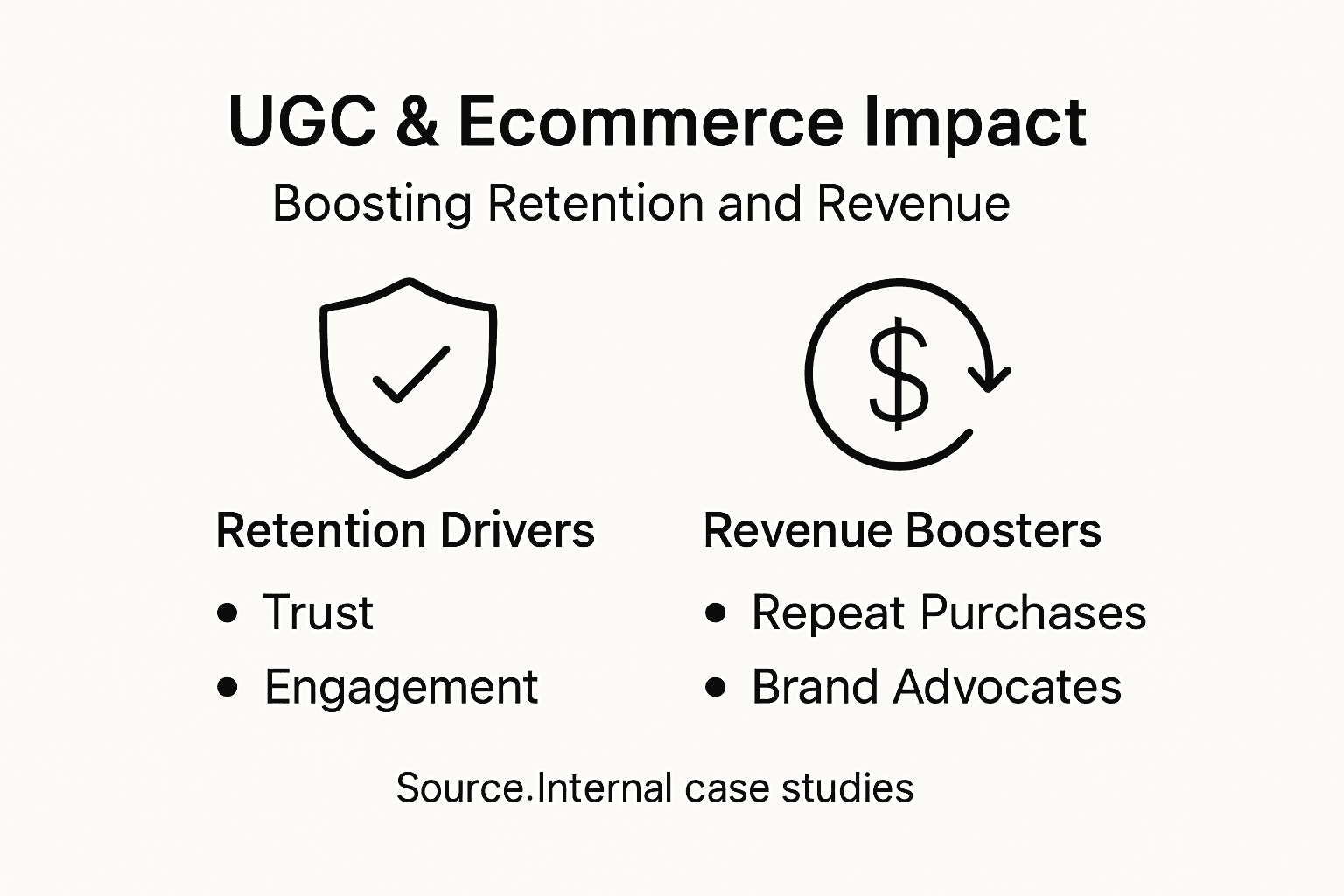
The retention mechanism works through repeated positive reinforcement. When a customer submits a review or photo, they invest emotional energy into your brand. That investment creates what psychologists call the “consistency principle.” Once someone has publicly endorsed your product, they become psychologically motivated to continue supporting that decision through repeat purchases. Additionally, customers who contribute UGC receive recognition and validation from other community members. This social feedback loop incentivizes continued engagement. In practical terms, this means your retention email sequences should actively request UGC from customers, not just sales messages. A post-purchase email that asks “Share your experience with a photo” performs better in driving long-term retention than a post-purchase email that immediately promotes the next product. You are building a community, not just harvesting transactions.
Revenue impact flows directly from retention improvements. When your customer retention rate improves by even 5 percent, revenue typically increases by 25 to 95 percent depending on your industry and customer lifetime value. UGC drives this improvement through multiple channels. First, it reduces churn. Customers who feel valued through community recognition are less likely to switch to competitors. Second, it increases average order value. Customers who have contributed UGC and feel invested in your brand make larger purchases because they are less price-sensitive. Third, it enables word-of-mouth growth. Satisfied customers who see their content amplified naturally recommend your brand to peers, generating new customer acquisition at minimal cost compared to paid advertising. Consumer evaluations from UGC influence purchasing decisions and help companies tailor retention strategies that enhance both customer lifetime value and financial performance. Advanced brands now use machine learning to analyze patterns in their customer-generated reviews and photos, identifying which product features matter most, which customer segments are most loyal, and which retention messaging resonates strongest. This data-driven approach transforms UGC from a nice-to-have social element into a strategic business tool.
For brands using Klaviyo specifically, the retention revenue connection becomes even more powerful. Your email automation platform allows you to track which customers have contributed UGC and segment them accordingly. You can create email flows that prioritize high-value UGC contributors with exclusive offers, early access to new products, or special recognition. You can also use customer testimonials and photos within your regular promotional emails to these engaged segments, creating a virtuous cycle where your most loyal customers see content from peers like them. This segmentation approach means you are not treating all customers identically. You are recognizing and rewarding your advocates. This targeted strategy costs less to execute than broad promotional campaigns, yet generates higher returns because it speaks directly to customer values and psychological needs.
Pro tip: Build a dedicated “Brand Advocates” segment in Klaviyo by tagging customers who have submitted reviews or photos, then send them a monthly email featuring the best UGC from the community with a request to share new content, turning your most engaged customers into recurring content creators and brand ambassadors.
Risks, Legal Considerations, and Common Pitfalls
UGC delivers tremendous benefits, but only when managed correctly. The moment you decide to use customer content in your marketing campaigns, you enter legal territory that requires careful attention. Many brands treat UGC collection casually, assume that content posted publicly is free to use, and discover too late that they have created significant legal exposure. The reality is more complex. A customer who posts a photo on social media has not necessarily granted you permission to use that photo in your email campaigns, advertisements, or on your website. The platform terms of service do not automatically transfer usage rights to you. This distinction matters tremendously from a legal perspective.
Copyright and intellectual property rights represent the primary legal concern with UGC. When a customer creates and shares content, they automatically own the copyright to that content. You do not. Using their photo, video, or written review without explicit permission constitutes copyright infringement, regardless of whether the content is posted publicly. Additionally, UGC presents legal challenges including copyright issues and obtaining rights and permissions from customers. The solution requires clear legal documentation. Before using any customer content in your marketing, you must obtain explicit written consent. Your post-purchase email requesting photos should include language that grants you permission to use submitted content across your marketing channels. Your Klaviyo automation should route customers who submit content to a consent form or require them to accept terms of service that include usage rights. This documentation protects you legally. Without it, customers can demand removal of their content at any time, request compensation, or in extreme cases, pursue legal action. The cost of obtaining permissions upfront is minimal compared to the liability risk of unauthorized usage.
Data privacy and regulatory compliance create additional complexity. When customers submit UGC through your email campaigns or website, they are providing personal information. Depending on where your customers reside, various privacy regulations apply. The European Union’s General Data Protection Regulation (GDPR) imposes strict requirements on how you collect, store, and use customer data. California’s Consumer Privacy Act (CCPA) grants customers rights to know what data you hold and request deletion. Other jurisdictions have their own frameworks. When you collect customer photos or testimonials, you are collecting personal data. You must have a lawful basis for processing that data, maintain transparent privacy policies that explain your intentions, and honor customer requests for deletion. This means you cannot simply keep customer-generated content indefinitely. You need systems to track which customers have consented to which uses and honor requests for content removal promptly.
Content moderation and brand safety present operational risks that legal frameworks do not fully address. User-generated content sometimes contains false claims, offensive language, or defamatory statements. If you publish a customer testimonial claiming your product cures a medical condition, you become liable for that claim even though a customer made it. Implementing content moderation and securing necessary consents helps maintain ethical usage of UGC while protecting your brand. You must review all UGC before publishing in your marketing campaigns. This is not just about removing profanity. You need to verify that claims are truthful, ensure the content aligns with your brand values, and confirm no defamatory statements exist. Many brands overlook this step, assuming that because customers generated the content, it must be accurate. This assumption creates liability. Your legal responsibility extends to all content you publish, regardless of origin. Establish a review process within your team or work with legal counsel to develop content approval standards. Build this review step into your Klaviyo workflows before UGC appears in customer-facing emails.
Common pitfalls to avoid include treating social media sharing as automatic permission, using customer content without verification of claims, failing to maintain consent documentation, and neglecting to honor content removal requests. Additionally, avoid assuming that because content is posted publicly, it is licensed for commercial use. Avoid publishing customer testimonials without reviewing them for accuracy. Avoid collecting customer data without clear privacy notices. Avoid using customer names or photos without explicit permission, even if they shared the content publicly.
The table below summarizes potential legal risks with UGC and how to proactively address them:
| Legal Risk | Example Scenario | Proactive Solution |
|---|---|---|
| Copyright Infringement | Using a customer’s photo | Obtain explicit written permission |
| Data Privacy Violation | Storing personal testimonials | Maintain clear privacy policies |
| Defamatory Content | Publishing false claims | Implement strict review processes |
| Consent Management Failure | Missing removal requests | Track and document all consents |
Pro tip: Build a simple UGC consent workflow in Klaviyo that requires customers submitting photos or testimonials to check a box confirming you can use their content in marketing, then maintain a documented record of all consents with timestamps, providing clear evidence of permission if legal questions arise later.
Unlock the Full Potential of UGC to Elevate Your Ecommerce Email Strategy
User-Generated Content offers authentic social proof that builds trust and drives engagement yet many ecommerce brands struggle to seamlessly incorporate UGC into automated email flows that nurture retention and boost revenue. If you find managing segmentation for personalized UGC or creating compliant consent workflows challenging you are not alone. The article highlights how curated reviews photos and testimonials integrated at the right moments supercharge buyer confidence and foster loyal brand advocates.
Take Action specializes in transforming these UGC strategies into automated Klaviyo email campaigns that maximize impact while protecting your brand legally. Our data-driven approach ensures your welcome sequences abandoned cart emails and post-purchase follow-ups leverage user content to build community and enhance lifetime customer value. Let us help you implement proven systems for collecting and using UGC with precision segmentation and expert compliance support so you can convert engaged customers into passionate repeat buyers.
Ready to turn authentic customer voices into your most powerful growth engine Discover how our email automation and segmentation expertise combine human insight with AI-powered optimization to elevate your ecommerce brand. Visit Take Action today and start building an automated retention strategy that drives sustained revenue based on real customer stories.
Frequently Asked Questions
What is user-generated content (UGC) in ecommerce?
User-generated content (UGC) refers to any form of media, text, or action created and shared by customers about a brand’s products. This includes reviews, photos, testimonials, and social media posts. UGC is distinct because it comes from actual customers rather than professional marketers.
How does UGC enhance customer trust and engagement?
UGC enhances customer trust by providing authentic insights from peers rather than a faceless brand. When potential buyers see real people using a product and sharing their experiences, it reduces perceived risk and encourages them to engage with the brand more actively.
What are the best types of UGC to use in email marketing for ecommerce?
The best types of UGC for email marketing in ecommerce include written reviews, customer photographs, video demonstrations, and testimonials. Each type serves a unique purpose and resonates differently with customers, helping to boost engagement and conversion rates.
What legal considerations should brands keep in mind when using UGC?
Brands must obtain explicit permission to use UGC, as customers retain copyright ownership of their content. It’s crucial to have documented consent and to comply with data privacy regulations when collecting and using customer-generated content.
Recommended
- Customer Retention: Key Driver of Ecommerce Growth | Take Action Blog | Take Action
- UGC Influencer Marketing: Driving Email Retention | Take Action Blog | Take Action
- Understanding User Generated Content Benefits for Brands | Take Action Blog | Take Action
- 7 Loyalty Program Ideas to Boost Ecommerce Customer Value | Take Action Blog | Take Action