

Visuals in Content Marketing: Complete Guide
Over 90 percent of information sent to the brain is visual, making images and graphics some of the most powerful tools in content marketing today. With attention spans shrinking and competition growing, brands need more than words to stand out online. Understanding how to use visuals effectively can help you capture attention, boost engagement, and leave a lasting impact in the digital world.
Table of Contents
- Defining Visuals In Content Marketing
- Common Visual Content Types Explained
- How Visuals Boost Ecommerce Engagement
- Selecting Visuals Aligned With Your Brand
- Avoiding Visual Marketing Missteps
Key Takeaways
| Point | Details |
|---|---|
| Power of Visual Content | Visuals enhance storytelling, evoke emotions, and are strategically used to engage audiences in digital marketing. |
| Effective Visual Types | Key formats include infographics, motion graphics, video content, and interactive visuals, each serving different strategic purposes. |
| Ecommerce Engagement | Visual content significantly boosts customer interaction and conversion rates by creating immersive product experiences. |
| Brand Alignment | Selecting visuals that align with brand identity is crucial for authentic communication and avoiding misinterpretation. |
Defining Visuals in Content Marketing
Visual content has become a powerful communication tool for brands seeking to engage audiences in an increasingly digital landscape. According to Wikipedia, visual marketing is a strategic discipline that explores the intricate relationship between an object, its context, and its representative imagery, with the ultimate goal of making objects the central focus of visual communication.
Visual content marketing goes beyond simple graphics or images. It represents a deliberate approach to storytelling where visual elements are carefully crafted to connect with audiences, evoke emotions, and influence decision making. Catalog Images highlights that visual social marketing specifically leverages images and videos to enhance consumer engagement across digital platforms.
Effective visual content marketing typically encompasses several key elements:
- Compelling photographs and graphics
- Infographics that simplify complex information
- Short-form video content
- Animated illustrations
- Interactive visual experiences
For brands leveraging digital channels, these visual assets aren’t just decorative—they’re strategic communication tools designed to capture attention, convey messages quickly, and create memorable brand experiences. Understanding storytelling in marketing can further enhance how these visual elements are deployed to create meaningful connections with target audiences.
Common Visual Content Types Explained
Visual content has emerged as a critical strategy for brands to communicate effectively in the digital ecosystem. According to Marketer Magazine, short-form animated content, reels, and carousels using motion graphics have become particularly engaging formats, especially on platforms like Instagram where visual storytelling dominates.
Data visualization plays a pivotal role in modern content marketing. Wikipedia explains that information visualization involves creating graphic representations that help audiences quickly understand complex data through formats like charts, graphs, and infographics. These visual tools transform abstract information into digestible, compelling narratives that capture audience attention.
The most effective visual content types can be categorized into several key formats:
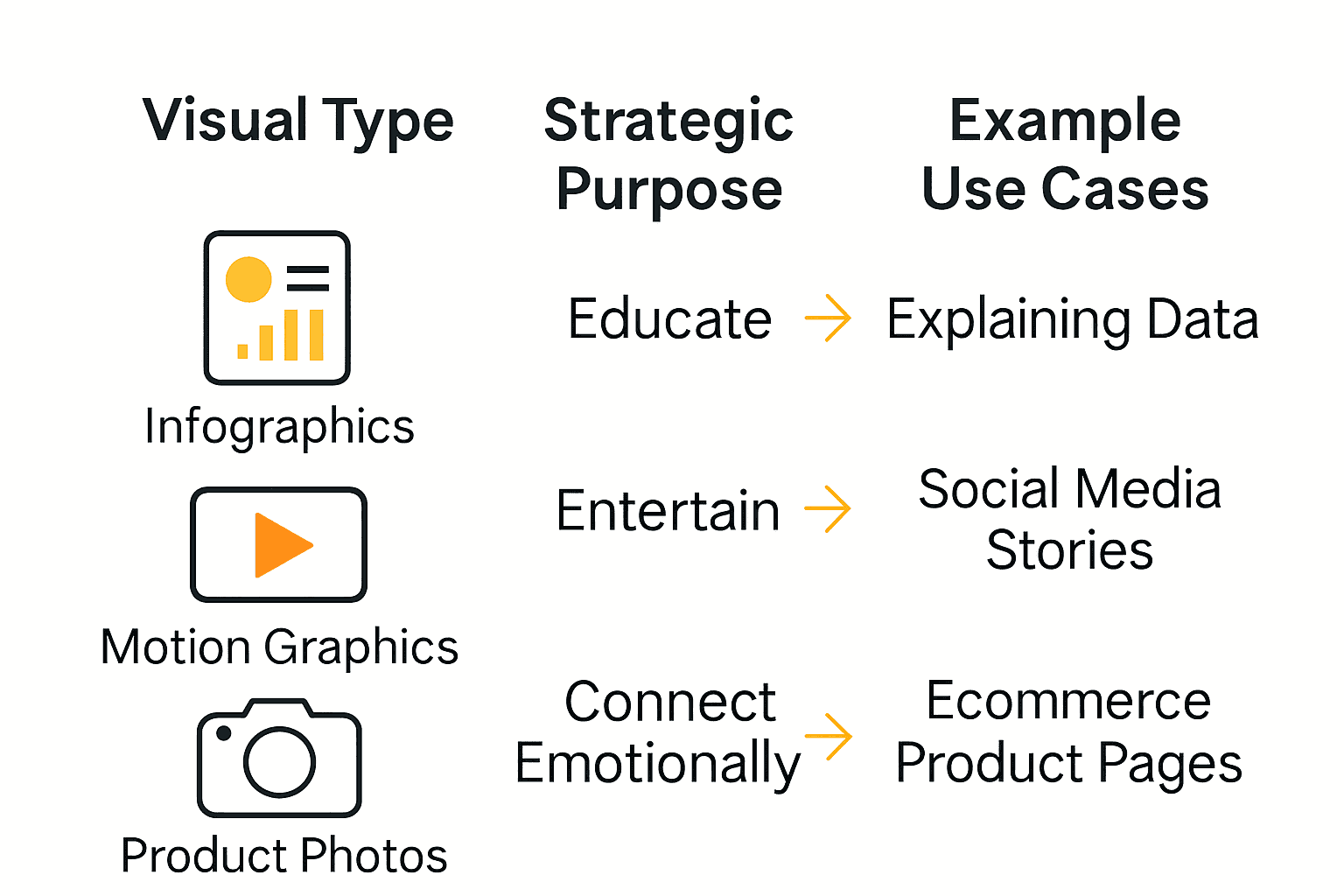
- Infographics: Complex data presented in visually appealing, easy-to-understand designs
- Motion Graphics: Animated illustrations that explain concepts dynamically
- Video Content: Short-form videos, explainer clips, and storytelling sequences
- Interactive Visuals: Clickable graphics, quizzes, and engaging visual experiences
- Photography: High-quality, authentic brand imagery
These visual content types serve different strategic purposes.
VIDEO:video_content] Some aim to educate, others to entertain, and many seek to create an emotional connection with the audience. By [Understanding storytelling in marketing, brands can select and craft visual content that resonates deeply with their target demographic, transforming passive viewers into engaged participants in their brand narrative.
How Visuals Boost Ecommerce Engagement
Visual content has transformed the way ecommerce brands connect with their audiences, becoming a critical strategy for driving customer engagement and conversion. International Journal of New Research and Development research reveals a strong consensus among marketers about the pivotal role of visual content in social media marketing, highlighting its importance in modern ecommerce strategies.
Engagement metrics show that visual content significantly outperforms text-only communication. Product images, interactive graphics, and dynamic visual storytelling create immersive experiences that capture potential customers’ attention and encourage deeper brand interaction. When customers can visualize products, understand their features, and emotionally connect through compelling imagery, they’re more likely to move through the purchasing funnel.

Key ways visuals boost ecommerce engagement include:
- Product Visualization: High-quality, multi-angle product images
- User-Generated Content: Customer photos and videos creating authenticity
- Interactive Demonstrations: 360-degree product views and video tutorials
- Emotional Storytelling: Visual narratives that connect beyond product features
- Social Proof: Customer review images and testimonial graphics
By exploring essential ecommerce marketing strategies, brands can understand how strategic visual content transforms casual browsers into committed customers. The goal isn’t just to show products, but to create visual experiences that resonate, inform, and ultimately drive meaningful engagement and sales.
Selecting Visuals Aligned With Your Brand
Visual communication is far more than aesthetic decoration—it’s a strategic language that speaks directly to your audience. According to Wikipedia’s exploration of visual rhetoric, effective communication hinges on carefully selecting visual elements that authentically represent your brand’s core message and resonate deeply with your target demographic.
Brands must think beyond surface-level attractiveness and consider how each visual element communicates their unique identity. Visual metaphor research suggests that complex brand narratives can be conveyed succinctly through strategic imagery, where one visual element symbolically represents deeper brand attributes and emotional connections.
Key considerations for selecting brand-aligned visuals include:
- Color Palette Consistency: Maintaining your brand’s specific color psychology
- Emotional Tone: Images that reflect your brand’s personality and values
- Storytelling Potential: Visuals that communicate your brand’s narrative
- Audience Relevance: Graphics that speak directly to your target market
- Technical Quality: Professional, high-resolution imagery
By understanding the importance of brand consistency, brands can transform their visual content from mere decoration to powerful communication tools that forge genuine connections with their audience. The most successful visual strategies don’t just showcase products—they tell a compelling, authentic brand story that invites customers to become part of something meaningful.
Avoiding Visual Marketing Missteps
Visual marketing is a delicate art that requires strategic precision and deep understanding of communication dynamics. Wikipedia’s exploration of visual rhetoric emphasizes that misalignment between visual elements and intended messages can lead to critical miscommunication, making it essential for brands to carefully craft their visual narratives.
Brand communication is vulnerable to misinterpretation when visual metaphors are used carelessly. Research on visual metaphors highlights the potential for confusion when visual elements are not thoughtfully designed to communicate precise meanings. A single misplaced image or poorly conceived graphic can undermine an entire marketing campaign’s effectiveness.
Common visual marketing missteps to avoid include:
- Inconsistent Branding: Visuals that deviate from established brand guidelines
- Low-Quality Imagery: Unprofessional or pixelated graphics
- Cultural Insensitivity: Visuals that might offend or alienate audience segments
- Overcomplicated Design: Graphics that confuse rather than clarify
- Misaligned Messaging: Visuals that contradict written content
By understanding content marketing mistakes ecommerce brands must avoid, brands can develop a more nuanced approach to visual storytelling. The goal is to create visual content that not only captures attention but communicates authentically, builds trust, and genuinely connects with the target audience.
Elevate Your Visual Content Strategy with Automated Email Marketing
Visual storytelling captures attention but converting that engagement into revenue can be a challenge many ecommerce brands face. This guide highlights how compelling visual content creates emotional connections and boosts ecommerce engagement. Yet, the real power is unlocked when those visuals align with a seamless, data-driven email marketing strategy designed to retain customers and increase conversions.
At Take Action, we specialize in transforming brand narratives into automated, conversion-focused email campaigns that complement your visual content perfectly. Whether you need help setting up targeted flows like abandoned cart recovery or want to boost open and click rates through intelligent segmentation, our expertise ensures your brand voice and aesthetics shine through every message.
Ready to turn your visual marketing efforts into measurable revenue growth?
Discover how combining captivating visuals with strategic email automation can drive lasting customer engagement. Visit Take Action today to start optimizing your email marketing for scalable ecommerce success.
Frequently Asked Questions
What is visual content marketing?
Visual content marketing is a strategic approach that utilizes visual elements like images, videos, and infographics to tell stories, engage audiences, and influence decision-making, going beyond mere decoration to create meaningful connections with target demographics.
How do visuals enhance customer engagement in ecommerce?
Visuals boost customer engagement in ecommerce by providing product visualization, creating immersive experiences through interactive demonstrations, and utilizing emotional storytelling that connects with customers beyond just product features.
What are some effective types of visual content for marketing?
Effective types of visual content for marketing include infographics, motion graphics, video content, interactive visuals, and high-quality photography, each serving different strategic purposes like educating, entertaining, or creating emotional connections with the audience.
How can brands select visuals that align with their identity?
Brands can select visuals that align with their identity by ensuring consistency in color palettes, maintaining an emotional tone that reflects their personality, and choosing images that communicate their narrative while resonating with their target audience.
Recommended
- Content Marketing Explained: Strategies, Types, and Impact | Take Action Blog | Take Action
- Understanding the Value of Branded Content in Marketing | Take Action Blog | Take Action
- What is a Content Hub? Understanding its Importance | Take Action Blog | Take Action
- Understanding What Makes Content Shareable | Take Action Blog | Take Action
- How to Manage Marketing Team for B2B Growth Success - Kadima