

What Is a Marketing Agency and Why It Matters
Choosing the right partner for growing an Ecommerce brand often means facing a complex maze of options and promises. When every marketing dollar counts, understanding how marketing agencies deliver value and shape customer journeys can make all the difference. This guide highlights the core principles and agency types behind effective brand strategies, helping you connect with customers, improve retention, and make more confident choices when evaluating agency expertise and Klaviyo email automation solutions.
Table of Contents
- Defining Marketing Agencies And Core Principles
- Different Types Of Marketing Agencies Explained
- How Marketing Agencies Operate And Deliver Value
- Benefits Of Partnering With An Agency For Brands
- Key Costs, Risks, And Common Pitfalls
Key Takeaways
| Point | Details |
|---|---|
| Understanding Agency Roles | Marketing agencies serve as strategic partners that help businesses implement effective marketing initiatives tailored to their objectives. |
| Importance of Performance Metrics | Agencies must demonstrate their value through measurable performance indicators like customer acquisition costs and conversion rates. |
| Types of Marketing Agencies | Choosing the right agency depends on your business needs; full-service agencies offer comprehensive solutions, while specialized agencies provide expert focus. |
| Navigating Risks and Expectations | Clear communication and understanding of expectations are crucial to avoid common pitfalls in agency partnerships, such as budget overruns and misaligned goals. |
Defining Marketing Agencies and Core Principles
Marketing agencies are professional organizations that help businesses develop and execute strategic marketing initiatives to connect with customers and drive growth. These specialized firms serve as critical intermediaries between brands and their target audiences, applying sophisticated techniques to create customer value.
At their core, marketing agencies operate around several foundational principles that distinguish them from traditional advertising services:
- Strategic Planning: Developing comprehensive marketing roadmaps tailored to specific business objectives
- Market Research: Conducting in-depth analysis of target demographics, consumer behaviors, and competitive landscapes
- Creative Execution: Designing compelling messaging and visual communications
- Performance Tracking: Measuring campaign effectiveness through quantitative metrics and analytics
The relationship between marketing agencies and their clients is fundamentally built on trust and accountability. These agencies function as specialized partners who leverage deep industry expertise to help brands navigate complex marketing challenges. Unlike internal marketing departments, agencies bring external perspectives and cross-industry insights that can unlock innovative strategies.
Performance metrics are central to understanding a marketing agency’s value. Successful agencies demonstrate measurable impact through key performance indicators like customer acquisition costs, conversion rates, brand awareness growth, and return on marketing investment.
Marketing agencies transform abstract business goals into concrete, actionable marketing strategies that drive meaningful customer engagement.
Pro tip: When selecting a marketing agency, prioritize partners who can demonstrate clear, data-driven results and align closely with your specific business objectives.
Different Types of Marketing Agencies Explained
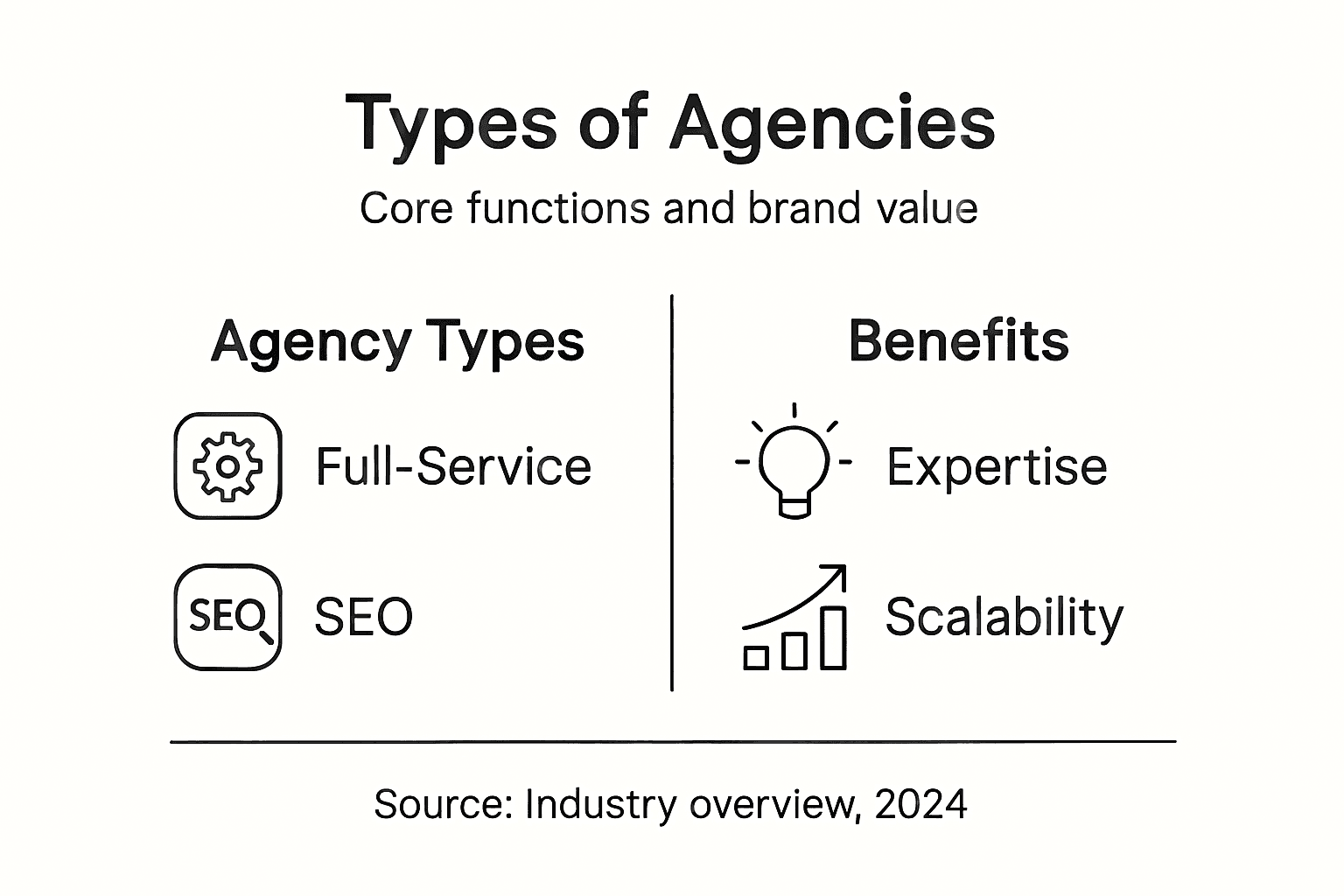
Marketing agencies come in diverse forms, each specializing in unique aspects of brand promotion and customer engagement. Marketing agencies are classified primarily into two broad categories: full-service and specialized agencies, offering businesses tailored solutions for their specific marketing needs.
The main types of marketing agencies include:
- Full-Service Agencies: Comprehensive marketing solutions covering strategy, branding, creative development, and media buying
- Digital Marketing Agencies: Focused on online platforms, including social media, search engine optimization, and digital advertising
- Creative Agencies: Specializing in branding, graphic design, and visual storytelling
- SEO Agencies: Concentrating on improving search engine rankings and online visibility
- Social Media Marketing Agencies: Dedicated to building and managing brand presence across social platforms
- Content Marketing Agencies: Developing strategic content to attract and engage target audiences
Each type of agency brings unique strengths to the table. Full-service agencies provide end-to-end marketing support, making them ideal for businesses seeking comprehensive marketing solutions. Specialized agencies, on the other hand, offer deep expertise in specific marketing domains, allowing brands to target precise marketing challenges with expert precision.

Here’s a quick comparison of major marketing agency types and the businesses they best serve:
| Agency Type | Best For | Typical Services |
|---|---|---|
| Full-Service | Growing brands needing a single point of contact | Branding, campaign management, media buying |
| Digital Marketing | Online-focused companies | SEO, social media, digital ads |
| Creative | Brands seeking strong visuals | Graphic design, brand storytelling |
| SEO | Businesses targeting organic web growth | On-page and technical SEO, link building |
| Social Media Marketing | Brands pursuing customer engagement | Platform management, content creation |
| Content Marketing | Companies prioritizing thought leadership | Blogs, whitepapers, video, infographics |
Choosing the right marketing agency is about matching your specific business objectives with an agency’s core competencies and industry expertise.
The selection process involves carefully evaluating an agency’s track record, understanding their approach, and ensuring alignment with your brand’s strategic goals. Some agencies excel in specific industries, while others offer more generalist approaches that can be adapted to various business contexts.
Pro tip: Before selecting a marketing agency, conduct thorough research, request case studies, and schedule consultations to truly understand their capabilities and fit with your business objectives.
How Marketing Agencies Operate and Deliver Value
Marketing agencies transform business strategies into actionable marketing initiatives by coordinating strategic marketing practices that generate measurable value for clients. These organizations function as dynamic partners, bridging the gap between business objectives and market opportunities through sophisticated approaches to customer engagement and brand positioning.
The core operational mechanisms of marketing agencies typically involve:
- Strategic Planning: Developing comprehensive marketing roadmaps aligned with client goals
- Market Research: Conducting deep analysis of target demographics and competitive landscapes
- Campaign Development: Creating integrated marketing campaigns across multiple channels
- Performance Tracking: Measuring and optimizing marketing outcomes using advanced analytics
- Resource Coordination: Aligning creative, technical, and strategic resources efficiently
Each marketing agency develops unique methodologies for delivering value. Some focus on data-driven insights, while others emphasize creative storytelling or technological innovation. The fundamental goal remains consistent: translating business objectives into compelling market strategies that drive measurable results.
Marketing agencies act as strategic interpreters, converting complex business goals into targeted, effective marketing initiatives that resonate with specific audience segments.
Successful agencies distinguish themselves through their ability to adapt, innovate, and provide transparent, results-oriented approaches. They leverage industry expertise, technological tools, and creative thinking to help businesses navigate increasingly complex market dynamics and consumer behaviors.
Pro tip: When evaluating a marketing agency, prioritize partners who can demonstrate clear, quantifiable results and show a deep understanding of your specific industry and business challenges.
Benefits of Partnering With an Agency for Brands
Brands today face increasingly complex marketing challenges that demand specialized expertise and strategic insights. Marketing agencies offer comprehensive solutions that transform business objectives into measurable marketing outcomes, providing businesses with a competitive edge in demanding market landscapes.
The key benefits of partnering with a marketing agency include:
- Expert Knowledge: Access to specialized skills across multiple marketing domains
- Cost Efficiency: Reduced overhead compared to maintaining full-time internal marketing teams
- Advanced Technologies: Leverage cutting-edge marketing tools and analytics platforms
- Strategic Flexibility: Quickly adapt marketing strategies to changing market conditions
- Comprehensive Perspective: Objective insights from professionals with diverse industry experience
- Scalable Resources: Expand or contract marketing efforts without long-term personnel commitments
Marketing agencies provide an external perspective that internal teams often struggle to maintain. They bring fresh creative strategies, data-driven approaches, and innovative solutions that can significantly accelerate brand growth. By combining deep industry expertise with advanced analytical capabilities, agencies help businesses navigate complex marketing challenges more effectively.
Successful brand partnerships with marketing agencies transform marketing from a cost center into a strategic growth engine.
The most effective agency relationships are built on transparent communication, clear performance metrics, and a shared commitment to achieving measurable business outcomes. Agencies that demonstrate adaptability, technological proficiency, and a genuine understanding of a brand’s unique challenges become true strategic partners.
Pro tip: When selecting a marketing agency, prioritize partners who can demonstrate proven results in your specific industry and show a clear, data-driven approach to achieving your business objectives.
Key Costs, Risks, and Common Pitfalls
Navigating the complexities of marketing agency partnerships requires careful consideration of potential risks and research challenges. Businesses must approach these relationships with a strategic mindset, understanding that not all agencies will deliver the same level of value or align perfectly with their specific marketing objectives.
Key risks and potential pitfalls in marketing agency relationships include:
- Misaligned Expectations: Unclear communication about project goals and deliverables
- Budget Overruns: Unexpected additional costs and scope creep
- Performance Inconsistency: Variability in campaign results and marketing effectiveness
- Data Privacy Concerns: Potential risks related to handling sensitive business information
- Communication Gaps: Lack of transparent and frequent reporting
- Cultural Mismatch: Incompatibility between agency approach and brand identity
The financial implications of engaging a marketing agency extend beyond direct service fees. Companies must factor in potential hidden costs such as onboarding time, strategy development, and the potential need for multiple iterations or strategy adjustments. Some agencies may lock clients into long-term contracts with minimal flexibility, which can become a significant financial risk.
Below is a summary of common risks in agency partnerships and recommended prevention strategies:
| Risk Area | Example Issue | Prevention Strategy |
|---|---|---|
| Expectation Alignment | Misunderstood deliverables | Set detailed goals and KPIs upfront |
| Budget Control | Unexpected cost increases | Agree on transparent, itemized pricing |
| Data Security | Mishandling sensitive information | Establish strict confidentiality terms |
| Communication | Irregular updates or reports | Schedule regular, structured check-ins |
| Cultural Fit | Agency does not reflect your brand | Assess values and work styles early |
Successful marketing agency partnerships are built on clear expectations, measurable outcomes, and mutual understanding of business objectives.
Mitigating these risks requires thorough due diligence, including comprehensive agency vetting, detailed contract negotiations, and establishing clear performance metrics. Brands should prioritize agencies that demonstrate transparency, provide detailed reporting, and show a proven track record of delivering measurable results in their specific industry.
Pro tip: Before signing any agency contract, request detailed case studies, conduct thorough reference checks, and establish clear key performance indicators to minimize potential risks and maximize marketing investment returns.
Unlock the Full Potential of Your Marketing Agency Partnership
The article highlights the critical need for strategic planning, performance tracking, and specialized expertise to transform marketing goals into measurable growth. If you are facing challenges in aligning your marketing efforts with clear, data-driven results or want to overcome common pitfalls such as misaligned expectations and inconsistent communication, partnering with the right agency could be a game changer.
At Take Action, we specialize in helping ecommerce and online brands leverage the power of automated email marketing and retention strategies using Klaviyo. Our approach focuses on increasing engagement, recovering abandoned carts, and scaling your brand through personalized campaigns designed to deliver measurable revenue growth. We combine human expertise with AI-driven insights to ensure your marketing investments produce clear, quantifiable returns while aligning perfectly with your brand’s voice and aesthetics.
Don’t let your marketing potential go untapped. Discover how to turn email into your primary growth channel. Visit Take Action today to explore our specialized services in campaign strategy, automation setup, and long-term brand partnerships. Start building a data-driven, conversion-focused marketing engine that truly matters to your business goals.
Frequently Asked Questions
What is a marketing agency?
Marketing agencies are professional firms that help businesses develop and execute strategic marketing initiatives to connect with customers and drive growth.
What are the core principles of marketing agencies?
The core principles include strategic planning, market research, creative execution, and performance tracking to ensure effective marketing strategies.
What types of services do marketing agencies offer?
Marketing agencies offer a range of services including branding, digital marketing, SEO, social media management, content creation, and campaign management tailored to specific business needs.
Why should a business partner with a marketing agency?
Partnering with a marketing agency provides access to expert knowledge, cost efficiency, advanced technologies, and a broader perspective, all of which help brands effectively navigate complex marketing challenges.
Recommended
- Understanding the Importance of Marketing Analytics | Take Action Blog | Take Action
- Understanding Storytelling in Marketing for Brands | Take Action Blog | Take Action
- What is Omnichannel Marketing? Understanding Its Importance | Take Action Blog | Take Action
- Understanding Marketing Automation Explained Simply | Take Action Blog | Take Action