

What Is a Sales Funnel? Complete Expert Overview
Almost every american business owner wants stronger sales, but few realize that a well-built sales funnel can increase conversions by over 50 percent. Knowing how prospects move from casual interest to loyal customers is essential for any business hoping to compete in a fast-changing market. This guide breaks down the sales funnel process, helping you spot opportunities and strengthen every step of your customer’s journey.
Table of Contents
- Defining The Sales Funnel And Its Purpose
- Key Stages Of A Sales Funnel Explained
- Types Of Sales Funnels For Online Brands
- Integrating Email Automation With Sales Funnels
- Common Mistakes When Building Sales Funnels
Key Takeaways
| Point | Details |
|---|---|
| Sales Funnel Purpose | The sales funnel maps the customer journey from awareness to purchase, helping businesses optimize their customer acquisition strategies. |
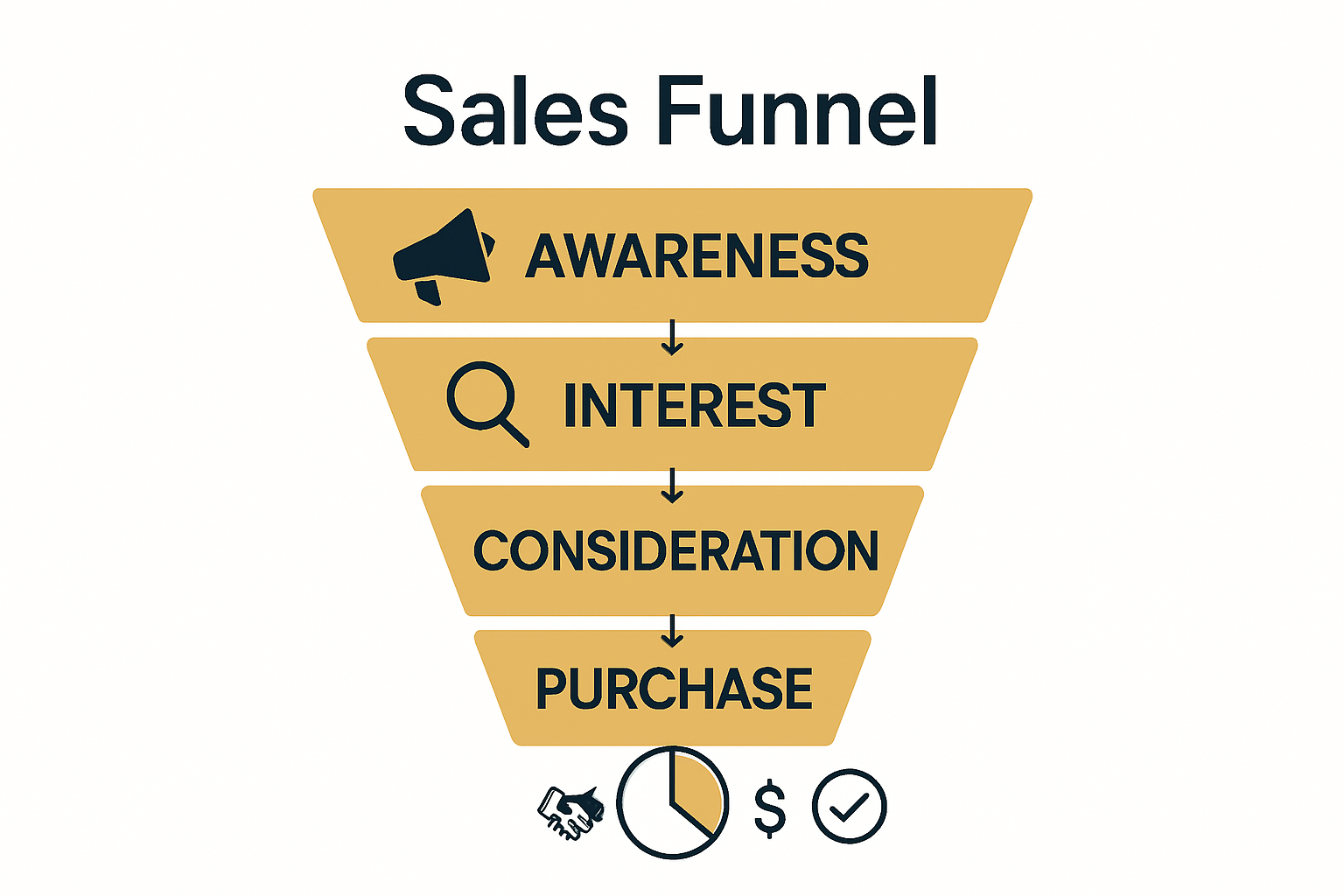
| Key Stages | A standard sales funnel typically includes awareness, interest, decision, and action stages, each requiring specific marketing approaches. |
| Email Automation Integration | Incorporating email automation enhances customer engagement throughout the sales funnel, utilizing behavior-driven strategies for better conversion. |
| Common Mistakes | Effective sales funnels require clear processes and targeted communication; common pitfalls include undefined sales processes and insufficient audience segmentation. |
Defining the Sales Funnel and Its Purpose
A sales funnel represents the strategic customer journey from initial awareness to final purchase, mapping how potential buyers move through different stages of engagement with a brand. Sales funnel analysis helps businesses understand and optimize their customer acquisition process by tracking how prospects transition from interested observers to committed buyers.
Typically, a sales funnel visualizes the customer’s progression through multiple interconnected stages. According to research from Salesforce, the funnel captures potential customers’ journeys from initial prospecting through to final purchase, with the specific number of stages varying based on each company’s unique sales model. These stages generally include awareness, interest, consideration, intent, evaluation, and purchase.
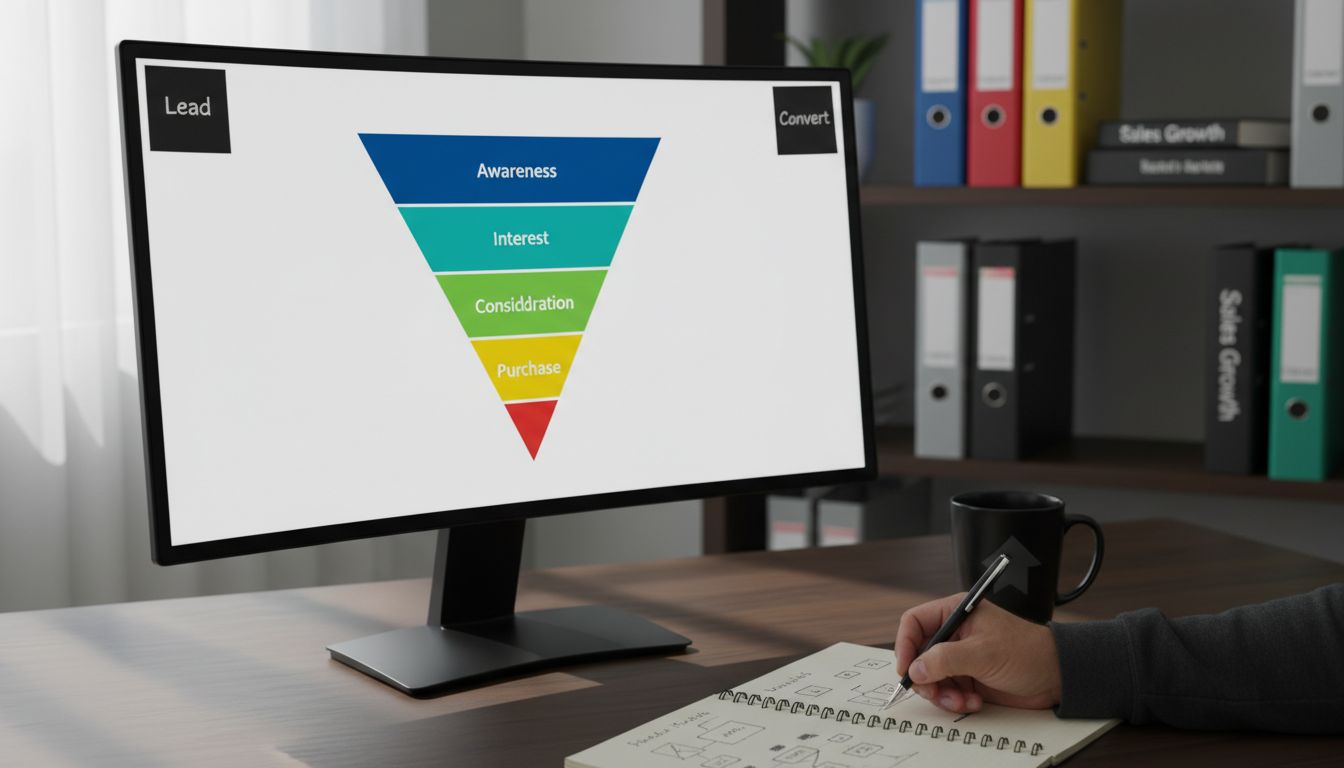
The primary purpose of a sales funnel extends beyond simple transaction tracking. By understanding marketing automation principles, businesses can strategically guide potential customers through each funnel stage, identifying potential drop-off points and implementing targeted interventions. IBM notes that analyzing the sales funnel helps organizations comprehend which marketing and sales strategies effectively convert prospects into actual customers, enabling data-driven refinements to their customer acquisition approach.
Key characteristics of an effective sales funnel include:
- Transparent customer progression stages
- Clear tracking mechanisms
- Targeted interventions at each stage
- Ability to identify and address potential barriers to conversion
- Continuous optimization based on performance metrics
Key Stages of a Sales Funnel Explained
A comprehensive sales funnel typically progresses through multiple strategic stages designed to transform potential customers from initial awareness to committed buyers. Increasing conversions requires understanding how prospects move through these interconnected phases, each representing a critical touchpoint in the customer journey.
According to research from Salesforce, a standard sales funnel consists of several key stages that may vary slightly depending on a company’s specific sales model. The fundamental stages generally include:
- Awareness: Potential customers first become familiar with a product or service
- Interest: Prospects demonstrate curiosity and begin seeking more information
- Decision: Customers evaluate the offering and compare alternatives
- Action: The final stage where a purchase is completed
These stages are not static but dynamic pathways that require strategic email sequences to guide potential customers effectively. Each stage demands unique marketing approaches and targeted communication strategies. For instance, during the awareness phase, businesses focus on creating visibility and generating initial interest, while the decision stage requires more detailed product information and compelling value propositions.
Businesses can optimize their sales funnel by implementing targeted lead generation techniques that address each stage’s specific challenges. By understanding how potential customers move through these stages, companies can develop more precise interventions, reduce drop-off rates, and ultimately improve overall conversion performance.
Types of Sales Funnels for Online Brands
Online brands can leverage multiple sales funnel approaches, each designed to address specific business objectives and customer engagement strategies. Drip marketing strategies play a crucial role in developing targeted sales funnel frameworks that effectively guide potential customers through their purchasing journey.
According to research from TechTarget, the number and structure of sales funnels can vary significantly based on business size, industry, and specific marketing goals. Typically, online brands utilize several primary sales funnel types:
- Product-Based Sales Funnel: Focused on direct product sales with linear customer progression
- Lead Generation Funnel: Designed to capture potential customer information and nurture relationships
- Webinar Sales Funnel: Leveraging educational content to convert interested prospects
- Evergreen Sales Funnel: Continuously running automated marketing sequences
- Membership or Subscription Funnel: Creating recurring revenue models
Email marketing strategies are particularly effective in implementing these diverse funnel types. The key is understanding that no single funnel design works universally. Successful online brands often develop automated workflows that can be customized and adapted to their specific target audience and product offerings.
Each sales funnel type requires unique optimization techniques, carefully mapped customer touchpoints, and strategic content delivery. The most effective online brands continuously test and refine their funnel approaches, using data-driven insights to improve conversion rates and create more personalized customer experiences.
Integrating Email Automation With Sales Funnels
Email automation transforms how online brands connect with potential customers throughout their sales funnel journey. Understanding the benefits of email automation provides critical insights into creating more personalized, responsive marketing strategies that adapt to customer behaviors and preferences.
Research highlights that effective email automation requires more than just sending generic messages. Modern customers expect multichannel interactions, which means brands must design sophisticated automation strategies that go beyond traditional email approaches.
Key strategies for integrating email automation with sales funnels include:
- Audience Segmentation: Divide contacts based on specific behaviors and interests
- Personalized Messaging: Create targeted content for different customer stages
- Multi-Channel Integration: Incorporate SMS, WhatsApp, and automated calls
- Behavioral Triggered Workflows: Design responses based on customer interactions
- Dynamic Content Adaptation: Adjust messaging in real-time based on user engagement
Klaviyo email automation techniques demonstrate how sophisticated marketing automation can transform customer journeys. By implementing comprehensive marketing automation checklists, brands can create seamless, intelligent systems that guide prospects through each sales funnel stage with precision and personalization. The goal is not just communication, but creating meaningful, contextual interactions that feel individualized and relevant to each potential customer.
Common Mistakes When Building Sales Funnels
Sales funnel development requires strategic planning and meticulous execution. Conversion rate optimization becomes critical when addressing common pitfalls that can undermine marketing effectiveness and revenue generation.
Research indicates that most sales funnel failures stem from a lack of structured planning. Businesses often make critical errors that prevent successful customer conversion, including:
- Undefined Sales Process: Failing to create a clear roadmap for customer progression
- Generic Messaging: Using one-size-fits-all communication across different customer segments
- Insufficient Performance Tracking: Neglecting to monitor key conversion metrics
- Poor Audience Segmentation: Treating all potential customers identically
- Inconsistent Follow-Up Strategies: Lack of systematic engagement at each funnel stage
Successful sales funnel implementation requires continuous optimization. Without rigorous performance assessment, brands risk creating ineffective marketing systems that waste resources and miss critical conversion opportunities. Tracking metrics such as open rates, click-throughs, and drop-off points provides the insights necessary to refine and improve the entire customer acquisition process. Sophisticated marketers understand that a sales funnel is not a static construct, but a dynamic system requiring constant adaptation and strategic refinement.
Take Control of Your Sales Funnel with Expert Email Automation
Building a clear, effective sales funnel is critical to converting prospects into loyal customers. The article highlights common challenges like generic messaging, poor audience segmentation, and inconsistent follow-ups that cause potential buyers to fall through the cracks. If you want to overcome these hurdles and leverage the power of automation, segmentation, and targeted campaigns, you need a partner who truly understands sales funnel dynamics.
Take Action specializes in turning email marketing into your most reliable growth channel. Our data-driven strategies focus on automating your customer journey with tailored flows such as welcome sequences, abandoned cart recovery, and post-purchase nurturing. We blend human expertise with AI insights to boost open and click rates while aligning perfectly with your brand voice and style. Discover how to optimize every stage of your funnel and increase conversions by visiting our website.
Ready to transform your sales funnel? Explore how our campaign strategy and email flow setup can guide prospects smoothly from awareness to purchase. Act now to automate customer retention and unlock scalable ecommerce growth through proven Klaviyo automation. Visit Take Action and start turning your email list into a powerful revenue engine today.
Frequently Asked Questions
What are the main stages of a sales funnel?
The main stages of a sales funnel typically include awareness, interest, consideration, intent, evaluation, and purchase. Each stage represents a critical touchpoint in the customer journey, guiding potential customers from initial awareness to a completed purchase.
How can businesses optimize their sales funnels?
Businesses can optimize their sales funnels by implementing targeted interventions at each stage, tracking performance metrics, and using data-driven insights to identify potential drop-off points. This may include customizing messaging and employing lead generation techniques tailored to each stage of the funnel.
What types of sales funnels exist for online brands?
Online brands may use various types of sales funnels, including product-based sales funnels, lead generation funnels, webinar sales funnels, evergreen sales funnels, and membership or subscription funnels. Each type serves different business goals and requires unique optimization strategies.
How does email automation enhance sales funnels?
Email automation enhances sales funnels by enabling personalized and responsive communication throughout the customer journey. It allows for audience segmentation, targeted messaging, multi-channel integration, and real-time adjustments based on customer behavior, ultimately improving engagement and conversion rates.
Recommended
- 7 Key Sales Funnel Stages for Ecommerce Growth Success | Take Action Blog | Take Action
- Understanding Marketing Automation Explained Simply | Take Action Blog | Take Action
- 7 Essential Lead Generation Techniques for 2025 | Take Action Blog | Take Action
- Take Action — Email Marketing & Retention Agency
- 7 Essential Types of Marketing Funnels for Business Growth - Jarrod Harman
- B2B Marketing Funnel Guide for SaaS and Real Estate Success - Kadima