

1–2 Emails a Week: Test Email Frequency for Marketers
Email frequency is simply how many emails you send subscribers over a given period, whether that’s daily, weekly, or monthly. Most brands should start testing somewhere between once a month and twice a week, since that’s the range that holds up best across industries before engagement starts to erode. The right number after that depends entirely on how valuable your emails are and how your specific audience responds.
TL;DR:
- Most brands should start with sending one to two emails per week and adjust based on engagement data and audience response.
- Segment-level caps, such as no more than three emails per week and eight per month per subscriber, prevent list fatigue and improve deliverability.
- Testing frequency with holdout groups over four to eight weeks yields more reliable insights than short-term experiments.
- Over-mailing leads to declining engagement, complaints, and a damaged sender reputation, especially if technical hygiene and suppression rules are neglected.
- Using segment-specific caps and giving subscribers control over their preferences helps optimize engagement and reduce unsubscribe rates.
Table of Contents
- What Is Email Frequency, and How Does It Differ From Cadence?
- What Is the Optimal Email Frequency to Start With?
- How Do You Choose the Right Frequency for Your List?
- How Do You Test Email Frequency and What Should You Measure?
- How Does Frequency Affect Deliverability and List Health?
- When Should You Send, and How Does Timing Interact With Frequency?
- What Are Some Starter Cadences by Business Type?
- A Practical Checklist for Implementing Frequency Changes
- The Bottom Line on Email Frequency
- Why We Default to Segment-Based Frequency Over Fixed Schedules
- How Take-action Helps You Find and Manage the Right Frequency
- Sources
What Is Email Frequency, and How Does It Differ From Cadence?
Frequency counts the sends. Cadence describes the rhythm, sequence, and timing logic behind this sends across different segments and lifecycle stages. You can hold frequency steady at, say, three emails a week and still have a messy cadence if a new subscriber gets a promotional blast on day one instead of a welcome sequence.
Take-action treats frequency and cadence as two separate levers because they solve different problems. Frequency answers “how many.” Cadence answers “in what order, to whom, and when.”
A useful way to see the difference in practice:
- Promotional sends — sale announcements, product launches, calendar-driven campaigns that count fully against your frequency total.
- Lifecycle emails — welcome series, abandoned cart, post-purchase flows that trigger off behavior, not the calendar.
- Transactional emails — order confirmations and shipping updates that subscribers expect regardless of marketing frequency.
A subscriber who just triggered a welcome flow and also gets hit with a flash sale email isn’t experiencing “twice a week.” They’re experiencing your program’s total volume, and that’s the number that actually predicts unsubscribes.
What Is the Optimal Email Frequency to Start With?
The evidence points to a fairly narrow starter band. FoundCoo’s frequency research puts the defensible range at once a month to twice a week for most brands, with cadence adjusted by segment from there. That’s a wide enough window to fit very different business models, but narrow enough to rule out the daily-blast approach that burns lists fast.
Survey snapshot: Among marketers surveyed by HubSpot, 33% send weekly and 26% send multiple times per month. Notably, 63% actively cut frequency for subscribers who’ve gone quiet, a sign that most experienced senders treat frequency as adjustable, not fixed.
Sector patterns matter more than a single universal number:
- B2B programs typically stay lean, often one to two sends weekly, since buying cycles are longer and inboxes are less tolerant of noise.
- Ecommerce brands tend to run hotter. Shopify’s cadence research found two targeted emails per week commonly outperforms lower cadences, provided each one carries real value like a restock alert or a relevant offer.
- Media and daily publishers are the legitimate exception to the “less is more” rule. A daily digest works because subscribers signed up expecting daily content. That’s not over-mailing, it’s the product.
The exception in the other direction: very small or niche lists where every email needs to justify its existence often perform best at monthly or even quarterly frequency, especially when the audience has a narrow, infrequent need.
How Do You Choose the Right Frequency for Your List?
Frequency decisions should never be a single company-wide number. Mailneo’s framework breaks it into three layers, and each one needs its own cap.
- Program-level frequency — the total volume any single subscriber can receive across every list and flow combined, not just your main newsletter.
- Segment-level frequency — different caps for new subscribers, active buyers, and lapsed contacts, since each group tolerates a different load.
- Subscriber-level frequency — the individual ceiling one person hits when promotional, lifecycle, and transactional messages overlap in the same week.
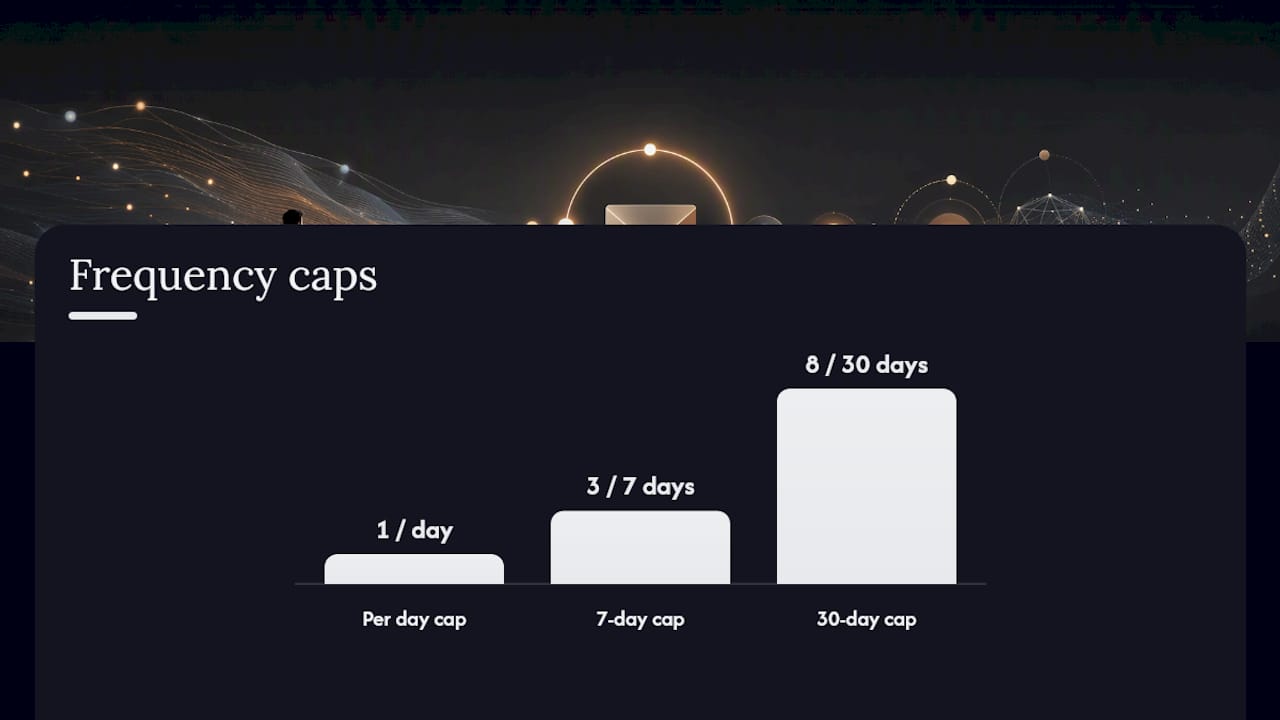
Mailneo recommends rough caps like no more than one marketing email a day, three per seven days, and eight per thirty days, then layering suppression rules on top so a cart abandonment flow doesn’t fire the same day as a big campaign send.
Your most engaged buyers can usually handle more volume than your average subscriber. Segmenting by engagement decile and testing higher frequency only on the top tier lets you find the ceiling without risking your whole list.
Pro Tip: Give subscribers a preference center where they can pick “weekly highlights” versus “everything,” and route that data straight into your Klaviyo segmentation. Letting people self-select frequency cuts unsubscribes far more effectively than guessing on their behalf.
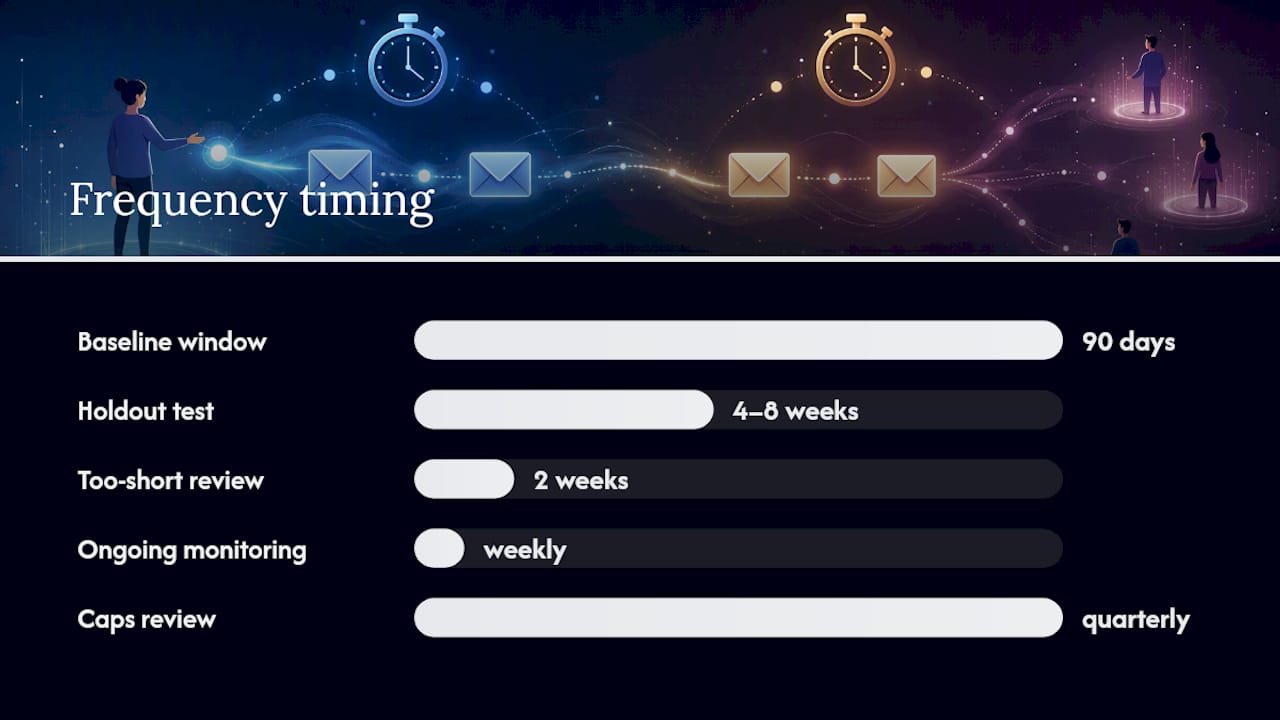
Suppression rules matter just as much as caps. If someone hasn’t opened in 90 days, they shouldn’t be counted in your regular send volume. They need a re-engagement track instead, with its own separate frequency logic.
How Do You Test Email Frequency and What Should You Measure?
Frequency tests fail most often because they run too short. MailerLite’s research recommends testing on a defined segment for at least four to eight weeks, since fatigue from over-mailing tends to show up gradually, not on day three.
Structure the test as a genuine holdout: split a segment randomly, hold one group at your current frequency, bump the other, and don’t touch anything else, no new subject line strategy, no creative overhaul, during the test window. Sample size matters too. A test on 500 people will give you noisy, unreliable signals; aim for segments large enough that a few dozen unsubscribes don’t swing your conclusion.
Watch these metrics, not just opens:
- Unsubscribe rate per send, tracked as a rate against the segment, not a raw count.
- Complaint rate, which affects deliverability far more than unsubscribes do.
- Click-to-open rate, a cleaner signal of content relevance than open rate alone.
- Revenue per recipient, the number that actually tells you whether higher frequency is paying for itself.
- Inbox placement, since mailbox providers quietly move you to spam long before subscribers complain.
Short-term revenue often ticks up when you add sends. That’s the trap. The Seventh Sense’s analysis notes that a frequency bump can boost revenue in week one while accelerating list attrition by week eight, so judge results on the full test window, not the first few sends.
How Does Frequency Affect Deliverability and List Health?
Over-mailing doesn’t just annoy people, it actively damages your sender reputation. Mailbox providers track engagement patterns per domain, and a spike in low engagement combined with a spike in complaints tells Gmail and Outlook to start routing you to spam before subscribers even lift a finger.
A few safeguards protect the list over time:
- Re-permission campaigns for contacts dormant 90 to 180 days, asking them to confirm interest before you keep mailing them at full volume.
- Dormancy suppression, removing inactive contacts from regular sends and moving them into a separate low-frequency win-back track.
- Authentication hygiene — SPF, DKIM, and DMARC configured correctly, since even a perfectly reasonable frequency will get flagged if your technical setup looks unverified.
- Consistent sending patterns, since providers reward predictability. Sporadic silence followed by a burst of five emails in three days reads as spammy behavior even at a modest overall volume.
The mere exposure effect from behavioral psychology explains part of this. Repeated, consistent contact builds familiarity up to a point, but that curve bends into irritation once volume outpaces perceived value. Consistency, not raw volume, is what earns long-term trust.
When Should You Send, and How Does Timing Interact With Frequency?
Timing and frequency aren’t separate decisions, they compound each other. Sending three emails a week on Tuesday, Wednesday, and Thursday feels completely different to a subscriber than sending three emails crammed into a single Monday morning.
Mailchimp’s engagement data shows Tuesday, Wednesday, and Thursday mornings tend to outperform other windows, with weekends generally weaker for promotional content. Treat that as a starting hypothesis, not a rule; B2B audiences behave differently than consumer lists, and your own open-rate data will tell you faster than any benchmark.
- Spread sends across the week rather than clustering them, even at the same total frequency.
- Respect subscriber time zones, especially for lists spanning multiple regions.
- Use send-time optimization inside Klaviyo to let individual engagement history determine delivery time rather than mailing everyone at once.
What Are Some Starter Cadences by Business Type?
Rather than guessing at a number, start from a template that matches your business model, then adjust based on what your first month of data shows.
- B2B programs — one educational or product-update email weekly, plus a monthly deeper-dive newsletter. Keep promotional asks rare and high-value.
- Ecommerce brands — two campaign emails per week, layered with automated flows (welcome, abandoned cart, post-purchase) that trigger independently of the campaign calendar. That combination matches what Shopify’s cadence data found effective, since flows carry the personalization campaigns can’t.
- Media and digest publishers — daily or near-daily sends work here because the audience opted in expecting that rhythm; the failure mode is inconsistency, not volume.
To ramp up, add one send per week to your highest-engagement decile only, hold for four weeks, and watch unsubscribe rate before rolling it out further. To dial back, cut lowest-engagement segments to monthly touches first rather than reducing frequency across the entire list at once. Seasonal peaks are the one time almost every business justifiably raises frequency temporarily, provided you scale back down once the promotional window closes.
A Practical Checklist for Implementing Frequency Changes
Most frequency mistakes happen in execution, not strategy. This is the sequence Take-action runs through with clients making a frequency change:
- Baseline first. Pull 90 days of send history and current unsubscribe/complaint rates before changing anything.
- Segment before you scale. Split the list into engagement tiers before adjusting anyone’s volume.
- Set caps in writing. Document program, segment, and subscriber-level limits so no single automation can override them.
- Build suppression logic. Make sure flows check against recent sends before firing.
- Run a real holdout. Test on one segment for a full four to eight weeks before rolling changes list-wide.
- Put it on a dashboard. Track unsubscribe-per-send, complaints, and revenue per recipient somewhere visible weekly, not buried in a monthly report.
The most common error is changing frequency and creative at the same time, which makes it impossible to know which change caused the result. The second most common: reviewing results after two weeks and calling it done. Fatigue signals build slowly, and a short review window will tell you the opposite of what’s actually happening.
Pro Tip: Assign one person ownership of the frequency dashboard, even if it’s a shared responsibility otherwise. Frequency decisions that require five people to sign off rarely get revisited, and stale caps quietly become the default forever.
Review the caps quarterly at minimum, and immediately after any major list growth event like a big paid acquisition push or a viral moment that added thousands of new, less-engaged contacts.
The Bottom Line on Email Frequency
Start most programs between one and two marketing emails a week, layer in lifecycle flows separately, and let engagement data, not a calendar, decide when to push higher. Pick your baseline this week and run a four-week holdout test before committing to anything permanent.
Why We Default to Segment-Based Frequency Over Fixed Schedules
Fixed weekly newsletters are easy to plan and easy to defend in a meeting, which is exactly why so many brands default to them, even when the data says their top segment could handle more and their bottom segment needs less. We’d rather set a program-level ceiling, let engagement deciles earn higher frequency, and suppress dormant contacts aggressively. It’s more setup work upfront. It also tends to protect deliverability longer than any single “best” number ever could. If you want a second opinion on your current caps, ask us for an audit.
— Take
How Take-action Helps You Find and Manage the Right Frequency
Running a proper holdout test, building segment-level caps, and keeping suppression rules current inside Klaviyo takes ongoing attention most in-house teams don’t have the bandwidth for. That’s the gap Take-action fills: we set up the flows, segmentation, and testing structure so frequency decisions are based on your actual engagement deciles rather than a guess baked into the marketing calendar.
Our work spans campaign strategy, welcome and abandoned cart flow builds, post-purchase automation, and the kind of AI-assisted personalization that lets you raise frequency safely for your best subscribers while dialing it back for everyone else. If your current cadence hasn’t been tested in months, or ever, get an audit from Take-action and see where your caps should actually sit.
Sources
This guide draws on frequency benchmarks from FoundCoo, ecommerce cadence data from Shopify, survey findings from HubSpot, and program-level cap guidance from Mailneo, along with testing-duration and deliverability research cited throughout the sections above.