

Prove Email Subscriber Acquisition ROI in 30 Days for Marketers
Email subscriber acquisition is the process of growing a permission-based, engaged email list that you own, not rent. Its primary purpose is building a reliable channel that drives revenue and retention. Unlike cold outreach or generic lead generation, acquisition specifically targets people who volunteer their contact information because they want to hear from you again.
TL;DR:
- Focusing on high-quality, permission-based email acquisition channels like content upgrades, SEO, and partnerships yields more engaged subscribers and better long-term results.
- Tracking metrics such as net list growth, cost per subscriber, and welcome email engagement provides a clearer picture of acquisition effectiveness than just measuring raw signups or open rates.
- Improving signup forms by simplifying fields, optimizing placement, and adding trust signals can significantly boost conversion rates and overall list quality.
- Strong onboarding sequences and behavior-triggered emails are crucial to converting signups into loyal customers and maintaining email deliverability.
- Prioritizing ongoing testing and fixing leaks in the welcome flow and capture points offers more ROI than chasing superficial tactics or increasing list size without regard for engagement.
Table of Contents
- What Counts as Email Subscriber Acquisition (and What Doesn’t)?
- Why Email Subscriber Acquisition Matters for Revenue and Retention
- How Do You Measure Subscriber Acquisition Success?
- Proven Strategies for Growing Your Email List
- What Makes a Signup Form Actually Convert?
- How Should a Welcome Flow Turn Signups Into Buyers?
- How Do You Protect Deliverability While Scaling Acquisition?
- How Do You Test and Improve Acquisition Over Time?
- Take-action’s 30-Day Acquisition Audit Checklist
- The Overrated Part of Acquisition, and What Actually Deserves the Budget
- Ready to Turn Acquisition Into Predictable Revenue?
- Sources
What Counts as Email Subscriber Acquisition (and What Doesn’t)?
Not every email you collect is an acquired subscriber. If someone hands over their address because they wanted a discount code, a checklist, or early access to a product drop, that’s acquisition. If you scraped an address off LinkedIn or bought a list from a data broker, that’s something else entirely, and it will hurt you.
The distinction matters because permission-based lists enable targeted, personalized campaigns that actually improve open and click rates. Cold outreach lists don’t have that context. You’re guessing at interest instead of confirming it.
Acquisition typically flows through a handful of channels:
- On-site capture: pop-ups, embedded forms, and footer signups on your own website
- Lead magnets: discount codes, guides, quizzes, or free tools traded for an email address
- SEO-driven content: blog posts and resource pages that rank and convert readers into subscribers
- Partnerships and co-marketing: shared audiences with complementary brands
- Social media: organic posts and paid ads that route traffic to a signup form
- Offline capture: in-store kiosks, event sign-in sheets, and point-of-sale tablets
Acquisition and retention aren’t separate departments. They’re two ends of the same rope. A new subscriber who never gets a compelling welcome sequence is functionally the same as no subscriber at all within a few months. Take-action’s approach to ecommerce list building treats acquisition and the first 30 days of engagement as one continuous motion, not two projects handed off between teams.
Why Email Subscriber Acquisition Matters for Revenue and Retention
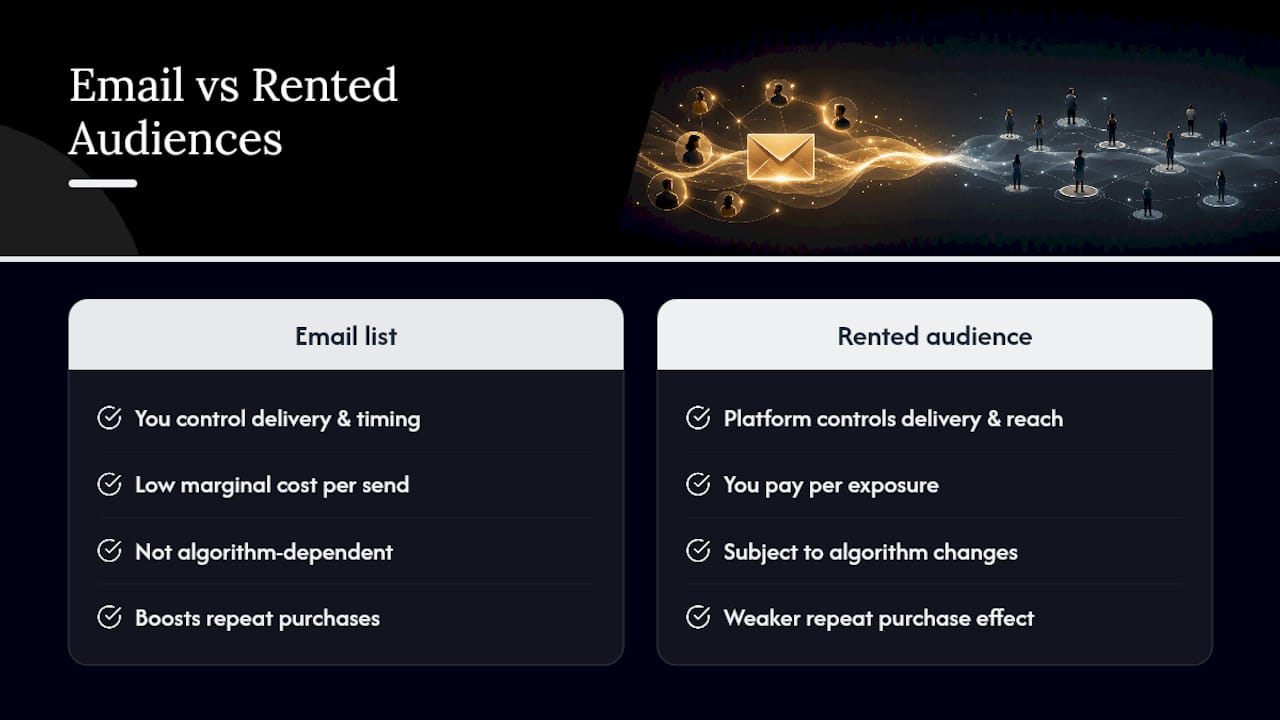
An email list you own behaves nothing like a rented audience on a social platform. Meta or TikTok can change its algorithm overnight and cut your organic reach in half. Your email list doesn’t do that. You control delivery, timing, and message, which is why brands with strong list programs treat email as a hedge against ad-platform volatility.
The financial case is straightforward once you look at where email fits in the customer lifecycle. Transactional emails already carry higher open rates than standard marketing sends, which makes them a natural extension point: a shipping confirmation or receipt is a moment when a customer is paying attention, and it’s a chance to deepen that relationship rather than waste it.
Three outcomes shift noticeably once a list matures:
Repeat purchase rate. Subscribers who joined through a genuine interest signal, like downloading a size guide or a buying checklist, convert on a second purchase far more reliably than someone acquired through a generic contest entry.
Abandoned cart recovery. This only works if the shopper’s email was captured with real consent and context. A list built through purchased contacts or scraped forms produces cart recovery flows that mostly get ignored or reported as spam.
Cost per acquisition over time. Paid channels charge you every single time. An email list, once built, keeps converting at close to zero marginal cost per send.
Here’s where most teams get the strategy backward: they chase list size instead of list quality. A list of 50,000 disengaged addresses is a liability, not an asset. It drags down your sender reputation, triggers spam filters, and makes every metric look worse than a smaller, more responsive list would. HubSpot’s list-building research is blunt about this: never buy lists, and prioritize engaged subscribers over raw volume, because engagement is what protects deliverability and long-term value. A brand with 8,000 subscribers who open and click regularly will outperform a brand with 80,000 who don’t.
How Do You Measure Subscriber Acquisition Success?
You can’t optimize what you don’t measure, and acquisition has its own scorecard separate from campaign performance. Most teams track open rates and call it a day, which misses the acquisition-specific metrics that actually predict whether your list will be worth anything in six months.
Start with net list growth rate, which accounts for churn instead of just counting new signups:
Net growth rate = (New subscribers − Unsubscribes − Hard bounces) ÷ Total list size at start of period
A list growing 10% monthly on paper but losing 8% to unsubscribes and bounces is really growing 2%. That distinction changes budget decisions.
Cost per acquired subscriber (CAC per subscriber) tells you whether a channel is worth scaling:
CAC per subscriber = Total channel spend ÷ Net new subscribers from that channel
Run this per channel, not in aggregate. A paid social campaign might produce subscribers at $2 each while a partnership activation produces them at $0.40 each with better long-term engagement. Without channel-level math, you’ll keep funding the expensive option.
Signup conversion rate measures how well your capture points actually work: visitors who see a form divided by those who complete it. Landing page conversion is a tighter version of the same metric, isolated to a specific offer or lead magnet.
Welcome-flow open and click rates serve as your earliest quality signal. A new subscriber who opens the first welcome email and clicks through is a fundamentally different asset than one who never opens it. Watch this in the first 72 hours.
Deliverability metrics round out the picture:
| Metric | What it signals | Healthy benchmark direction |
|---|---|---|
| Bounce rate | List hygiene and email validity | As close to zero as possible |
| Spam complaint rate | Sender reputation risk | Low, monitored every send |
| Unsubscribe rate | Content or targeting mismatch | Stable, not spiking |
| Welcome email open rate | Early engagement quality | Higher than regular campaign average |
These numbers work together. A rising unsubscribe rate paired with a falling welcome-flow open rate usually means your acquisition channel is bringing in the wrong people, not that your content got worse.
Proven Strategies for Growing Your Email List
Not all acquisition tactics deliver the same quality of subscriber, and treating them as interchangeable is where most list-building efforts stall. Some channels move fast but produce shallow engagement. Others take longer to set up but produce subscribers who stick around and buy. Here’s how the major tactics stack up.
-
Lead magnets and content upgrades. A discount code converts fast but attracts deal-seekers who may never open another email once they’ve used it. A genuinely useful resource, like a sizing guide, a buyer’s checklist, or an industry report, attracts subscribers who wanted the content itself, which correlates with better long-term open rates. Mailmodo’s acquisition research ranks content-based lead magnets above pure discount offers for subscriber quality, even though discounts convert at a higher initial rate.
-
On-site capture: pop-ups, timed banners, exit intent. These are the highest-volume tactic available and the easiest to test. The UX rules matter more than the mechanism: a pop-up that fires within 3 seconds of landing annoys visitors and produces low-intent signups. One that triggers after meaningful engagement (scroll depth, time on page, or exit intent) captures people who’ve already decided they’re interested.
-
SEO-driven landing pages and organic content. Slower to build, but the subscribers it produces already trust your expertise before they sign up. Someone who found your guide to fabric care through a search engine and then subscribed for more tips is a warmer lead than someone who saw a random ad.
-
Social organic and paid acquisition. Paid social scales quickly and lets you target lookalike audiences, but cost per subscriber climbs fast and quality varies widely by platform and creative. Organic social, by contrast, is slow but tends to produce subscribers already familiar with your brand voice.
-
Partnerships, guest content, and co-marketing. Two brands with overlapping but non-competing audiences can swap newsletter mentions, run joint giveaways, or co-host a webinar. This tactic is underused because it requires relationship-building, but Retainful’s acquisition guide points to partnership-sourced subscribers as some of the highest-quality additions to a list, since they arrive with a trust transfer from the referring brand.
-
Offline capture: events, retail, point-of-sale. If you have any physical touchpoint, a tablet at checkout or a sign-in sheet at an event still works. The catch: offline capture needs an explicit opt-in checkbox, not an assumption that handing over a business card equals consent.
Here’s the prioritization question every marketing lead should ask before testing a new channel:
- Does this channel let me test and get results within two weeks?
- Does the resulting subscriber arrive with context about why they signed up?
- Can I attribute the subscriber to this specific channel for measurement?
- Does the tactic risk collecting addresses without real consent?
Fast channels like pop-ups and paid social let you validate quickly but often need volume to offset lower per-subscriber quality. Slower channels like SEO content and partnerships take longer to scale but tend to reward you with subscribers who convert and stay subscribed.
Pro Tip: Run your lead magnet A/B test with the exact same traffic source and placement, changing only the offer. A discount code versus a content guide, tested head-to-head on identical traffic, will tell you more about your audience’s actual motivation than any amount of industry benchmarking.
The tactical mix that works for a footwear brand won’t be identical to one that works for a software company or a local retailer. What holds across categories is Mailmodo’s core recommendation: prioritize channels by expected subscriber quality and how fast you can test them, not by which tactic sounds most sophisticated.
What Makes a Signup Form Actually Convert?
The mechanics of your signup form matter as much as the offer behind it. A great lead magnet paired with a clunky, five-field form will underperform a mediocre offer paired with a frictionless one-field form nearly every time.
Placement and timing determine whether a form gets seen by the right visitor at the right moment. A well-timed exit-intent pop-up, triggered only after someone has scrolled through meaningful content, catches people who are already engaged and about to leave.
Field choices should stay minimal at first contact. Ask for an email address and nothing else on the first form. If you need birthday, preferences, or purchase history, collect those later through progressive profiling, either in the welcome series or through a follow-up preference center. Every additional field on the initial form measurably drops completion rates.

Microcopy carries more weight than most teams assume. “Sign up for our newsletter” tells the visitor nothing about what they get. Value-first CTA copy consistently outperforms vague, generic phrasing.
Privacy language and trust signals reduce hesitation. A short line like “We respect your inbox, unsubscribe anytime” next to the submit button addresses the exact objection a hesitant visitor is silently having. This is a small addition with an outsized effect on completion rates for skeptical visitors.
Confirmation and delivery need to be instant and clear. If someone traded their email for a discount code or a guide, the confirmation page should either deliver it immediately or state clearly when and how they’ll receive it. A vague “Thanks for subscribing!” with no next step creates doubt about whether the signup even worked.
Some quick wins worth testing this month:
- Reduce your signup form to a single required field
- Rewrite your CTA button copy to state the specific benefit
- Add a one-line trust statement near every capture point
- Test moving your primary pop-up trigger from time-based to scroll-based
Pro Tip: Test your confirmation page delivery speed yourself, on mobile, using a slow connection. Delivery delays that seem trivial on a fast office Wi-Fi connection can feel broken on a phone in a store, which is where a lot of your offline and social-driven signups happen.
How Should a Welcome Flow Turn Signups Into Buyers?
A signup is not a subscriber relationship. It’s an invitation to build one, and the welcome flow is where that relationship either forms or dies quietly. This is the acquisition-to-retention bridge, and it deserves more attention than most brands give it.
-
Send the first email within minutes, not hours. Someone who just handed over their email is at peak attention. A welcome email delivered instantly, thanking them and delivering whatever was promised, captures that moment. Delayed delivery loses it.
-
Segment immediately by signup source. Someone who subscribed through a discount pop-up has different intent than someone who subscribed through a detailed buying guide. The AMA’s guidance on email marketing treats segmentation and welcome sequencing as inseparable, since a generic welcome series wastes the context you already have about why someone joined.
-
Structure the series across three to five emails over one to two weeks. A typical sequence introduces the brand story, showcases social proof or bestsellers, delivers a short-window offer, and then transitions into regular campaign cadence. Take-action’s automated workflow examples show how this sequencing structure adapts across different ecommerce categories.
-
Use behavior triggers, not just time delays. If a subscriber clicks through to a product page but doesn’t buy, that’s a different next-email trigger than someone who opens but never clicks anything.
-
Measure open and click rates on each individual email in the sequence, not just the series overall. A steep drop-off between email two and email three tells you exactly where the sequence loses people, which is far more useful than an aggregate average.
Content that reliably performs in welcome sequences includes founder or brand-origin stories, genuine social proof like review counts or press mentions, and a time-bound offer that creates a reason to act now rather than later. Skip the generic “here’s what we sell” email. Nobody signed up for a catalog.
How Do You Protect Deliverability While Scaling Acquisition?
Growing a list fast is easy. Growing one that still lands in the inbox six months later is the actual skill. Every acquisition decision you make either protects or damages your sender reputation, and reputation damage compounds quietly until deliverability collapses all at once.
The first rule is absolute: never buy an email list. HubSpot is direct about this, and the reasoning holds up under scrutiny. Purchased lists have never opted in to hear from you, so open rates crater, spam complaints spike, and your sender reputation with providers like Gmail and Outlook takes damage that follows you across every future campaign, not just the one send.
Beyond that non-negotiable, a few practical rules protect list health as you scale:
- Choose double opt-in for higher-risk acquisition channels (contests, giveaways, co-marketing swaps) where signup intent is less certain, even though it costs you some volume
- Single opt-in works fine for high-trust, high-intent channels like a checkout-page signup from an actual customer
- Remove hard bounces immediately, ideally through automated suppression rather than a manual quarterly cleanup
- Watch spam complaint rate as a leading indicator, not just unsubscribes, since complaints hurt deliverability far more severely
- Make unsubscribing genuinely easy, since a frustrated subscriber who can’t find the unsubscribe link will complain to their inbox provider instead
Tracking the acquisition source for every subscriber pays off here too. When a specific channel starts generating disproportionate complaints or bounces, you can shut off that specific source instead of guessing which part of your funnel broke. Salesforce’s list-building framework ties this directly to list quality: permission-based collection isn’t just an ethical baseline, it’s the mechanical reason targeted, personalized campaigns perform better in the first place.
How Do You Test and Improve Acquisition Over Time?
Acquisition isn’t a project with an end date. It’s a system that needs the same testing discipline you’d apply to paid ad creative or product pricing. Treating your first version of a signup form or lead magnet as final is the single most common mistake in this whole discipline.
Attribution starts with tagging every subscriber by source at the moment of signup, whether that’s a UTM parameter, a form ID, or a simple tag in your email platform. Without this, you’re optimizing blind. You’ll know your list grew, but not which channel actually did the work.
A few testing ideas worth running in sequence rather than all at once:
- A/B test your lead magnet offer against a different offer type (discount versus content) on identical traffic
- Test CTA button copy variations for specificity versus vague language
- Test pop-up trigger timing (immediate versus scroll-based versus exit-intent)
- Test landing page layout with and without social proof elements above the fold
Cohort analysis matters more here than most teams realize. Instead of asking “how many subscribers did we get last month,” ask “how did the subscribers from March’s Instagram campaign perform 90 days later compared to the subscribers from March’s SEO content?” That comparison, tracked over a real time window, tells you which channel is actually worth more, even if it looked more expensive per subscriber upfront.
Once you have channel-level cohort data, shift budget toward whatever produces the best CAC per engaged subscriber, not the lowest CAC per raw signup. A channel that costs more but produces subscribers who open, click, and buy is worth more than a cheap channel full of one-time email addresses.
Take-action’s 30-Day Acquisition Audit Checklist
A focused first month can reveal most of what’s broken in an acquisition program. Here’s the sequence Take-action runs with new clients before recommending any new spend.
Week 1: Measurement baseline. Pull current net list growth rate, CAC per subscriber by channel, and welcome-flow open rates. You can’t fix what you haven’t measured.
Week 2: Capture audit. Review every on-site form, pop-up, and landing page for field count, timing, and CTA copy. Most audits find at least one high-traffic page with no capture point at all.
Week 3: Welcome flow assessment. Check email-by-email open and click rates in the current sequence. Identify the exact point where engagement drops.
Week 4: Quick lead-magnet experiments. Launch one new offer test against the current best-performer, measured against identical traffic.
- Prioritize the welcome flow fix first; it affects every future subscriber, not just new ones
- Fix high-traffic capture points before low-traffic ones
- Run one test at a time to keep attribution clean
Pro Tip: If you only have time for one fix this month, fix the welcome flow. A better acquisition funnel feeding a weak welcome sequence still wastes most of the value you just paid to generate.
The Overrated Part of Acquisition, and What Actually Deserves the Budget
Most acquisition advice obsesses over top-of-funnel tricks: better pop-up copy, smarter exit-intent timing, another lead magnet format. Those things help marginally. What the research actually supports is less exciting: the welcome flow is where acquisition either pays off or evaporates, and most brands under-invest in it relative to how much they spend attracting the signup in the first place.
The conventional advice treats list size as the scoreboard. It isn’t. A smaller, engaged list will outperform a bloated one on every metric that touches revenue, and it protects your sender reputation while doing it. If you take one thing from this guide, prioritize measurement before tactics: know your CAC per engaged subscriber before you scale any channel, and know exactly where your welcome sequence loses people before you add a single new capture form. Fix the leaks before you turn up the tap. Everything else is optimization around the edges.
— Take
Ready to Turn Acquisition Into Predictable Revenue?
Building the list is half the job. Converting that list into repeat revenue through a properly built welcome sequence, segmentation, and lifecycle automation is the harder half, and it’s the half most brands never fully finish. Take-action specializes in exactly that gap, running Klaviyo setup, welcome flows, cart abandonment automations, and ongoing campaign strategy for ecommerce brands that need email to function as a real growth channel, not an afterthought.
If your welcome flow open rates are lagging or your acquisition channels aren’t tagged well enough to know what’s actually working, that’s the exact starting point Take-action’s team audits first. You can see the full range of services, from flow setup to long-term managed programs, and get a sense of how a partnership works, on the Take-action services page. Book a conversation there to get a clear read on what your acquisition funnel and welcome sequence are actually producing right now.