

What is online marketing: mastering email automation
While most brands chase paid ads, the real revenue powerhouse sits quietly in your subscribers’ inboxes. Automated email marketing generates over three times the revenue of manual campaigns, yet many ecommerce marketers overlook this critical channel. This guide reveals how email automation transforms retention and builds sustainable growth beyond fleeting ad spend.
Table of Contents
- Introduction To Online Marketing: Definition And Scope
- The Critical Role Of Email Marketing Automation In Ecommerce
- How Personalization And Segmentation Power Effective Email Campaigns
- Building And Optimizing High-Impact Email Flows For Retention
- Common Misconceptions About Online Marketing And Email Automation
- Integrating Ai And Human Expertise To Maximize Email Engagement
- Conclusion And Next Steps For Ecommerce Marketers
- Discover Expert Email Marketing And Retention Support
- Frequently Asked Questions
Key takeaways
| Point | Details |
|---|---|
| Online marketing extends far beyond ads | Email marketing drives superior retention compared to paid acquisition channels |
| Automation delivers massive revenue impact | Automated emails generate 20-30% of total ecommerce revenue with minimal manual effort |
| Segmentation multiplies engagement | Targeted campaigns achieve 14% higher opens and double the click-through rates |
| Strategic flows target journey touchpoints | Welcome, cart abandonment, and post-purchase sequences maximize customer lifetime value |
| AI plus human creativity wins | Combining data-driven optimization with authentic brand voice produces best results |
Introduction to online marketing: definition and scope
Online marketing encompasses all digital channels brands use to reach customers, from search engines and social media to content marketing and paid advertising. Each channel serves specific purposes in the customer journey.
Email stands apart as the retention champion. Unlike social posts that disappear in feeds or ads that stop when budgets run dry, email creates direct, owned relationships with customers. Customer retention through email costs far less than acquiring new buyers while generating higher lifetime value.
For ecommerce brands, mastering online marketing means understanding how channels work together. Paid ads attract attention. SEO builds authority. Social media sparks conversations. But email marketing automation turns one-time buyers into loyal customers who return repeatedly.
Key online marketing channels include:
- Email marketing for direct customer communication and retention
- Search engine optimization to capture organic traffic
- Social media for brand awareness and community building
- Paid advertising to drive targeted acquisition
- Content marketing to educate and engage audiences
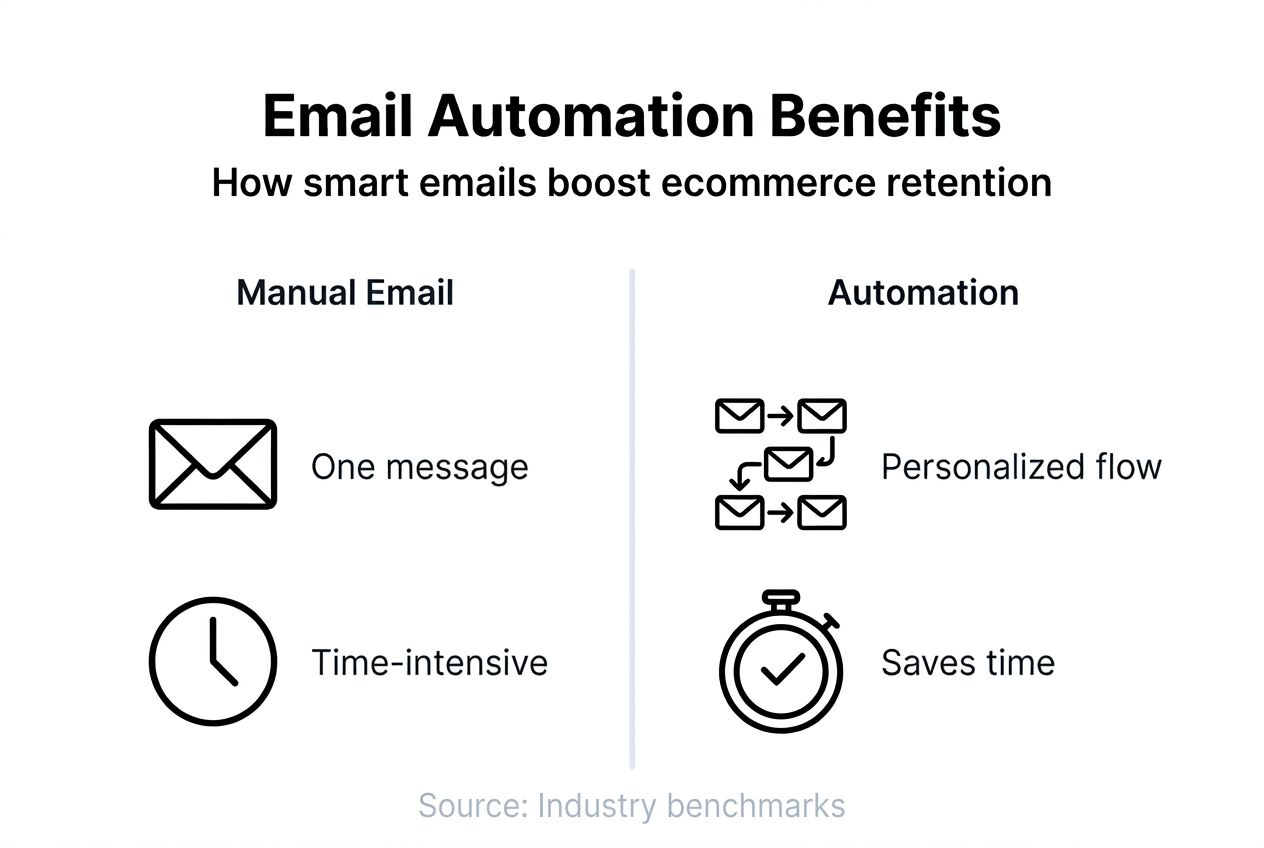
Email marketing automation specifically enables personalized outreach at scale. Instead of manually crafting individual messages, automation triggers relevant emails based on customer behaviors like purchases, browsing patterns, or engagement levels. This technology transforms email from a labor-intensive task into a revenue-generating system that works continuously.

The strategic advantage becomes clear when you consider timing. Automated systems send the perfect message at the exact moment customers need it, whether that’s welcoming new subscribers, recovering abandoned purchases, or nurturing repeat buyers. This precision drives significantly better results than batch-and-blast manual campaigns.
The critical role of email marketing automation in ecommerce
Automation separates mediocre email programs from revenue powerhouses. While manual campaigns require constant effort for modest returns, automated workflows generate 20-30% of total revenue for ecommerce brands with proper setup.
The performance gap is staggering. Automated sequences achieve over 300% higher revenue per email compared to promotional blasts. This happens because automation delivers relevance and timing that manual sending cannot match.
Essential automated flows every ecommerce brand needs:
- Welcome series to introduce new subscribers to your brand story and products
- Cart abandonment sequences to recover lost sales from browsing shoppers
- Post-purchase follow-ups that drive reviews, referrals, and repeat orders
- Customer winback campaigns to re-engage inactive buyers before they churn
- Browse abandonment reminders for visitors who viewed products without buying
Each flow targets specific customer journey moments where timely communication dramatically impacts behavior. A welcome email sent immediately after signup capitalizes on peak interest. An abandoned cart reminder within hours recovers purchases while intent remains high. Post-purchase sequences build momentum toward the critical second order.
| Flow Type | Average Open Rate | Revenue Impact | Optimal Send Window |
|---|---|---|---|
| Welcome Series | 45-55% | High first purchase conversion | Within 1 hour of signup |
| Cart Abandonment | 40-45% | 15-25% revenue recovery | 1, 24, 72 hours after exit |
| Post-Purchase | 35-40% | Drives 2nd purchase, reviews | 3, 7, 30 days after order |
| Browse Abandonment | 30-35% | Moderate conversion lift | 4-24 hours after session |
Pro Tip: Start with welcome and cart abandonment flows first. These two sequences typically generate the highest immediate revenue impact and require minimal ongoing management once properly configured.
Automation also enables sophisticated nurturing impossible through manual campaigns. A single welcome series might branch into different paths based on first purchase category, sending tailored product recommendations and education that match each customer’s demonstrated interests. This personalization at scale drives the outsized revenue results automation delivers.
How personalization and segmentation power effective email campaigns
Sending identical messages to every subscriber wastes your list’s potential. Segmentation divides customers into groups based on behaviors, preferences, and purchase patterns, enabling targeted communication that resonates.
Segmented campaigns deliver 14% higher open rates and double the clicks compared to generic blasts. This performance lift translates directly to revenue when you match offers to customer intent.
Behavioral segmentation focuses on actions customers take:
- Purchase history segments by product category, average order value, or frequency
- Engagement level separates active openers from dormant subscribers
- Browsing behavior identifies product interests before purchases occur
- Lifecycle stage distinguishes new customers from loyal repeat buyers
Personalization takes segmentation further by customizing message content for each recipient. Beyond inserting first names, sophisticated personalization includes product recommendations based on browsing history, offers matching past purchase categories, and content aligned with engagement patterns.
The technical implementation connects your ecommerce platform with email software to sync customer data continuously. When someone purchases a specific product category, that data updates their profile instantly, triggering appropriate follow-up sequences and updating future campaign targeting.
Effective personalization strategies:
- Dynamic product blocks showing items related to recent views or purchases
- Conditional content that changes based on customer lifetime value
- Send time optimization delivering emails when each person typically engages
- Predictive recommendations using AI to surface next likely purchases
Pro Tip: Audit your customer data monthly to identify new behavioral patterns worth segmenting. Fresh segments based on emerging trends keep your messaging relevant as customer behaviors evolve throughout the year.
The compounding effect matters most. Each layer of segmentation and personalization incrementally improves performance. A campaign sent to engaged customers, featuring products related to their last purchase, sent at their typical open time will dramatically outperform a generic Sunday morning blast to your entire list.
Building and optimizing high-impact email flows for retention
Creating effective automated sequences requires mapping customer journeys first. Identify every touchpoint where timely communication influences behavior, from initial awareness through repeat purchases and potential churn.
Start by documenting your ideal customer path:
- Awareness stage where prospects discover your brand
- Consideration phase as they evaluate products and compare options
- Purchase moment when they convert to customers
- Post-purchase experience including delivery and product use
- Retention period where you encourage repeat orders
- Potential reactivation if engagement drops
Each stage presents email opportunities. Targeted abandoned cart flows exemplify perfect timing, reaching customers precisely when purchase intent peaks but friction caused hesitation.
Best practices for flow construction:
- Limit welcome series to 3-5 emails over 2 weeks to avoid overwhelming new subscribers
- Space cart abandonment reminders at 1 hour, 24 hours, and 72 hours for optimal recovery
- Send post-purchase emails at 3 days for delivery confirmation, 7 days for review requests, and 30 days for replenishment or cross-sells
- Keep individual emails focused on single clear calls to action
- Test different subject line approaches, send times, and offer structures continuously
A/B testing drives ongoing optimization. Test one variable at a time to isolate what moves metrics. Subject line tests reveal messaging that captures attention. Send time experiments identify when your audience engages most. Offer tests determine which incentives drive conversions without training customers to wait for discounts.
Monitor these key performance indicators:
- Open rates showing subject line and sender name effectiveness
- Click-through rates indicating content relevance and call-to-action strength
- Conversion rates measuring ultimate revenue impact
- Unsubscribe rates signaling frequency or relevance issues
Adjust flows based on performance data. If a specific email in your welcome series shows weak engagement, revise the content or reposition it in the sequence. When cart abandonment recovery drops, test new subject lines or adjusted discount offers.
The optimization cycle never ends. Customer preferences shift, competitive dynamics change, and seasonal factors influence behavior. Quarterly flow audits ensure your sequences remain effective as conditions evolve.
Common misconceptions about online marketing and email automation
Several persistent myths prevent ecommerce marketers from fully leveraging email automation’s potential. Understanding these misconceptions helps you avoid strategic mistakes that limit growth.
Myth 1: Online marketing equals paid advertising. Many marketers equate digital promotion entirely with Facebook ads and Google campaigns. While paid channels drive awareness, they represent just one component of comprehensive online marketing. Email, content, SEO, and organic social all contribute to sustainable growth without ongoing ad spend.
Myth 2: Email marketing is intrusive spam. This outdated view stems from batch-and-blast tactics of the past. Modern email automation sends targeted, relevant messages customers actually want based on their behaviors and preferences. Permission-based email to engaged subscribers who opted in creates value, not annoyance.
Myth 3: Acquisition matters more than retention. Brands often obsess over new customer acquisition while neglecting existing buyers. Reality inverts this priority. Retaining customers costs 5-25 times less than acquiring new ones, and repeat buyers spend more per order while requiring less convincing. Email automation excels at retention, making it a higher-ROI investment than most acquisition channels.
“The misconception that email is dead or ineffective persists despite overwhelming data showing email generates the highest ROI of any marketing channel for ecommerce brands. Automation amplifies this advantage by making personalized retention scalable.”
These beliefs limit potential when marketers allocate budgets primarily to paid ads while treating email as an afterthought. The brands winning at ecommerce invert this model, building robust email programs first, then using paid channels to feed their retention engine with new customers.
Shifting perspective requires recognizing email automation as infrastructure, not tactics. Like a warehouse or fulfillment system, email flows work continuously to generate revenue. Once built, they require optimization rather than constant recreation, delivering compounding returns as your list grows.
Integrating AI and human expertise to maximize email engagement
Artificial intelligence transforms email marketing by analyzing massive datasets to identify patterns humans miss. AI tools optimize send times by learning when each subscriber typically opens emails, predict which products individual customers will likely purchase next, and generate subject line variations to test against control messages.
Common AI applications in email marketing:
- Send time optimization analyzing individual engagement patterns
- Predictive product recommendations based on collaborative filtering
- Subject line generators testing variations against performance data
- Content optimization suggesting layout and copy improvements
- Churn prediction identifying at-risk customers for proactive retention
Despite AI’s analytical power, human creativity remains essential. Algorithms excel at pattern recognition but struggle with emotional resonance, brand voice consistency, and cultural context. The most effective email programs combine AI’s optimization capabilities with human strategic thinking and creative execution.
Human marketers contribute what AI cannot:
- Brand voice that reflects authentic personality and values
- Emotional storytelling that builds genuine customer connections
- Strategic campaign planning aligned with business objectives
- Cultural awareness preventing tone-deaf messaging
- Creative concepts that surprise and delight rather than optimize incrementally
The hybrid approach works best. Use AI to analyze data, identify opportunities, and optimize technical elements like timing and personalization. Then apply human judgment to craft messages that feel authentic rather than algorithmically generated.
Practical integration means letting AI handle repetitive optimization while humans focus on strategy and creativity. AI tests subject lines, but humans write compelling campaign concepts. AI predicts product affinity, but humans design engaging merchandising stories around those products. AI identifies churn risk, but humans craft winback campaigns that emotionally reconnect.
This collaboration produces better results than either approach alone. AI ensures technical excellence and continuous improvement. Human expertise ensures messages resonate emotionally and align with brand strategy. Together, they create email programs that both perform measurably and build lasting customer relationships.
Conclusion and next steps for ecommerce marketers
Email automation represents the most powerful retention tool available to ecommerce brands, generating 20-30% of revenue while requiring minimal ongoing manual effort. Unlike paid advertising that demands constant investment, properly configured email flows work continuously to convert subscribers into customers and customers into loyal repeat buyers.
The strategic elements matter most. Segmentation ensures relevance by targeting messages to specific customer behaviors and preferences. Personalization increases engagement by matching content to individual interests. Journey mapping identifies critical touchpoints where timely communication influences purchase decisions. Together, these elements transform email from promotional noise into valuable customer communication.
For ecommerce marketers ready to implement or improve email automation, start with foundational flows: welcome series for new subscribers and cart abandonment for recovery. These two sequences typically generate immediate revenue impact while you build out more sophisticated nurturing programs.
Measure continuously and optimize relentlessly. Test subject lines, send times, content approaches, and offer strategies to incrementally improve performance. Small gains compound as your list grows and your flows mature.
Consider partnering with specialists when scaling beyond basics. Expert agencies bring proven frameworks, technical expertise, and strategic guidance that accelerate results while avoiding costly mistakes. The investment in professional email marketing support typically pays for itself through improved campaign performance and faster implementation.
Discover expert email marketing and retention support
Building a revenue-generating email program requires expertise across strategy, technology, and creative execution. While the concepts are straightforward, implementation details determine whether your automation delivers industry-leading results or mediocre performance.
Take Action specializes in transforming email into your primary growth channel through proven automation frameworks and personalized strategies. Our team combines deep Klaviyo expertise with ecommerce-specific best practices to build flows that maximize engagement and customer lifetime value. Whether you are launching your first automated sequences or scaling existing programs, our email marketing and retention agency delivers the strategic guidance and technical execution needed to achieve measurable growth. Explore our email marketing agency services to discover how we help ecommerce brands automate retention and accelerate revenue through sophisticated email solutions.
Frequently asked questions
What is online marketing in simple terms?
Online marketing means promoting products or services through digital channels like email, social media, search engines, and websites to reach and engage customers. Email marketing specifically focuses on personalized, direct communication that builds customer relationships and drives repeat purchases.
Why is email automation crucial for ecommerce retention?
Email automation sends timely, relevant messages triggered by specific customer actions, dramatically increasing retention and revenue without requiring manual effort for each send. Automated sequences recover abandoned purchases, nurture new customers, and re-engage inactive buyers efficiently at scale.
How can personalization improve my email campaign results?
Personalization increases email relevance by matching content, offers, and timing to individual customer behaviors and preferences, resulting in significantly higher open rates, click-through rates, and conversions. Segmented campaigns deliver 14% better opens and double the clicks compared to generic messages sent to entire lists.
What are common email flows I should automate?
Welcome series for new subscribers, abandoned cart recovery sequences, and post-purchase follow-ups represent the foundational automated flows every ecommerce brand needs. These sequences nurture initial interest, recover lost sales, and encourage repeat buying with minimal ongoing management once properly configured.
Recommended
- Digital Marketing Services: Driving Ecommerce Growth | Take Action Blog | Take Action
- Complete Guide to Email Marketing for Beginners | Take Action Blog | Take Action
- Business Networking Strategies for Automated Email Growth | Take Action Blog | Take Action
- Digital Media Strategy: Unlocking Ecommerce Growth | Take Action Blog | Take Action
- 7 Benefits of Email Automation for Ecommerce Success