

Why Email Newsletters Work: Boost Ecommerce Retention
TL;DR:
- Email newsletters strongly outperform other channels in customer engagement and long-term retention.
- They build trust, social proof, and exclusivity, fostering deeper customer loyalty.
- Consistent, value-driven content and automation are key to maximizing ecommerce results.
Despite the explosive growth of paid social and influencer marketing, email newsletters consistently outperform nearly every other channel when it comes to genuine customer engagement and long-term retention. Many ecommerce teams chase the newest tactic while leaving their newsletter program on autopilot, collecting dust. That’s a costly mistake. Email newsletters are far more effective than most marketers realize, especially for direct-to-consumer brands trying to build loyalty without endlessly pouring money into paid ads. This guide breaks down exactly why newsletters work, what’s holding most brands back, and how you can start using them as a true retention engine.
Table of Contents
- The psychological drivers behind effective newsletters
- Core reasons email newsletters drive ecommerce results
- Common misconceptions and how to overcome them
- Best practices for building high-performing ecommerce newsletters
- Why the typical ‘newsletter’ mindset holds brands back
- Amplify your retention strategy with expert help
- Frequently asked questions
Key Takeaways
| Point | Details |
|---|---|
| Trust drives engagement | Value-led, consistent newsletters build trust and foster customer loyalty. |
| Retention beats reach | Owned email audiences drive stronger, longer-lasting results than social media followers. |
| Debunk the email myth | Brands who treat newsletters as pure sales spam miss out on powerful retention opportunities. |
| Best practices unlock ROI | Segmenting, automating, and testing newsletter content leads to measurable gains in purchase and retention rates. |
The psychological drivers behind effective newsletters
Understanding why customers open newsletters consistently comes down to psychology, not luck. When you grasp the mental levers that drive engagement, you can engineer your content to activate them deliberately.
The first driver is trust. When your newsletter delivers education, useful tips, or honest brand stories, readers start to associate your emails with value rather than noise. That association builds over time, and eventually your sender name alone becomes a signal worth opening. Value-first content like education and social proof is what shifts a subscriber from passive reader to loyal buyer.
Social proof is the second major driver. Testimonials, user-generated stories, and real customer results reduce the anxiety a hesitant buyer feels before purchasing. When a reader sees someone like them succeeding with your product, the decision becomes easier. You can learn more about using social proof strategically inside email to move people through your funnel faster.
The third driver is exclusivity. Subscribers who feel like insiders, people who get early access, behind-the-scenes content, or member-only offers, have a stronger reason to stay subscribed. This sense of belonging is a powerful retention mechanism that paid ads simply cannot replicate.
Here are the primary psychological motivators that high-performing newsletters activate:
- Trust: Consistent, honest content builds credibility over time
- Reciprocity: When you give value first, readers feel compelled to give back (by buying)
- Consistency: A predictable cadence trains subscribers to expect and look forward to your emails
- Exclusivity: VIP-feel content creates belonging and reduces churn
“The brands winning with newsletters aren’t blasting promotions. They’re showing up consistently with content that makes subscribers feel seen, informed, and valued.”
If you’re still fuzzy on the newsletter fundamentals that make this possible, that’s worth revisiting before investing heavily in campaigns. Getting the foundation right determines everything else.
Core reasons email newsletters drive ecommerce results
Once you understand what motivates readers to open and engage, it’s natural to ask what makes newsletters such a strong channel for ecommerce brands specifically.
The biggest structural advantage is ownership. Unlike Instagram or TikTok, your email list belongs to you. Algorithm changes don’t erase your reach overnight. Every subscriber on that list opted in, which means you have direct, permission-based access to people who already raised their hand for your brand.

Segmentation is the second major strength. With a tool like Klaviyo, you can split your audience by purchase history, browsing behavior, geographic location, or engagement level. That means a first-time buyer gets a completely different newsletter than a VIP repeat customer. Relevance drives results. Check out these newsletter ideas for retention that you can adapt for different audience segments.
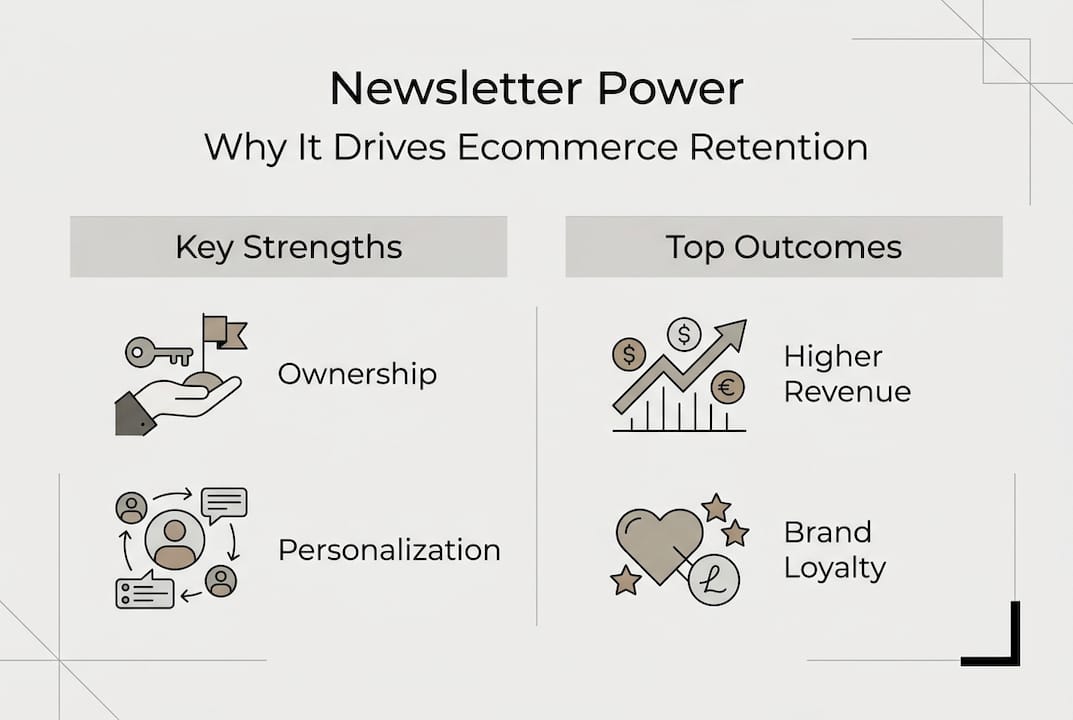
And the ROI speaks for itself. Email marketing consistently delivers returns that paid social struggles to match, especially once you factor in the compounding value of a growing owned list.
Here are the top five reasons newsletters deliver measurable ecommerce results:
- Direct communication: No intermediary platform controls your reach
- Segmentation: Tailor content for each stage of the customer lifecycle
- Measurable ROI: Every open, click, and conversion is trackable
- Automation readiness: Flows and triggered sequences work around the clock
- Brand recall: Regular sends keep your brand top-of-mind between purchases
Stat to know: Revenue matters more than open or click rates alone. Brands testing broad versus narrow sends often find that a smaller, more engaged segment generates more actual revenue than blasting the full list. The email impact data from real ecommerce brands confirms this pattern repeatedly.
The combination of ownership, personalization, and reliable tracking makes newsletters a channel where you control your own destiny.
Common misconceptions and how to overcome them
Equipped with knowledge of what drives results, it’s equally important to sidestep the misconceptions that sabotage even the best intentions.
The most persistent myth is that email is dead. It isn’t. Email continues to outperform newer platforms on revenue per recipient, customer retention, and lifetime value metrics. Brands chasing TikTok trends while neglecting their lists are leaving money on the table.
The second myth is that newsletters equal spam. This only happens when brands prioritize promotions over value. A newsletter packed with genuine insight, exclusive stories, and useful tips earns its place in the inbox. Consistent value beats pure promotion every time, and subscribers will tell you with their open rates.
The third myth is that one message fits all subscribers. It doesn’t. Sending the same content to your newest subscriber and your most loyal customer is a missed opportunity on both ends. Segmentation and personalization are what turn a generic blast into a relevant, welcome message.
| Misconception | Evidence-based reality |
|---|---|
| Email is obsolete | Delivers higher ROI than most emerging channels |
| Newsletters are spam | Value-centric emails build loyalty and reduce churn |
| One-size-fits-all works | Segmentation lifts relevance and conversion rates |
| Design matters most | Content quality and cadence outperform flashy templates |
| More sends equals more revenue | Consistent value sends beat high-volume batch blasts |
Pro Tip: Before obsessing over design or send volume, nail your content quality and establish a consistent cadence. Subscribers forgive plain emails. They don’t forgive irrelevant ones.
Need a spark? Explore newsletter inspiration to break through creative blocks, or browse Klaviyo-specific ideas if that’s your platform of choice.
Best practices for building high-performing ecommerce newsletters
Avoiding misconceptions puts you on the right track. Now here’s how to get the most out of your newsletter investments.
The best-performing ecommerce newsletters balance three content types: educational content, product spotlights, and authentic brand stories. Leaning too hard on promotions trains readers to tune out. Mix in tips, behind-the-scenes content, and customer wins to keep things fresh and valuable. Value-first, tested, and consistent newsletters outperform one-off promotional blasts across virtually every retention metric.
Automation keeps you consistent without burning out your team. Set up triggered sequences for post-purchase follow-ups, re-engagement campaigns, and loyalty milestones. These run in the background while your team focuses on bigger creative lifts. The right automation tools make this scalable without sacrificing the personal feel subscribers expect.
Top content types that consistently drive retention:
- Educational tips tied to your product category
- Customer testimonials and transformation stories
- Segment-based exclusive offers and early access
- Behind-the-scenes brand or founder content
- Curated product roundups based on purchase behavior
Here’s a quick reference for matching practices to outcomes:
| Best practice | Typical result | Key KPI |
|---|---|---|
| Consistent weekly sends | Higher open rates over time | Open rate, list health |
| Segmented campaigns | Improved conversion | Revenue per email |
| A/B testing subject lines | 10-20% open rate lift | Open rate |
| Automated post-purchase flow | Repeat purchase uplift | Repeat purchase rate |
| Feedback loops | Reduced churn | Unsubscribe rate |
Testing is non-negotiable. Run A/B tests on subject lines, send times, and call-to-action placement regularly. Small improvements compound fast. Explore email marketing tips to find specific test ideas that work for ecommerce.
Pro Tip: Add a simple one-question survey to your newsletter every few months asking subscribers what content they want more of. Use customer feedback to refine your editorial calendar and reduce guesswork.
Why the typical ‘newsletter’ mindset holds brands back
Here’s the uncomfortable truth most brands won’t admit: they treat newsletters as a campaign, not a relationship. They plan a batch of sends for Q4, hit publish, and call it a strategy. Then they wonder why their unsubscribe rate spikes after the holidays.
Real retention doesn’t work like that. It requires a consistent, evolving conversation with your customer base. Retention isn’t just email, it’s a full customer experience system, but newsletters are one of the highest-potential and most underused parts of that system.
The “set-and-forget” approach is what causes the most damage. When newsletters go stale or feel irrelevant, subscribers don’t complain. They just stop opening. And once that disengagement sets in, re-engagement is expensive.
The brands seeing the biggest wins treat their newsletter program as a living product. They iterate based on feedback, adjust based on performance data, and integrate newsletter insights into the broader customer experience. Explore newsletter innovation ideas that keep your program feeling fresh rather than formulaic. The mindset shift from “campaign” to “customer relationship” is where the real gains begin.
Amplify your retention strategy with expert help
If you’re ready to move from theory to action, expert guidance can help accelerate your results. Building a newsletter program that actually drives retention takes more than good intentions. It takes the right strategy, the right tools, and ongoing optimization.
Take Action is a specialized email marketing and retention agency that helps direct-to-consumer brands build newsletter programs that do real work. From campaign strategy to full automation setup, we translate insights like the ones in this article into measurable revenue. Whether you’re starting from scratch or optimizing what you already have, we can help you setup a retention strategy built around your brand’s unique audience. Reach out to explore a custom audit or book a strategy session with our team.
Frequently asked questions
What makes email newsletters more effective than social media for ecommerce?
Email newsletters give you direct, owned access to your customers without algorithm interference, leading to higher engagement rates and far more measurable ROI than social platforms can deliver.
How often should ecommerce brands send newsletters for best results?
Weekly or biweekly sending tends to work best, provided every send delivers clear, consistent value rather than recycled promotions that train readers to ignore you.
What type of content works best in ecommerce newsletters?
Educational tips, exclusive offers, and authentic customer stories perform best, especially when tailored by segment so each subscriber receives content that reflects where they are in their journey with your brand.
Do newsletters really help with customer retention?
Absolutely. Consistent value-driven sends keep your brand relevant between purchases, deepening the relationship that turns one-time buyers into repeat customers over time.
Recommended
- 7 Innovative Ecommerce Newsletter Ideas for Higher Retention | Take Action Blog | Take Action
- Online Marketing Strategy: Driving Ecommerce Retention | Take Action Blog | Take Action
- Blog - Email Marketing Insights | Take Action | Take Action
- How to Repurpose Content for Ecommerce Email Success | Take Action Blog | Take Action
- How to Market Opal Jewelry for Maximum Impact Online - Australian Opal Direct