

Why email storytelling drives real ecommerce growth
TL;DR:
- Moving from promotional to narrative-driven emails significantly boosts engagement and revenue.
- Stories foster brand loyalty, reduce reliance on discounts, and improve key email metrics.
- Embedding structured narratives into flows increases repeat purchases and long-term customer value.
One switch can change your retention game entirely. Brands that moved from purely promotional emails to narrative-driven sequences saw results that are hard to ignore. One team generated $24K in revenue within 90 days simply by building a story into their flows rather than blasting another discount code. For e-commerce brands still treating email as a megaphone for promos, that number should raise questions. This guide walks through why story works, what the data actually shows, and exactly how to build narrative arcs into the automated flows your customers move through every day.
Table of Contents
- Why transactional emails alone can’t build lasting brands
- The measurable impact of email storytelling: Evidence from real brands
- Building narrative arcs into your email flows
- Making your story matter: Personalization, consistency, and retention
- Our perspective: The real barrier to powerful brand storytelling in email
- Ready to turn stories into sales?
- Frequently asked questions
Key Takeaways
| Point | Details |
|---|---|
| Emotional engagement wins | Narrative-driven emails outperform pure discounts by building stronger customer loyalty. |
| Data proves storytelling works | Case studies show tangible boosts in open rates, click-through, and sales when using brand stories. |
| Integrate stories into flows | Automated storytelling sequences maximize retention and repeat purchase. |
| Personalization drives retention | Tailoring your email story arcs to specific segments leads to better customer outcomes. |
Why transactional emails alone can’t build lasting brands
Discount-driven email has a ceiling. You can only cut prices so far before margin disappears, and the customers you attract with constant promotions are exactly the ones who leave the moment a competitor offers something cheaper. It is a cycle that erodes brand value quietly, one campaign at a time.
Here is what purely transactional emails typically deliver:
- A short-term spike in revenue tied to a coupon
- Customers conditioned to wait for deals before buying
- No emotional reason for anyone to prefer your brand over a generic alternative
- Increasing unsubscribe rates as inboxes fill with “10% off” messages that look identical from every sender
The deeper problem is that transactional emails treat every subscriber as a transaction rather than a person. Order confirmations, shipping updates, and sale announcements are necessary, but they do not build the kind of relationship that drives a customer to open your next email because they are genuinely interested in what you have to say.
“Narrative coherence reduces uncertainty, increases repeat purchase rates, and helps brands soften their reliance on heavy discounting.” Storytelling for ecommerce growth puts it plainly: the brands with the longest customer relationships are the ones that give people a reason to care, not just a reason to click.
This insight reshapes how you should think about every email your brand sends. When customers understand your origin story, your values, and the thinking behind each product, they are buying into something larger than the item in their cart. That psychological shift is what narrative-driven fashion examples in premium markets have demonstrated for years. Brands like those deliberately weave craft, heritage, and ethics into their communications because they know those stories justify the price point and reduce the need for discounting.
The practical implication for your email program is significant. Instead of building every campaign around a price message, you build it around a moment: the founder’s initial obsession, the sourcing trip that changed a supplier relationship, the customer whose feedback shaped a product update. Each of those moments creates a micro-narrative that connects with readers on a human level.
Pair this thinking with solid customer journey mapping and you can identify exactly where in the customer lifecycle a particular story will resonate most. A first-time buyer needs a different narrative than someone who has purchased five times. Getting that alignment right is what separates brands that grow subscriber lists into loyal communities from those that grow lists into coupon hunters.
The shift from transactional to emotional does not mean abandoning offers entirely. It means wrapping offers in context, in character, in meaning. When you do that, your promotional emails perform better too, because the reader already trusts the brand behind the offer.
The measurable impact of email storytelling: Evidence from real brands
Evidence matters more than theory when you are making decisions about your email program. So here is what actually happened when brands committed to a narrative approach.
One agency took a client through a 90-day email overhaul focused on story-driven campaigns and automated flows built around the brand’s identity. The revenue and engagement results showed clear movement across every key metric. Open rates climbed because subject lines reflected genuine brand personality rather than generic urgency tactics. Click-through rates improved because the email body gave readers something to follow, a story arc that made the CTA a natural next step rather than an interruption.
Here is how narrative and transactional email campaigns typically compare across core KPIs:
| Metric | Transactional approach | Narrative approach |
|---|---|---|
| Average open rate | 18 to 22% | 28 to 38% |
| Click-through rate | 1.5 to 2.5% | 3.5 to 6% |
| Repeat purchase rate | 12 to 18% | 25 to 35% |
| Unsubscribe rate | 0.4 to 0.8% | 0.1 to 0.3% |
| Revenue per email sent | Low baseline | 2x to 3x baseline |
These are not marginal improvements. A jump from 18% to 35% open rates changes your deliverability reputation, your sender score, and ultimately how many people even see your emails in the future. A doubling of repeat purchase rate directly increases customer lifetime value without any additional acquisition spend.
The brand storytelling results from brands that have systematized narrative flows consistently point to a few common drivers. First, storytelling emails generate more replies and direct replies are a strong deliverability signal that tells inbox providers your content is worth reading. Second, customers who engage with narrative flows tend to have higher average order values because the story primes them to think about the brand aspirationally rather than transactionally.
A quick example: A skincare brand shifted its post-purchase sequence from generic care instructions to a three-email arc about the founder’s ingredient sourcing process. The result was a 40% increase in second-purchase conversion within 60 days. No new discount. No additional traffic spend. Just a better story told at the right moment.

Why does retention respond so strongly to narrative? Because stories create familiarity, and familiarity drives preference. When a customer reads about the team behind your product, the challenges you overcame, or the specific philosophy that guides your design choices, they build a mental model of your brand that no competitor can easily displace. That mental model is the actual asset driving long-term average order value and lifetime value growth.
Building narrative arcs into your email flows
Storytelling without structure is just content. The brands that see consistent results are the ones that embed narrative into their automated flows so that every new subscriber and every returning customer moves through a deliberate story sequence without the brand team needing to intervene manually.
Here is how to approach the three core flows where narrative has the biggest impact:
- Welcome series. This is your single best opportunity to establish brand identity. Most welcome sequences lead with a discount. Try leading with the founding story, the problem your brand was built to solve, or the belief system behind your product line. Save the offer for email three, after the reader has already invested emotionally.
- Post-purchase series. The moment after a customer buys is when trust is highest and curiosity is genuine. Use this window to tell the story of what they bought: how it was made, who made it, what values guided the process. This is exactly what DTC storytelling in action looks like when done well. The result is fewer returns, more reviews, and higher second-purchase rates.
- Re-engagement series. When a subscriber goes quiet, a story arc can pull them back more effectively than a “we miss you” discount. Surface a behind-the-scenes moment, a community story, or a product evolution that shows your brand has grown since their last visit.
The principle behind building these automated workflows for ecommerce is that each email in a sequence should advance the story, not restart it. Think of it like chapters, where each chapter assumes the reader remembers the previous one and moves the narrative forward.
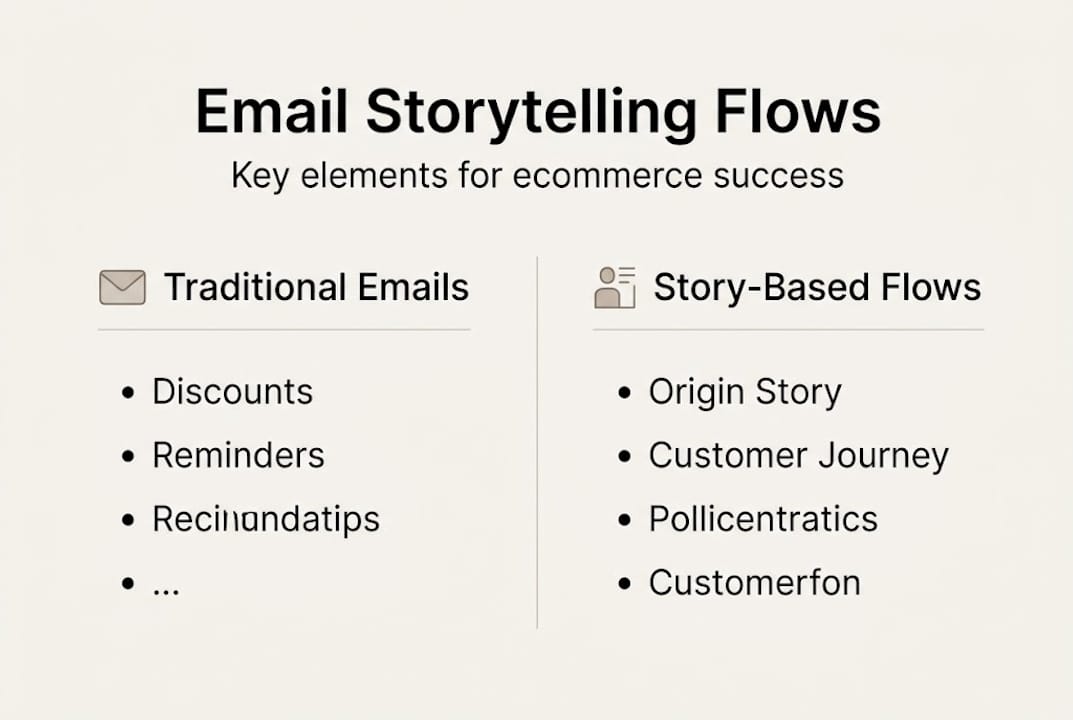
Here is a quick comparison of traditional versus narrative approaches in these core flows:
| Flow | Traditional approach | Narrative approach |
|---|---|---|
| Welcome | Discount code + product catalog | Brand origin story + community invitation |
| Post-purchase | Order confirmation + upsell | Product story + behind-the-scenes content |
| Re-engagement | “We miss you” + bigger discount | New chapter in brand story + soft CTA |
When evaluating automation tools for narrative flows, look specifically for platforms that support conditional branching based on engagement. Klaviyo, for example, allows you to detect whether a subscriber opened and clicked specific narrative emails and then route them into a deeper story arc or a purchase-focused sequence based on their behavior. That combination of narrative and behavioral logic is where email storytelling reaches its full retention potential.
One agency that built storytelling into automated flows across welcome, post-purchase, and re-engagement sequences helped a client reach $100K in email revenue in 2025. The core mechanic was not a bigger list. It was a better story told consistently across every touchpoint.
Pro Tip: Design each automated flow as a mini-arc with a clear beginning, a turning point, and a resolution. Subscribers who complete a three-email mini-arc are significantly more likely to make a purchase than those who receive three disconnected messages on a schedule.
Making your story matter: Personalization, consistency, and retention
A compelling brand story told to the wrong person at the wrong time loses most of its power. Personalization is what transforms a good narrative strategy into an exceptional retention engine.
Start by segmenting your list around lifecycle stage. A new subscriber needs an origin story. A customer who has purchased three times needs a story about community, exclusivity, or brand evolution. A lapsed customer needs something that signals you have changed and grown. Each of these audiences is in a different emotional relationship with your brand, and the story arc they receive should reflect that.
Contemporary fashion brand storytelling demonstrates this principle well. Brands in that space tailor their narrative to match where the customer is in their journey with the brand, not just where they are in the purchase funnel. That is a subtly different framing, but it leads to very different email content.
Core elements of a retention-building brand narrative in email include:
- A clear point of view. Your brand should have a consistent perspective on your industry, your customer, and your craft. That POV should run through every email you send.
- Recurring characters. Founders, makers, suppliers, and long-term customers can all serve as recurring figures that give your narrative continuity across emails and campaigns.
- Tension and resolution. The best brand stories acknowledge real challenges and show how your brand navigates them. That honesty builds trust faster than polished promotional copy.
- An ongoing arc. Think of your email program as a serial, not a series of standalone broadcasts. Each email should feel like it is part of something larger.
Tying these narrative elements to loyalty program storytelling amplifies the retention effect. When loyalty milestones are framed as story chapters (“You have been with us for one year, here is what has changed”) rather than generic rewards notifications, members feel recognized rather than managed.
Narrative coherence also reduces product returns and customer churn by setting accurate expectations. When customers know what your brand stands for before they buy, they are less likely to be disappointed by the product when it arrives. That alignment between story and product experience is one of the strongest retention levers available to e-commerce brands.
Pro Tip: Audit your current email flows for narrative gaps every quarter. Look for the email where the story stops and the promotion starts. That gap is where customers disengage. Closing it is usually faster than building a new flow from scratch.
Our perspective: The real barrier to powerful brand storytelling in email
Most brands that struggle with email storytelling are not short on inspiration. They have a genuine story. What they lack is the editorial process and the workflow discipline to turn that story into a repeatable asset across every flow and campaign.
The real problem is that storytelling gets treated as supplementary content, something to add when there is time, rather than the foundation every email is built on. That framing produces inconsistent results because the narrative only shows up when someone on the team is motivated to write creatively. The rest of the time, it defaults back to promotions.
The brands that win at retention think like publishers. They map story arcs across the full customer lifecycle, assign narrative roles to each flow, and review their sequences the same way an editor reviews a publication. They are always looking for gaps in the plot, moments where the brand voice drops out and leaves subscribers with nothing to connect to.
Repurposing content for email is one of the fastest ways to close those gaps without creating everything from scratch. Blog posts, founder interviews, social content, and customer testimonials all contain the raw material for compelling email narratives. The work is in the curation and sequencing, not always in the original creation.
Build the process first. The inspiration will follow.
Ready to turn stories into sales?
If this article gave you a clearer picture of how narrative-driven email can fuel repeat purchases and reduce your reliance on discounting, the next step is making it operational for your brand.
At Take Action, we specialize in turning story strategy into automated email systems that retain customers and grow revenue. As email storytelling experts, we build welcome flows, post-purchase arcs, and re-engagement sequences that carry your brand voice from first open to loyal repeat buyer. Whether you are starting from scratch or auditing what you already have, our team as a dedicated ecommerce retention agency can help you close the narrative gaps that are quietly costing you lifetime value. Let’s build something worth reading.
Frequently asked questions
How does brand storytelling in email directly boost sales?
Story-driven emails build familiarity and trust, which reduces the need for heavy discounting and motivates repeat purchases. Brands using narrative approaches have generated measurable revenue lifts within as little as 90 days.
Which email flows benefit most from strong storytelling?
Welcome, post-purchase, and re-engagement flows deliver the strongest retention and average order value gains when narrative arcs are applied. Building storytelling into those automated flows is directly linked to seven-figure email revenue outcomes.
Can storytelling reduce returns and customer churn?
Yes, because consistent narrative sets accurate expectations before purchase and builds emotional investment after. Narrative coherence lowers returns and strengthens repeat purchase behavior.
Are there best practices for personalizing stories in email?
Segment your list by lifecycle stage and tailor the story arc to match where each customer is in their relationship with your brand, not just where they are in the purchase funnel.
How do I measure the ROI of storytelling-driven emails?
Track open rate, click-through rate, repeat purchase rate, and revenue per email sent, then benchmark those against your previous promotional campaigns. Detailed engagement and revenue metrics from documented case studies provide realistic targets to aim for.