

Active Listening in Business: Driving Engagement and Loyalty
Most American companies underestimate the power of true active listening in business communication. Research shows that teams who consistently use active listening skills outperform their peers, with employee engagement jumping by up to 45 percent. In today’s diverse workplaces, being able to focus, understand, and respond to colleagues is not just polite, it is a strategic advantage that drives trust and lasting partnerships. Discover how elevating this overlooked skill can transform your daily professional interactions.
Table of Contents
- Defining Active Listening In Business Communication
- Core Principles And Key Behaviors For Teams
- Applying Active Listening In Email Marketing Strategy
- Overcoming Barriers And Common Pitfalls
- Measuring Impact On Retention And Customer Trust
Key Takeaways
| Point | Details |
|---|---|
| Active Listening as a Core Skill | Active listening is essential for effective business communication, requiring full attention and intentional engagement. It fosters deeper understanding and stronger professional relationships. |
| Transformative Impact on Teams | Implementing active listening improves team dynamics by promoting mutual respect and collaboration, ultimately leading to enhanced collective performance. |
| Application in Email Marketing | Utilizing active listening strategies in email marketing can elevate customer engagement, transforming communication into meaningful dialogues that build trust. |
| Measuring Effectiveness | Organizations should quantify the effects of active listening on customer retention and trust through metrics like Net Promoter Score (NPS) and customer lifetime value analysis. |
Defining Active Listening in Business Communication
Active listening represents a strategic communication approach that goes far beyond simply hearing words. It is a deliberate, sophisticated skill set designed to transform professional interactions through deep comprehension and intentional engagement.
At its core, active listening is a powerful communication tool in modern multicultural business environments that requires practitioners to fully concentrate, understand, respond, and remember what is being communicated. Unlike passive hearing, this approach demands cognitive and perceptual processes that extract nuanced meaning from verbal and nonverbal communication signals.
The fundamental components of active listening include:
- Maintaining focused eye contact
- Providing verbal and nonverbal acknowledgment signals
- Asking clarifying questions
- Reflecting back key information to confirm understanding
- Suspending personal judgments during the communication process
Effective listening encompasses complex cognitive processes that involve more than just hearing sounds. It requires individuals to simultaneously interpret speech sounds, comprehend linguistic structures, and extract broader contextual meanings. Professionals who master these skills can dramatically improve workplace communication, build stronger relationships, and create environments of mutual understanding and respect.
Core Principles and Key Behaviors for Teams
Active listening transforms team dynamics by creating an environment of mutual respect, understanding, and collaborative potential. It requires intentional behavioral strategies that go beyond mere hearing to truly comprehend and engage with team members.

The CALM Framework highlights four core themes essential for cultivating effective team communication: Conversation, Active Listening, Leadership Engagement, and Mechanism for Feedback. Central to this approach is the understanding that active listening is not a passive activity, but a deliberate leadership skill that fosters trust and psychological safety within professional environments.
Key behaviors for implementing effective active listening include:
- Maintaining full, undivided attention during conversations
- Eliminating digital and environmental distractions
- Practicing empathetic body language
- Asking clarifying and reflective questions
- Avoiding interruptions or premature problem-solving
- Demonstrating genuine curiosity about team members’ perspectives
Emotional intelligence plays a critical role in developing these listening skills, with leaders who exhibit high empathy and social awareness more successfully creating cohesive and motivated teams. By prioritizing deep understanding over quick responses, organizations can create communication cultures that value nuanced interpretation, respect individual experiences, and drive meaningful workplace connections.
Applying Active Listening in Email Marketing Strategy
Email marketing requires a nuanced approach that goes beyond traditional broadcasting, transforming communication from a one-way transmission to an interactive dialogue. Successful strategies demand genuine engagement and responsiveness to customer signals and feedback.
Active listening principles can dramatically enhance customer perception and satisfaction by demonstrating that brands truly hear and understand their audience’s needs and concerns. This approach transforms email communication from a transactional interaction into a meaningful conversation that builds trust and emotional connection.
Key strategies for implementing active listening in email marketing include:
- Analyzing customer response patterns
- Segmenting audiences based on engagement levels
- Crafting personalized response templates
- Implementing dynamic content that adapts to individual preferences
- Creating feedback loops that demonstrate authentic listening
- Tracking and responding to customer sentiment indicators
Effective email communication involves carefully reflecting customer feelings and meanings through thoughtful interpretation of their responses. By paraphrasing and validating customer experiences, marketers can develop more targeted, empathetic communication strategies that resonate deeply with their audience’s underlying needs and motivations.
Overcoming Barriers and Common Pitfalls
Active listening demands continuous self-awareness and intentional practice, requiring professionals to recognize and systematically dismantle communication barriers that impede genuine understanding. The journey toward effective listening is rarely straightforward and often requires strategic introspection and skill development.
Active listening represents a crucial soft skill that requires deliberate practice and continuous refinement, comparable to critical thinking and problem-solving abilities. Professionals must acknowledge that listening is not a passive activity but an active, challenging process that demands sustained mental engagement and emotional intelligence.
Common barriers to effective active listening include:
- Premature judgment and bias
- Internal mental distractions
- Preparation of immediate responses
- Emotional reactivity
- Interrupting or anticipating conversation directions
- Physical and technological interruptions
- Lack of genuine curiosity about others’ perspectives
Effective communication requires systematic approach to overcoming listening barriers by promoting problem-solving efficacy and reducing potential misunderstandings. Successful listeners cultivate techniques such as suspending personal agenda, practicing empathetic engagement, and developing a genuine commitment to understanding underlying meanings beyond surface-level communication.
Measuring Impact on Retention and Customer Trust
Customer retention represents a critical metric that transforms active listening from an abstract concept into a measurable business strategy. Organizations must develop sophisticated approaches to quantify the tangible impact of attentive communication on long-term customer relationships.
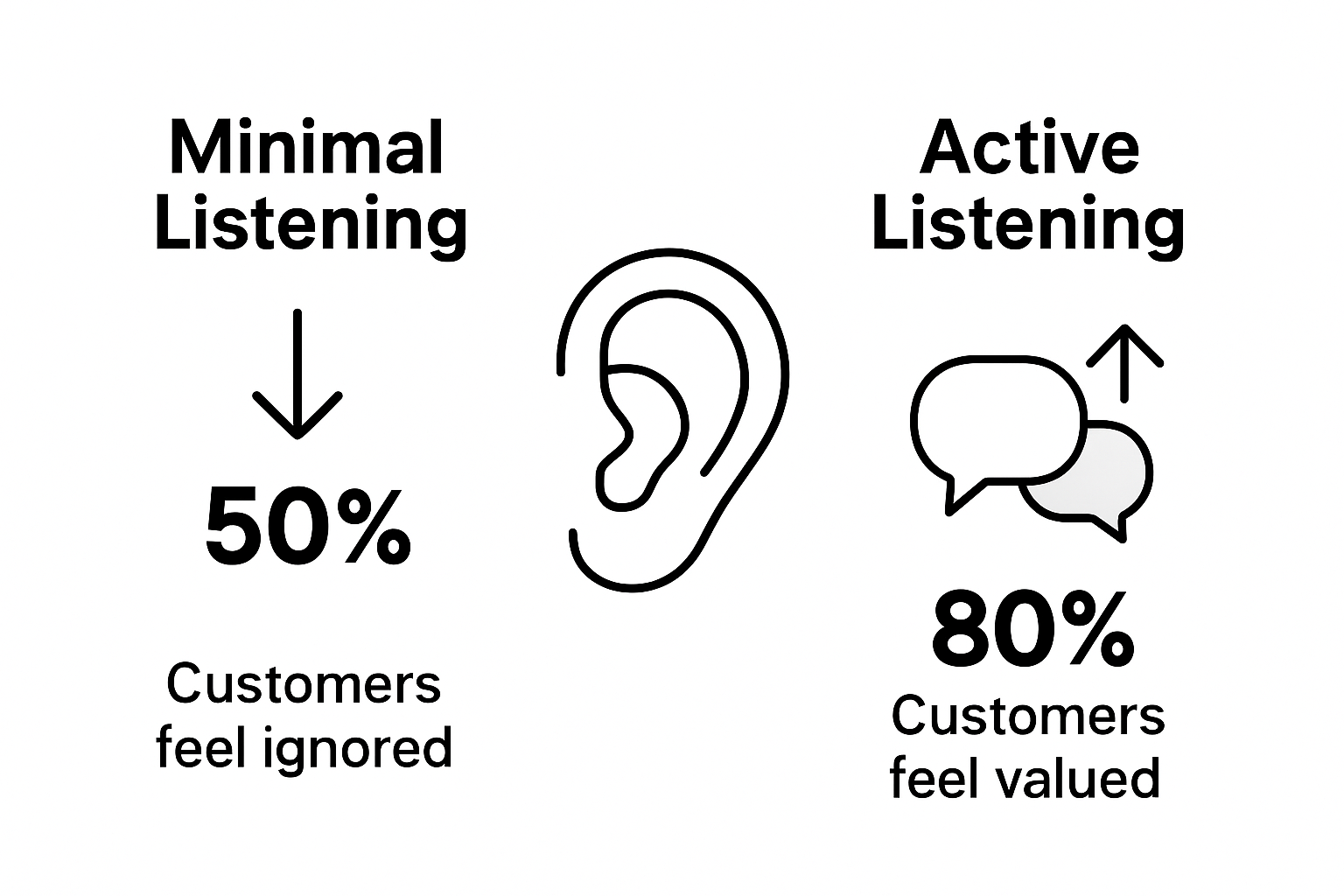
Active listening directly enhances customer satisfaction by increasing perceived preferential treatment, creating a quantifiable pathway to improved retention rates. This approach goes beyond traditional customer service by demonstrating a genuine commitment to understanding and addressing individual customer needs.
Key metrics for measuring the impact of active listening include:
- Customer retention rate changes
- Net Promoter Score (NPS) fluctuations
- Reduced customer complaint volumes
- Average customer lifetime value
- Frequency of repeat purchases
- Customer engagement depth indicators
- Sentiment analysis scores
Organizational frameworks like the CALM approach demonstrate how structured communication strategies can systematically build trust and improve long-term customer and employee relationships. By implementing rigorous measurement techniques, businesses can transform active listening from a soft skill into a data-driven competitive advantage that directly impacts bottom-line performance.
Transform Your Business Communication with Expert Email Marketing
Active listening is not just a skill but a vital strategy to truly engage your audience and build lasting trust. The article highlights challenges like overcoming communication barriers and creating meaningful connections that increase customer retention and loyalty. If you want to turn your email marketing into a growth engine that listens and responds to your customers’ needs, you need a partner who understands these nuances.
At Take Action, we specialize in transforming email into a powerful channel that automates customer retention and fosters deeper engagement through advanced segmentation, personalized flows, and data-driven insights using Klaviyo. Our tailored strategies help you apply active listening principles by analyzing and responding dynamically to customer behavior. Ready to move beyond basic emails and create campaigns that truly resonate? Visit Take Action today and start turning attentive communication into measurable business growth.
Frequently Asked Questions
What is active listening in business communication?
Active listening is a deliberate communication strategy that involves fully concentrating, understanding, responding, and remembering what is being said. It goes beyond merely hearing words, requiring cognitive and perceptual processes to extract nuanced meaning from both verbal and nonverbal signals.
How can active listening improve team dynamics?
Active listening fosters mutual respect and understanding within teams. By employing behaviors such as maintaining attention, practicing empathetic body language, and avoiding interruptions, team members cultivate trust and psychological safety, leading to stronger collaboration and communication.
What are some key strategies for implementing active listening in email marketing?
Key strategies include analyzing customer response patterns, segmenting audiences based on engagement levels, crafting personalized response templates, and creating feedback loops. These approaches help transform email communication into meaningful conversations that demonstrate genuine brand engagement.
What barriers can hinder effective active listening in the workplace?
Common barriers include premature judgments, distractions (both mental and physical), emotional reactivity, and interruptions. Overcoming these challenges requires self-awareness, empathy, and a commitment to understanding others’ perspectives.
Recommended
- Complete Guide to Building Customer Loyalty Online | Take Action Blog | Take Action
- The Essential Guide to Business Values Importance | Take Action Blog | Take Action
- Master Branding for Small Businesses: Build Loyalty in 2025 | Take Action Blog | Take Action
- Master Community Building Online for Ecommerce Success | Take Action Blog | Take Action