

Benefits of Segmentation: Unlocking Email Revenue Growth
Most American marketers miss out on powerful results when they skip email segmentation. Studies show that segmented campaigns can deliver a staggering 760 percent increase in revenue compared to one-size-fits-all emails. In a digital world where attention is scarce, understanding and applying precise segmentation ensures every message feels personal, relevant, and action-worthy. Learn why defining and refining your email strategy with smart segmentation is no longer an option for brands aiming to connect and convert.
Table of Contents
- Defining Segmentation In Email Marketing
- Core Segmentation Types For Ecommerce Brands
- How Segmentation Drives Engagement And Revenue
- Personalization, Automation, And Customer Journeys
- Pitfalls And Mistakes To Avoid In Segmentation
Key Takeaways
| Point | Details |
|---|---|
| Email Segmentation Enhances Engagement | Segmenting email lists allows for personalized messaging that resonates with subscriber preferences, leading to higher engagement rates. |
| Combining Segmentation Types Maximizes Impact | Utilizing multiple segmentation strategies provides deeper insights and enables more tailored marketing communications. |
| Data Accuracy is Crucial | Regularly verify and update customer data to ensure effective segmentation and relevant messaging. |
| Avoid Over-segmentation | Creating too many narrow segments can complicate marketing strategies; focus on maintaining a balanced approach. |
Defining Segmentation in Email Marketing
Email segmentation represents a strategic approach that transforms generic email communication into precision-targeted messaging. By dividing an email list into distinct groups based on specific characteristics, brands can deliver hyper-relevant content that resonates with individual subscriber preferences. Email audience segmentation enables marketers to move beyond one-size-fits-all communication and create personalized experiences that drive meaningful engagement.
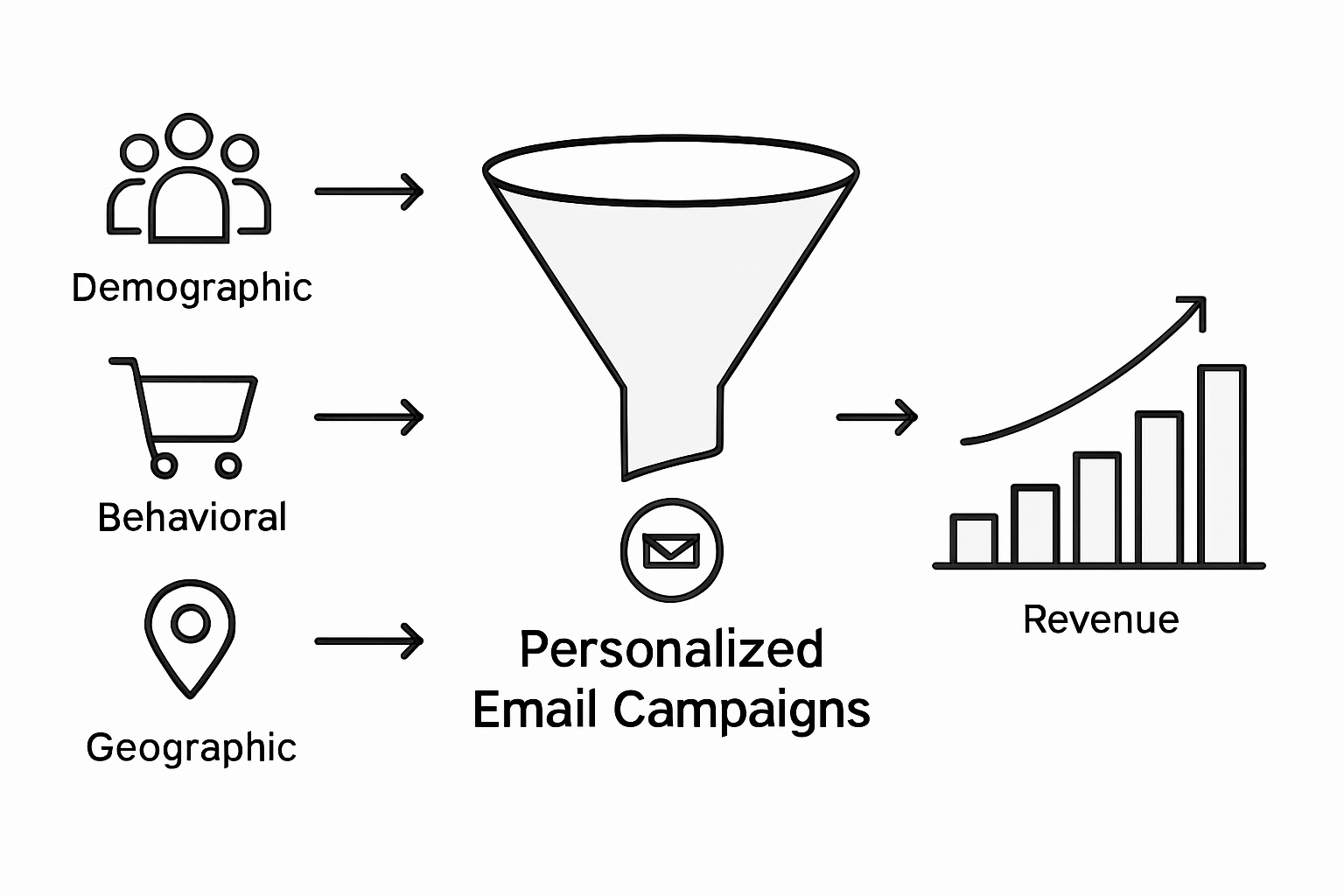
At its core, segmentation breaks down your email list into smaller, more focused subgroups defined by shared attributes. These attributes might include demographic information like age and location, behavioral data such as past purchase history, engagement levels with previous emails, or specific interactions with your brand. For instance, an ecommerce clothing brand could segment customers by gender, past purchase categories, size preferences, or frequency of shopping.
The power of segmentation lies in its ability to create highly targeted communications. Rather than broadcasting identical messages to an entire list, marketers can craft nuanced content that speaks directly to each group’s unique characteristics and needs. This approach dramatically increases the likelihood of subscribers finding the content relevant, which translates into higher open rates, improved click-through rates, and ultimately, enhanced revenue potential.
Pro Tip for Email Segmentation: Start simple by creating 3-5 initial segments based on your most obvious customer differences, then progressively refine your approach as you gather more data about subscriber behaviors and preferences.
Core Segmentation Types for Ecommerce Brands
Ecommerce brands have multiple powerful approaches to segmenting audience data, each offering unique insights into customer behavior and preferences. Demographic segmentation provides the foundational layer, breaking down customers by measurable characteristics such as age, gender, income level, education, and marital status. These basic attributes help brands create initial targeting strategies that speak directly to specific population segments.

Behavioral segmentation represents a more dynamic approach to understanding customer interactions. This method tracks specific actions like purchase frequency, average order value, product categories purchased, website browsing patterns, and engagement with previous marketing campaigns. An advanced ecommerce brand might segment customers who have made multiple purchases in the past 90 days differently from one-time buyers, creating tailored communication strategies that match each group’s purchasing patterns.
Geographic and psychographic segmentation offer additional nuanced approaches to understanding customer diversity. Geographic segmentation allows brands to target customers based on location, climate, population density, or regional preferences, which can be particularly useful for businesses with region-specific product offerings. Psychographic segmentation delves deeper, examining lifestyle choices, personal values, interests, and attitudes that influence purchasing decisions. This approach helps brands create more emotionally resonant marketing messages that connect beyond surface-level demographics.
Pro Tip for Advanced Segmentation: Combine multiple segmentation types to create highly specific customer profiles, allowing for increasingly personalized and effective marketing communications that feel individually crafted.
Here’s a concise comparison of four core segmentation types commonly used by ecommerce brands:
| Segmentation Type | What It Tracks | Typical Use Case | Business Impact |
|---|---|---|---|
| Demographic | Age, gender, income | Targeting specific buyer groups | Wider reach for generalized offers |
| Behavioral | Purchases, engagement | Retargeting and loyalty programs | Increased repeat purchases |
| Geographic | Location, climate | Localized promotions | Improved regional performance |
| Psychographic | Lifestyle, attitudes | Personalized emotional messaging | Stronger customer loyalty |
How Segmentation Drives Engagement and Revenue
Strategic email marketing segmentation transforms generic communication into powerful revenue-generating interactions by delivering precisely targeted content that resonates with specific audience groups. Engagement metrics dramatically improve when brands move beyond mass communication, creating personalized experiences that speak directly to individual customer needs, preferences, and behavioral patterns.
Conversion optimization emerges as a primary benefit of sophisticated email segmentation. By analyzing customer data and creating targeted messaging, brands can significantly increase the likelihood of recipients taking desired actions. For instance, a segment of customers who previously purchased workout equipment might receive different promotional content compared to first-time visitors, ensuring that each communication feels relevant and compelling. This targeted approach leads to higher open rates, improved click-through percentages, and ultimately, increased sales conversions.
The revenue impact of segmentation extends far beyond immediate transactional outcomes. Advanced segmentation allows brands to build deeper customer relationships by demonstrating an understanding of individual preferences and needs. Customers who consistently receive personalized, meaningful communications are more likely to develop long-term loyalty, generate repeat purchases, and become brand advocates. By treating each segment as a unique community with specific characteristics, businesses can create more emotional connections that transcend traditional marketing approaches.
Pro Tip for Revenue-Driven Segmentation: Continuously refine your segments by tracking engagement metrics and customer feedback, allowing your targeting strategy to evolve dynamically with changing customer behaviors and preferences.
Personalization, Automation, and Customer Journeys
Marketing automation in email campaigns represents a sophisticated approach to transforming customer interactions from generic broadcasts into personalized, intelligent experiences. By leveraging advanced software and data analytics, brands can create dynamic communication pathways that adapt in real-time to individual customer behaviors, preferences, and engagement patterns. This technological evolution allows businesses to move beyond traditional one-size-fits-all marketing strategies, crafting nuanced journeys that feel uniquely tailored to each recipient.
The intersection of personalization and automation creates powerful opportunities for building deeper customer relationships. Automated systems can now track intricate customer interactions across multiple touchpoints, enabling brands to deliver precisely targeted content at optimal moments in the customer journey. For example, an abandoned cart might trigger a personalized follow-up email with specific product recommendations, or a customer’s previous purchase history could inform future promotional content, increasing the likelihood of conversion through hyper-relevant messaging.
Customer journey mapping becomes exponentially more sophisticated with advanced segmentation and automation technologies. By understanding and predicting customer behaviors, brands can design intricate communication flows that guide prospects through carefully constructed engagement sequences. These journeys are not linear but dynamic, responding to real-time customer signals and adjusting messaging, timing, and content to maximize relevance and emotional connection. The result is a more intuitive, responsive marketing approach that feels less like a sales pitch and more like a personalized conversation.
Pro Tip for Customer Journey Optimization: Implement a continuous feedback loop that uses engagement metrics to dynamically refine your automation strategies, ensuring your customer journeys remain adaptive and increasingly precise over time.
Pitfalls and Mistakes to Avoid in Segmentation
Common email marketing segmentation strategies often fall victim to critical errors that can undermine entire marketing efforts. Over-segmentation represents one of the most prevalent mistakes brands make, creating such narrow audience groups that communication becomes fragmented and ineffective. When segments become too granular, marketing teams spend excessive time managing complex categorizations while losing sight of meaningful engagement strategies.
Data accuracy emerges as another critical challenge in effective segmentation. Many brands collect customer information without establishing robust verification processes, leading to outdated, incomplete, or incorrect subscriber profiles. Relying on stale demographic data or failing to update customer information can result in irrelevant messaging that feels disconnected from actual customer experiences. Successful segmentation requires continuous data refinement, integrating multiple touchpoints to create dynamic, responsive audience profiles that evolve with changing customer behaviors.
Ignoring the strategic alignment between segmentation and broader business objectives can also derail marketing efforts. Segments should not exist in isolation but must connect directly to specific revenue goals, customer retention strategies, and brand positioning. Some organizations create segments based on arbitrary characteristics without considering how these groupings translate into actionable marketing initiatives. The most effective segmentation approaches integrate behavioral insights, purchase history, engagement metrics, and predictive analytics to create meaningful, purpose-driven audience categories that drive genuine business value.
Pro Tip for Segmentation Success: Conduct a quarterly audit of your audience segments, eliminating underperforming categories and consolidating fragmented groups to maintain a lean, purposeful segmentation strategy.
The table below summarizes key pitfalls in email segmentation and strategies to avoid them:
| Pitfall | Why It Happens | Best Practice to Fix |
|---|---|---|
| Over-segmentation | Too many narrow groups | Consolidate and simplify lists |
| Data accuracy issues | Outdated or missing information | Regular data verification |
| Misaligned business goals | Segments not linked to objectives | Align segments with KPIs |
Unlock the Full Potential of Email Segmentation for Your Brand
The article highlights how poor segmentation leads to generic messaging that fails to engage your audience or drive revenue. If you have struggled with sending irrelevant emails, managing complex customer groups, or seeing low returns from your campaigns, you are not alone. The key to overcoming these common pain points lies in mastering behavioral and demographic segmentation combined with automation to deliver highly personalized customer journeys. Understanding your audience through data-driven segmentation enables you to increase open rates, boost conversions, and build long-term loyalty — not just quick wins.
At Take Action, we specialize in turning these segmentation challenges into growth opportunities. Our expert team focuses on Klaviyo-powered solutions that blend human insight with AI to craft and automate segmented campaigns tailored to your brand voice and customer behaviors. Whether you need to optimize welcome series, recover abandoned carts, or nurture post-purchase loyalty, we create strategic email flows built for scalable revenue growth and measurable impact.
Ready to transform your email marketing with precision segmentation and automation techniques that work?
Boost your revenue with data-driven segmentation today
Take the next step to unlock personalized customer journeys and automated engagement that increase your open and click rates now. Visit Take Action and let us help you transform your email into a powerful growth channel that moves beyond one-size-fits-all messaging.
Frequently Asked Questions
What is email segmentation?
Email segmentation is the process of dividing an email list into smaller groups based on specific characteristics, allowing brands to send targeted, relevant content to distinct audience segments.
How does segmentation improve email marketing engagement?
Segmentation enhances engagement by sending personalized messages that resonate with individual subscriber preferences, resulting in higher open rates, click-through rates, and conversion rates.
What are the key types of segmentation for ecommerce brands?
The key types of segmentation for ecommerce brands include demographic segmentation (age, gender), behavioral segmentation (purchase history, engagement), geographic segmentation (location), and psychographic segmentation (lifestyle and interests).
How can brands avoid common segmentation pitfalls?
Brands can avoid common segmentation pitfalls by conducting regular audits of audience segments, ensuring data accuracy with continuous updates, and aligning segmentation with broader business objectives to maintain purposeful strategies.
Recommended
- Email Campaign Best Practices for 2025 Success | Take Action Blog | Take Action
- What is Audience Segmentation? Understanding Its Importance | Take Action Blog | Take Action
- Audience Targeting Strategies: Complete Expert Guide | Take Action Blog | Take Action
- Email Frequency Best Practices for Maximum Engagement | Take Action Blog | Take Action