

Boost ecommerce growth: SEO and Klaviyo automation
Ecommerce brands that integrate SEO insights with Klaviyo email automation see open rates jump up to 50% compared to generic campaigns. Yet many online retailers treat search optimization and email marketing as separate channels, missing opportunities to enhance customer retention and revenue. This guide shows you how combining SEO digital marketing with Klaviyo’s powerful automation workflows creates a synergy that drives measurable ecommerce growth.
Table of Contents
- Understanding The Role Of SEO In Ecommerce Email Marketing
- Integrating SEO Data With Klaviyo Segmentation And Personalization
- Key Klaviyo Automation Workflows Aligned With SEO Funnel Stages
- Common Misconceptions About SEO And Email Marketing Integration
- Framework And Decision Criteria For Combining SEO Digital Marketing With Email Automation
- Practical Implementation Tips And Case Studies For Ecommerce Brands
- Summary And Next Steps For Ecommerce Brands Using Klaviyo And SEO
Key takeaways
| Point | Details |
|---|---|
| SEO boosts email performance | Combining SEO insights with automation increases open rates by up to 50% through better targeting. |
| Segmentation becomes precise | SEO behavior data enables hyper-targeted customer segments for personalized campaigns. |
| Workflow optimization improves revenue | Aligning automation flows with search intent stages enhances cart recovery and reduces churn. |
| Integration drives retention | SEO-enriched email automation can reduce customer churn by 12% while increasing overall revenue. |
| Practical frameworks guide implementation | Decision criteria and case studies help ecommerce brands plan and execute integration effectively. |
Understanding the role of SEO in ecommerce email marketing
SEO digital marketing establishes the foundation for quality traffic to your online store. When customers find you through organic search, they arrive with specific intent that reveals what they want and where they sit in the buying journey.
This search behavior creates valuable data points. Someone searching for “best waterproof hiking boots” shows different intent than someone typing “hiking boot care tips.” Understanding these distinctions lets you tailor email content that resonates immediately.
Combining SEO insights with email marketing automation increases open rates by up to 50% through better targeting and content relevance. When you know what brought subscribers to your site, you can craft emails addressing those exact interests.
Here’s how SEO strengthens your email marketing foundation:
- Organic search attracts subscribers already interested in your product category
- Keyword data reveals customer pain points and motivations
- Search intent signals indicate where buyers are in their decision process
- High-quality organic traffic converts to engaged email subscribers
- SEO content topics inform relevant email campaign themes
SEO importance for ecommerce brands extends beyond rankings. It creates a qualified audience primed for email engagement. This SEO and email marketing synergy transforms both channels into revenue drivers rather than isolated tactics.
Integrating SEO data with Klaviyo segmentation and personalization
Klaviyo’s segmentation power multiplies when fed with SEO intelligence. Traditional email segments rely on purchase history and basic demographics. Adding search behavior and keyword intent data creates precision targeting that generic methods can’t match.
Start by capturing the search terms that brought visitors to your site. When someone subscribes after landing on a blog post about “organic skincare for sensitive skin,” tag that subscriber with relevant intent data. This creates segments based on actual interests, not assumptions.
Personalization goes deeper than inserting a first name. Dynamic content blocks in Klaviyo can display products matching the subscriber’s original search intent. Someone who arrived searching for vegan protein powder sees different recommendations than someone researching weight gain supplements.

Combining SEO insights with email marketing automation increases open rates by up to 50% because messages align with what subscribers already care about. Click-through rates improve similarly when content matches search intent.
Effective email segmentation strategies leverage these approaches:
- Tag subscribers by search keyword category at capture
- Create segments for different intent levels (research, comparison, ready to buy)
- Use landing page topics to infer product interests
- Track on-site behavior after email clicks to refine segments
- Combine SEO intent with purchase cycle stage for ultra-targeted campaigns
Advanced list segmentation techniques incorporate search seasonality patterns. If certain keywords spike quarterly, prepare targeted campaigns for those segments ahead of the trend. This proactive approach maximizes revenue from predictable search behavior.
Pro Tip: Prioritize segmentation for high-intent commercial keywords first. Someone searching “buy X online” converts faster than informational searchers, so focus automation efforts where revenue impact hits quickest.
The importance of segmentation becomes clear when you see SEO insights boosting email personalization performance. Relevant content reaches interested buyers at the right moment, creating a seamless experience from search to inbox.
Key Klaviyo automation workflows aligned with SEO funnel stages
Your automated workflows should mirror how customers discover you through search. Different keyword types indicate different funnel stages, and your email flows must adapt accordingly.
Welcome series emails work best when acknowledging the subscriber’s entry point. Someone who joined after reading comparison content needs different messaging than someone who subscribed on a product page. SEO data tells you which scenario applies.
Abandoned cart emails gain power when referencing the search intent that brought the customer initially. If they found you searching for “eco-friendly yoga mats,” remind them how your product meets that specific sustainability concern.
Post-purchase sequences should extend the original search intent. A customer who bought after searching “beginner guitar” appreciates follow-up emails about learning resources and compatible accessories for newcomers.
Here’s how to structure SEO-aligned automation workflows:
- Map your top 20 converting keywords to funnel stages (awareness, consideration, decision)
- Create welcome flow variants for each stage with appropriate content depth
- Customize abandoned cart messaging to reference original search intent categories
- Build post-purchase sequences that extend the problem the search query aimed to solve
- Set up browse abandonment flows triggered by product category views matching search keywords
- Design win-back campaigns acknowledging the customer’s original discovery method
Among email automation tools, Klaviyo excels at handling these complex conditional flows. You can trigger different paths based on custom properties populated with SEO intent data.
Timing matters too. High-intent commercial searches suggest ready buyers who need shorter nurture sequences. Informational keyword traffic requires longer education-focused flows before pitching products.
Test flow variations against each other. A welcome series optimized for “problem-aware” searchers might outperform generic onboarding by 40% or more in engagement and first purchase rate.
Common misconceptions about SEO and email marketing integration
Many ecommerce operators believe SEO and email marketing function independently. This siloed thinking costs revenue and wastes effort on both channels.
One persistent myth claims organic search traffic doesn’t engage with email. Reality shows the opposite. Subscribers acquired through high-quality content convert better because they trust your expertise before joining your list.
Another false belief suggests email lists don’t benefit from SEO keyword research. Yet understanding what your audience searches for provides the best email subject line and content ideas you’ll ever find.
Some brands ignore SEO data when crafting emails, leading to messaging mismatches that increase unsubscribe rates. When your emails discuss topics unrelated to what brought subscribers to your site, engagement plummets.
Many ecommerce brands mistakenly assume SEO and email marketing operate independently, missing out on synergistic effects that drive up to 30% higher revenue when coordinated effectively. This lost opportunity stems from organizational silos where SEO teams never communicate with email marketers.
Key myths to abandon:
- SEO only drives one-time visitors with no retention value
- Email subscribers don’t care about search-optimized content
- Keyword data is irrelevant for email campaign planning
- Organic traffic engages less than paid traffic subscribers
- Integration requires complex technical implementation
The truth? SEO-enriched email automation reduces churn by up to 12% while increasing customer lifetime value. When you know how customers found you, retention becomes easier because you understand their needs from day one.
“Integrating SEO intelligence with email marketing automation transforms both channels from cost centers into profit drivers. Brands that connect search intent data with automated email sequences see revenue increases averaging 30% within six months of implementation.”
This SEO and email marketing synergy works because it aligns customer discovery patterns with ongoing communication. You’re not interrupting. You’re continuing a conversation the customer started when they searched.
Framework and decision criteria for combining SEO digital marketing with email automation
A mental model helps visualize how SEO intent phases align with Klaviyo email lifecycle stages. Think of search behavior as revealing customer readiness, then match email automation to that readiness level.
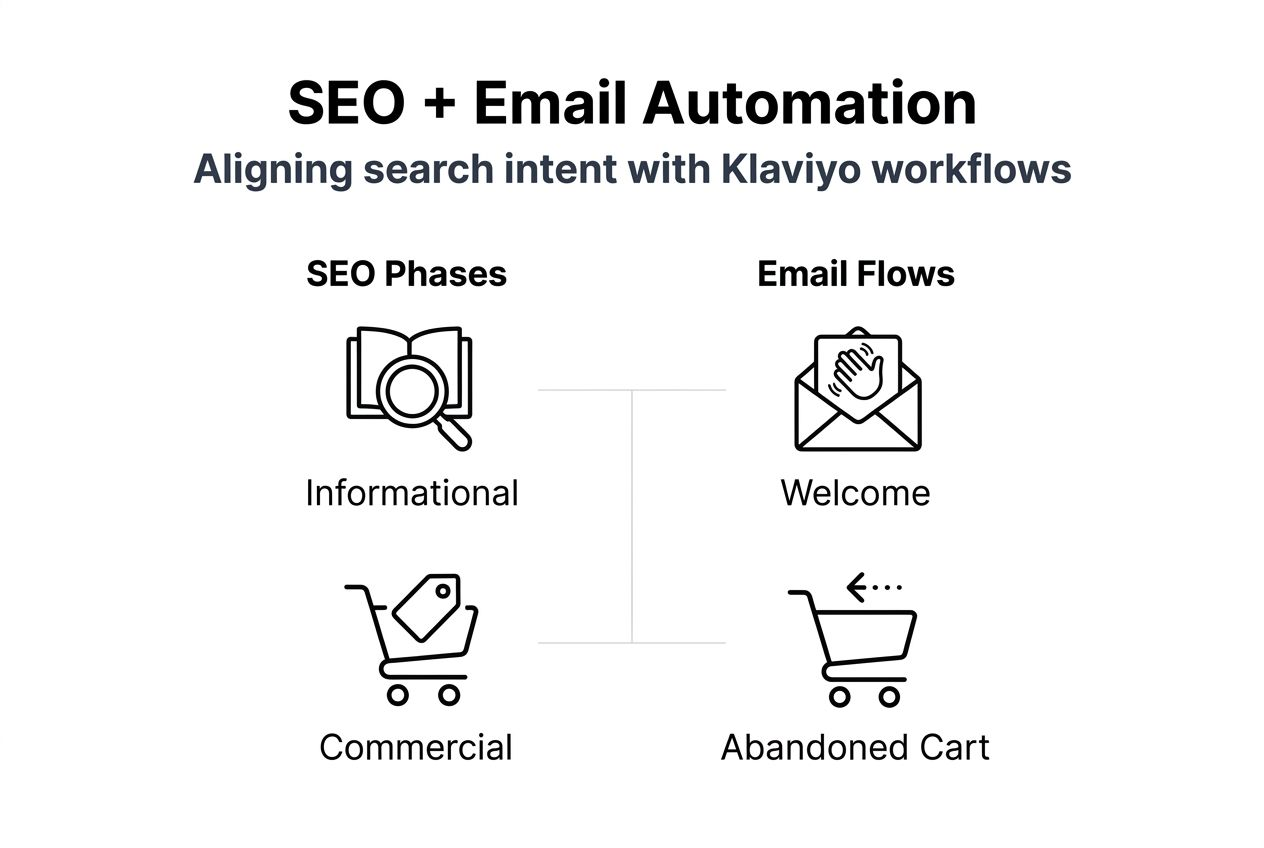
Awareness stage searchers using broad informational keywords need educational welcome series introducing your brand expertise. Consideration stage searchers comparing options require comparison guides and social proof in their nurture sequences. Decision stage searchers with commercial intent benefit from product-focused emails with clear calls to action.
Before diving into integration, assess your readiness using these decision criteria:
- Data compatibility: Can you capture and pass search keyword data to Klaviyo custom properties?
- Workflow customization: Does your team have skills to build conditional flows based on intent data?
- Content inventory: Do you have email templates suitable for different intent stages?
- Measurement capability: Can you track revenue by segment and attribute it to search intent categories?
- Scalability: Will your chosen approach work as your subscriber base grows?
- Compliance: Does your data collection method meet privacy regulations in your markets?
Here’s how generic approaches compare to SEO-enhanced methods:
| Aspect | Generic Segmentation | SEO-Driven Enhancement |
|---|---|---|
| Welcome series | One-size-fits-all introduction | Intent-matched education or product focus |
| Abandoned cart | Standard discount offer | Messaging addresses original search concern |
| Product recommendations | Bestsellers or recent views | Matches search keyword category and intent |
| Re-engagement | Generic “we miss you” message | References original discovery topic |
| Send timing | Fixed schedule | Optimized by search seasonality patterns |
This framework guides your implementation priorities. Start with the automation flows generating the most revenue, typically abandoned cart and post-purchase. Layer in SEO intelligence gradually rather than rebuilding everything at once.
Expected ROI varies by implementation depth. Basic keyword tagging and simple segmentation might lift revenue 8 to 12%. Advanced intent-based dynamic content and predictive send timing can drive 25 to 35% improvements.
Pro Tip: Don’t over-engineer your automation initially. Start with three intent categories (informational, comparison, transactional) and expand as you validate the approach. Complexity without proven incremental gains wastes resources and confuses your team.
Explore more strategic insights at the email marketing insights blog to refine your integration approach.
Practical implementation tips and case studies for ecommerce brands
Transforming theory into practice requires systematic execution. Here’s a step-by-step process for syncing SEO keyword intent data with Klaviyo segmentation and automation:
- Install tracking to capture referring search keywords or landing page URLs for new subscribers
- Create custom properties in Klaviyo for intent stage, keyword category, and content topic
- Map your content to intent categories and ensure data passes correctly at subscription
- Build three variant welcome flows for awareness, consideration, and decision intent levels
- Customize abandoned cart templates with dynamic content blocks referencing intent categories
- Set up reporting to measure performance differences between intent-based segments
- Iterate based on performance data, expanding successful approaches
Real-world results demonstrate the power of this integration. An outdoor gear retailer implemented intent-based segmentation and saw welcome series conversion rates jump from 3.2% to 5.8% within 60 days. Their abandoned cart recovery improved from 11% to 17% after adding search intent context to reminder emails.
Another case involved a supplements brand that tagged subscribers by whether they arrived via health condition keywords or fitness performance keywords. Tailoring product recommendations and educational content to these categories increased average order value by 23% and reduced unsubscribe rates by 31%.
Common pitfalls to avoid:
- Siloed data systems where SEO analytics never reach email marketing tools
- Stale workflows that don’t update as search trends and customer interests evolve
- Over-segmentation creating too many micro-audiences to manage effectively
- Ignoring mobile optimization despite most searches happening on phones
- Failing to test variants, leaving performance gains on the table
Fixes are straightforward. Establish regular data syncs between analytics platforms and Klaviyo. Schedule quarterly workflow audits to refresh content and logic based on current search trends. Start with broader segments before splitting into smaller niches.
Pro Tip: Set up a monthly review comparing your top search keywords with your most successful email subject lines. Patterns emerge quickly, revealing content themes that resonate across channels.
Learn why segmentation matters for sustainable growth. The SEO matters guide provides additional context. For broader strategic approaches, explore advanced ecommerce sales strategies that complement email and SEO integration.
These ecommerce sales strategies work synergistically with email automation, creating multiple revenue growth levers working in concert.
Summary and next steps for ecommerce brands using Klaviyo and SEO
Integrating SEO digital marketing with Klaviyo automation creates measurable improvements in customer retention, engagement metrics, and revenue per subscriber. You’ve learned how search intent data enables precision segmentation, how to align automation workflows with customer discovery patterns, and why separating these channels costs you money.
Use this checklist to begin your integration:
- Audit current subscriber capture points to identify where search data can be collected
- Choose three to five high-traffic keyword categories to start segmentation testing
- Create intent-based custom properties in Klaviyo for tagging subscribers
- Build or modify one automation flow incorporating search intent logic
- Establish baseline metrics for open rates, click rates, and revenue per email
- Implement tracking and let the flow run for 30 days
- Analyze performance differences between intent segments
- Expand successful approaches to additional workflows
- Schedule quarterly reviews to update segments as search trends evolve
Continuous optimization sustains growth. Search behavior changes with seasons, trends, and market conditions. Your email automation must adapt accordingly. Monitor which keyword categories drive the highest lifetime value and allocate more personalization resources to those segments.
Scale gradually. Master intent-based welcome and abandoned cart flows before tackling complex predictive sending or advanced dynamic content. Each improvement builds on the last, creating compounding returns.
The synergy between organic search and automated email marketing represents one of the highest-ROI opportunities in ecommerce today. Most competitors still treat these channels separately, giving you a competitive advantage when you integrate thoughtfully.
Understand customer retention importance as you implement these strategies. Retention improvements from better email personalization compound over time, making early investment in integration extremely valuable.
Take action now. Start small, measure everything, and expand what works. Your subscribers already told you what they want when they searched. Now give it to them through perfectly timed, relevant automated emails.
Take action to elevate your ecommerce email marketing
You’ve learned how combining SEO insights with Klaviyo automation drives measurable revenue growth. Putting these strategies into practice requires expertise, time, and ongoing optimization.
Take Action specializes in helping ecommerce brands leverage email segmentation strategies that integrate seamlessly with your marketing ecosystem. Our team builds automated workflows that align with customer discovery patterns, creating personalized experiences that boost retention and revenue.
Explore actionable insights and proven frameworks on the Take Action blog. You’ll find detailed guides on segmentation, automation best practices, and revenue optimization tactics tailored for ecommerce brands using Klaviyo.
Ready to transform email into your primary growth channel? Take Action email marketing agency combines human expertise with data-driven strategies to maximize your Klaviyo investment. Let’s build automated systems that turn subscribers into loyal, high-value customers.
Frequently asked questions
How does SEO data improve email personalization in Klaviyo?
SEO data reveals the specific problems and interests that brought subscribers to your site. When you tag subscribers with their original search intent, Klaviyo can dynamically display products, content, and offers matching those exact interests. This relevance dramatically improves engagement compared to generic personalization.
What are the best Klaviyo flows to optimize with SEO insights?
Start with welcome series, abandoned cart, and browse abandonment flows since these generate the most immediate revenue. Welcome series benefit from intent-based variants that match education level to search type. Abandoned cart emails gain power when addressing the original search concern that brought the customer.
How do I measure success after integrating SEO and email automation?
Track open rates, click rates, conversion rates, and revenue per email for intent-based segments versus generic segments. Monitor customer lifetime value by acquisition source to see if SEO-sourced subscribers retain better. Set up cohort analysis comparing subscribers tagged with search intent data against those without such tagging.
Can small ecommerce brands benefit from SEO-email integration?
Absolutely. Small brands often see faster results because they can implement changes quickly without bureaucratic approval processes. Start with basic keyword category tagging and simple welcome flow variants. Even minimal personalization based on search intent typically lifts conversion rates 15 to 25% for small stores.
How often should I update my automation based on SEO changes?
Review your automation workflows quarterly to ensure they align with current search trends and seasonal patterns. Update product recommendations monthly if your catalog changes frequently. Monitor your top converting keywords weekly and adjust email content themes if you notice significant shifts in what customers search for.
Recommended
- Email Segmentation Strategies for Ecommerce Growth | Take Action Blog | Take Action
- Blog Post Promotion Strategies for Ecommerce Growth | Take Action Blog | Take Action
- 7 Steps Ecommerce Marketing Checklist for Brand Growth Success | Take Action Blog | Take Action
- Email Marketing Mistakes That Hurt Ecommerce Growth | Take Action Blog | Take Action
- How to Boost Ecommerce Sales with Advanced Store Strategies
- Amazon SEO Step by Step: Boost Your Product Visibility