
Building Brand Authority: Complete Expert Guide
Did you know that businesses with strong brand authority are trusted by nearly 90 percent of consumers? In a crowded digital marketplace, credibility and expertise have become powerful assets for any company hoping to stand out. Understanding what drives brand authority can help transform ordinary brands into respected leaders that attract loyalty, trust, and lasting customer relationships.
Table of Contents
- Understanding Brand Authority Fundamentals
- Types of Brand Authority in Ecommerce
- Key Strategies for Building Authority
- Leveraging Email Marketing for Trust
- Common Pitfalls and How to Avoid Them
Key Takeaways
| Point | Details |
|---|---|
| Brand Authority is Crucial | Establishing credibility and trust in your industry is essential for differentiating your business and achieving long-term success. |
| Diverse Strategies for Authority | Brands should leverage various tactics, including thought leadership, customer testimonials, and community engagement to enhance their authority. |
| Technology and Innovation Matter | Utilizing cutting-edge technologies and immersive experiences can significantly boost your brand’s credibility and customer interaction. |
| Email Marketing Builds Trust | Effective email marketing should focus on personalized, valuable content to foster meaningful connections and enhance brand authority. |
Understanding Brand Authority Fundamentals
In the competitive world of digital marketing, brand authority represents a company’s perceived credibility, expertise, and trustworthiness within its industry. According to Wikipedia, a brand transcends mere visual symbols, encompassing both tangible elements like logos and intangible dimensions such as customer experiences and perceptions.
Building brand authority requires a strategic approach that goes beyond traditional marketing tactics. The Semantic Brand Score (SBS) research provides fascinating insights into how brands can measure and enhance their market significance. This metric evaluates three critical dimensions: brand prevalence, diversity, and connectivity. By understanding these elements, businesses can develop more nuanced strategies to establish their market position.
Key components of developing brand authority include:
- Consistently delivering high-quality products or services
- Demonstrating thought leadership in your industry
- Creating valuable, educational content
- Building genuine relationships with your audience
To truly establish brand authority, companies must focus on authenticity and meaningful engagement. Understanding the importance of brand voice becomes crucial in this journey, as it helps create a distinctive and recognizable presence in a crowded marketplace. By combining strategic communication, expertise demonstration, and consistent value delivery, brands can transform from mere business entities into trusted industry leaders.
Types of Brand Authority in Ecommerce
In the dynamic world of online retail, brand authority manifests through multiple strategic approaches that differentiate successful ecommerce businesses from their competitors. Abbacus Technologies highlights that ecommerce brands can establish authority by strategically showcasing customer testimonials, collaborating with industry professionals, and actively engaging with their audience through social media and community discussions.
The landscape of building brand authority in ecommerce is multifaceted. Scandiweb suggests several compelling methods for brands to demonstrate credibility, including:
- Providing scientific backing for products
- Leveraging authoritative imagery like professional lab coats
- Displaying awards and industry badges to highlight competencies
Beyond these tactical approaches, mastering brand positioning strategies becomes crucial in establishing a distinctive market presence. Brands can categorize their authority development into several key types:
Here’s a summary of the key types of brand authority in ecommerce:
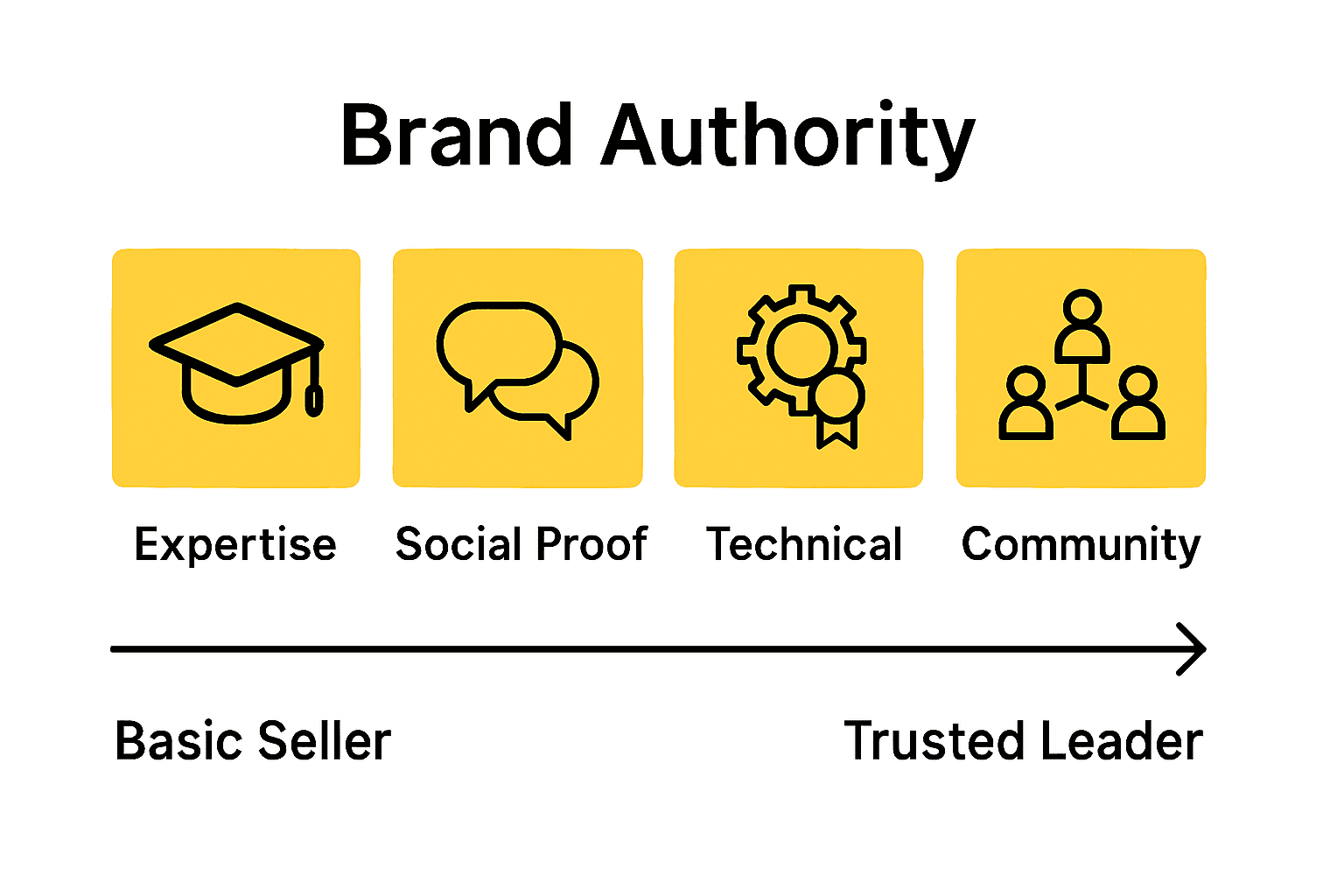
| Type of Authority | Core Focus | Common Tactics |
|---|---|---|
| Expertise Authority | Deep industry knowledge | Educational content Research insights |
| Social Proof Authority | Customer validation | Reviews Testimonials Case studies |
| Technical Authority | Product quality & innovation | Highlighting features Certifications Awards |
| Community Authority | Brand-audience connection | Online communities Social media engagement |
- Expertise Authority: Demonstrating deep knowledge through educational content, research, and thought leadership
- Social Proof Authority: Utilizing customer reviews, testimonials, and case studies
- Technical Authority: Showcasing product quality, innovation, and unique technological capabilities
- Community Authority: Building engaged online communities and fostering meaningful customer interactions
Successful ecommerce brands understand that building authority is an ongoing process. By consistently delivering value, maintaining transparent communication, and strategically presenting their unique strengths, they transform from mere online sellers into trusted industry leaders.

Key Strategies for Building Authority
Brand authority isn’t built overnight. It requires a comprehensive, strategic approach that combines multiple elements of digital marketing and customer engagement. Triple Whale highlights an innovative approach to brand building by leveraging contactless marketing techniques like augmented reality, QR codes, and interactive displays that can dramatically enhance customer engagement and reinforce a brand’s innovative image.
Effective brand authority strategies typically involve a multi-dimensional approach:
- Developing consistent and compelling content
- Demonstrating industry expertise
- Creating authentic customer experiences
- Leveraging social proof and testimonials
One critical aspect of building authority is establishing thought leadership. Understanding thought leadership marketing can help brands position themselves as innovative and trustworthy voices in their industry. This means going beyond traditional marketing by providing genuinely valuable insights, research, and educational content that solves real problems for your target audience.
Technology and innovation play a significant role in modern brand authority. Brands can differentiate themselves by:
- Implementing cutting-edge customer interaction technologies
- Creating immersive digital experiences
- Showcasing transparency in product development
- Consistently delivering exceptional customer value
Ultimately, building brand authority is about creating a genuine connection with your audience.
It requires a commitment to excellence, continuous learning, and a willingness to adapt and innovate in an ever-changing digital landscape.
Leveraging Email Marketing for Trust
Email marketing represents a powerful channel for building brand authority and establishing deep customer connections. Abbacus Technologies emphasizes that engaging with customers through email allows brands to address queries, provide updates, and offer solutions, fundamentally fostering a sense of reliability and authority in the eCommerce space.
Successful email marketing strategies for building trust involve several critical components:
- Personalized communication
- Consistent and valuable content delivery
- Transparent and authentic messaging
- Responsive customer support
- Strategic segmentation
Email campaign best practices for 2025 highlight the importance of creating a narrative that resonates with your audience. This means moving beyond transactional communications and developing emails that provide genuine value, educate customers, and demonstrate your brand’s expertise and commitment.
Key tactics for leveraging email to build trust include:
- Implementing sophisticated email automation
- Creating segmented, targeted communication flows
- Developing educational content series
- Showcasing customer success stories
- Providing exclusive insights and early access
Trustworthy email marketing isn’t about volume—it’s about relevance, authenticity, and creating meaningful connections that make customers feel understood and valued.
Common Pitfalls and How to Avoid Them
Brand authority is fragile and can be easily undermined by common strategic mistakes. Scandiweb highlights critical pitfalls that can derail brand credibility, such as failing to provide scientific backing for products and neglecting to showcase awards or competency badges that demonstrate expertise.
Key pitfalls in building brand authority include:
- Inconsistent messaging across platforms
- Lack of transparency
- Ignoring customer feedback
- Overpromising and underdelivering
- Failing to adapt to market changes
Understanding brand consistency becomes crucial in navigating these challenges. Abbacus Technologies emphasizes that neglecting customer engagement can significantly undermine brand authority. Brands must actively interact through multiple channels, demonstrating responsiveness and genuine commitment to their audience.
Strategies to overcome common brand authority pitfalls:
- Develop a comprehensive, consistent brand narrative
- Implement robust customer feedback mechanisms
- Regularly validate and showcase your expertise
- Maintain transparency in product claims and capabilities
- Continuously educate your audience about your brand’s unique value
Successful brands recognize that building authority is an ongoing process of genuine communication, consistent performance, and adaptive learning. The most respected brands don’t just avoid pitfalls—they transform potential weaknesses into opportunities for deeper customer connection.
Elevate Your Brand Authority With Expert Email Marketing
Building lasting trust and authority requires more than just great products. As highlighted in the guide to building brand authority, challenges like consistently delivering educational content, demonstrating thought leadership, and fostering genuine customer connections are crucial yet difficult to manage alone. You need a reliable partner who understands how to transform email into your primary channel for engagement, retention, and revenue growth.
At Take Action, we specialize in combining human expertise with AI-driven insights to help ecommerce brands overcome these exact hurdles. Our tailored email marketing solutions focus on automation, segmentation, and strategic campaign design — all aligned to your brand voice and identity. From setting up welcome flows and abandoned cart recovery to delivering customer-centric content series, we empower you to build authentic connections that amplify your brand’s authority and trust.
Ready to transform your email strategy into a powerful growth engine that builds brand authority and drives real results? Partner with Take Action and start automating customer engagement with thoughtful, conversion-focused campaigns today. Discover how we can help you elevate your brand through email marketing tailored to your ecommerce success.
Frequently Asked Questions
What is brand authority, and why is it important?
Brand authority is the perceived credibility, expertise, and trustworthiness of a company within its industry. It is important because it helps establish a brand as a leader, increases customer trust, and enhances market competitiveness.
How can businesses build brand authority?
Businesses can build brand authority by consistently delivering high-quality products or services, demonstrating thought leadership, creating valuable content, and engaging genuinely with their audience through various channels.
What types of brand authority exist in ecommerce?
In ecommerce, the main types of brand authority include Expertise Authority (deep industry knowledge), Social Proof Authority (customer validation), Technical Authority (product quality and innovation), and Community Authority (connecting with the audience).
What role does email marketing play in establishing brand authority?
Email marketing plays a crucial role in establishing brand authority by fostering direct communication with customers, providing valuable content, and addressing their queries. A well-executed email strategy enhances customer trust and loyalty through personalized and relevant interactions.
Recommended
- Master Branding for Small Businesses: Build Loyalty in 2025 | Take Action Blog | Take Action
- Growing a Personal Brand: Boost Your Influence by 2025 | Take Action Blog | Take Action
- Understanding Thought Leadership Marketing for Brands | Take Action Blog | Take Action
- Understanding the Importance of Brand Consistency | Take Action Blog | Take Action