
Complete Guide to Building Customer Loyalty Online
More than 80 percent of online shoppers say a positive experience makes them more likely to stick with a brand. In the crowded marketplace of digital business, loyalty is the difference between a fleeting visitor and a lifelong customer. When brands understand what truly keeps people coming back, they find powerful ways to foster trust, generate repeat purchases, and inspire customers to share their experiences with others.
Table of Contents
- Defining Customer Loyalty In Online Business
- Core Strategies For Earning Online Loyalty
- Personalization, Segmentation, And Automation Tactics
- Key Metrics For Measuring Customer Retention Success
- Avoiding Common Pitfalls In Loyalty Building
Key Takeaways
| Point | Details |
|---|---|
| Understanding Customer Loyalty | Customer loyalty is driven by consistent repeat purchases, emotional connections, and the willingness to recommend a brand. It requires creating experiences that extend beyond simple transactions. |
| Core Strategies for Loyalty | Earning customer loyalty involves personalization, responsive communication, and proactive problem resolution. Businesses must develop meaningful engagements that foster ongoing relationships. |
| Metrics for Retention Success | Measuring customer loyalty should include key metrics like Customer Lifetime Value (CLV), Net Promoter Score (NPS), and Retention Rate to gauge satisfaction and track progress. |
| Avoiding Loyalty Pitfalls | Businesses should avoid inconsistent messaging and neglecting customer feedback. A strategic approach that prioritizes customer experience is essential for building lasting loyalty. |
Defining Customer Loyalty in Online Business
Customer loyalty represents a strategic business relationship where customers consistently choose a specific brand’s products or services over competitors. According to bjbde.org, customer loyalty is fundamentally “the act of customers buying current brands repeatedly” which emerges from sustained customer satisfaction and positive brand experiences.
In the digital landscape, customer loyalty transcends simple repeat purchases. As research from ejournal.unimap.edu.my suggests, it represents a deeper “customer’s attachment to the products and services provided by a business” driven by emotional connection and consistent positive interactions. For online businesses, this means creating experiences that go beyond transactional exchanges.
Key characteristics of robust customer loyalty in online business include:
- Consistent repeat purchasing behavior
- Strong emotional connection to the brand
- Willingness to recommend the brand to others
- Resistance to competitor offerings
- Active engagement with brand content and communications
Building genuine customer loyalty requires a multifaceted approach that prioritizes customer experience, personalization, and ongoing value delivery. This involves understanding customer needs, providing exceptional service, and creating memorable interactions that transform one-time buyers into long-term brand advocates.
Core Strategies for Earning Online Loyalty
In today’s competitive digital marketplace, earning customer loyalty requires a strategic and nuanced approach. Sciencepg.com highlights that “customer loyalty is a decisive factor affecting a company’s long-term profits,” making it critical for businesses to develop targeted strategies that transform casual interactions into sustained relationships.
The landscape of online customer loyalty has dramatically evolved. As research from arxiv.org reveals, successful businesses are shifting from merely attracting website visitors to intentionally converting casual customers into loyal brand advocates. This transformation demands a comprehensive approach that goes beyond traditional transactional models.
Key strategies for earning online loyalty include:
- Personalized customer experiences
- Consistent and responsive communication
- Transparent and reliable service delivery
- Proactive problem resolution
- Meaningful engagement beyond sales transactions
Implementing these strategies requires a holistic view of customer interaction. By prioritizing service quality, understanding customer needs, and creating memorable digital experiences, online businesses can cultivate a loyal customer base that not only returns but actively promotes the brand through positive word-of-mouth and genuine advocacy. Explore our guide on branding for small businesses to dive deeper into building lasting customer relationships.
Personalization, Segmentation, and Automation Tactics
In the digital commerce landscape, customer loyalty hinges on sophisticated technological approaches that transform generic interactions into personalized experiences. According to arxiv.org, the “rapid development of technology has drastically changed the way consumers do their shopping,” with an increasing number of webshops integrating Artificial Intelligence (AI) to enhance customer satisfaction and loyalty.
Advanced tactics for earning customer loyalty require a multifaceted approach combining precise audience segmentation, intelligent personalization, and strategic automation. Audience segmentation allows businesses to categorize customers based on specific behavioral, demographic, and psychographic characteristics, enabling more targeted and meaningful interactions. Learn more about audience segmentation strategies to refine your approach.
Key tactics for effective customer loyalty include:
- Implementing AI-driven personalization technologies
- Creating dynamic customer journey mapping
- Developing intelligent recommendation engines
- Utilizing predictive analytics for anticipating customer needs
- Crafting hyper-personalized communication strategies
Successful implementation demands a holistic understanding of customer data and advanced technological integration. By leveraging AI and machine learning, businesses can create seamless, intuitive experiences that not only meet but anticipate customer expectations, ultimately transforming transactional relationships into long-term loyalty.

Key Metrics for Measuring Customer Retention Success
Measuring customer loyalty requires a comprehensive approach that goes beyond simple transactional data. According to en.wikipedia.org, the Net Promoter Score (NPS) provides a critical benchmark by asking customers “the likelihood that they would recommend a company, product, or service to a friend or colleague” - a powerful indicator of genuine customer satisfaction and potential brand advocacy.
Beyond NPS, successful businesses utilize a multi-dimensional framework for tracking customer retention. The service-profit chain concept, as outlined by Harvard Business Review researchers, demonstrates the intricate connection between employee satisfaction, customer loyalty, and overall profitability. Dive deeper into marketing analytics to understand these critical relationships.
Key metrics for measuring customer retention success include:
- Customer Lifetime Value (CLV)
- Repeat Purchase Rate
- Churn Rate
- Net Promoter Score (NPS)
- Customer Satisfaction Score (CSAT)
- Retention Rate
- Average Order Value (AOV)
Effective customer retention measurement requires a holistic approach that combines quantitative metrics with qualitative insights.
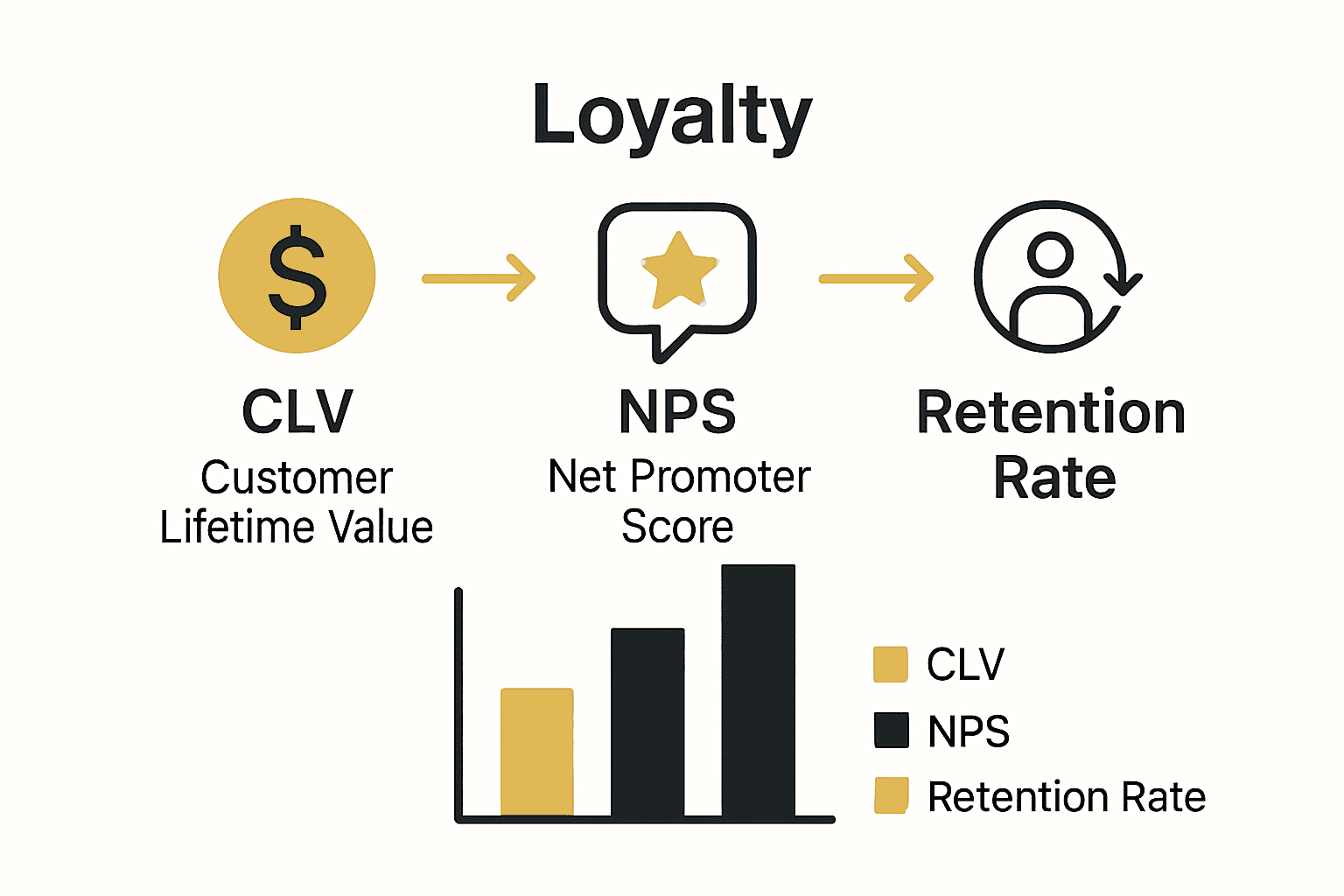 By tracking these indicators consistently and adapting strategies based on their trends, businesses can create a dynamic, responsive customer loyalty ecosystem that drives sustainable growth and long-term success.
Avoiding Common Pitfalls in Loyalty Building
Building customer loyalty is a nuanced process that requires strategic insight and careful execution. According to en.wikipedia.org, customer loyalty encompasses both attitudinal and behavioral components, meaning businesses must address psychological and practical aspects of customer relationships to create lasting engagement.
Drawing from The Loyalty Effect, a groundbreaking work by Fred Reichheld, understanding the deeper mechanisms of customer retention becomes crucial. Explore our guide on branding mistakes to avoid to prevent common missteps that can undermine customer trust and loyalty.
Common pitfalls in loyalty building include:
- Inconsistent brand messaging
- Neglecting personalized customer experiences
- Failing to address customer feedback
- Overlooking post-purchase engagement
- Complicated loyalty program structures
- Ignoring customer communication preferences
- Treating loyalty as a transactional relationship
Successful loyalty strategies require a holistic approach that goes beyond traditional marketing techniques. By understanding and proactively addressing potential barriers to customer retention, businesses can create meaningful, long-lasting connections that transform casual buyers into passionate brand advocates.
Unlock True Customer Loyalty with Expert Email Marketing
Building lasting customer loyalty means more than just repeat purchases. The article highlights how personalized experiences, strategic automation, and emotional connections are key to transforming casual buyers into passionate advocates. If you struggle with inconsistent communication, low engagement, or ineffective loyalty programs your challenge is clear. You need a partner who blends data-driven insights with human creativity to create automated, behavior-based email campaigns that resonate deeply with your audience.
At Take Action, we specialize in turning email marketing into your strongest growth engine. Our tailored solutions leverage AI-powered segmentation and flows like welcome series, abandoned cart recovery, and post-purchase nurture to increase open rates and customer lifetime value. We help ecommerce brands build sustainable connections that go beyond transactions and foster loyalty that lasts. Discover how to harness email automation effectively in line with the article’s detailed strategies by exploring our approach to audience segmentation and branding essentials for small businesses.
Ready to elevate your online business with proven retention tactics and create loyal customers who champion your brand Act now to optimize your email marketing with Take Action and turn one-time buyers into lifelong advocates.
Frequently Asked Questions
What are the key characteristics of customer loyalty in online businesses?
The key characteristics of customer loyalty in online businesses include consistent repeat purchasing behavior, strong emotional connections to the brand, willingness to recommend the brand to others, resistance to competitor offerings, and active engagement with brand content and communications.
How can businesses effectively measure customer retention success?
Businesses can measure customer retention success using metrics such as Customer Lifetime Value (CLV), Repeat Purchase Rate, Churn Rate, Net Promoter Score (NPS), Customer Satisfaction Score (CSAT), Retention Rate, and Average Order Value (AOV).
What strategies can enhance customer loyalty in online environments?
Key strategies to enhance customer loyalty in online environments include delivering personalized customer experiences, maintaining consistent and responsive communication, providing reliable service delivery, proactively resolving issues, and engaging customers meaningfully beyond sales transactions.
How does technology play a role in building customer loyalty?
Technology plays a crucial role in building customer loyalty through audience segmentation, intelligent personalization, and automation tactics. Utilizing AI-driven personalization technologies and predictive analytics can create more tailored, engaging customer experiences that enhance satisfaction and loyalty.
Recommended
- 7 Must-Read Business Book Recommendations for Ecommerce Growth | Take Action Blog | Take Action
- 7 Local Business Marketing Tips for Ecommerce Growth | Take Action Blog | Take Action
- Master Branding for Small Businesses: Build Loyalty in 2025 | Take Action Blog | Take Action
- 10 Proven Ways to Increase Online Sales in 2025 | Take Action Blog | Take Action