

Content Marketing: Driving Ecommerce Growth Globally
Driving repeat sales feels harder when customers are pulled in by countless competing offers, yet the solution often lies closer than you think. Effective content marketing gives your ecommerce brand a clear advantage by focusing on valuable customer experiences instead of constant hard sells. By prioritizing trustworthy content, which research shows is the most significant factor influencing ecommerce brand engagement, you set the foundation for lasting relationships and higher lifetime value. This guide unpacks how a strategic approach to content can create loyal customers for American brands using Klaviyo automations.
Table of Contents
- Defining Content Marketing for Ecommerce Brands
- Key Types of Content and Distribution Channels
- How Content Marketing Drives Retention and Sales
- Automation and Klaviyo’s Role in Content Strategy
- Common Pitfalls and Alternatives to Paid Advertising
Key Takeaways
| Point | Details |
|---|---|
| Focus on Content Marketing | Shift from hard selling to creating valuable content that engages and builds loyalty with customers. |
| Leverage Automation | Use platforms like Klaviyo to personalize content delivery and enhance customer relationships through targeted communications. |
| Utilize Multiple Distribution Channels | Optimize your content across owned, earned, and paid channels to maximize reach and engagement with your audience. |
| Avoid Common Pitfalls | Stay aware of audience needs, maintain consistent posting, and diversify content strategies to prevent reliance on paid advertising alone. |
Defining Content Marketing for Ecommerce Brands
Content marketing for ecommerce is not about hard selling your products. It’s about creating valuable experiences that your customers actually want to engage with.
Content marketing means developing and sharing valuable, relevant, and consistent content that attracts and keeps a clearly defined audience. For ecommerce brands, this strategy directly influences purchasing decisions and builds lasting customer loyalty.
The core of ecommerce content marketing rests on three pillars:
-
Trust: Trustworthy content ranks as the most significant factor driving ecommerce engagement, helping customers feel confident in your brand.
-
Value: Content that educates, solves problems, or entertains keeps your audience returning and builds genuine connections.
-
Consistency: Regular, reliable content delivery shows customers you’re actively invested in their experience, not just making one-time sales.
Unlike traditional advertising, content marketing works quietly in the background. It positions your brand as a knowledgeable resource rather than just a vendor pushing products.
When customers trust your content, they’re far more likely to choose your brand over competitors—and stay loyal long term.
Think of it this way: A customer visiting your site for a product answer should discover an honest, helpful resource. That’s when purchase decisions happen naturally.
For Klaviyo users, content marketing integrates seamlessly into your automation workflows. Valuable content fuels email campaigns, nurtures customer journeys, and creates touchpoints that convert.
The shift toward content-driven ecommerce reflects a global reality: customers now expect brands to educate, not just sell. Your content becomes the bridge between their needs and your solutions.
Pro tip: Audit your current content to identify gaps where customers have questions your competitors aren’t answering—those gaps are your growth opportunities.
Key Types of Content and Distribution Channels
Content only works when it reaches the right people at the right time. That’s where distribution channels come in—they’re your megaphone to customers worldwide.
Ecommerce content falls into distinct types, each serving a different purpose in the customer journey:
Here’s a summary of the main content types and how they impact ecommerce success:
| Content Type | Primary Purpose | Business Impact |
|---|---|---|
| Blog articles | Inform and educate | Boosts organic traffic and credibility |
| Product guides & tutorials | Simplify usage | Reduces returns and increases trust |
| Videos | Humanize and engage | Increases conversions and brand loyalty |
| Infographics & visuals | Clarify concepts | Encourages social sharing and reach |
| Testimonials & case studies | Build credibility | Drives conversions and repeat business |
-
Blog posts and articles: Educate customers, improve search visibility, and establish authority in your niche.
-
Product guides and tutorials: Help customers understand features, use cases, and benefits before purchasing.
-
Video content: Demonstrate products in action, build emotional connections, and boost engagement rates significantly.
-
Infographics and visual content: Simplify complex information and increase shareability across social platforms.
-
Customer testimonials and case studies: Provide social proof that drives trust and conversions.
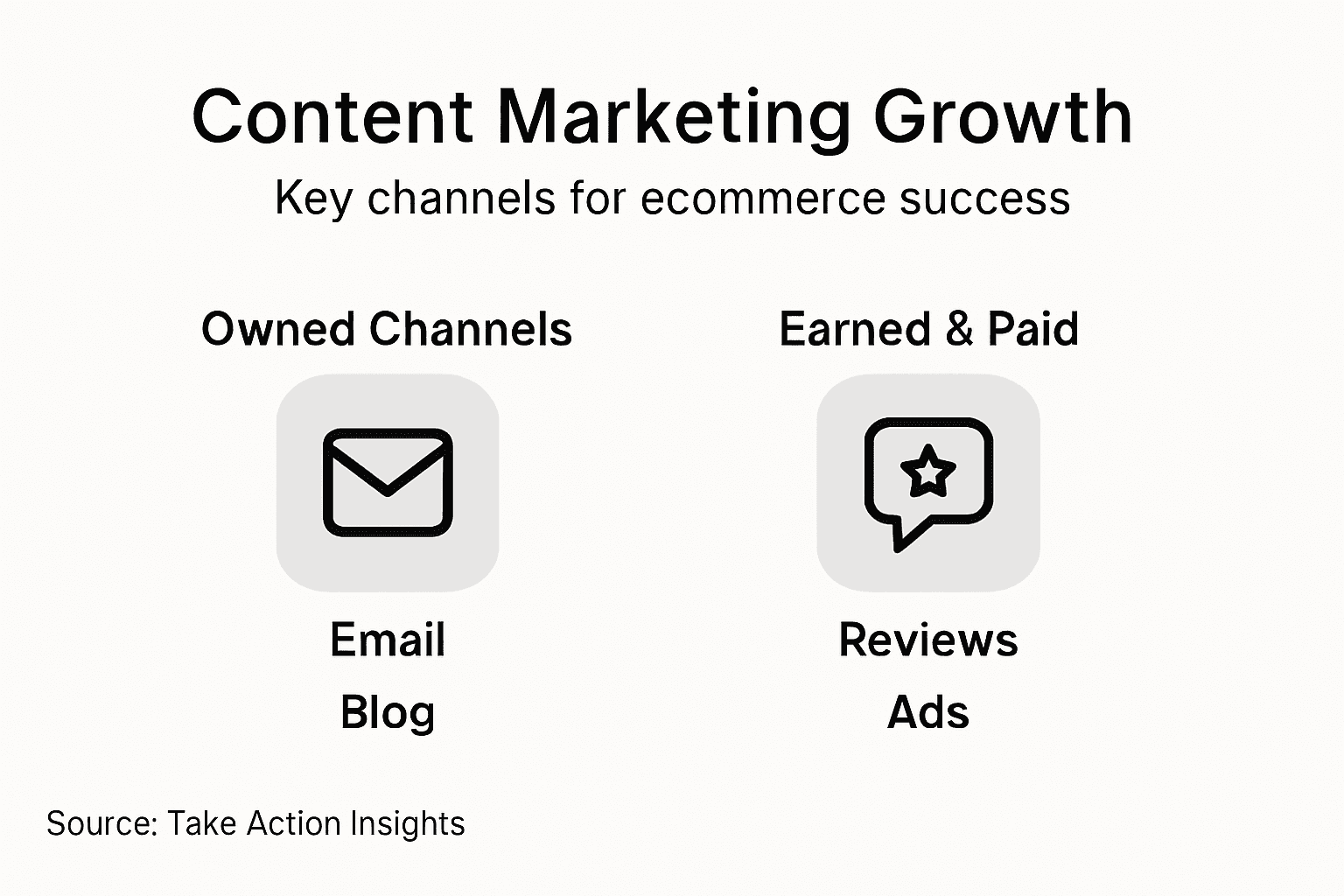
Now, where do you distribute this content? Distribution channels split into three categories: owned, earned, and paid.
Owned channels include your website, email list, and social media accounts. These are spaces you control completely.
Earned channels happen when customers or media naturally share your content—organic mentions, reviews, or word-of-mouth recommendations.
Paid channels amplify reach through advertising, sponsored content, and promotional placements.
Compare the distribution channels for ecommerce content marketing:
| Channel Type | Control Level | Reach Potential | Typical Investment |
|---|---|---|---|
| Owned | Full control | Audience you build | Time and content |
| Earned | Limited control | Organic discovery, wide | Quality-driven |
| Paid | Partial control | Broad but costly access | Financial budget |
The strongest ecommerce brands use all three simultaneously, creating a reinforcing cycle where owned content gets shared through earned channels, which then informs paid strategy.
For Klaviyo users, email sits at the intersection of all three. Your email list is owned, shares often get earned, and email advertising extends paid reach.
Email delivers content directly to engaged customers without algorithm interference. Video thrives on platforms like YouTube and TikTok where discovery happens naturally. Blog articles drive long-term organic search traffic. Each channel plays a different role.
Multi-channel distribution doesn’t mean spreading thin across every platform. It means choosing channels where your specific audience already spends time, then creating content formats that perform best there.
Pro tip: Start by mapping where your customers already engage—then prioritize the three channels (owned, earned, paid) that will actually reach them, rather than trying to maintain presence everywhere at once.
How Content Marketing Drives Retention and Sales
Content marketing isn’t just about attracting new customers. It’s about keeping them coming back and making them spend more when they do.

Here’s the reality: acquiring a new customer costs significantly more than retaining an existing one. Content creates reasons for customers to stay engaged with your brand long after their first purchase.
When you consistently deliver valuable content, several things happen:
-
Trust builds naturally: Customers see you as a resource, not just a vendor.
-
Engagement increases: Regular touchpoints keep your brand top-of-mind without aggressive sales tactics.
-
Loyalty develops: Customers who feel educated and valued become repeat buyers.
-
Word-of-mouth spreads: Satisfied customers share your content, bringing in new audiences organically.
Content aligned with your sales funnel works harder than generic material. Educational content answers objections before purchase. Post-purchase guides reduce returns and increase satisfaction. Exclusive content rewards loyal customers.
Creating engaging, relevant content fosters strong brand relationships that directly translate to higher lifetime value and repeat purchases.
Your email list becomes the engine here. For Klaviyo users, content-driven email campaigns nurture customers through every stage. A welcome series educates new buyers. Post-purchase emails guide usage and uncover expansion opportunities. Newsletters keep dormant customers active.
The brands scaling fastest aren’t chasing vanity metrics—they’re using content to deepen customer relationships and drive repeat revenue.
Consider a customer who bought once but hasn’t returned. A targeted email with educational content addressing common issues from their purchase category can reignite engagement. Video tutorials, comparison guides, or style inspiration all serve double duty: they provide real value while subtly guiding customers toward additional purchases.
Personalization amplifies this effect. Content tailored to customer behavior, purchase history, and preferences outperforms generic broadcasts. A customer who bought athletic wear needs different content than one who bought formal pieces.
Data analytics show which content topics drive engagement, clicks, and conversions. Use these insights to double down on what works and adjust what doesn’t. This continuous optimization compounds results over time.
Pro tip: Segment your email list by customer type (new, repeat, at-risk, VIP) and create distinct content sequences for each—repeat customers shouldn’t receive the same educational content as newcomers.
Automation and Klaviyo’s Role in Content Strategy
Automation transforms content marketing from a manual grind into a scalable growth engine. Instead of sending the same generic email to everyone, you’re delivering personalized content at precisely the right moment.
Klaviyo sits at the center of this transformation. The platform connects your content strategy with customer data, allowing you to send targeted messages based on behavior, preferences, and purchase history.
Here’s what automation enables:
-
Timing perfection: Welcome series trigger instantly when customers join your list. Abandoned cart emails arrive before they forget. Post-purchase sequences deliver at optimal moments.
-
Personalization at scale: Customers see content relevant to their interests and actions, not generic blasts.
-
Consistent touchpoints: Nurture sequences run 24/7 without manual effort, keeping content flowing while you focus on strategy.
-
Data-driven decisions: Track which content drives engagement, clicks, and conversions in real time.
Klaviyo’s evolution toward AI-driven personalization and predictive analytics means your content strategy gets smarter over time. The platform learns which content resonates with which segments, then automatically optimizes delivery and timing.
Consider a typical workflow: A customer browses your winter collection. An automated email sequence triggers with style guides, customer testimonials, and sizing tips—all content they actually need. If they purchase, a post-purchase series guides them through product care and introduces complementary items.
Without automation, this requires manual sending, perfect timing, and constant monitoring. With Klaviyo, it’s set once and compounds forever.
Automation doesn’t replace strategy—it executes strategy perfectly at scale, freeing you to focus on creative direction and growth initiatives.
Segmentation amplifies automation’s power. You’re not automating the same message to everyone. You’re creating distinct workflows for different customer groups based on behavior, purchase value, and engagement level.
The real win emerges over months. Customers experiencing consistent, relevant content develop stronger relationships with your brand. Repeat purchase rates climb. Customer lifetime value grows exponentially.
Pro tip: Start with one high-impact automation (welcome series or abandoned cart) rather than building everything at once—measure results, optimize based on data, then layer in additional workflows.
Common Pitfalls and Alternatives to Paid Advertising
Paid advertising works until it doesn’t. Rising costs, ad saturation, and platform algorithm changes have made relying solely on paid ads increasingly risky for ecommerce brands.
Most brands fall into predictable traps when building content marketing strategies. Understanding these mistakes saves time and budget.
Common pitfalls include:
-
Ignoring audience segmentation: Sending the same content to everyone wastes reach and dilutes messaging.
-
Inconsistent posting: Sporadic content confuses audiences and damages brand visibility over time.
-
Neglecting customer needs: Creating content you want to share instead of content customers actually need guarantees poor engagement.
-
Over-reliance on single channels: Depending entirely on SEO or paid ads alone leaves you vulnerable to algorithm changes.
The smartest brands explore alternatives to paid advertising that build sustainable, organic growth without constant ad spend increases.
Email marketing ranks first among these alternatives. Your email list is owned, not rented from social platforms. Content shared via email reaches engaged subscribers directly, generating consistent revenue without rising costs.
Organic social media builds authentic communities around your brand. Consistent, valuable content posted to platforms like Instagram and TikTok reaches followers genuinely interested in your niche.
Influencer partnerships leverage existing audiences aligned with your brand values. Unlike paid ads, influencer collaborations build credibility through trusted voices.
Affiliate marketing turns customers into promoters. They earn commissions while spreading your content and products organically.
The brands winning long-term aren’t chasing paid ad trends—they’re building owned audiences and content engines that generate revenue independent of ad platforms.
Content-driven strategies compound over time. A blog post written today continues attracting customers months from now. An email nurture sequence converts new subscribers indefinitely. Paid ads stop working the moment you stop paying.
For Klaviyo users, email becomes the primary growth channel, reducing ad spend dependency. You’re building a direct relationship with customers rather than borrowing access through Facebook or Google.
This shift requires patience. Content marketing rewards consistency, not speed. Brands that commit to six months of authentic content marketing outpace those jumping between tactics constantly.
Pro tip: Allocate 30% of marketing budget to owned channels (email, blog, owned social) instead of splitting everything across paid ads—the compounding returns will surprise you within six months.
Turn Content Marketing Challenges into Ecommerce Growth with Expert Email Strategies
The article highlights how building trust, delivering consistent value, and using automation are key challenges in ecommerce content marketing that directly impact customer retention and revenue growth. Many brands struggle with segmenting their audience properly, creating timely personalized content, and reducing dependency on costly paid ads. If you want to transform these obstacles into opportunities for deeper engagement and lasting loyalty you need a partner who specializes in leveraging Klaviyo automation to fuel your entire content-driven email strategy.
At Take Action we combine data-driven precision with human creativity to build automated email flows that guide your customers through every stage—from welcome sequences to abandoned cart recoveries and post-purchase education. Our campaign strategy focuses on delivering the right content at the right moment using segmentation and AI insights so you can increase open and click rates without wasting resources on broad generic messaging. Automating these key touchpoints unlocks scalable growth while freeing you to focus on creating content that resonates.
Ready to stop chasing fleeting paid ad wins and start turning your email list into your most valuable growth channel? Discover how our email marketing and retention services can reshape your content marketing efforts. Visit Take Action today and take the first step toward automated, measurable ecommerce success.
Frequently Asked Questions
What is content marketing for ecommerce?
Content marketing for ecommerce is the process of creating and sharing valuable, relevant content that engages customers and influences their purchasing decisions, ultimately building loyalty.
Why is trust important in ecommerce content marketing?
Trust plays a crucial role in ecommerce content marketing as it helps customers feel confident in the brand, leading to increased engagement and long-term loyalty.
How can content marketing improve customer retention in ecommerce?
By delivering consistent, valuable content, ecommerce brands can keep customers engaged, build trust, and encourage repeat purchases, which ultimately increases customer lifetime value.
What types of content are effective for ecommerce brands?
Effective content types for ecommerce brands include blog articles, product guides, videos, infographics, and customer testimonials. Each serves a unique purpose in educating customers and aiding in their purchasing decisions.
Recommended
- 7 Top Content Marketing Channels for Ecommerce Growth | Take Action Blog | Take Action
- Digital Marketing Services: Driving Ecommerce Growth | Take Action Blog | Take Action
- Digital Media Strategy: Unlocking Ecommerce Growth | Take Action Blog | Take Action
- How to Plan Content for Scalable Ecommerce Growth | Take Action Blog | Take Action
- 8 Powerful Ecommerce Content Ideas to Boost Sales in 2025 - Affinsy Blog | Affinsy
- Ecommerce Growth Strategy: Driving Revenue with Automation