

Content Marketing for Coaches: Build Stronger Client Funnels
Most American coaches find it challenging to attract clients who truly value their unique approach. With competition rising fast, the difference between blending in and standing out comes down to understanding exactly who you want to help. When you clarify your audience and goals, you unlock the power to design programs that connect, build trust, and fuel real results. Get clear on these essentials to transform how you reach your next client.
Table of Contents
- Step 1: Define Your Coaching Audience and Core Goals
- Step 2: Develop Compelling, Value-Driven Content Assets
- Step 3: Integrate Email Automation With Targeted Messaging
- Step 4: Optimize Engagement Through Segmentation and Personalization
- Step 5: Track Performance and Refine Content Strategies
Quick Summary
| Key Point | Explanation |
|---|---|
| 1. Define your audience sharply | Understand your ideal clients and their challenges for targeted engagement and effective program design. |
| 2. Create valuable content assets | Develop diverse forms of content to address specific client pain points and showcase your coaching expertise. |
| 3. Utilize email automation effectively | Implement personalized email sequences to nurture relationships and guide potential clients through their decision-making journey. |
| 4. Segment your audience thoughtfully | Break down your audience into specific personas for customized messaging that aligns with their motivations and goals. |
| 5. Track and refine your strategies | Continuously analyze performance data to improve content effectiveness and enhance client engagement over time. |
Step 1: Define Your Coaching Audience and Core Goals
Defining your ideal coaching audience represents the critical first milestone in building a powerful client funnel. This strategic process involves understanding precisely who you want to help and what unique problems you can solve for them.
Start by analyzing your past client interactions and identifying common characteristics and challenges. Effective audience definition requires deep introspection about your professional strengths and the specific demographic or psychographic segments where you generate the most meaningful results. Coaches who successfully narrow their focus can design more targeted programs that resonate deeply with their ideal clients.
To refine your audience selection, map out detailed profiles that go beyond basic demographics. Consider factors like professional background, career stage, personal motivations, and specific pain points your coaching can address. A narrow, well-understood audience allows you to craft compelling messaging and service offerings that speak directly to their needs. Warning: Resist the temptation to be a generalist who tries to help everyone. Specialization creates more trust and perceived expertise in your chosen niche.

Your next step will involve translating these audience insights into clear, actionable goals that will guide your entire coaching strategy and marketing approach.
Step 2: Develop Compelling, Value-Driven Content Assets
Creating powerful content assets is your strategic pathway to attracting and nurturing potential coaching clients. This step transforms your audience insights into meaningful resources that demonstrate your expertise and solve real problems.
Start by exploring diverse content strategies that align with your target audience’s specific needs. Coaches can leverage multiple content formats including blog posts, video tutorials, podcast episodes, downloadable worksheets, and webinars. The key is developing materials that provide tangible value and showcase your unique coaching approach. When generating content ideas, focus on addressing specific challenges your ideal clients face by creating resources that offer actionable solutions and measurable insights.
To maximize your content’s impact, incorporate proven instructional design principles. Emerging AI technologies can help coaches develop more engaging and diverse educational materials that resonate with different learning styles. Pro tip: Always prioritize quality over quantity. One deeply researched, transformative piece of content will outperform multiple surface level resources. Your content should not just inform but inspire action and demonstrate the potential transformation your coaching can provide.
In the next phase, you will learn how to strategically distribute these content assets to attract and engage your ideal coaching clients.
Step 3: Integrate Email Automation with Targeted Messaging
Email automation represents a powerful strategy for coaches to deliver personalized communication that nurtures potential clients through their decision making journey. This step transforms your content strategy into a dynamic system that engages prospects with precisely timed and crafted messages.
Email automation technologies enable coaches to segment audiences and create targeted communication pathways that speak directly to individual client needs. By leveraging AI driven messaging strategies, you can develop sophisticated email sequences that adapt to client interactions and demonstrate your understanding of their unique challenges. The key is designing workflows that feel personal and responsive rather than generic mass communications.
Implementing effective email automation requires careful strategic planning. Pro tip: Map out your client journey in advance and create content that addresses specific stages of their decision making process. Your automated emails should provide progressive value by offering increasingly sophisticated insights that build trust and showcase your coaching expertise. Warning: Avoid over messaging or appearing too aggressive. The goal is to provide genuine value that positions you as a trusted advisor who understands their specific transformation needs.
The next stage will involve tracking and optimizing your email automation to continuously improve client engagement and conversion rates.
Step 4: Optimize Engagement Through Segmentation and Personalization
Effective coaching requires a sophisticated approach to understanding and connecting with your potential clients. This step transforms generic communication into a precision targeted strategy that speaks directly to individual client needs and motivations.
Audience segmentation strategies enable coaches to create nuanced communication pathways that reflect distinct coaching interaction principles. By breaking down your audience into specific personas based on professional background, career challenges, learning style, and personal goals, you can craft messaging that feels intimately designed for each subgroup. The key is moving beyond demographic data to understand the deeper psychological drivers that motivate your potential clients.
Implementing advanced personalization requires strategic thinking and careful data analysis. Pro tip: Develop detailed client persona profiles that go beyond surface level characteristics and capture the underlying motivations and aspirations of different coaching segments. Warning: Avoid over generalizing or creating too many narrow segments that fragment your messaging. Your goal is to create meaningful distinctions that allow for genuine connection while maintaining a cohesive overall communication strategy.
The next phase will involve developing targeted content and communication workflows that bring these segmentation insights to life.
Step 5: Track Performance and Refine Content Strategies
Tracking and refining your content strategy is essential for continuous improvement and sustained coaching success. This step transforms raw performance data into actionable insights that help you optimize your marketing approach and client engagement.
Performance marketing techniques enable coaches to measure the effectiveness of their content with precision. Continuous reflection and adaptation are critical for maintaining a dynamic and responsive coaching practice. By implementing robust tracking mechanisms, you can identify which content resonates most strongly with your target audience, understand engagement patterns, and make data driven decisions about future content development.
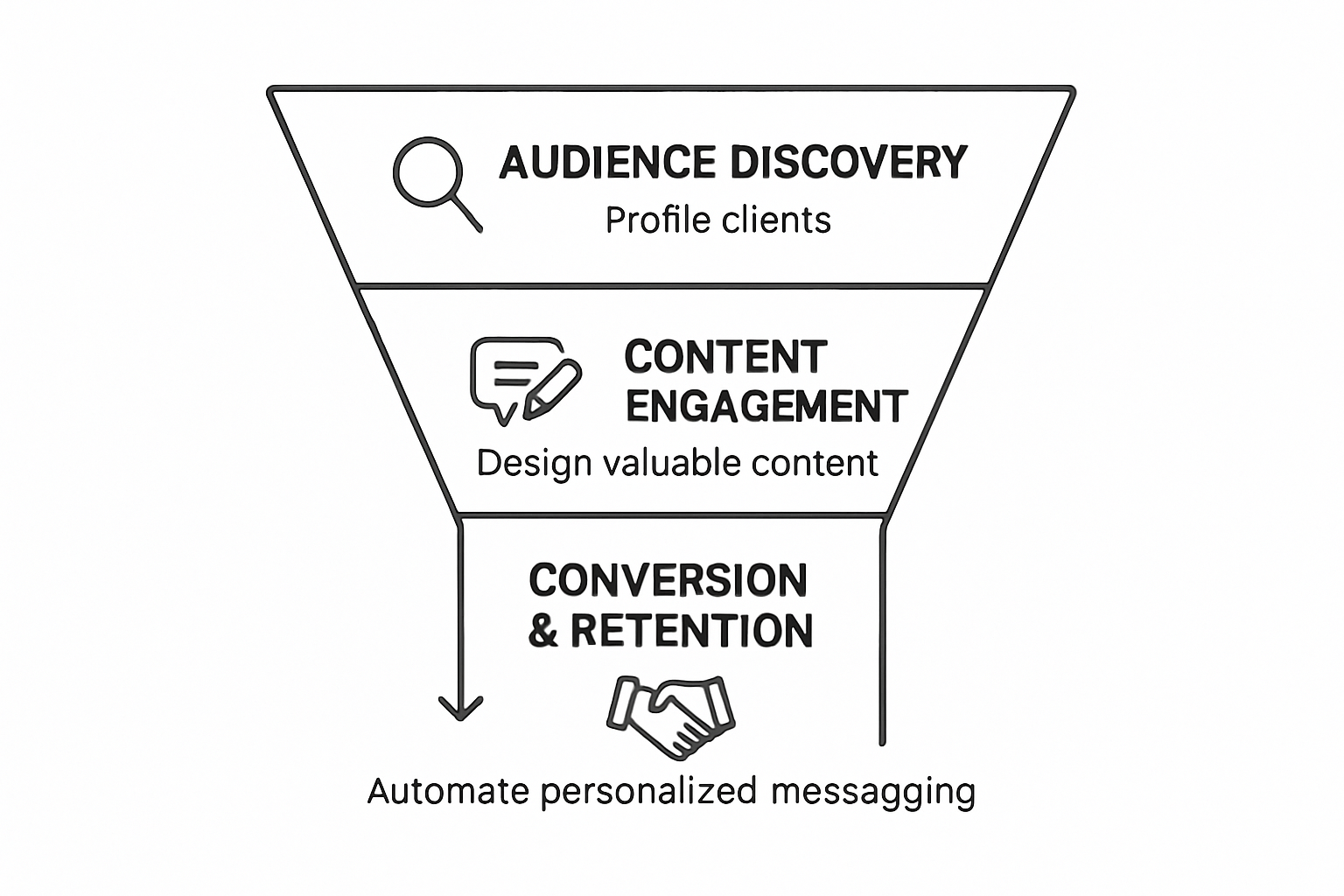
Implementing a systematic performance tracking approach requires strategic thinking and careful analysis. Pro tip: Develop a comprehensive dashboard that captures key performance indicators such as open rates, click through rates, content downloads, and conversion metrics. Warning: Avoid getting lost in data complexity. Focus on metrics that directly relate to client acquisition and engagement. Your goal is to create a lean, focused tracking system that provides clear insights into your content strategy effectiveness and highlights opportunities for strategic refinement.
The next phase will involve using these performance insights to iterate and improve your overall coaching marketing approach.
Transform Your Coaching Client Funnels with Precision Email Automation
Building a strong client funnel starts with understanding your audience and creating valuable content that truly resonates. This article highlights the challenges coaches face such as crafting personalized communication, segmenting audiences effectively, and delivering timely, engaging emails that nurture client relationships toward conversion. At Take Action, we specialize in turning these complex tasks into streamlined, automated systems tailored for coaches and service providers looking to scale.
By leveraging our expertise in email marketing and retention strategies using Klaviyo, you can automate targeted messaging, boost open and click rates, and convert prospects into loyal clients without overwhelming manual effort. Whether it’s designing welcome flows, abandoned cart sequences, or long-term engagement campaigns, our data-driven approach ensures your content reaches the right clients when it matters the most.
Ready to elevate your coaching business with expertly crafted email automation workflows that drive measurable growth? Visit Take Action today and explore how our strategic campaigns and advanced segmentation can help build stronger, more effective client funnels that reflect your unique coaching voice. Learn how our proven solutions align perfectly with the insights from Content Marketing for Coaches to transform your email channel into your primary growth engine.
Frequently Asked Questions
How do I define my ideal coaching audience?
Defining your ideal coaching audience involves analyzing your past client interactions to identify common characteristics and challenges. Start by mapping out detailed profiles that consider factors like professional background, personal motivations, and specific pain points your coaching can address.
What types of content assets should I create for my coaching practice?
You should create diverse content assets such as blog posts, video tutorials, downloadable worksheets, and webinars that align with your audience’s needs. Focus on offering resources that provide tangible value and actionable solutions to the challenges your ideal clients face.
How can I implement email automation effectively for my coaching business?
To implement email automation effectively, segment your audience and design targeted communication pathways that address individual client needs. Map out your client journey and create content that provides progressive value, ensuring your emails feel personal and relevant to their decision-making process.
What are the best ways to track my content performance?
The best way to track your content performance is to develop a dashboard that captures key performance indicators such as open rates and click-through rates. Focus on metrics that relate directly to client engagement and acquisition to identify areas for improvement within 30 days.
How can I personalize my communication with clients?
To personalize your communication, develop detailed client persona profiles that capture underlying motivations and goals. Use this information to craft messaging that feels tailored to each specific subgroup, creating stronger connections while maintaining a cohesive communication strategy.
Why is it important to avoid being a generalist in coaching?
Being a generalist can dilute your perceived expertise and trustworthiness in your niche. By narrowing your focus, you create more impactful programs and messaging that resonate deeply with your ideal clients, leading to stronger client relationships and better results.
Recommended
- What Is a Sales Funnel? Complete Expert Overview | Take Action Blog | Take Action
- 7 Evergreen Content Ideas for Growing Your Brand | Take Action Blog | Take Action
- Content Marketing Explained: Strategies, Types, and Impact | Take Action Blog | Take Action
- 10 Creative Content Ideas for Newsletters to Boost Engagement | Take Action Blog | Take Action
- Understanding the Importance of Customer Communication – My WordPress