

Customer Lifetime Value: Driving Profitable Growth With Email
Nearly 80 percent of American ecommerce revenue comes from repeat customers rather than first-time buyers. For managers at direct-to-consumer brands, this reality means shifting focus from one-off transactions to building loyal relationships is essential. Unlocking the true potential of Customer Lifetime Value not only guides smarter resource allocation but turns retention email campaigns into powerful profit drivers. Discover how data-driven segmentation and automated Klaviyo workflows can multiply your impact and keep valuable customers engaged longer.
Table of Contents
- Defining Customer Lifetime Value and Its Role
- Distinguishing Historic vs Predicted CLV Metrics
- How CLV Segmentation Optimizes Email Campaigns
- Automating Retention Strategies With Klaviyo
- Common CLV Calculation Mistakes To Avoid
Key Takeaways
| Point | Details |
|---|---|
| Understanding CLV | Customer Lifetime Value (CLV) measures the total financial worth of a customer over time, guiding strategic resource allocation and marketing efforts. |
| Historic vs Predicted CLV | Utilizing both Historic and Predicted CLV metrics enables brands to tailor customer engagement strategies for better retention and profitability. |
| CLV Segmentation | Effective email marketing can be achieved through CLV segmentation, allowing for targeted communication that enhances customer engagement and loyalty. |
| Avoiding Calculation Mistakes | Accurate CLV calculations require accounting for all relevant costs and incorporating dynamic data to avoid strategic errors in decision-making. |
Defining Customer Lifetime Value and Its Role
Customer Lifetime Value (CLV) represents the total financial worth a customer generates for a business throughout their entire relationship. While traditional sales metrics capture individual transaction values, CLV provides a comprehensive view of a customer’s long-term economic potential. Strategic resource allocation becomes possible by understanding the net present value of future cash flows from each customer relationship.
At its core, CLV quantifies the total revenue a business can reasonably expect from a single customer account. This metric goes beyond immediate sales, considering repeat purchases, potential upsells, cross-sells, and the customer’s overall engagement trajectory. Ecommerce brands leveraging customer retention strategies can dramatically increase their CLV by focusing on building lasting relationships rather than pursuing one-time transactions.
Companies calculate CLV by analyzing historical purchasing patterns, average order value, purchase frequency, and customer retention rates. The most sophisticated approaches incorporate predictive modeling to estimate future interactions, factoring in variables like customer demographics, engagement levels, and historical spending behaviors. This nuanced approach allows brands to segment customers, personalize marketing efforts, and prioritize high-value customer relationships.
Pro tip: Track your customer lifetime value monthly and segment customers into tiers to develop targeted retention strategies that maximize long-term revenue potential.
Distinguishing Historic vs Predicted CLV Metrics
Historic Customer Lifetime Value (CLV) and Predicted CLV represent two distinct yet complementary approaches to understanding a customer’s long-term value. Historic CLV is a retrospective analysis based on actual past transaction data, providing a concrete snapshot of a customer’s previous spending patterns. Loyalty program insights can help brands leverage this historical data to understand existing customer behavior and segment their audience more effectively.
Predicted CLV, in contrast, is a forward-looking metric that uses statistical modeling and machine learning algorithms to forecast a customer’s potential future value. This approach goes beyond simple historical data by incorporating predictive elements such as customer engagement patterns, likelihood of repeat purchases, potential churn risk, and estimated future spending trajectories. By analyzing complex behavioral signals, brands can anticipate customer potential rather than relying solely on past performance.
The key difference between these two metrics lies in their temporal focus and analytical complexity. Historic CLV offers a clear view of what has already occurred, while Predicted CLV provides strategic foresight into potential future interactions. Sophisticated ecommerce brands typically use a combination of both metrics to develop nuanced customer engagement strategies. This integrated approach allows for more precise resource allocation, personalized marketing efforts, and targeted customer retention initiatives.
Here’s a comparison of Historic vs Predicted CLV and how they support business strategy:
| Metric Type | Data Source | Business Use | Typical Analytical Tools |
|---|---|---|---|
| Historic CLV | Past transaction records | Retrospective segmentation | Cohort analysis, spreadsheets |
| Predicted CLV | Predictive modeling, behavior | Foresight & targeting | Machine learning, statistical models |
Pro tip: Combine historic and predicted CLV metrics to create a comprehensive customer value profile that enables more intelligent, data-driven marketing decisions.
How CLV Segmentation Optimizes Email Campaigns
Customer Lifetime Value (CLV) segmentation transforms email marketing from a generic broadcast approach to a precision-targeted strategy that maximizes engagement and revenue. Sophisticated marketing models integrate CLV with customer behavioral patterns to create highly personalized communication channels that speak directly to each customer’s unique value and potential.

The segmentation process typically involves dividing customers into distinct groups based on their calculated lifetime value, allowing marketers to craft nuanced email strategies for each segment. Email segmentation strategies enable brands to develop targeted approaches such as premium content for high-value customers, retention campaigns for at-risk mid-tier customers, and reactivation efforts for lower-value segments. This approach ensures that marketing resources are allocated efficiently, maximizing return on investment and improving overall customer engagement.
Advanced CLV segmentation goes beyond simple monetary value, incorporating complex behavioral signals like purchase frequency, average order value, product preferences, and engagement history. By analyzing these multidimensional customer attributes, brands can create dynamic email campaigns that adapt to changing customer behaviors. For instance, high-value customers might receive exclusive early access to new products, while customers with potential for growth receive educational content and targeted upsell recommendations.
Pro tip: Create at least three distinct CLV segments with tailored email content and communication frequency to optimize engagement and maximize customer lifetime value.
Automating Retention Strategies With Klaviyo
Advanced retention strategies through automated workflows enable ecommerce brands to transform customer interactions from sporadic transactions into consistent, personalized engagement experiences. Klaviyo’s sophisticated automation tools leverage data-driven insights to create intelligent, behavior-triggered communication pathways that adapt dynamically to individual customer journeys.
The platform’s core strength lies in its ability to segment customers using complex criteria like purchase history, engagement levels, and predictive lifetime value. By implementing RFM (Recency, Frequency, Monetary) analysis, brands can develop nuanced automated email sequences that speak directly to each customer’s unique relationship with the brand. Automated workflow strategies enable businesses to deploy targeted campaigns such as welcome series, abandoned cart recoveries, post-purchase follow-ups, and win-back sequences with precision and minimal manual intervention.
Klaviyo’s automation capabilities extend beyond simple triggered emails. The platform allows for complex, multi-step workflows that can incorporate conditional logic, ensuring that each customer receives the most relevant content based on their specific behaviors and attributes. These intelligent systems can automatically adjust messaging, timing, and offers to maximize engagement, reduce churn, and incrementally improve customer lifetime value through carefully orchestrated touchpoints.
Pro tip: Configure at least three distinct automated workflows targeting different customer segments, using behavioral triggers and personalized content to optimize retention and revenue.
Common CLV Calculation Mistakes To Avoid
Critical pitfalls in customer lifetime value calculations can dramatically undermine the accuracy of strategic business decisions. Many ecommerce brands unknowingly sabotage their financial modeling by treating CLV as a simplistic, one-dimensional metric, failing to account for the nuanced complexities of customer relationships and true economic value.
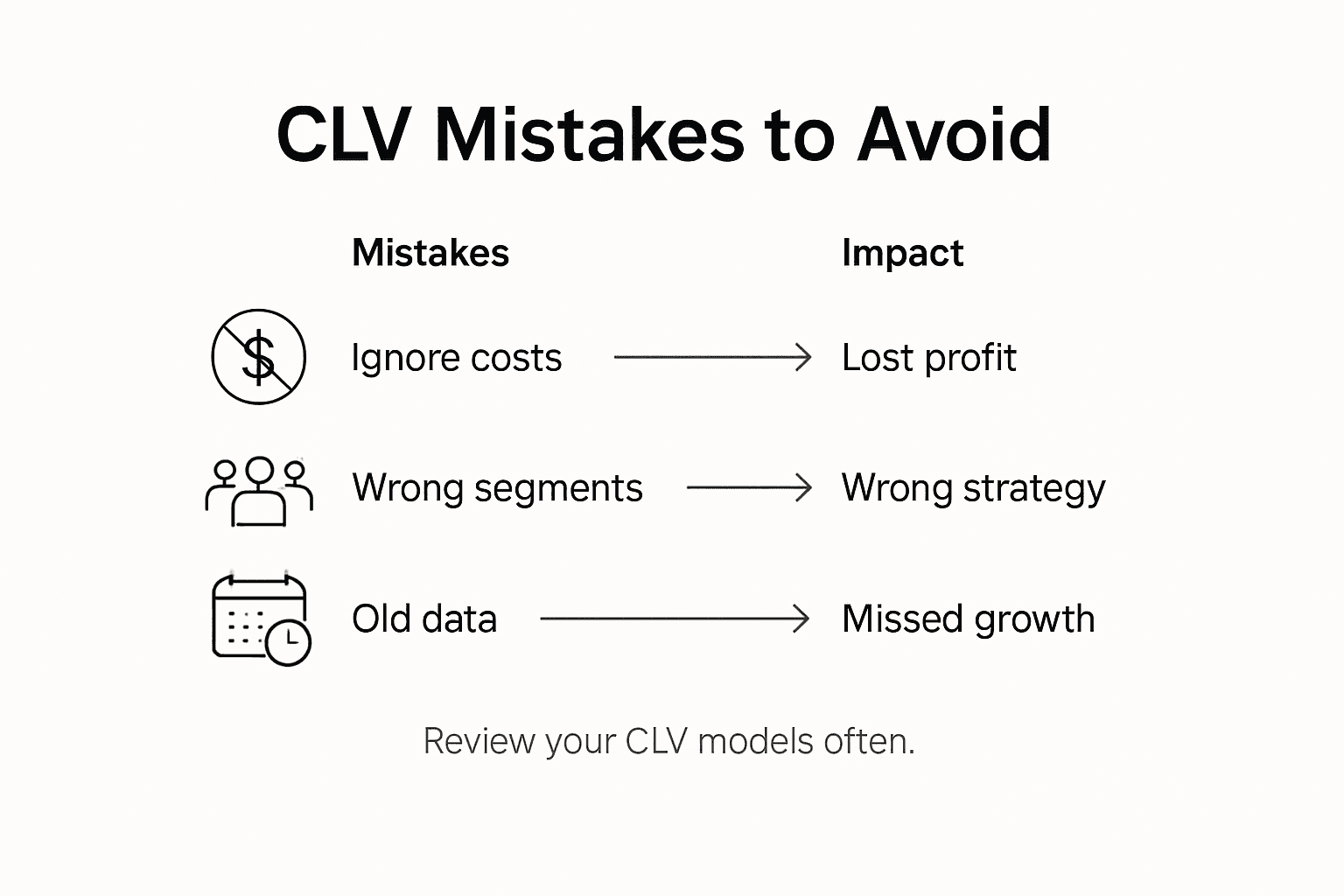
One of the most prevalent errors is conflating gross revenue with actual customer value without considering critical cost factors. Acquisition costs, operational expenses, and variable transaction expenses must be meticulously subtracted to reveal the genuine net value of each customer segment. Comprehensive CLV calculation challenges demand a holistic approach that integrates multiple data points, including purchase frequency, average order value, retention probability, and potential future revenue streams.
Advanced CLV modeling requires sophisticated techniques like time-value discounting and dynamic segmentation to provide meaningful insights. Oversimplified calculations that ignore future revenue’s present value, assume unrealistic customer retention periods, or rely on static historical data can lead to severely distorted strategic decisions. Successful brands develop adaptive CLV models that continuously incorporate new behavioral data, adjust for market changes, and provide granular insights into customer economic potential.
The table below summarizes key CLV calculation mistakes and their business impact:
| Mistake | Description | Negative Business Impact |
|---|---|---|
| Ignoring true costs | Not subtracting acquisition & transactional costs | Overestimates customer profitability |
| Using static data | Relying only on historical records | Strategy fails to adapt to changes |
| No time-value discounting | Treating future revenue as present value | Misallocates marketing resources |
Pro tip: Implement a quarterly CLV model review process that recalibrates your calculations using the most recent customer behavioral data and accounts for changing market dynamics.
Unlock the Full Potential of Your Customer Lifetime Value with Expert Email Strategies
Maximizing Customer Lifetime Value requires smart automation, precise segmentation, and data-driven campaigns tailored to increase retention and revenue over time. If you are struggling with transforming CLV insights into actionable email marketing strategies or finding it difficult to integrate predictive CLV into your campaigns, there is a better way forward. At Take Action, we specialize in leveraging Klaviyo’s powerful automation and data capabilities to help ecommerce brands automate retention workflows, segment customers by lifetime value, and craft personalized emails that boost long-term profits.
Don’t let your CLV data sit idle when it can drive measurable growth. Partner with us to create sophisticated email flows like welcome series, abandoned cart recoveries, and post-purchase sequences that adapt to your customers’ unique behaviors. Visit Take Action now to learn how our specialized email marketing services can turn your customer insights into sustainable revenue growth through proven automation and segmentation techniques.
Frequently Asked Questions
What is Customer Lifetime Value (CLV)?
Customer Lifetime Value (CLV) represents the total revenue a customer is expected to generate for a business throughout their relationship. It provides a comprehensive view of a customer’s long-term economic potential, beyond just individual transactions.
How is CLV calculated?
CLV is calculated by analyzing historical purchasing patterns, average order value, purchase frequency, and customer retention rates. Advanced methods may use predictive modeling to estimate future interactions based on various customer attributes.
Why is email segmentation important for CLV?
Email segmentation allows businesses to target specific groups of customers based on their CLV. This enables personalized communication strategies that enhance engagement and improve retention, ultimately maximizing revenue.
What are common mistakes to avoid when calculating CLV?
Common mistakes include ignoring true customer acquisition costs, relying on static historical data, and failing to apply time-value discounting. These errors can lead to inaccurate assessments of customer profitability and ineffective marketing strategies.
Recommended
- Customer Retention: Key Driver of Ecommerce Growth | Take Action Blog | Take Action
- Email Campaign Best Practices for 2025 Success | Take Action Blog | Take Action
- Email Segmentation Strategies for Ecommerce Growth | Take Action Blog | Take Action
- 7 Loyalty Program Ideas to Boost Ecommerce Customer Value | Take Action Blog | Take Action