

Customer Retention: Key Driver of Ecommerce Growth
Most American ecommerce brands see as much as 65 percent of their revenue come from returning customers, yet many overlook the power of retention-focused strategies. Long-term growth relies on more than just acquiring new shoppers—instead, success means turning one-time buyers into loyal brand advocates. This guide explores proven tactics for elevating retention rates, crafted for ecommerce managers who want to harness advanced email marketing with Klaviyo and reclaim lost sales worldwide.
Table of Contents
- Defining Customer Retention In Ecommerce
- Customer Retention Versus Acquisition Strategies
- How Retention Drives Long-Term Profitability
- Core Tactics For Boosting Retention Rates
- Measuring Success And Avoiding Common Pitfalls
Key Takeaways
| Point | Details |
|---|---|
| Customer Retention is Essential | Retaining existing customers is more cost-effective than acquiring new ones, significantly impacting profitability. |
| Personalization Increases Loyalty | Tailored experiences drive engagement, leading to higher repeat purchase rates and customer satisfaction. |
| Comprehensive Measurement is Key | Utilizing multiple metrics, including customer lifetime value and churn rate, provides deeper insights into retention strategies. |
| Effective Use of Technology | Advanced CRM systems allow for real-time tracking of customer behavior, facilitating proactive retention efforts. |
Defining Customer Retention in Ecommerce
Customer retention represents the strategic ability of an ecommerce business to keep customers purchasing repeatedly over time, transforming initial transactions into long-term relationships. At its core, retention goes beyond simple repeat purchases by measuring a brand’s capacity to create sustainable engagement that generates consistent revenue.
Research examining customer retention reveals complex interactions between cognitive, technological, and emotional factors. Systematic literature reviews demonstrate that successful retention strategies integrate multiple dimensions, including customer satisfaction, perceived value, and digital experience quality. Effective retention is not about a single interaction, but creating a comprehensive ecosystem where customers feel valued and understood.
Key elements defining customer retention in ecommerce include frequency of purchases, average order value, customer lifetime value, and the duration of the customer relationship. Brands must track metrics like repeat purchase rate, which indicates how many customers return after their first transaction. Successful ecommerce businesses typically aim for retention rates between 35-50%, understanding that acquiring a new customer costs five times more than maintaining an existing one.
Pro Tip: Retention Tracking Hack: Implement a cohort analysis in your analytics platform to track customer behavior groups over time, allowing you to identify precise moments when customer engagement begins to decline and proactively intervene.
Customer Retention Versus Acquisition Strategies
Customer retention and customer acquisition represent two fundamentally different yet interconnected marketing approaches for ecommerce businesses. While acquisition focuses on attracting new customers, retention centers on maintaining and deepening relationships with existing customers. Marketing strategy research consistently demonstrates that retention strategies are often more cost-effective and profitable compared to continuous acquisition efforts.
The economics of customer retention are compelling. Acquiring a new customer can cost up to five times more than retaining an existing one, making retention a critical financial strategy. Existing customers are also more likely to make larger purchases, with studies showing they spend 67% more than new customers. Comprehensive market analyses reveal that businesses with strong retention strategies experience more sustainable growth and higher profitability compared to those primarily focused on constant customer acquisition.
Effective ecommerce strategies blend both acquisition and retention approaches. Successful brands recognize that while acquiring new customers is important, nurturing existing relationships provides more predictable revenue streams. Key differences include acquisition’s focus on broad marketing campaigns and lead generation, while retention emphasizes personalized experiences, loyalty programs, and targeted engagement strategies. Metrics like customer lifetime value, repeat purchase rate, and average order frequency become crucial indicators of a brand’s retention success.
Pro Tip: Retention Strategy Optimization: Develop a segmented approach by creating tailored communication and offers for different customer groups based on their purchase history, engagement level, and potential value to maximize retention effectiveness.
Here’s a side-by-side look at the main differences between customer acquisition and retention strategies in ecommerce:
| Aspect | Acquisition Approach | Retention Approach |
|---|---|---|
| Primary Goal | Attract new customers | Keep existing customers engaged |
| Key Activities | Broad marketing, lead generation | Loyalty programs, personalized offers |
| Cost Efficiency | High costs per customer | Lower long-term cost per customer |
| Revenue Impact | Generates new but unpredictable sales | Drives stable, recurring revenue |
| Measurement Focus | Leads, cost per acquisition | Customer lifetime value, repeat purchase |
How Retention Drives Long-Term Profitability
Long-term profitability in ecommerce is fundamentally tied to a brand’s ability to create sustainable customer relationships. Predictive analytics research demonstrates that strategic retention approaches can dramatically transform a company’s financial trajectory by reducing customer acquisition costs and increasing lifetime customer value.
The economic mechanics of retention are powerful. Loyal customers spend more frequently and in larger amounts, with studies showing repeat customers can generate up to 300% more revenue over their lifetime compared to one-time buyers. Email marketing investigations reveal that targeted communication strategies can enhance customer loyalty by creating personalized, meaningful interactions that go beyond transactional relationships.

Retention drives profitability through multiple interconnected mechanisms. These include reduced marketing expenses, higher average order values from loyal customers, increased word-of-mouth referrals, and more predictable revenue streams. Successful brands implement comprehensive retention strategies that include personalized communication, loyalty programs, exclusive benefits, and continuous value delivery that makes customers feel genuinely appreciated and understood.
Pro Tip: Profitability Tracking: Implement a customer lifetime value (CLV) dashboard that tracks individual customer segments, allowing you to quickly identify and nurture your most profitable customer groups while developing targeted strategies to improve retention across different segments.
Core Tactics for Boosting Retention Rates
Improving customer retention requires a multifaceted approach that goes beyond simple transactional interactions. Website quality research consistently demonstrates that creating exceptional digital experiences forms the foundation of successful retention strategies, emphasizing the critical role of user-friendly interfaces and seamless customer interactions.
Effective retention tactics involve several key strategic elements. First, personalization stands out as a critical driver, with data showing that tailored experiences can increase customer loyalty by up to 80%. This includes segmented email marketing, customized product recommendations, and individualized communication that makes customers feel uniquely understood. Loyalty programs also play a pivotal role, providing tangible incentives for repeat purchases through points systems, exclusive discounts, and tiered rewards that encourage continued engagement.
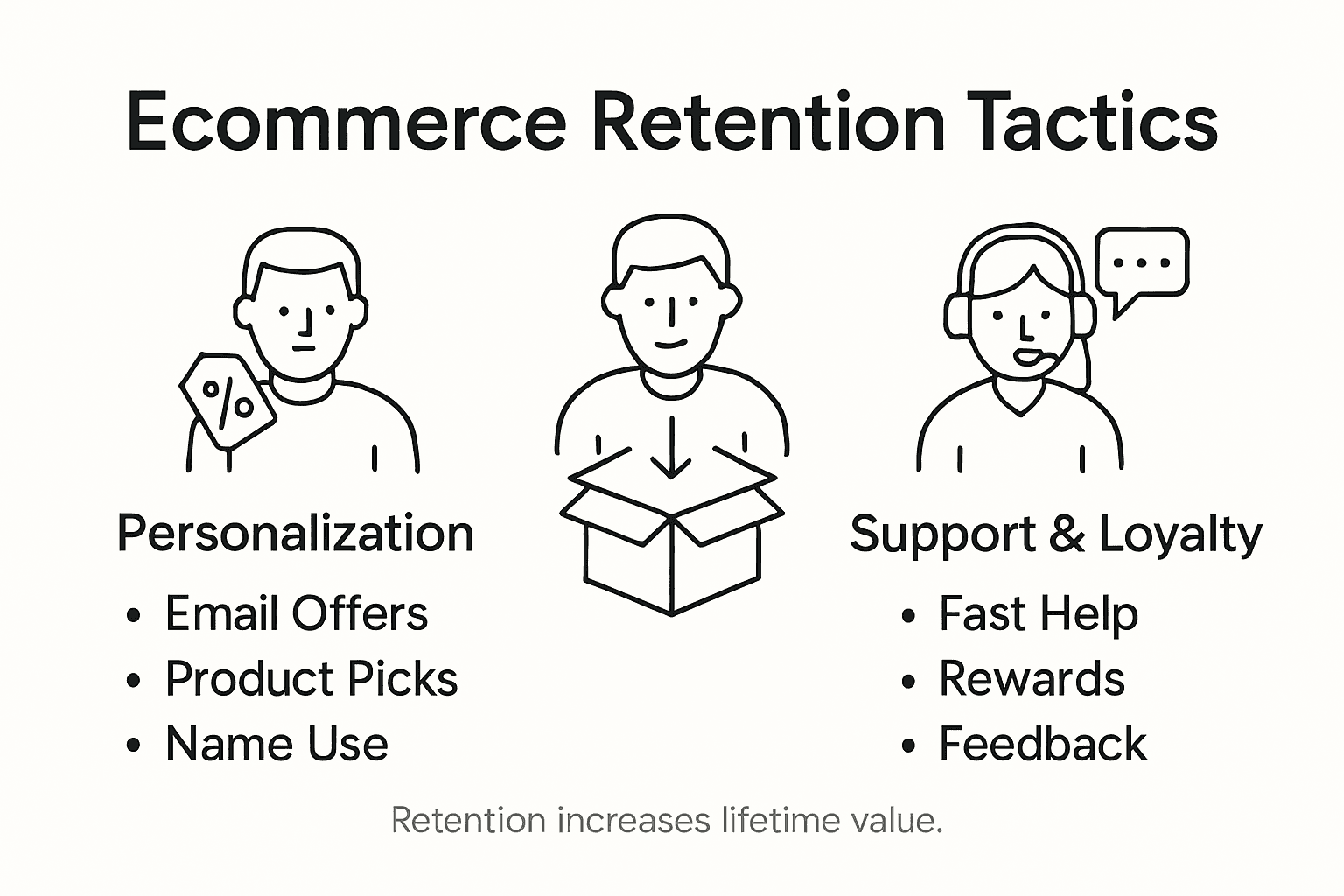
Technological integration becomes paramount in modern retention strategies. Advanced customer relationship management (CRM) systems enable brands to track individual customer journeys, predict potential churn, and proactively address potential friction points. Key retention techniques include implementing robust post-purchase follow-up sequences, creating engaging re-engagement campaigns for inactive customers, and developing sophisticated segmentation strategies that allow for hyper-personalized communication across multiple channels.
Pro Tip: Retention Audit Strategy: Conduct a quarterly comprehensive review of your customer retention metrics, analyzing drop-off points, engagement rates, and lifetime value to continuously refine and optimize your retention approach.
The table below summarizes core tactics and their business impact for improving ecommerce customer retention:
| Tactic | Example Activity | Expected Business Impact |
|---|---|---|
| Personalization | Segmented product recommendations | Boosts loyalty and repeat purchases |
| Loyalty Programs | Tiered rewards, points systems | Increases customer lifetime value |
| Proactive Communication | Automated post-purchase emails | Reduces churn and increases engagement |
| Advanced CRM Integration | Journey tracking, churn prediction | Enables timely, targeted interventions |
Measuring Success and Avoiding Common Pitfalls
Effective customer retention measurement requires a comprehensive approach that goes beyond surface-level metrics. Advanced AI frameworks are transforming how brands analyze customer behavior, integrating sophisticated risk modeling and segmentation techniques to provide deeper insights into retention dynamics.
The most critical metrics for measuring retention success include customer lifetime value (CLV), repeat purchase rate, churn rate, and customer satisfaction scores. Brands commonly make mistakes by focusing solely on aggregate numbers instead of understanding nuanced customer segment behaviors. Client retention studies highlight that granular analysis reveals more actionable insights, showing how different customer groups respond to retention strategies with varying levels of engagement.
Common pitfalls in retention measurement include overlooking qualitative data, failing to segment customers effectively, and relying on outdated or incomplete tracking methodologies. Successful ecommerce brands implement multi-dimensional tracking systems that combine quantitative metrics with contextual understanding. This involves creating detailed customer personas, mapping individual journey touchpoints, and developing predictive models that anticipate potential churn before it occurs.
Pro Tip: Retention Metric Audit: Develop a quarterly dashboard that tracks key retention metrics across different customer segments, using machine learning algorithms to identify emerging patterns and potential drop-off points before they impact overall revenue.
Unlock Lasting Ecommerce Growth Through Smart Customer Retention
The article highlights a crucial challenge ecommerce brands face: turning one-time buyers into loyal customers by mastering retention strategies such as personalized communication, automated flows, and segmentation. You want to reduce churn, increase repeat purchases, and boost lifetime customer value all while lowering costly acquisition expenses. This is where Take Action comes in as your growth partner. We specialize in transforming your email marketing into a powerful retention engine by leveraging both human expertise and AI insights to build engaging campaigns tailored to your brand voice.
Increase customer lifetime value with proven strategies like targeted welcome series, abandoned cart reminders, and post-purchase flows—precisely the tactics the article identifies as key to retention success. Our Klaviyo automation solutions automate these processes smoothly so you can focus on scaling your business.
Ready to stop losing customers and start turning them into your most profitable assets? Visit Take Action today and discover how our data-driven approach to retention and email marketing helps ecommerce brands grow sustainably. Don’t wait to take advantage of tailored segmentation and automation that boosts engagement and revenue in measurable ways. Explore more about how to optimize your email flows and create long-term value from every customer interaction.
Frequently Asked Questions
What is customer retention in ecommerce?
Customer retention in ecommerce refers to the ability of a business to keep its customers engaged and purchasing repeatedly over time, focusing on building long-term relationships rather than just one-time transactions.
Why is customer retention important for ecommerce businesses?
Customer retention is crucial because it is often more cost-effective to maintain existing customers than to acquire new ones. Retained customers typically spend more and contribute to more predictable revenue streams.
How can ecommerce companies improve customer retention rates?
Ecommerce companies can improve retention rates by personalizing customer experiences, implementing loyalty programs, using advanced CRM systems, and proactively engaging with customers through targeted communication strategies.
What metrics should businesses track to measure customer retention success?
To measure customer retention success, businesses should track metrics such as customer lifetime value (CLV), repeat purchase rate, churn rate, and customer satisfaction scores to gain insights into customer engagement and loyalty.
Recommended
- Complete Guide to Building Customer Loyalty Online | Take Action Blog | Take Action
- 7 Habits of Successful Entrepreneurs for Ecommerce Growth | Take Action Blog | Take Action
- 7 Must-Read Business Book Recommendations for Ecommerce Growth | Take Action Blog | Take Action
- SEO Matters: Complete Guide for Ecommerce Brands | Take Action Blog | Take Action