

Email Marketing Explained: Strategies for Ecommerce Growth
Over 80 percent of ecommerce shoppers say they prefer personalized emails from brands. With inboxes busier than ever, cutting through the noise takes more than generic promotions or mass blasts. Today, brands are discovering that thoughtfully crafted email marketing isn’t just about reaching customers—it builds loyalty and drives sales. This guide breaks down the strategies, tools, and pitfalls so you can use email to turn occasional buyers into dedicated fans.
Table of Contents
- Defining Email Marketing for Ecommerce Brands
- Types of Email Campaigns and Flows
- How Automation and Segmentation Drive Results
- Optimizing Engagement With Klaviyo Tools
- Common Pitfalls and Email Compliance Essentials
Key Takeaways
| Point | Details |
|---|---|
| Email Marketing Importance | Email marketing is a key strategy for ecommerce brands, focusing on direct communication to enhance customer relationships and drive sales. |
| Leveraging Automation | Automation allows for hyper-personalized and timely communications, significantly improving customer engagement and operational efficiency. |
| Segmented Campaigns | Effective email marketing utilizes segmentation strategies to deliver tailored content to users at various stages of their buying journey. |
| Compliance Essentials | Adhering to email marketing regulations and best practices is critical to maintaining customer trust and avoiding legal repercussions. |
Defining Email Marketing for Ecommerce Brands
Email marketing represents a strategic digital communication approach specifically designed to connect brands directly with their customers through targeted electronic messaging. According to Wikipedia, email marketing involves sending commercial messages to groups of people, ultimately aiming to enhance customer relationships, encourage loyalty, and drive sales.
Digital communication at its core, email marketing for ecommerce goes beyond simple promotional messaging. It’s a sophisticated strategy that allows brands to segment audiences, personalize content, and create meaningful interactions that transform one-time buyers into repeat customers. IJARSCT Research highlights that effective email marketing targets specific audiences based on critical demographic factors like age, geography, and consumer behavior.
For ecommerce brands, email marketing isn’t just about sending messages—it’s about creating a comprehensive customer journey. The most successful strategies leverage automation, segmentation, and personalization to deliver precisely timed and crafted communications. This means:
- Welcoming new subscribers with tailored introductions
- Recovering abandoned shopping carts
- Sending post-purchase follow-ups
- Recommending products based on previous purchases
- Re-engaging customers who haven’t shopped recently
These targeted approaches transform email from a simple communication channel into a powerful revenue generation tool. By understanding customer preferences and behaviors, brands can create email experiences that feel less like marketing and more like personalized conversation. When done strategically, email marketing becomes an essential growth engine for ecommerce businesses.
Types of Email Campaigns and Flows
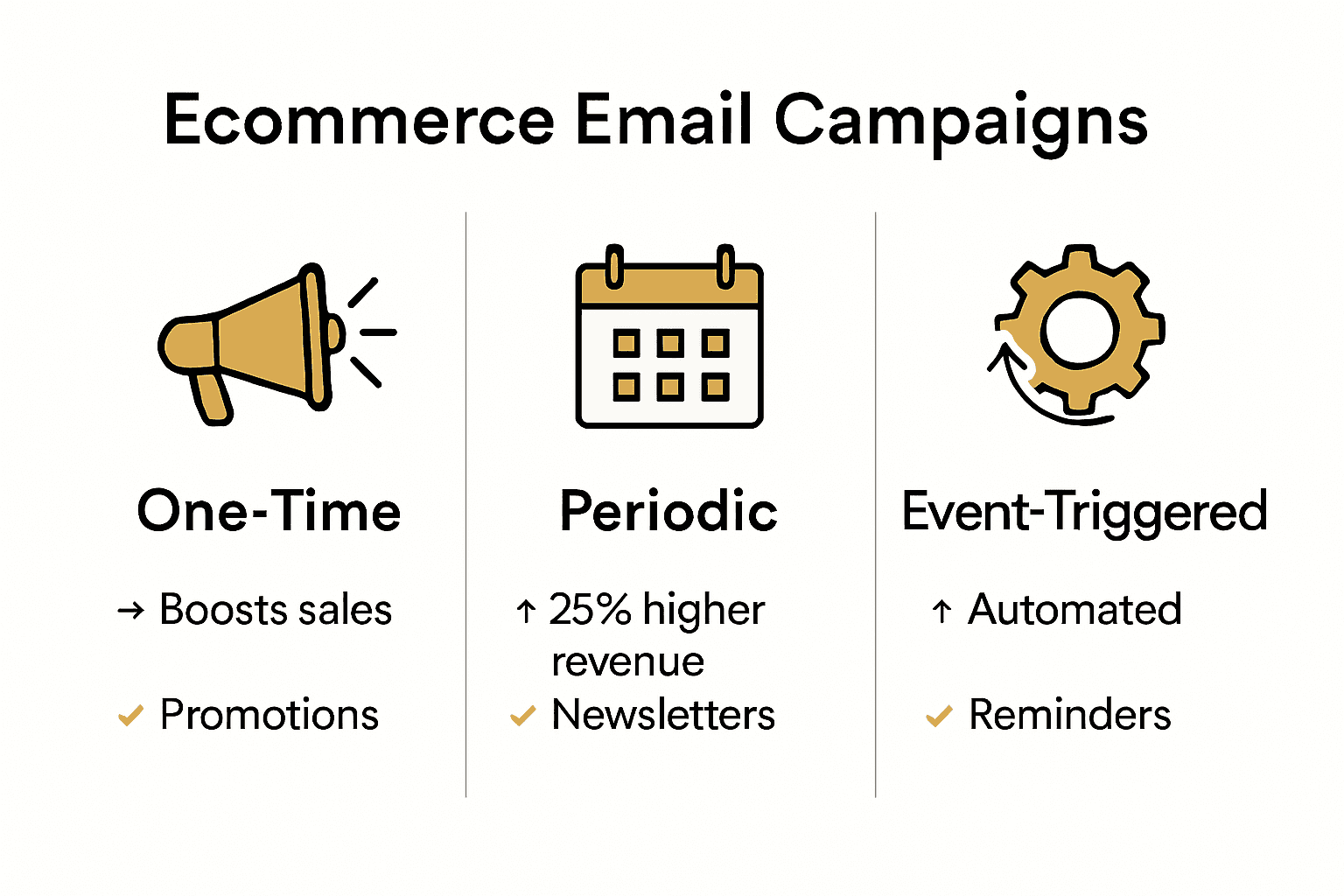
Email marketing for ecommerce encompasses multiple strategic approaches designed to engage customers at different stages of their buying journey. According to MoEngage, email campaigns can be broadly categorized into three primary types: one-time campaigns, periodic campaigns, and event-triggered campaigns, each serving unique objectives in audience engagement.
One-Time Campaigns represent standalone email communications typically used for specific announcements, product launches, or seasonal promotions. These are manually created and sent to selected audience segments at predetermined times. In contrast, Periodic Campaigns follow a consistent schedule—weekly newsletters, monthly product roundups, or quarterly sale announcements—maintaining regular brand communication.
Event-triggered campaigns, also known as automated flows, offer the most dynamic email marketing strategy. Milked Media highlights that these campaigns are automatically initiated by specific user behaviors or interactions. Common automated flows in ecommerce include:
- Welcome Series: Greeting new subscribers
- Abandoned Cart Recovery: Reminding customers about unpurchased items
- Post-Purchase Follow-ups: Requesting reviews or suggesting complementary products
- Win-back Campaigns: Re-engaging dormant customers
- Browse Abandonment: Targeting users who viewed but didn’t purchase products
By strategically implementing these email campaign types, ecommerce brands can create personalized, timely communications that not only enhance customer experience but also drive significant revenue growth.
 The key is understanding each campaign’s unique purpose and deploying them with precision and relevance.
How Automation and Segmentation Drive Results
Marketing automation transforms email strategies from generic broadcasts to precision-targeted communications. According to Wikipedia, marketing automation involves using sophisticated software to automate critical tasks like segmentation, targeting, and tracking, which dramatically enhances personalization and operational efficiency for ecommerce brands.
The power of automation lies in its ability to create hyper-personalized customer experiences. By leveraging user data, behavioral insights, and advanced segmentation techniques, brands can develop nuanced communication strategies that speak directly to individual customer preferences. JETIR Research emphasizes that effective targeting through segmentation ensures emails remain highly relevant to recipients, directly translating to improved engagement and conversion rates.
Successful automation and segmentation strategies typically incorporate multiple sophisticated approaches:
- Behavioral Segmentation: Categorizing customers based on their interactions, purchase history, and website behavior
- Demographic Segmentation: Grouping customers by age, location, income, and other demographic factors
- Purchase Cycle Segmentation: Targeting customers differently based on their stage in the buying journey
- Predictive Segmentation: Using AI and machine learning to anticipate future customer actions
By implementing these advanced segmentation techniques, ecommerce brands can create intelligent, responsive email marketing systems that not only communicate but truly connect with their audience. The result is a more engaging, personalized experience that drives customer loyalty and significantly boosts revenue potential.
Optimizing Engagement With Klaviyo Tools
Klaviyo has revolutionized email marketing for ecommerce brands by providing sophisticated tools that transform customer interactions into strategic revenue opportunities. According to Milked Media, the platform offers advanced capabilities for setting up automated email flows and campaigns that enable highly personalized communication based on intricate customer behaviors.
The platform’s true power lies in its ability to create dynamic, behavior-triggered communications that adapt in real-time to individual customer journeys. By leveraging granular segmentation and predictive analytics, Klaviyo allows brands to design email experiences that feel less like marketing and more like personalized conversations. These tools go beyond simple email sending, providing deep insights into customer preferences, purchase patterns, and engagement potential.
Key optimization strategies within Klaviyo include:
- Automated Customer Journeys: Creating multi-step email sequences based on specific triggers
- Advanced Segmentation: Dividing audiences by purchase history, engagement levels, and predicted behaviors
- Predictive Send Times: Identifying optimal email delivery moments for each individual subscriber
- A/B Testing: Continuously refining email content, subject lines, and design elements
- Revenue Tracking: Measuring direct monetary impact of each email campaign
By implementing these sophisticated Klaviyo tools, ecommerce brands can transform email from a basic communication channel into a precision-engineered revenue generation engine. The result is a more intelligent, responsive marketing approach that consistently delivers the right message to the right customer at the exact right moment.
Common Pitfalls and Email Compliance Essentials
Email marketing compliance represents a critical foundation for successful digital communication strategies. According to STEC Research, successful email marketing campaigns require meticulous attention to capturing recipients’ attention while simultaneously adhering to best practices that ensure higher returns and maintain professional standards.
The landscape of email marketing is fraught with potential legal and ethical challenges that can significantly impact brand reputation. ArXiv Research emphasizes the paramount importance of respecting user privacy and obtaining explicit consent, which forms the bedrock of maintaining customer trust and avoiding potential regulatory penalties.
Common pitfalls that ecommerce brands must vigilantly avoid include:
- Unsolicited Mass Emailing: Sending emails without explicit subscriber consent
- Ignoring Unsubscribe Requests: Failing to promptly honor opt-out preferences
- Misleading Subject Lines: Creating deceptive email headers to increase open rates
- Inconsistent Sender Information: Using unclear or changing sender identities
- Neglecting Data Protection Regulations: Overlooking GDPR, CAN-SPAM, or CCPA requirements
Successful email marketing goes beyond avoiding mistakes—it’s about creating a transparent, respectful communication ecosystem that prioritizes customer experience, maintains legal compliance, and builds long-term brand credibility. The most effective strategies integrate rigorous consent mechanisms, clear communication protocols, and a genuine commitment to recipient preferences.
Unlock Ecommerce Growth with Expert Email Marketing Support
The article highlights how crucial strategies like automation, segmentation, and personalized flows are for turning email marketing into a powerful growth engine for ecommerce brands. If you find it challenging to implement effective welcome series, abandoned cart recovery, or predictive segmentation on your own you are not alone. Many brands struggle to transform data and customer behavior insights into timely and relevant email campaigns that truly engage and convert.
Take Action specializes in solving these exact challenges by combining human expertise with AI-driven analytics to optimize every touchpoint in the customer journey. From setting up sophisticated Klaviyo flows to scaling your email programs with data-backed strategies, we help ecommerce businesses increase open rates, recover lost revenue, and build lasting customer loyalty.
Start turning email into your primary revenue driver now with proven solutions tailored for brands ready to grow. Visit Take Action to explore how our campaign strategy, automation setup, and ongoing partnership will deliver measurable results for your ecommerce business.
Ready to transform your email marketing into a steady growth channel? Discover customized strategies and expert support waiting for you at Take Action. Explore how targeted flows and segmentation can work for your brand today.
Frequently Asked Questions
What is email marketing for ecommerce brands?
Email marketing for ecommerce brands involves utilizing strategic email communications to connect directly with customers. It focuses on enhancing customer relationships, driving sales, and turning one-time buyers into repeat customers.
What types of email campaigns are effective for ecommerce?
Effective email campaigns for ecommerce include one-time campaigns for specific announcements, periodic campaigns like newsletters, and event-triggered campaigns that respond to customer behaviors, such as abandoned cart recovery and post-purchase follow-ups.
How does automation improve email marketing results?
Automation enhances email marketing by allowing brands to send personalized communications based on specific user actions. It enables targeted responses such as welcome emails, reminders for abandoned carts, and win-back initiatives for inactive customers.
What are the key compliance essentials for email marketing?
Key compliance essentials for email marketing include obtaining explicit consent from recipients, promptly honoring unsubscribe requests, avoiding misleading subject lines, providing clear sender information, and adhering to data protection regulations like GDPR and CAN-SPAM.
Recommended
- 7 Essential Ecommerce Marketing Strategies for Growth | Take Action Blog | Take Action
- Marketing Automation Checklist for Ecommerce Growth Success | Take Action Blog | Take Action
- 7 Must-Read Business Book Recommendations for Ecommerce Growth | Take Action Blog | Take Action
- Maximize Sales with Content Marketing for Ecommerce
- E-commerce SEO in 2025: Essential Strategies for Success