

Email Segmentation Strategies for Ecommerce Growth
More than 60 percent of Ecommerce managers in Europe report customer retention is tougher than finding new buyers. While American brands often set the pace in advanced segmentation, many European businesses miss out on tailored strategies that drive real results in Klaviyo. Using proven segmentation techniques, you can uncover hidden revenue opportunities and keep your customers coming back long after their first purchase.
Table of Contents
- Step 1: Define Actionable Segmentation Goals
- Step 2: Collect and Organize Customer Data
- Step 3: Build Dynamic Audience Segments in Klaviyo
- Step 4: Personalize and Automate Targeted Campaigns
- Step 5: Test and Optimize Segmentation Performance
Quick Summary
| Key Message | Explanation |
|---|---|
| 1. Define clear segmentation goals | Establish specific objectives for your email marketing, such as increasing order value or reducing cart abandonment, to drive targeted campaigns. |
| 2. Organize comprehensive customer data | Collect relevant demographic and behavioral customer data and centralize it in a CRM for effective segmentation and consistent insights. |
| 3. Create dynamic segments with Klaviyo | Utilize Klaviyo’s real-time segments based on customer behaviors to adapt your marketing strategies and improve targeting precision. |
| 4. Personalize and automate campaigns | Use customer data and predictive insights to create automated campaigns that are timely and personalized for increased engagement. |
| 5. Continuously test and optimize strategies | Regularly analyze performance metrics and conduct tests on segments to refine and enhance your overall email marketing effectiveness. |
Step 1: Define actionable segmentation goals
Creating precise email segmentation strategies starts with understanding what you want to achieve for your Ecommerce business. Defining clear segmentation goals transforms generic marketing efforts into targeted revenue driving campaigns.
Start by identifying specific business objectives that segmentation will help you accomplish. These might include increasing average order value, reducing cart abandonment, reactivating dormant customers, or improving overall customer lifetime value. Each goal requires a different segmentation approach. For instance, recovering lost sales demands a distinct strategy compared to nurturing high-value repeat purchasers.
To construct meaningful segments, analyze your customer data beyond basic demographics. Look at behavioral indicators like purchase frequency, total spend, product categories purchased, and engagement levels with previous email campaigns. This deeper understanding allows you to create segments that are not just descriptive but actionable and directly tied to your business growth objectives.
Pro tip: Create a segmentation goal matrix that maps specific customer behaviors to targeted outcomes, helping you systematically track and optimize your email marketing performance.
Here’s a summary of key email segmentation goals and the data indicators typically used to support each:
| Segmentation Goal | Recommended Data Indicators | Business Impact |
|---|---|---|
| Increase order value | Purchase frequency, order history | Higher revenue per customer |
| Reduce cart abandonment | Cart activity, abandonment rates | More completed sales |
| Reactivate dormant customers | Last engagement date, inactivity length | Greater customer retention |
| Boost lifetime value | Average spend, repeat purchases | Increased long-term profitability |
Step 2: Collect and organize customer data
Transforming your Ecommerce marketing strategy begins with gathering comprehensive customer insights. Effective customer data collection is crucial for creating targeted segmentation strategies that drive meaningful engagement and revenue growth.

Start by identifying the key data points essential for understanding your customer base. These typically include demographic information like age, location, and gender, as well as behavioral data such as purchase history, product preferences, average order value, and interaction patterns across your digital platforms. Leverage multiple data collection methods including website analytics, customer surveys, social media insights, and transaction records to build a holistic view of your audience.
Organize your collected data into a centralized customer relationship management (CRM) system that allows easy segmentation and analysis. Ensure data quality by regularly cleaning and updating your database, removing duplicate entries, and verifying information accuracy. This systematic approach enables you to create dynamic customer segments that can be quickly adjusted based on evolving business goals and customer behaviors.
Pro tip: Implement a data governance framework that standardizes data collection processes and ensures consistent, reliable customer information across all your marketing platforms.
Step 3: Build dynamic audience segments in Klaviyo
Transforming your email marketing requires creating intelligent, adaptable customer segments that evolve with your audience. Klaviyo segments are dynamic groups of contacts that automatically update in real-time based on specific customer behaviors and characteristics, enabling precision targeting that traditional static lists cannot achieve.
To build effective segments, navigate to the Klaviyo Segments section and use the platform’s condition builder. Start by selecting primary criteria such as purchase history, engagement levels, or specific profile properties. For example, you might create segments like high-value customers who have purchased more than three times in the past six months, or customers who have abandoned carts with products over a certain price point. Combine multiple conditions to create nuanced segments that reflect complex customer behaviors and potential marketing opportunities.
Each segment should align with specific marketing objectives, whether that means re-engaging dormant customers, rewarding loyal buyers, or targeting potential repeat purchasers. Regularly review and refine your segments to ensure they remain relevant and effective as your customer base evolves and your business goals shift.
Pro tip: Create no more than 5-7 core segments initially to maintain manageability and prevent overwhelming your marketing strategy.
The table below compares manual static segments to Klaviyo dynamic segments for Ecommerce email marketing:
| Feature | Static Segments | Klaviyo Dynamic Segments |
|---|---|---|
| Update Frequency | Manual, infrequent | Automatic, real-time |
| Adaptability | Rigid and fixed | Responsive to behavior |
| Workload | High management effort | Minimal ongoing effort |
| Personalization | Limited targeting | Advanced multi-layer targeting |
Step 4: Personalize and automate targeted campaigns
Modern email automation integrates AI, personalization, and behavioral analysis to deliver precisely timed and highly relevant marketing messages that resonate with individual customers. By leveraging customer data and predictive modeling, you can create automated campaigns that feel personal and timely, significantly improving engagement and conversion rates.
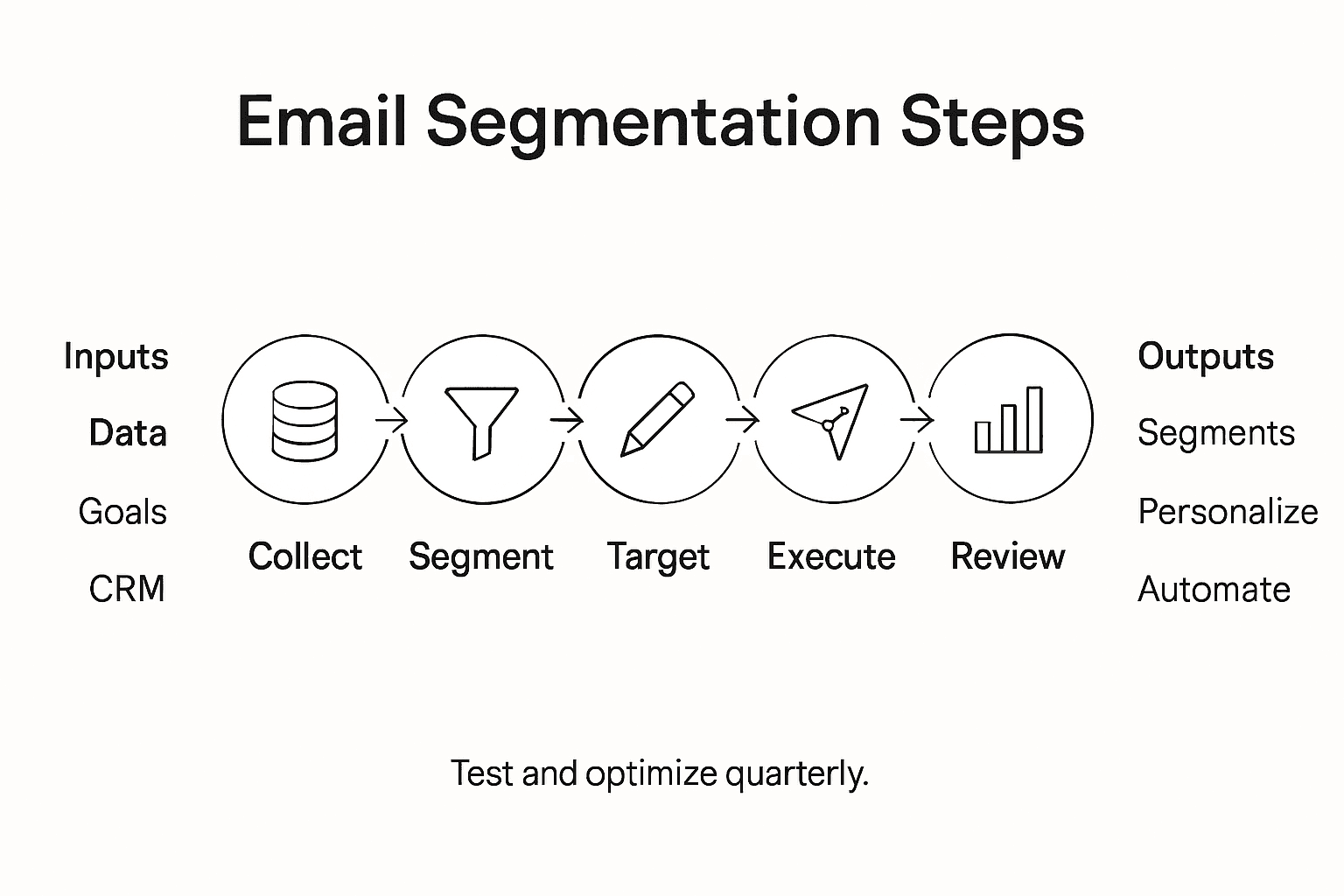
Start by mapping out your customer journey and identifying key trigger points for automated campaigns. These might include welcome series for new subscribers, abandoned cart reminders, post purchase follow ups, and reengagement sequences for inactive customers. Use your segmentation data to customize content, ensuring each message speaks directly to the recipient’s specific interests, past behaviors, and potential future needs.
Improve your campaign personalization by incorporating dynamic content blocks that automatically adjust based on individual customer profiles. Utilize merge tags in Klaviyo to pull in specific customer information like first name, recent purchase history, or recommended products. Test and iterate on your automated workflows regularly, monitoring performance metrics to continuously refine your approach and maximize the impact of your personalized marketing efforts.
Pro tip: Create a minimum of three variations for each automated campaign to provide enough personalization flexibility while keeping your workflow management streamlined.
Step 5: Test and optimize segmentation performance
Advanced email segmentation requires continuous testing and optimization to ensure your marketing strategies deliver maximum impact. Implementing a systematic approach to measuring and refining your segmentation efforts will help you transform raw data into actionable insights that drive meaningful business growth.
Begin by establishing clear key performance indicators (KPIs) for each segment. These might include metrics like open rates, click through rates, conversion rates, and customer lifetime value. Use Klaviyo’s built-in analytics to conduct A/B testing on different segment configurations, comparing how variations in demographic criteria, behavioral triggers, and engagement thresholds impact overall campaign performance.
Implement a quarterly review process where you critically analyze segment effectiveness. Look for segments that are underperforming or have become less relevant over time. Be prepared to merge, split, or completely redesign segments based on emerging patterns in customer behavior. Pay special attention to how different segments respond to specific messaging styles, product recommendations, and promotional strategies to continuously refine your targeting approach.
Pro tip: Allocate at least 10% of your marketing budget to experimental segmentation testing to discover innovative targeting strategies that could significantly improve your campaign performance.
Unlock Powerful Ecommerce Growth with Precision Email Segmentation
If you are struggling to turn customer data into actionable, revenue-driving email campaigns, this article highlights the challenge of defining clear segmentation goals and building dynamic audience groups. Many Ecommerce brands find it difficult to personalize their messaging or automate workflows that truly resonate because they lack advanced segmentation strategies using tools like Klaviyo. Key pain points include reducing cart abandonment, reactivating inactive customers, and boosting lifetime value—all achievable with the right expertise.
Take Action specializes in partnering with brands to solve these exact challenges. Our team combines human insight with AI-driven optimization to create dynamic Klaviyo segments, set up automated email flows, and deliver targeted campaigns that increase engagement and maximize revenue. From welcome series to abandoned cart recovery and post-purchase nurturing, we ensure your email marketing moves beyond generic blasts into tailored conversations that drive results.
Ready to transform your email marketing into your primary growth engine by leveraging proven segmentation and automation techniques?
Visit Take Action today to discover how our strategic email campaigns and retention services can accelerate your Ecommerce success. Act now to start turning customer data into your strongest revenue channel with expert help focused on your brand and growth goals.
Frequently Asked Questions
What are the key goals for email segmentation in Ecommerce?
Understanding your key goals is essential for effective email segmentation. Common objectives include increasing average order value, reducing cart abandonment, and reactivating dormant customers. Start by identifying which goals align with your business strategy to guide your segmentation efforts.
How can I effectively collect customer data for segmentation?
Gather comprehensive customer data by utilizing various sources like website analytics, customer surveys, and transaction records. Organize this data in a centralized system to facilitate easy access and segmentation, ensuring you’re capturing key information such as purchase history and engagement levels.
What are dynamic segments in Klaviyo, and how do I create them?
Dynamic segments in Klaviyo automatically update based on real-time customer behaviors. To create them, access the Segments section, select criteria like purchase history or engagement, and combine multiple conditions to capture nuanced customer behaviors that align with your business objectives.
How do I personalize email campaigns based on customer segments?
To personalize email campaigns, utilize customer data to create tailored content that speaks directly to each segment’s interests and behaviors. Incorporate dynamic content blocks that adjust based on individual customer profiles and regularly test variations to enhance personalization effectiveness.
What metrics should I track to assess the performance of my email segments?
Track key performance indicators (KPIs) such as open rates, click-through rates, and conversion rates for each segment to evaluate their effectiveness. Establish a review process to analyze these metrics regularly, which can help you identify underperforming segments and make necessary adjustments to improve engagement and revenue.
Recommended
- Benefits of Segmentation: Unlocking Email Revenue Growth | Take Action Blog | Take Action
- Email Marketing Explained: Strategies for Ecommerce Growth | Take Action Blog | Take Action
- 7 Steps Ecommerce Marketing Checklist for Brand Growth Success | Take Action Blog | Take Action
- How to Repurpose Content for Ecommerce Email Success | Take Action Blog | Take Action