

Engage Customers with Klaviyo: Boost Open Rates 40% in 2026
Your Klaviyo account sends automated emails, but open rates remain flat and cart recovery barely moves the needle. Generic messaging fails to connect because your emails treat every subscriber the same. This guide walks you through the exact prerequisites, automation setup, segmentation tactics, optimization strategies, and success metrics to transform your Klaviyo email marketing from invisible to irresistible in 2026.
Table of Contents
- Prerequisites: What You Need Before Starting
- Step 1: Set Up Key Automated Email Flows In Klaviyo
- Step 2: Implement Strategic Customer Segmentation
- Step 3: Optimize Campaigns With Data-Driven Testing And Analytics
- Common Mistakes In Email Automation And How To Fix Them
- Expected Outcomes And Key Success Metrics
- Alternative Engagement Strategies And Considerations
- Boost Your Klaviyo Email Strategy With Expert Support
- FAQs About Engaging Customers With Klaviyo Email Marketing
Key Takeaways
| Point | Details |
|---|---|
| Segmentation impact | Increase open rates by up to 40% through targeted messaging. |
| Cart recovery | Automated flows recover 10 to 15% of abandoned sales. |
| A/B testing gains | Testing improves click rates about 20% consistently. |
| Frequency management | Avoid over-emailing to reduce opt-outs by 25%. |
| Analytics benefits | Continuous optimization reduces customer churn by up to 12%. |
Prerequisites: What You Need Before Starting
Before building automated flows or segmenting your audience, you need foundational elements in place. Skipping these steps creates inconsistent campaigns that fail to deliver results.
You need an active Klaviyo account integration with your ecommerce platform like Shopify, WooCommerce, or Magento. This connection feeds customer data into Klaviyo automatically, enabling real-time triggers and personalized messaging. Without proper integration, your automation cannot respond to purchase events or browsing behavior.
Your customer data must be clean and enriched. Purchase histories, browsing patterns, and engagement metrics form the foundation for effective segmentation. Remove duplicate profiles, merge outdated records, and verify email addresses regularly to maintain deliverability. Dirty data produces irrelevant messaging that hurts engagement.
Basic email marketing knowledge matters. You should understand concepts like open rates, click-through rates, conversion tracking, and automation triggers. If these terms feel foreign, spend time learning fundamentals before executing complex flows.
Define your brand voice and design standards now. Every automated email should feel like it comes from the same brand. Create templates, establish tone guidelines, and standardize visual elements before launching campaigns. Inconsistency erodes trust and recognition.
Set clear business goals. Are you focused on increasing repeat purchase rates, reducing cart abandonment, or re-engaging dormant customers? Specific goals guide your automation strategy and help you measure success accurately. Without targets, you cannot assess performance or iterate effectively.
Pro Tip: Document your email workflows on paper before building them in Klaviyo to spot logical gaps and improve trigger conditions.
Step 1: Set Up Key Automated Email Flows in Klaviyo
With prerequisites met, foundational automated email flows become your always-on revenue drivers. These sequences target customers at critical lifecycle moments when they’re most receptive to messaging.
-
Build a welcome email series that introduces new subscribers to your brand story, product range, and value proposition. Send the first email immediately after signup, follow with educational content 24 hours later, then offer a first-purchase incentive on day three. This sequence sets expectations and builds early engagement.
-
Configure abandoned cart recovery emails that trigger when someone adds items but doesn’t complete checkout. Send the first reminder within one hour while intent remains high, add social proof or urgency in a second email at 24 hours, and include a small discount in a final attempt at 48 hours. Timing matters enormously here.
-
Create post-purchase flows that thank customers, provide order updates, request reviews, and suggest complementary products. These emails transform one-time buyers into repeat customers by maintaining engagement beyond the transaction. Schedule the thank-you email immediately, the review request five days post-delivery, and cross-sell recommendations two weeks later.
-
Optimize email timing using Klaviyo’s send time optimization feature, which analyzes individual engagement patterns to deliver messages when each subscriber typically opens emails. This personalization can lift open rates significantly without changing content.
-
Maintain brand consistency across all automated emails through approved templates and tone guidelines. Every touchpoint should reinforce your brand identity, from subject lines to footer copy. Inconsistent messaging confuses subscribers and weakens brand recall.
Pro Tip: Test different discount depths in abandoned cart sequences to find the minimum incentive that drives conversions without training customers to wait for deals.
Step 2: Implement Strategic Customer Segmentation
After establishing automated flows, enhance their impact through email segmentation strategies that deliver personalized messaging at scale. Generic emails produce generic results.

Segment by purchase recency and frequency to identify your most valuable customers. Create VIP segments for customers with three or more purchases in 90 days, active segments for one to two purchases in 180 days, and at-risk segments for no purchases in 180 days. Each group needs different messaging frequencies and offer types.
Group customers by browsing behavior and product interests. Someone who viewed running shoes five times but never purchased needs different messaging than someone who bought running shoes last month. Use product affinity data to personalize recommendations and increase relevance.
Develop engagement-based segments separating active openers from lapsed subscribers. Active subscribers can handle more frequent sends, while boosting ecommerce email engagement with dormant subscribers requires re-engagement campaigns with compelling incentives. Monitor engagement trends monthly and adjust segment definitions accordingly.
Prioritize high lifetime value customers with exclusive early access, special promotions, and personalized recommendations. These customers drive disproportionate revenue and deserve dedicated attention. Calculate customer lifetime value in Klaviyo using purchase history and average order value.
Clean your list regularly by suppressing unengaged profiles. User segmentation for personalized marketing includes removing subscribers who haven’t opened emails in 180 days, as they hurt deliverability and inflate costs. Send a final re-engagement campaign before suppression to capture any remaining interest.
| Segment Type | Criteria | Messaging Strategy |
|---|---|---|
| VIP Customers | 3+ purchases in 90 days | Exclusive offers, early access, high send frequency |
| Active Buyers | 1-2 purchases in 180 days | Regular promotions, product education |
| At-Risk | No purchase in 180+ days | Win-back campaigns, strong incentives |
| Engaged Non-Buyers | Opens emails but no purchase | Social proof, urgency, first-purchase discount |
Step 3: Optimize Campaigns with Data-Driven Testing and Analytics
With segmentation deployed, use testing and analytics to maximize performance continuously. Every campaign offers learning opportunities that compound over time.
-
Run A/B tests systematically on subject lines, preview text, send times, and content formats. Test one variable at a time with statistically significant sample sizes. Winning variants from predictive analytics for targeted campaigns become your new control for future tests. Document results to build institutional knowledge.
-
Analyze core metrics weekly including open rates, click-through rates, conversion rates, and revenue per recipient. Identify underperforming emails and diagnose root causes. Low opens indicate subject line issues, while low clicks suggest content relevance problems. Revenue per recipient reveals which segments drive real business impact.
-
Adjust automation flows based on performance data rather than assumptions. If your abandoned cart sequence shows most conversions happen after the first email, consider removing the third email to reduce costs. Use target audience research for higher ROI to refine trigger conditions and timing.
-
Track retention and repeat purchase metrics monthly to understand long-term engagement trends. Calculate repeat purchase rate, average days between purchases, and customer lifetime value by cohort. These metrics reveal whether your email strategy builds sustainable growth or extracts short-term value.
-
Iterate continuously rather than setting up campaigns and forgetting them. Email marketing effectiveness degrades over time as audiences become desensitized. Refresh creative quarterly, test new messaging angles, and stay current with seasonal trends to maintain performance.
Pro Tip: Create a dashboard in Klaviyo tracking your top five metrics so you spot trends immediately rather than discovering problems weeks later.
Common Mistakes in Email Automation and How to Fix Them
Even well-intentioned automation strategies fail when common pitfalls go unaddressed. Recognizing these common email marketing mistakes early saves time and preserves subscriber relationships.
-
Over-emailing destroys engagement. Sending daily promotional emails trains subscribers to ignore you or unsubscribe. Respect inbox space by limiting promotional sends to two or three per week maximum. Use preference centers letting subscribers choose frequency.
-
Generic messaging wastes segmentation potential. If every segment receives identical content, your segmentation adds no value. Tailor subject lines, offers, and product recommendations to segment characteristics. Personalization requires effort but drives measurable lift.
-
Inconsistent brand voice confuses subscribers. When automated emails sound robotic while promotional emails feel conversational, subscribers question authenticity. Establish voice guidelines and train everyone creating email content to maintain consistency.
-
Ignoring spam complaints signals bigger problems. Rising complaint rates indicate relevance issues or list quality problems. Monitor complaints weekly and investigate spikes immediately. One complaint per thousand sends is acceptable, but higher rates demand action.
-
Neglecting list hygiene kills deliverability. Bounced emails and inactive addresses accumulate over time, hurting sender reputation. Suppress hard bounces immediately, remove soft bounces after three failures, and sunset unengaged subscribers after 180 days of inactivity.
-
Failing to mobile optimize loses half your audience. Most emails open on mobile devices, yet many brands design for desktop. Use single-column layouts, large tap targets, and concise copy that works on small screens. Test every template on multiple devices before deployment.
Expected Outcomes and Key Success Metrics
Implementing these Klaviyo strategies produces measurable improvements across key performance indicators. Understanding realistic benchmarks helps you assess progress and identify areas needing attention based on customer retention and success metrics.
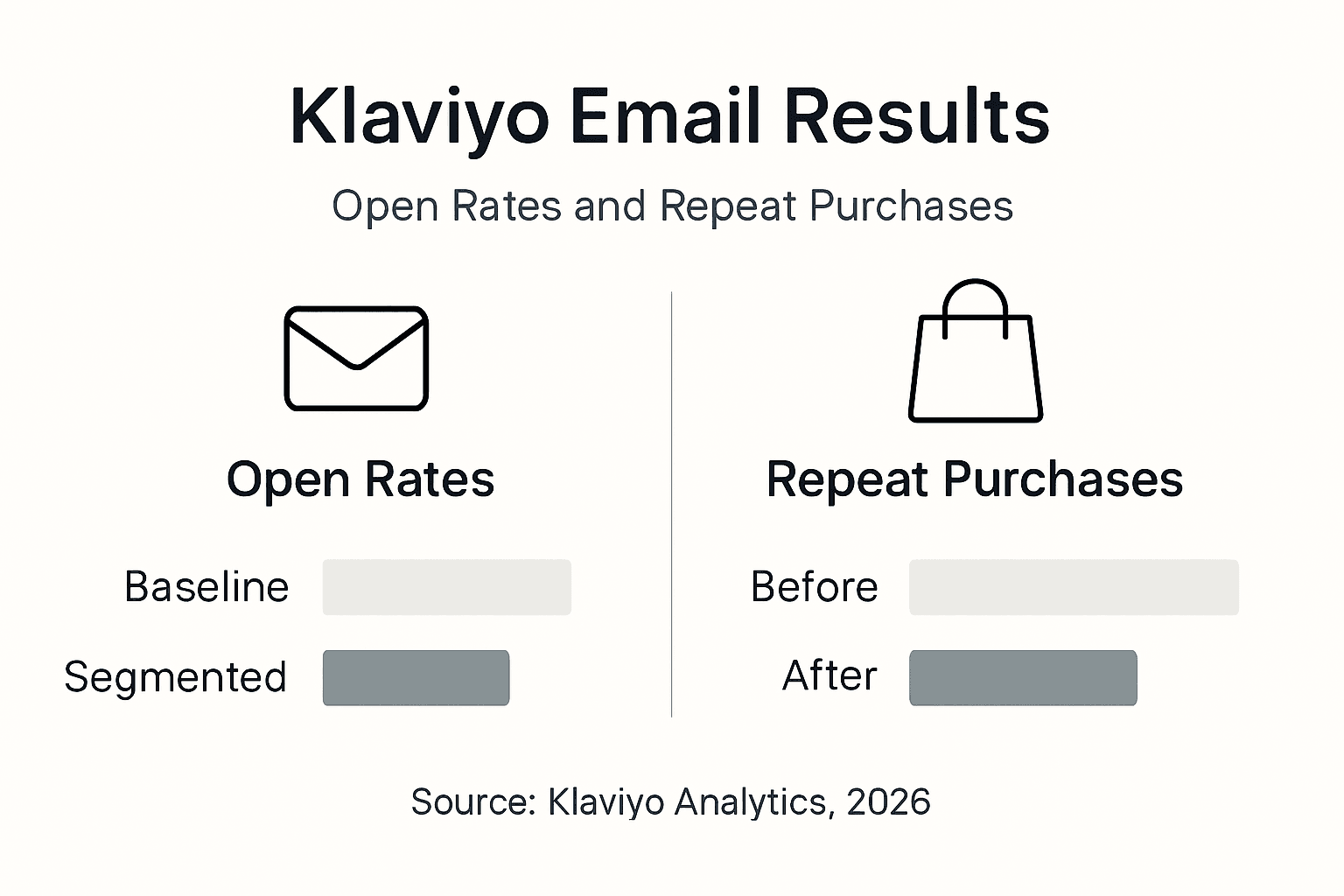
Segmented campaigns typically boost open rates by approximately 40% compared to generic blasts. This lift comes from relevant subject lines and optimized send times matching subscriber behavior. Track open rates by segment to identify which groups respond best.
Abandoned cart flows recover between 10% and 15% of potential lost sales when properly configured with appropriate timing and incentives. This translates to substantial revenue from customers already showing purchase intent. Monitor cart recovery rate weekly as a leading revenue indicator.
Post-purchase sequences increase repeat purchase rates by 10% to 20% by keeping your brand top of mind and suggesting complementary products. Calculate repeat purchase rate by dividing customers with multiple purchases by total customers. Higher rates indicate stronger retention.
A/B testing improves click-through rates roughly 20% by optimizing calls to action, content layout, and offer presentation. Compound these gains over time through continuous testing. Track click rate trends monthly to ensure sustained improvement.
Consistent analytics-driven adjustments reduce churn by up to 12% by identifying at-risk customers early and deploying targeted win-back campaigns. Calculate monthly churn as customers lost divided by total customers. Lower churn means healthier long-term growth.
| Metric | Baseline | With Optimization | Improvement |
|---|---|---|---|
| Open Rate | 15% | 21% | +40% |
| Cart Recovery | 5% | 6.5% | +30% |
| Click-Through Rate | 2.5% | 3% | +20% |
| Repeat Purchase Rate | 20% | 24% | +20% |
| Customer Churn | 8% | 7% | -12% |
Alternative Engagement Strategies and Considerations
Email automation anchors your engagement strategy, but complementary channels amplify results when integrated thoughtfully with your Klaviyo campaigns.
SMS marketing delivers immediate open rates above 90% and complements time-sensitive emails like flash sales or shipping updates. Klaviyo includes SMS capabilities, allowing coordinated messaging across channels. However, SMS requires explicit consent and strict compliance with regulations. Use SMS sparingly for high-value messages to avoid fatigue.
Social media retargeting through social content strategy extends reach beyond email subscribers and reinforces messaging through multiple touchpoints. Retarget cart abandoners or email non-openers on Facebook and Instagram. This channel costs more per conversion but captures audiences less responsive to email.
Direct mail and personalized packaging create memorable physical touchpoints that digital channels cannot replicate. Send handwritten thank-you notes to top customers or include surprise samples in orders. These tactics build emotional connections but involve higher costs and logistics complexity.
Live chat integration provides instant customer engagement and can capture email addresses from website visitors. Use chat to answer pre-purchase questions and reduce cart abandonment. However, live chat requires staffing and works better alongside automated flows rather than replacing them.
Business networking strategies through partnerships and collaborations introduce your brand to new audiences. Co-marketing campaigns with complementary brands expand reach efficiently. Balance automation with personal outreach for VIP customers to optimize lifetime value.
Boost Your Klaviyo Email Strategy with Expert Support
You have learned the frameworks, but execution separates knowledge from results. Professional expertise unlocks Klaviyo’s full potential faster than trial and error alone.
Take Action specializes in email segmentation strategies and automation proven to drive ecommerce growth. We build customized flows, implement advanced segmentation, and optimize campaigns through continuous testing. Our team combines human creativity with AI-driven insights to maximize engagement and revenue from your email channel.
Explore our blog for real-world automated workflows examples showing how top ecommerce brands structure their Klaviyo campaigns. Learn from case studies demonstrating measurable improvements across key metrics.
Partner with our email marketing & retention agency for data-driven optimization that transforms email into your primary growth channel. We handle strategy, execution, and iteration so you focus on running your business while email revenue scales predictably.
FAQs About Engaging Customers with Klaviyo Email Marketing
What is the best frequency to send automated emails without spamming?
Limit promotional emails to two or three per week maximum while allowing transactional and triggered emails to send as needed. Use preference centers letting subscribers control frequency. Monitor unsubscribe rates weekly as an early warning system.
How does segmentation improve email campaign results?
Segmentation delivers relevant content to specific audience groups based on behavior, purchase history, or engagement levels. This relevance increases open rates by up to 40% and improves click-through rates significantly. Generic emails cannot match personalized messaging performance.
Which Klaviyo metric most accurately tracks customer retention?
Repeat purchase rate measures the percentage of customers making multiple purchases and directly reflects retention success. Calculate it monthly by dividing customers with two or more purchases by total customers. Combine this with customer lifetime value for complete retention visibility.
Can I integrate SMS with Klaviyo automation?
Klaviyo includes native SMS capabilities allowing coordinated email and text campaigns from one platform. Use SMS for time-sensitive messages like flash sales or shipping updates. Obtain explicit consent before sending and comply with regulations to avoid penalties.
How long before I see results from email automation?
Expect initial results within two to four weeks as automated flows accumulate data and optimization begins. Significant improvements in retention and repeat purchases typically appear after 90 days when post-purchase flows mature. Continuous optimization compounds gains over six to twelve months.
Recommended
- List Segmentation: Boosting Ecommerce Email Engagement | Take Action Blog | Take Action
- Master Target Audience Research for Higher Email ROI | Take Action Blog | Take Action
- Social Content Strategy: Driving Email Engagement Growth | Take Action Blog | Take Action
- Email Segmentation Strategies for Ecommerce Growth | Take Action Blog | Take Action
- Luxury Trends in 2026: What Affluent Shoppers Want