

Master Ethical Marketing Practices for Email Success
Over half of American consumers say they would leave a brand after just one privacy misstep. For ecommerce marketing managers working with Klaviyo, the challenge goes beyond sending another campaign. Trust and retention depend on ethical, compliant email strategies that respect global standards. This guide unpacks how to navigate legal frameworks, transparent data collection, consent-driven segmentation, and honest messaging so you can build lasting customer loyalty without compromising your brand’s reputation.
Table of Contents
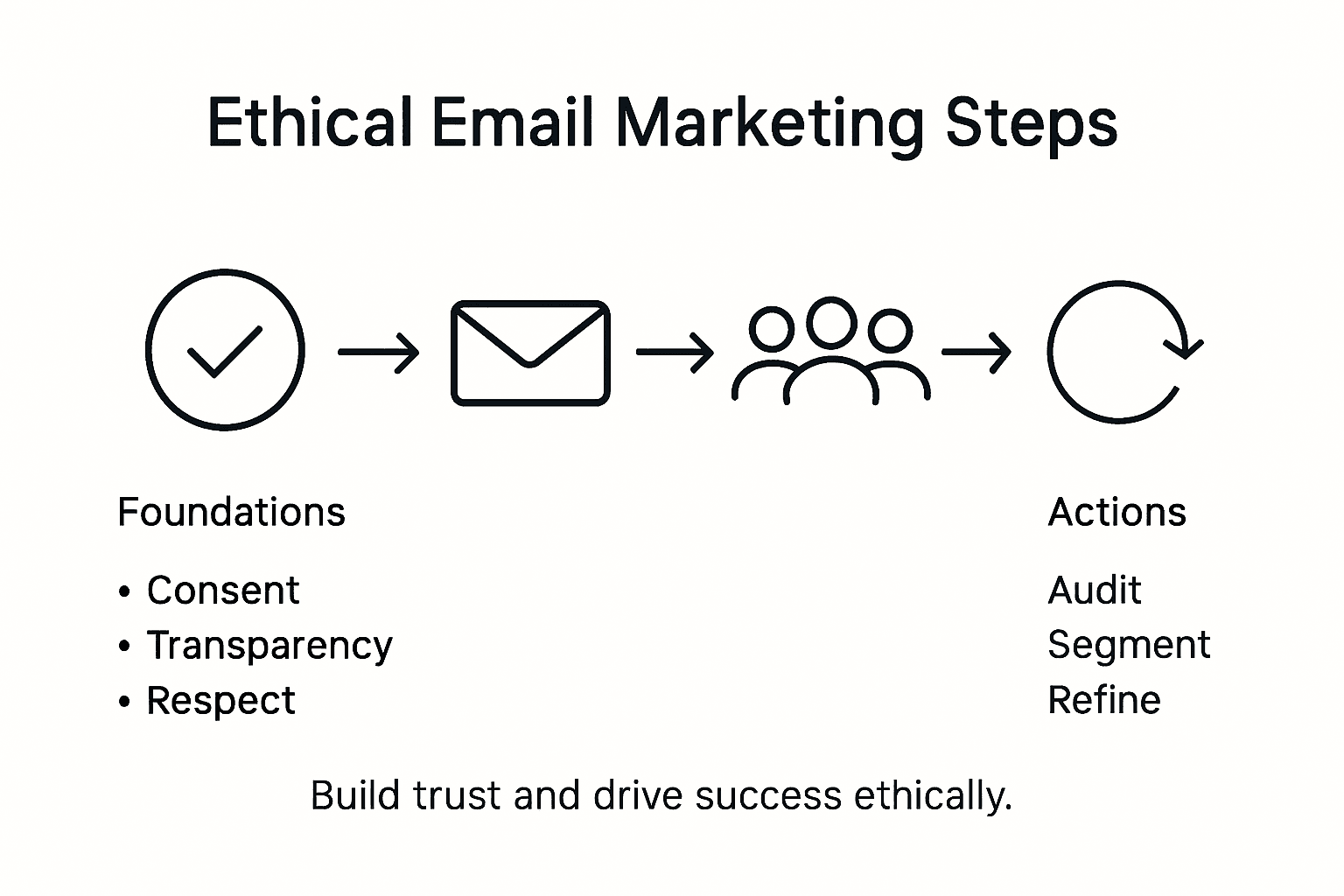
- Step 1: Assess Compliance With Legal And Ethical Standards
- Step 2: Define Transparent And Respectful Data Collection
- Step 3: Implement Consent-Driven Segmentation Strategies
- Step 4: Design Value-Focused, Honest Campaign Messaging
- Step 5: Monitor Impact And Optimize For Sustained Trust
Quick Summary
| Key Point | Explanation |
|---|---|
| 1. Strategic Compliance Audit | Conduct a thorough audit of email practices against international legal standards to avoid compliance pitfalls and protect your brand. |
| 2. Transparent Data Practices | Establish clear data collection frameworks that prioritize user consent and privacy to build customer trust and ensure compliance with regulations. |
| 3. Consent-Driven Segmentation | Implement segmentation strategies that rely on explicit user consent and preferences to create personalized and respectful marketing communications. |
| 4. Honest Campaign Messaging | Craft messaging that genuinely conveys value, addressing audience needs without manipulation, ensuring a clear and relatable communication style. |
| 5. Continuous Performance Monitoring | Set up tracking frameworks to analyze both quantitative metrics and qualitative subscriber feedback to optimize email marketing strategies effectively. |
Step 1: Assess compliance with legal and ethical standards
Email marketing compliance is more than just a checkbox exercise. You need a strategic approach to navigate the complex landscape of global regulations and protect your brand’s reputation. Understanding international email marketing legal frameworks helps you build trust with customers and avoid potential legal pitfalls.
Start by conducting a comprehensive audit of your current email marketing practices against key international standards. This means examining consent mechanisms, unsubscribe processes, data handling protocols, and content accuracy. Global regulatory requirements vary significantly across regions like the European Union, United States, Canada, and Asia Pacific, so you cannot apply a one size fits all approach. Focus on major regulations such as the CAN-SPAM Act, General Data Protection Regulation (GDPR), California Consumer Privacy Act (CCPA), and Canadian Anti Spam Legislation (CASL).
Create a detailed checklist that covers critical compliance elements: verifying explicit subscriber consent, ensuring transparent data collection practices, providing clear opt out mechanisms, maintaining accurate sender information, and implementing robust data security measures. Document your current processes and identify any potential gaps or areas requiring immediate improvement.
Pro tip: Consult with a legal professional specializing in digital marketing regulations to conduct a thorough compliance review and develop a tailored strategy for your specific business needs.
Here’s how major email marketing regulations compare globally:
| Regulation | Region | Consent Requirement | Penalties for Non-Compliance |
|---|---|---|---|
| CAN-SPAM Act | United States | Opt-out allowed, no prior consent | Up to $43,792 per violation |
| GDPR | European Union | Explicit opt-in and data rights | Up to €20M or 4% global revenue |
| CCPA | California, USA | Consumer data control, opt-out | Up to $7,500 per violation |
| CASL | Canada | Express consent required | Up to $10M CAD for companies |
Step 2: Define transparent and respectful data collection
Building customer trust starts with creating crystal clear data collection practices that respect individual privacy and autonomy. Ethical data collection goes far beyond mere legal compliance and becomes a fundamental strategy for long term customer relationships.

To develop transparent data collection practices, you must establish a comprehensive framework that prioritizes user consent and information clarity. Privacy regulations like GDPR and CAN-SPAM require businesses to explicitly communicate their data usage intentions. This means crafting consent forms that clearly explain what specific data you are collecting, why you need it, how you will use it, and providing granular opt in choices that give subscribers genuine control.
Implement robust documentation processes where every data collection point includes precise language about your intentions. Create easy to understand privacy policies, use plain language explanations, and provide straightforward mechanisms for subscribers to review, modify, or delete their personal information. Your goal is to transform data collection from a transactional interaction into a transparent, respectful dialogue that builds genuine trust.
Pro tip: Regularly audit and update your data collection practices to ensure ongoing alignment with evolving privacy standards and emerging customer expectations.
Step 3: Implement consent-driven segmentation strategies
Consent-driven segmentation transforms your email marketing approach from a generic broadcast to a personalized, respectful communication strategy. Advanced research on privacy-centric segmentation demonstrates how strategic data classification can enhance targeted marketing while maintaining user autonomy.
Begin by redesigning your data collection and segmentation process to prioritize explicit user consent and granular preferences. Modern segmentation techniques leverage multiple data points to create nuanced customer profiles that respect individual privacy boundaries. This means creating multi-step consent forms that allow subscribers to select precisely what types of information they are willing to share and how they want to be contacted. Develop clear, straightforward language that explains the value proposition for each segment of data collection, giving users complete transparency about how their information will be used.
Implement a dynamic segmentation framework that continuously updates based on user interactions and expressed preferences. Design preference centers that enable subscribers to modify their consent settings easily, track their data, and understand the exact ways your marketing communications will use their information. By treating consent as an ongoing dialogue rather than a one time checkbox, you build trust and demonstrate your commitment to respecting individual privacy preferences.
Pro tip: Create visual consent interfaces that make data sharing choices intuitive and engaging, transforming privacy controls from a legal requirement into a user friendly experience.
Step 4: Design value-focused, honest campaign messaging
Ethical messaging requires a strategic approach that prioritizes transparency and genuine value to build meaningful connections with your audience. Your email campaigns should communicate authentic benefits that truly matter to your subscribers, moving beyond manipulative tactics toward genuine communication.
Craft your messaging by first understanding your audience’s core needs and motivations. This means developing content that speaks directly to their challenges, aspirations, and practical requirements. Avoid exaggerated claims or sensationalized language. Instead, focus on clear, measurable value propositions that demonstrate exactly how your offering solves specific problems. Use concrete examples, real world outcomes, and straightforward language that builds trust through honest representation of what subscribers can realistically expect.
Develop a consistent brand voice that remains true to your core values across all communication channels. This involves creating email content that sounds like a genuine conversation, not a sales pitch. Test your messaging with small audience segments to ensure it resonates authentically, and be prepared to iterate based on subscriber feedback. Prioritize clarity, empathy, and practical utility in every communication, showing subscribers that you understand and respect their time and intelligence.
Pro tip: Create a messaging checklist that requires every campaign to answer three key questions before sending verification does this message provide genuine value what specific problem does it solve and would I personally find this helpful.
Step 5: Monitor impact and optimize for sustained trust
Continuous measurement and strategic optimization are critical for maintaining long term subscriber trust and engagement in email marketing. Your approach must go beyond simple metrics to understand the deeper dynamics of subscriber relationships.
Implementing a comprehensive tracking framework requires analyzing both quantitative performance indicators and qualitative feedback signals. This means developing a robust system that captures not just open rates and click throughs, but also subscriber sentiment, interaction patterns, and long term engagement trends. Track key metrics like email response rates, time spent reading, forwarding behaviors, and direct feedback responses. Pay special attention to segmentation performance, understanding how different audience groups react to your messaging and identifying opportunities for more personalized communication.
Establish a regular review cycle where you critically examine your email marketing performance. Create dynamic dashboards that provide real time insights into campaign effectiveness, and set up automated alerts for significant changes in subscriber behavior. Be prepared to rapidly adapt your strategies based on emerging data, always prioritizing transparency and value. Your goal is to create a continuous feedback loop that demonstrates your commitment to meeting subscriber needs and maintaining an authentic, trustworthy relationship.
Pro tip: Design a quarterly impact assessment process that includes both algorithmic performance analysis and direct subscriber surveys to capture holistic insights into your email marketing effectiveness.
Here’s a summary of key metrics for ongoing email marketing optimization:
| Metric | What It Measures | Business Impact |
|---|---|---|
| Open Rate | Email initial engagement | Reveals subject line effectiveness |
| Click-Through Rate | Link interaction | Shows content relevancy and interest |
| Unsubscribe Rate | List attrition | Indicates message alignment issues |
| Direct Feedback | Qualitative responses | Guides content and strategy improvements |
Elevate Your Email Marketing with Ethical Strategies and Expert Support
Mastering ethical email marketing requires more than compliance with regulations like GDPR and CAN-SPAM Act. Your brand needs transparent data collection, consent-driven segmentation, and honest messaging to build long-term trust and sustained revenue growth. If you are an ecommerce brand or an online business struggling to implement these complex frameworks or optimize your Klaviyo automations for maximum impact, professional guidance is essential.
Take Action expertly combines human insight with AI-powered analytics to automate retention, increase engagement, and recover abandoned carts without sacrificing respect for customer privacy. Our data-driven, conversion-focused email campaigns align perfectly with your brand voice and deliver genuine value to subscribers. Explore how our campaign strategy and email flow setup services can help you implement transparent consent practices and tailored segmentation that enhance subscriber trust while boosting revenue.
Start turning your email marketing into a powerful growth channel today with Take Action. Contact us now to build scalable, compliant campaigns that respect customer autonomy and maximize lifetime value.
Frequently Asked Questions
How can I ensure compliance with email marketing regulations?
To ensure compliance with email marketing regulations, start by auditing your current practices against key standards like the CAN-SPAM Act and GDPR. Create a checklist that includes verifying subscriber consent, providing easy opt-out options, and maintaining accurate sender information.
What steps should I follow to collect data ethically in my email campaigns?
To collect data ethically, prioritize clear communication about your data usage intentions in your consent forms. Clearly outline what data you collect, why you need it, and how subscribers can control their information.
How do I implement consent-driven segmentation for my email lists?
To implement consent-driven segmentation, redesign your data collection process to allow subscribers to specify their preferences. Create simplified, step-by-step consent forms that explain data usage, allowing users to easily select how and when they want to receive communications.
What should my email campaign messaging focus on to be considered ethical?
Your email campaign messaging should focus on delivering clear, honest value to your subscribers. Avoid manipulative language and instead communicate practical benefits, providing concrete examples of how your offerings solve specific problems for your audience.
How can I monitor subscriber trust and optimize my email marketing efforts?
To monitor subscriber trust, establish a comprehensive tracking framework that measures both quantitative and qualitative indicators like engagement rates and subscriber feedback. Regularly assess your performance and adapt your strategies based on this data to ensure ongoing alignment with subscriber needs.
What key metrics should I track for optimizing my email marketing campaigns?
For optimizing your email marketing campaigns, track metrics such as open rates, click-through rates, and unsubscribe rates. Establish a review cycle for these metrics to identify areas for improvement and aim to reduce unsubscribe rates by around 20% over the next few campaigns.
Recommended
- Marketing Psychology Basics: The Complete Guide | Take Action Blog | Take Action
- Email Campaign Best Practices for 2025 Success | Take Action Blog | Take Action
- Business Ethics: Why They Matter for Ecommerce Brands | Take Action Blog | Take Action
- Email Marketing Explained: Strategies for Ecommerce Growth | Take Action Blog | Take Action