

Future of Remote Work: Transforming Ecommerce Teams
Over half of American ecommerce leaders say remote work has changed how their teams connect and deliver results. As team members spread across North America, staying agile is often just as important as being creative. With Klaviyo powering your campaigns, understanding the evolution of remote work can help you create efficient team processes, sharpen your email marketing, and strengthen customer retention—even when no one is in the same room.
Table of Contents
- Defining Remote Work and Its Evolution
- Remote Work Models In Ecommerce Marketing
- Key Tools Powering Distributed Teams
- Email Marketing and Retention In Hybrid Workplaces
- Security, Compliance, and Future Challenges
Key Takeaways
| Point | Details |
|---|---|
| Remote Work is Here to Stay | The shift to remote work has redefined operational norms and requires robust digital strategies. |
| Adaptable Communication is Key | Emphasizing asynchronous communication tools is essential for maintaining productivity and cohesion. |
| Invest in Technology | Adopting advanced analytics and AI tools enhances decision-making and enables effective marketing strategies. |
| Cybersecurity is Critical | A proactive security framework must be established to mitigate risks in distributed work environments. |
Defining Remote Work and Its Evolution
Remote work has transformed from a niche concept to a global workplace revolution, fundamentally reshaping how ecommerce teams operate. The evolution of working from home reveals a dramatic shift in professional dynamics, with technological advancements and pandemic pressures accelerating changes that were already brewing beneath the surface.
Historically, remote work emerged as sporadic arrangements allowing occasional flexibility. However, the COVID-19 pandemic dramatically accelerated this trend, compelling organizations worldwide to reconsider traditional office structures. Technological infrastructure became the backbone of this transformation, enabling seamless communication and collaboration across distributed teams. Digital tools like video conferencing, cloud-based project management platforms, and real-time messaging systems made geographic separation nearly irrelevant for knowledge workers.
For ecommerce brand managers specifically, remote work represents more than just a location shift. It signifies a profound reimagining of team dynamics, productivity measurement, and talent acquisition. Research from the European Trade Union Institute highlights how remote work has triggered significant paradigm shifts in labor practices, challenging conventional assumptions about workplace effectiveness. The transition demands robust digital communication strategies, clear performance metrics, and intentional team-building approaches that transcend physical boundaries.
Pro tip: Invest in asynchronous communication tools and establish clear digital collaboration protocols to maintain team cohesion and productivity in remote ecommerce environments.
Remote Work Models in Ecommerce Marketing
Ecommerce marketing teams are increasingly adopting flexible work arrangements that prioritize productivity and collaboration. The systematic literature review highlights the evolution from contingency to structural remote work models, revealing critical strategies for maintaining team effectiveness across distributed environments.

Three primary remote work models have emerged for ecommerce marketing professionals: fully remote, hybrid, and distributed teams. Fully remote models enable complete geographic flexibility, allowing talent acquisition from global talent pools without physical location constraints. Hybrid models represent a balanced approach, typically involving partial office presence and remote work days, which can optimize team collaboration while maintaining individual productivity autonomy. Distributed teams, meanwhile, represent a more decentralized structure where team members work from various global locations, leveraging diverse perspectives and round-the-clock operational capabilities.
Successful implementation of these models requires sophisticated digital infrastructure, robust communication protocols, and performance measurement systems that transcend traditional office-based metrics. Ecommerce marketing teams must invest in cloud-based collaboration tools, establish clear digital communication guidelines, and develop trust-based management approaches that focus on outcomes rather than physical presence. This approach demands reimagining team dynamics, emphasizing asynchronous communication, and creating inclusive digital workspaces that support both individual creativity and collective innovation.
Here’s a summary of remote work models in ecommerce marketing and their unique advantages:
| Model Type | Key Advantage | Example Use Case |
|---|---|---|
| Fully Remote | Global talent access | Hire specialized designers |
| Hybrid | Balance collaboration/focus | In-office brainstorming |
| Distributed | 24/7 productivity | Multi-timezone campaigns |
Pro tip: Develop a comprehensive digital communication strategy that includes standardized communication channels, response time expectations, and virtual team-building activities to maintain team cohesion in remote work environments.
Key Tools Powering Distributed Teams
Ecommerce marketing teams are revolutionizing their operational capabilities through advanced technological solutions that enable seamless collaboration and data-driven decision making. Machine learning and deep learning tools have emerged as critical frameworks for transforming distributed team performance, providing unprecedented insights into customer behavior and operational efficiency.
The core technological ecosystem for distributed ecommerce marketing teams comprises several essential categories of tools. Communication platforms like Slack, Zoom, and Microsoft Teams create real-time connection points, while project management tools such as Asana, Trello, and Monday.com facilitate task tracking and collaborative workflow management. Cloud-based document sharing systems like Google Workspace and Dropbox ensure instant access to critical files, while advanced analytics tools enable team members to extract actionable insights regardless of physical location.
Big data analytics and AI technologies have become fundamental in addressing complex ecommerce challenges, particularly for distributed teams seeking to optimize supply chain operations and customer segmentation strategies. Advanced machine learning algorithms can now predict customer behaviors, personalize marketing approaches, and identify potential market opportunities with remarkable precision. These technologies essentially function as intelligent team members, processing vast amounts of data and generating strategic recommendations that transcend traditional human analytical capabilities.
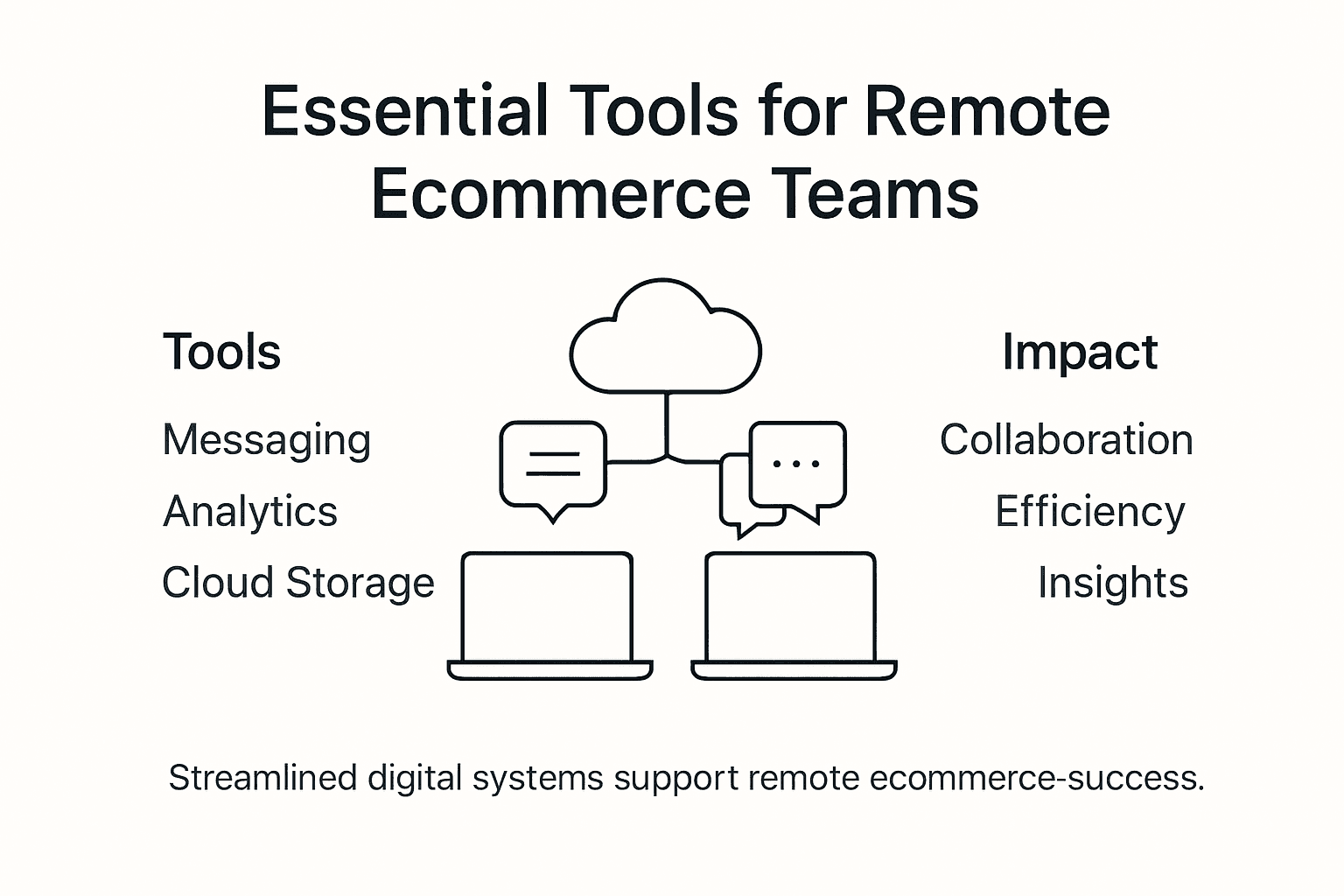
The following table highlights major categories of tools that empower distributed ecommerce teams:
| Tool Category | Main Function | Business Impact |
|---|---|---|
| Communication | Real-time collaboration | Faster team decision making |
| Project Management | Task tracking and workflow | Higher project completion rates |
| Cloud Document Sharing | Secure file access | Improved knowledge sharing |
| Analytics & AI | Data-driven insights | Better marketing strategies |
Pro tip: Implement a comprehensive digital tool integration strategy that ensures seamless data flow between communication, project management, and analytics platforms to maximize distributed team productivity.
Email Marketing and Retention in Hybrid Workplaces
Hybrid work environments are fundamentally reshaping how ecommerce marketing teams approach customer engagement and retention strategies. Randomized control trials demonstrate that hybrid work models can significantly improve job satisfaction and employee retention, creating a unique opportunity to reimagine email marketing approaches that mirror these dynamic workplace transformations.
Communication strategies in hybrid workplaces require nuanced, technology-enabled approaches that transcend traditional email marketing techniques. Segmentation becomes critical, with personalized email campaigns that recognize the diverse working patterns and preferences of team members. Advanced targeting mechanisms allow marketers to craft messages that resonate with employees operating across different physical and digital environments, ensuring consistent brand messaging and engagement regardless of individual work locations.
Research exploring employee engagement in hybrid settings highlights the importance of adaptive communication frameworks, particularly for distributed ecommerce teams. Successful email marketing in these environments demands sophisticated segmentation, real-time analytics, and flexible content strategies that can dynamically adjust to changing team dynamics. By leveraging data-driven insights, marketing teams can develop retention campaigns that not only capture customer attention but also reflect the collaborative spirit of hybrid work models.
Pro tip: Implement AI-driven personalization tools that can analyze individual customer interaction patterns across multiple channels, enabling more precise and contextually relevant email marketing strategies.
Security, Compliance, and Future Challenges
As distributed work models become increasingly prevalent, ecommerce teams must navigate an increasingly complex landscape of cybersecurity risks and regulatory compliance. Systematic reviews reveal significant vulnerabilities introduced by remote work environments, highlighting the critical need for adaptive security strategies that balance operational flexibility with robust protection mechanisms.
Cybersecurity challenges in distributed teams encompass multiple dimensions, including technological vulnerabilities and human behavioral risks. Phishing attempts, device misuse, and unmanaged “shadow IT” practices represent significant threats to organizational data integrity. Sophisticated security frameworks must now address not just technological defenses, but also comprehensive employee training programs that cultivate a culture of digital awareness and proactive risk management. Multifactor authentication, encrypted communication channels, and continuous security awareness training become essential components of a holistic approach to protecting sensitive customer and organizational data.
The future of secure remote work demands a dynamic, behavior-aware approach to cybersecurity governance. Advanced machine learning algorithms can now monitor and analyze potential security anomalies in real time, providing predictive insights that enable preemptive risk mitigation. Organizations must develop flexible security protocols that can adapt to emerging technological landscapes, integrating zero trust architectures, continuous authentication mechanisms, and intelligent threat detection systems that can respond to evolving digital risks with unprecedented speed and precision.
Pro tip: Implement a comprehensive security awareness program that includes regular simulated phishing tests, mandatory quarterly cybersecurity training, and personalized risk assessments for distributed team members.
Empower Your Ecommerce Team for the Future of Remote Work
The shift to remote and hybrid work models presents ecommerce teams with new challenges like maintaining seamless communication, leveraging data-driven insights, and sustaining customer engagement across digital channels. This article highlights the critical need for robust digital collaboration and personalized, automated marketing strategies to thrive in a distributed environment. If your ecommerce brand struggles with increasing retention, optimizing email flows, or scaling revenue beyond paid ads, you are not alone.
At Take Action, we specialize in transforming these challenges into growth opportunities by combining human expertise with AI-powered segmentation and automation. Our tailored solutions help ecommerce teams automate customer retention, boost open and click rates, and recover abandoned carts—perfect for remote, hybrid, or fully distributed teams focused on results. Discover how integrating the right email marketing strategy can turn digital complexities into dependable revenue streams.
Elevate your ecommerce marketing with a partner who understands the evolving future of work. Explore our services and start turning your email channel into a primary growth driver today.
Explore Our Solutions
Learn More About Scaling with Email Automation
Partner with Take Action Now

Ready to transform your ecommerce team’s remote challenges into measurable growth? Visit Take Action and take the first step toward scaling your brand with data-driven email marketing designed for the future of work.
Frequently Asked Questions
What is remote work in the context of ecommerce teams?
Remote work in ecommerce teams refers to the practice of employees working from various locations outside of a traditional office setting, leveraging technology for communication and collaboration, which became widespread due to advancements in digital tools and the COVID-19 pandemic.
What are the main remote work models adopted by ecommerce marketing teams?
The main remote work models for ecommerce marketing teams include fully remote, hybrid, and distributed teams. Fully remote allows for complete geographic flexibility, hybrid combines office presence with remote days, and distributed teams work from various global locations simultaneously.
How do technology and digital tools impact remote ecommerce teams?
Technology and digital tools enhance communication, project management, and data analytics for remote ecommerce teams, allowing for seamless collaboration, improved tracking of tasks, and data-driven decision-making regardless of team members’ physical locations.
What are the security challenges associated with remote work in ecommerce?
Security challenges in remote work for ecommerce include cybersecurity risks like phishing and data breaches. Teams must implement robust security frameworks, including employee training, multi-factor authentication, and advanced monitoring systems to protect sensitive information.
Recommended
- 7 Branding Trends for 2025 Every Ecommerce Brand Must Know | Take Action Blog | Take Action
- 7 Habits of Successful Entrepreneurs for Ecommerce Growth | Take Action Blog | Take Action
- 7 Must-Read Business Book Recommendations for Ecommerce Growth | Take Action Blog | Take Action
- Master Community Building Online for Ecommerce Success | Take Action Blog | Take Action
- Auraglowbeauty your one stop for Fashion, Beauty and Skincare – IGZ Clothing
- What Is Contemporary Menswear and Why It Matters – Vellure Homme