

Google SEO Agency: Impact on Ecommerce Growth
Trusting a Google SEO agency to deliver results can feel risky when myths and confusion still dominate the conversation. Ecommerce brand owners often find that misinformation from online forums and social networks makes it tough to separate facts from sales pitches. Understanding the difference between common misconceptions and real agency methods helps you avoid wasted investment and focus on advanced email automation strategies that truly drive growth.
Table of Contents
- Google SEO Agencies Explained And Misconceptions
- What Google SEO Agencies Actually Do
- Five Major Misconceptions About SEO Agencies
- How To Evaluate A Real Agency
- Core Services And Agency Specializations
- Technical SEO Services
- Content Strategy And Optimization
- Link Building And Authority
- Specialized Reporting And Analysis
- Key Attributes And Performance Metrics
- The Metrics That Matter
- Setting Goals That Stick
- Reporting And Transparency
- Risks, Costs, And Common Pitfalls
- Financial Risks And Hidden Costs
- Technical And Strategy Pitfalls
- Expectation Management And Attribution Challenges
- Comparing SEO And Email Automation Channels
- How SEO And Email Marketing Differ
- Timeline And Investment Differences
- The Combined Approach Wins
Key Takeaways
| Point | Details |
|---|---|
| Understanding SEO Agencies | Google SEO agencies optimize visibility through technical setup, content strategy, and authority building, targeting organic traffic. |
| Misconceptions | Common myths can mislead businesses, like the idea that SEO is a one-time project or that longer content always ranks better. |
| Evaluating Agencies | Prioritize agencies that provide case studies, transparent methods, and clear reporting, with a focus on measurable outcomes. |
| Integration of Channels | Combine SEO with email marketing for maximum growth, as each supports different stages of customer acquisition and retention. |
Google SEO Agencies Explained and Misconceptions
A Google SEO agency is a firm that optimizes your ecommerce store’s visibility in Google search results. These agencies handle technical setup, content strategy, and link building to drive organic traffic. The goal is straightforward: get your products in front of customers actively searching for what you sell.
However, the SEO industry is rife with confusion. Common SEO myths spread through forums and social media faster than accurate information, especially among business owners new to search optimization. This creates a landscape where misconceptions outnumber facts, and agencies exploit these gaps.
What Google SEO Agencies Actually Do
Reputable agencies focus on three core areas:
- Technical SEO — fixing site speed, mobile responsiveness, and indexing issues so Google can crawl your pages effectively
- Content optimization — creating or improving product descriptions, category pages, and blog content to match search intent
- Authority building — earning quality backlinks from relevant websites that signal trust to Google’s algorithm
They don’t promise rankings. They can’t. Google’s algorithm considers hundreds of factors, and no agency controls them all.
Five Major Misconceptions About SEO Agencies
Misunderstanding what SEO actually does leads brands to hire the wrong partner or abandon the channel entirely.
Myth 1: SEO is a one-time project. Your competitors don’t stop optimizing after month three. SEO requires ongoing monitoring, updates, and adjustments. A single content refresh won’t sustain rankings for years.
Myth 2: Longer content always ranks better. Word count is irrelevant if the content doesn’t answer the searcher’s actual question. A 500-word page that directly addresses customer concerns outranks a 3,000-word fluff piece every time.
Myth 3: Backlinks alone guarantee rankings. Quality backlinks matter, but they’re one piece of the puzzle. Without solid technical SEO and relevant content, links deliver minimal impact. The relationship between these factors matters more than any single tactic.
Myth 4: SEO results are immediate. Organic traffic typically takes 3-6 months to show meaningful movement, sometimes longer depending on competition. Agencies claiming month-one rankings are misleading you.
Myth 5: Your website needs a perfect domain authority score. Domain authority tools provide estimates, not Google rankings. Focus on relevance and user experience instead. A newer domain with better content outperforms an aged domain with poor relevance.
Here’s a comparison of common SEO agency misconceptions versus the actual reality:
| Misconception | Reality | Business Impact |
|---|---|---|
| SEO is a one-time project | Needs ongoing updates | Stops rankings from declining |
| Longer content always ranks higher | Relevance beats word count | Reduces wasted content investment |
| Backlinks guarantee results | Quality and site foundation matter more | Prevents misallocated link-building effort |
| SEO delivers immediate results | Traffic growth is gradual | Sets realistic timeline expectations |
| Domain authority is crucial | Relevance and user value are key | Shifts focus to helpful content |
How to Evaluate a Real Agency
Request these specifics before signing a contract:
- Ask for case studies with traffic data (not vague claims)
- Clarify the timeline — they should mention 3-6 months minimum
- Demand transparency about their methods (no “black hat” tactics)
- Verify they audit your site first before proposing solutions
- Confirm they provide monthly reporting with actual metrics
Learn more about how SEO drives ecommerce growth and the complementary channels that strengthen your overall strategy.
The best SEO agencies focus on what’s best for your customers, not gaming algorithms. Sustainable growth follows naturally from that approach.
Pro tip: When evaluating agencies, ask them to explain Google’s Core Web Vitals and how they optimize for them—this separates agencies keeping pace with current Google priorities from those using outdated playbooks.
Core Services and Agency Specializations
Google SEO agencies don’t all operate the same way. Some focus narrowly on technical fixes, while others build comprehensive strategies across multiple channels. Understanding what each service does helps you pick the right partner for your ecommerce needs.
Most agencies offer a mix of services tailored to your business stage. A brand struggling with site speed needs different expertise than one with solid rankings but poor conversion rates. The best agencies assess your specific situation before recommending solutions.

Technical SEO Services
Technical SEO is the foundation. Without it, no amount of content or link building matters because Google can’t properly crawl and index your site.
Services include:
- Site speed optimization (image compression, server response times, caching)
- Mobile responsiveness fixes (ensuring your site works perfectly on phones)
- Crawl error resolution (fixing broken links, redirect chains, and XML sitemap issues)
- Structured data implementation (helping Google understand your products, prices, and reviews)
- Core Web Vitals optimization (loading speed, interactivity, visual stability)
This work happens behind the scenes. Your customers never see it, but Google notices immediately.
Content Strategy and Optimization
Content strategy teams research what your customers actually search for, then create or optimize pages to answer those queries directly. This isn’t about stuffing keywords—it’s about matching search intent with relevant, helpful information.
They handle:
- Keyword research for product pages and category pages
- Content audits identifying gaps and outdated material
- Product description optimization for search visibility and conversions
- Blog strategy aligned with customer questions and buying stages
- Content updates keeping existing pages competitive
A specialized approach works better than generic templates. Your athletic wear customers search differently than your furniture buyers.
Link Building and Authority
Link building signals to Google that other websites trust your content. Quality backlinks from relevant, authoritative sites strengthen your domain credibility.
This includes:
- Identifying link opportunities from industry publications and blogs
- Outreach campaigns securing backlinks through relationships
- Resource page submissions (getting listed on guides and directories)
- Broken link building (replacing dead links on other sites with yours)
- Brand mentions turned into actual links
Reputable agencies focus on relevance over quantity. Five links from fashion blogs matter more than fifty from unrelated sites.
Specialized Reporting and Analysis
Many agencies offer applied research and analysis services that dig deeper than standard monthly reports. They analyze competitor strategies, market trends, and customer behavior patterns to inform your SEO direction.
This might include:
- Competitive intelligence (what your rivals rank for and how)
- Search trend analysis (identifying growing opportunities)
- User behavior research (how visitors navigate your site)
- ROI measurement (connecting SEO traffic to actual revenue)
Agencies worth hiring don’t just report metrics—they explain what data means for your business and recommend specific actions based on findings.
Pro tip: Ask prospective agencies which services they handle in-house versus outsource. In-house technical SEO and strategy work usually delivers better results than agencies juggling too many clients with outsourced teams.
Key Attributes and Performance Metrics
A great Google SEO agency doesn’t just promise rankings. It commits to measurable outcomes tied directly to your ecommerce revenue. Before partnering with any agency, understand what metrics actually matter and which ones are vanity numbers.
The right agencies obsess over results. They set specific, achievable goals and track progress against those benchmarks every single month. This accountability separates partners from vendors.
The Metrics That Matter
Not all metrics are created equal. Some drive revenue; others just look impressive in PowerPoint.
Metrics with real business impact:
Below is a summary of key metrics that actually matter when evaluating SEO agency performance:
| Metric | What It Measures | Why It Matters |
|---|---|---|
| Organic conversions | Sales/leads from search | Links SEO to business results |
| Organic traffic growth | Visitors from Google | Indicates visibility improvements |
| Keyword rankings | Position for target searches | Tracks competitive progress |
| Click-through rate | % of impressions as clicks | Reveals ad copy and title strength |
| Search visibility score | Industry-wide ranking presence | Gauges broad market standing |
- Organic conversions — actual sales or leads from unpaid search traffic (this is the number one priority)
- Organic traffic growth — the volume of visitors arriving through search results
- Keyword rankings — where your site ranks for target search terms your customers use
- Organic click-through rate — percentage of search impressions that become clicks to your site
- Search visibility score — your overall prominence across all keywords in your industry
SEO KPIs directly measure whether your investment actually converts browsers into buyers. If your organic traffic doubled but conversions stayed flat, something’s broken in your sales funnel or product pages.
Vanity metrics to ignore:
- Domain authority scores (estimates only, not Google rankings)
- Backlink quantity without quality assessment
- Keyword rankings for irrelevant search terms
- Traffic that doesn’t align with your products
Setting Goals That Stick
Good agencies help you define what success actually looks like for your business. This varies dramatically based on your industry, competition, and current stage.
A brand with zero organic traffic needs different goals than one already getting 5,000 monthly visitors. An agency worth hiring asks about your revenue targets, not just traffic targets. They understand that 500 qualified visitors converting at 3% delivers more value than 5,000 unqualified browsers.
Reporting and Transparency
You need monthly reports showing:
- Organic traffic trends (month-over-month and year-over-year comparisons)
- Keyword ranking movements for priority search terms
- Organic conversions tied to revenue impact
- Backlink acquisition and quality metrics
- Technical health status and any fixes implemented
Reputable agencies combine comprehensive site health metrics with straightforward explanations of what changed and why. They also explain obstacles—like algorithm updates—that affected results.
Demand clarity on timelines too. Most agencies should show initial movement in 2-3 months, meaningful traffic increases in 4-6 months, and significant revenue impact by month six to eight.
Agencies that tie SEO results directly to your revenue are the ones seriously invested in your success. Everything else is just activity without outcomes.
Pro tip: Request a sample report before signing any contract. This shows you exactly what data you’ll receive monthly and whether the agency explains findings in language you actually understand versus industry jargon.
Risks, Costs, and Common Pitfalls
SEO requires patience and strategy. Bad agencies promise quick fixes, use risky tactics, and disappear when results stall. Understanding what can go wrong helps you avoid partnerships that waste time and money.
The biggest risk isn’t investing in SEO—it’s investing in the wrong approach. A poorly executed campaign can damage your site’s visibility for months.
Financial Risks and Hidden Costs
SEO isn’t cheap, but it shouldn’t drain your budget either. Expect to pay between $1,000 and $10,000 monthly depending on your industry competitiveness and current site state.
Hidden costs to watch for:
- Unexpected site redesigns uncovering technical debt
- Content rewriting or expansion beyond initial scope
- Tools and software licenses agencies use on your behalf
- Rush fees for accelerated timelines
- Extra fees if rankings don’t improve after six months
Reputable agencies provide upfront pricing with clear deliverables. If an agency won’t explain what you’re paying for, walk away.
Technical and Strategy Pitfalls
SEO mistakes can trigger Google penalties or tank your rankings overnight. Common pitfalls include keyword stuffing, neglecting user intent, and poor mobile optimization.
Other dangerous tactics agencies sometimes use:
- Building unnatural backlinks from low-quality sites
- Creating duplicate content across pages
- Using cloaking or hidden text to manipulate rankings
- Over-optimizing for keywords without matching search intent
- Ignoring technical SEO foundations
Google’s algorithm is sophisticated. It catches these shortcuts and penalizes sites aggressively. Recovery from a manual penalty takes months and damages your organic visibility.
Expectation Management and Attribution Challenges
Marketing professionals face complex attribution challenges tracking which channels drive conversions. When you run SEO alongside email marketing, paid ads, or social media, separating which channel deserves credit becomes complicated.
Some agencies deliberately create confusion so they can claim credit for results driven by other channels. Demand clear attribution. You should know exactly how much organic traffic converted to sales versus traffic from other sources.
Also watch for agencies that lose focus after initial results. Once your site ranks well, maintaining those positions requires ongoing work—not just occasional adjustments.
The cheapest agency isn’t the best investment if it uses tactics that trigger penalties or ignores your conversion goals. Cheapest often means most risk.
Pro tip: Ask prospective agencies what they’d do if Google released an algorithm update that hurt your rankings. Their answer reveals whether they adapt strategically or panic and blame external factors beyond their control.
Comparing SEO and Email Automation Channels
SEO and email automation are not competitors—they’re complementary channels that drive ecommerce growth differently. Understanding how each works helps you allocate budget strategically and maximize customer lifetime value.
Many brands choose one channel over the other based on budget constraints. The smarter approach uses both, since they serve distinct purposes in your customer journey.
How SEO and Email Marketing Differ
SEO brings cold traffic. It targets customers actively searching for products you sell but who don’t yet know your brand exists. The payoff comes slowly but scales indefinitely once your content ranks.
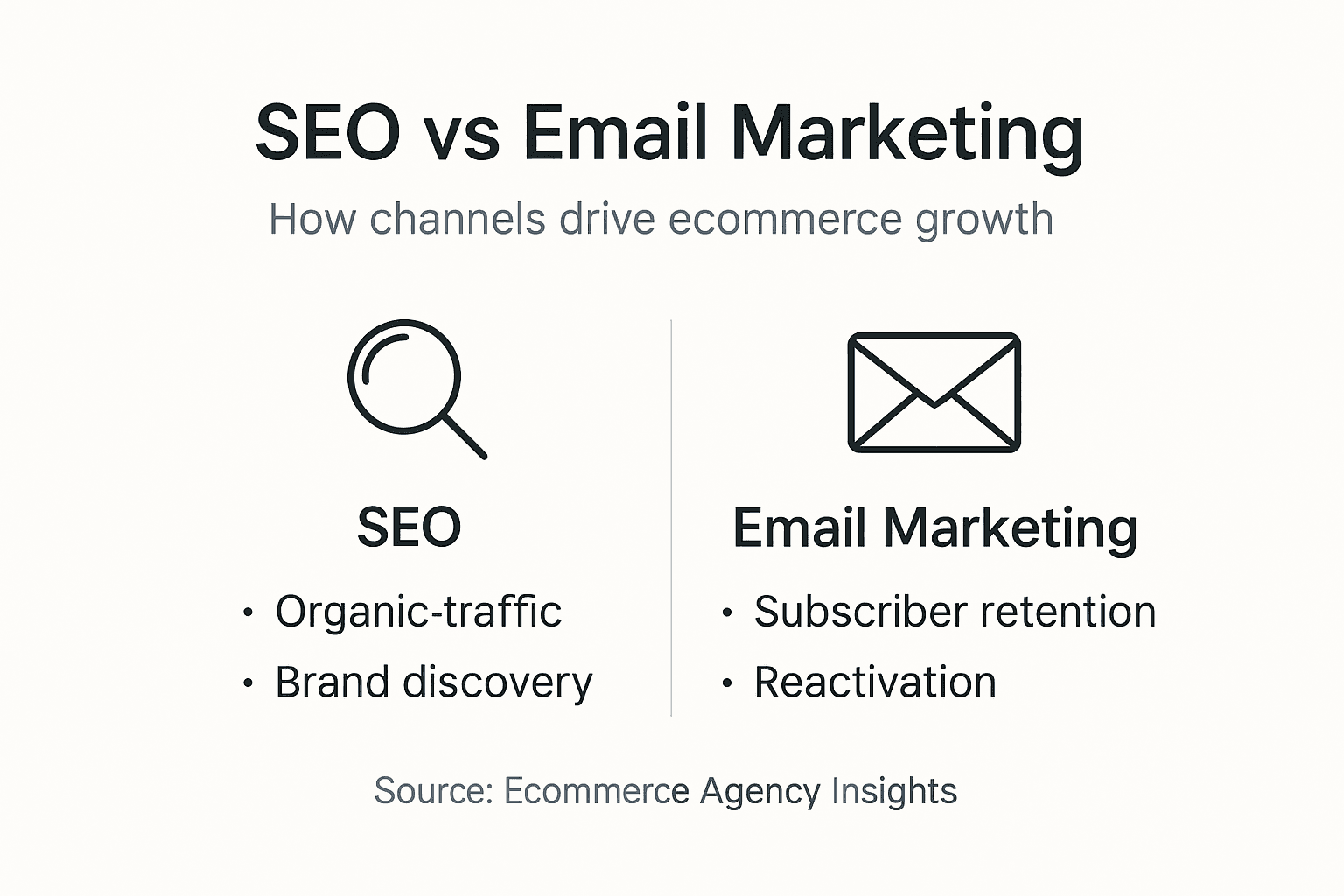
Email automation engages warm audiences. It converts subscribers who already opted in, re-engages inactive customers, and drives repeat purchases. Results appear within days or weeks, not months.
Email marketing versus SEO strategies serve different functions in customer acquisition and retention. SEO focuses on organic search visibility through content quality and technical optimization. Email relies on direct communication with known subscribers.
Timeline and Investment Differences
Timelines separate these channels dramatically:
- SEO: 3-6 months for initial traction, 6-12 months for significant revenue impact
- Email automation: 1-3 weeks to show meaningful lift in repeat customer revenue
Investment patterns also differ. SEO requires upfront content creation and technical work before generating returns. Email automation costs less initially but scales with subscriber growth.
A brand with existing customers gains immediate ROI from email automation. A brand building market awareness invests in SEO first.
The Combined Approach Wins
The best ecommerce brands run both simultaneously. SEO fills your top of funnel with new buyers. Email automation maximizes their lifetime value through targeted campaigns.
Consider this: SEO brings 500 new monthly visitors. Without email automation, maybe 50 convert immediately. Email automation captures the other 450 visitors by staying in their inbox with personalized automation that improves targeting and timing, converting them into customers months later.
Metrics to track for each channel:
- SEO: Organic conversions, customer acquisition cost, lifetime value of organic buyers
- Email: Repeat purchase rate, revenue per subscriber, automation flow conversion rates
Budget allocation depends on your stage. Early-stage brands (under 6 months) prioritize email automation. Established brands (1+ year) balance both equally or lean into SEO.
The strongest growth comes from channels working together, not from choosing one and ignoring the other. SEO acquires customers; email maximizes their value.
Pro tip: Track which email subscribers came from organic search, then analyze their behavior separately. This reveals whether organic searchers convert differently than other audiences, informing both your SEO and email strategies.
Amplify Your Ecommerce Growth Beyond SEO with Strategic Email Marketing
Navigating the complexities of Google SEO is essential for ecommerce success but sustaining growth demands more than just search engine visibility. Many brands face challenges like slow traffic growth, ongoing content updates, and the long wait for meaningful revenue impact. The article highlights that SEO brings cold traffic with a delayed payoff while emphasizing the critical role of ongoing optimization and realistic timelines.
Take Action helps ecommerce brands break through these hurdles by turning email marketing into a powerful, automated growth engine. By leveraging Klaviyo-powered automation and segmentation, we transform new and existing visitors into loyal customers quickly, driving measurable revenue through high-converting flows like welcome sequences, abandoned cart recovery, and post-purchase campaigns. Our data-driven approach complements your SEO efforts by maximizing customer lifetime value and diversifying your revenue streams.
Don’t wait months for SEO gains to translate into sales when you can ignite immediate growth with smart email strategies. Explore how our email marketing and retention solutions can accelerate your brand’s journey from traffic to revenue. Visit Take Action today to start converting more visitors into lifelong customers and secure ongoing ecommerce success.
Frequently Asked Questions
What services do Google SEO agencies provide for ecommerce growth?
Reputable Google SEO agencies focus on technical SEO, content optimization, and link building to enhance your website’s visibility and drive organic traffic. They ensure your site is fast, mobile-friendly, and relevant to customer queries.
How long does it take to see results from SEO efforts?
Typically, it takes 3-6 months to see meaningful changes in organic traffic and rankings. SEO is an ongoing process that requires continuous updates and adjustments based on performance and market trends.
What are the common misconceptions about hiring an SEO agency?
One major misconception is that SEO is a one-time project. In reality, it requires ongoing effort to maintain and improve rankings. Other myths include the belief that longer content always ranks better or that backlinks alone guarantee rankings.
How can I evaluate the effectiveness of an SEO agency?
To gauge effectiveness, you should look for transparency in reporting, including organic traffic growth, keyword rankings, and conversions. A good agency will also provide clear timelines and case studies with actual performance data.
Recommended
- SEO Matters: Complete Guide for Ecommerce Brands | Take Action Blog | Take Action
- Digital Media Buying Agency Impact on Ecommerce | Take Action Blog | Take Action
- Blog - Email Marketing Insights | Take Action | Take Action
- 7 Essential Keyword Research Tips for Ecommerce Growth | Take Action Blog | Take Action
- Boost Your Success with Customer Engagement in Retail | BonusQR
- What Is Global Luxury E-Commerce – How It Redefines Fashion Shopping