

How to Create a Content Calendar for Effective Email Marketing
Every Ecommerce brand manager in North America faces the challenge of keeping Klaviyo email campaigns relevant and effective throughout the year. When goals and audience segments are mapped out, it shapes every decision from timing to message. A clear process for building your content calendar can drive consistent engagement, help you capitalize on critical campaign opportunities, and support customer retention. From setting objectives to refining strategies, you will discover how precise audience mapping transforms generic emails into conversion-focused communication.
Table of Contents
- Step 1: Assess Email Marketing Goals And Audience Segments
- Step 2: Collect Key Dates And Campaign Opportunities
- Step 3: Map Out Email Themes And Content Pillars
- Step 4: Schedule Campaigns Using Your Content Calendar Tool
- Step 5: Review And Refine Your Calendar For Optimal Results
Quick Summary
| Key Point | Explanation |
|---|---|
| 1. Define Email Marketing Goals | Clearly outline specific objectives to shape content strategies for your campaigns. |
| 2. Segment Your Audience Effectively | Group customers based on characteristics for personalized and targeted email content. |
| 3. Identify Key Dates for Campaigns | Track important dates to align marketing emails with timely opportunities for engagement. |
| 4. Develop Strong Content Pillars | Create foundational themes that resonate with audiences, ensuring consistent messaging. |
| 5. Regularly Review Your Calendar | Continuously assess performance metrics and adjust strategies for optimal results. |
Step 1: Assess email marketing goals and audience segments
Creating an effective email marketing content calendar begins with understanding your specific goals and identifying the right audience segments. This strategic foundation will determine the direction and success of your email campaigns.
Start by clearly defining your marketing objectives. Are you looking to increase product sales, boost customer engagement, recover abandoned carts, or drive repeat purchases? Each goal requires a different approach to segmentation and content strategy. Audience targeting strategies help you align your email content precisely with your business objectives.
To develop meaningful audience segments, break down your customer base into distinct groups based on key characteristics. These might include:
- Purchase history
- Demographic information
- Engagement levels with previous emails
- Customer lifecycle stage
- Specific product interests
- Geographic location
Effective segmentation allows you to create personalized, highly targeted email content that speaks directly to each group’s unique needs and preferences. Precise audience mapping transforms generic email blasts into compelling, conversion-driven communication.
Here’s a quick summary of how different audience segments can shape your email marketing approach:
| Segment Type | Primary Benefit | Content Focus |
|---|---|---|
| Purchase history | Boosts conversions | Upsell/cross-sell |
| Demographics | Improves relevance | Personalization |
| Engagement level | Increases retention | Targeted offers |
| Lifecycle stage | Nurtures relationships | Onboarding/loyalty |
| Product interests | Drives specific product sales | Recommendations |
| Geographic location | Localizes campaigns | Regional deals/events |
Segmented email campaigns can drive up to 760% increase in revenue compared to non-segmented approaches.
Pro tip: Use your customer data analytics tools to continuously refine and update your audience segments, ensuring your email content remains relevant and engaging.
Step 2: Collect key dates and campaign opportunities
Building a comprehensive content calendar requires systematically identifying and tracking important dates that can drive meaningful email marketing campaigns. This strategic approach ensures you never miss an opportunity to connect with your audience.
Key content marketing dates are essential for creating timely and relevant email content throughout the year. Start by mapping out different types of key dates that can inspire your email campaigns:
- Cultural holidays (Christmas, Thanksgiving, Independence Day)
- Industry-specific events (trade shows, conferences, product launches)
- Company milestones (anniversaries, quarterly achievements)
- Seasonal transitions (back to school, summer sales)
- Customer lifecycle moments (birthdays, signup anniversaries)
- Regional and local events relevant to your target audience
Consider creating a master spreadsheet or using a digital calendar tool to track these important dates systematically. Organize dates by category and potential campaign themes to help you visualize potential email marketing opportunities well in advance.
Proactively planning your content calendar can increase email engagement by up to 35% compared to reactive marketing approaches.
Pro tip: Create a color-coded system in your calendar to quickly distinguish between different types of campaign opportunities and ensure comprehensive coverage.
Step 3: Map out email themes and content pillars
Developing a strategic framework for your email marketing content requires thoughtful planning and a deep understanding of your audience’s needs. By creating robust content pillars, you’ll establish a consistent and engaging communication strategy that resonates with your subscribers.
Content marketing pillar strategies help brands organize their messaging around core themes that provide value and maintain audience interest. Start by identifying 3-5 primary content pillars that align with your brand’s mission and your audience’s key interests:
- Product education (features, use cases, benefits)
- Industry insights (trends, expert perspectives, innovations)
- Customer success stories (testimonials, case studies, transformative experiences)
- Problem-solving content (tips, tutorials, helpful resources)
- Behind-the-scenes (company culture, team highlights, brand personality)
Each content pillar should connect directly to your broader marketing objectives and provide genuine value to your subscribers. Develop a narrative arc within these themes that guides subscribers through a meaningful journey, keeping them engaged and anticipating your next email.
Consistent, well-structured content pillars can increase email engagement rates by up to 50% and improve long-term subscriber retention.
Pro tip: Rotate your content pillars strategically to maintain variety while keeping a cohesive overall narrative that reinforces your brand’s core message.
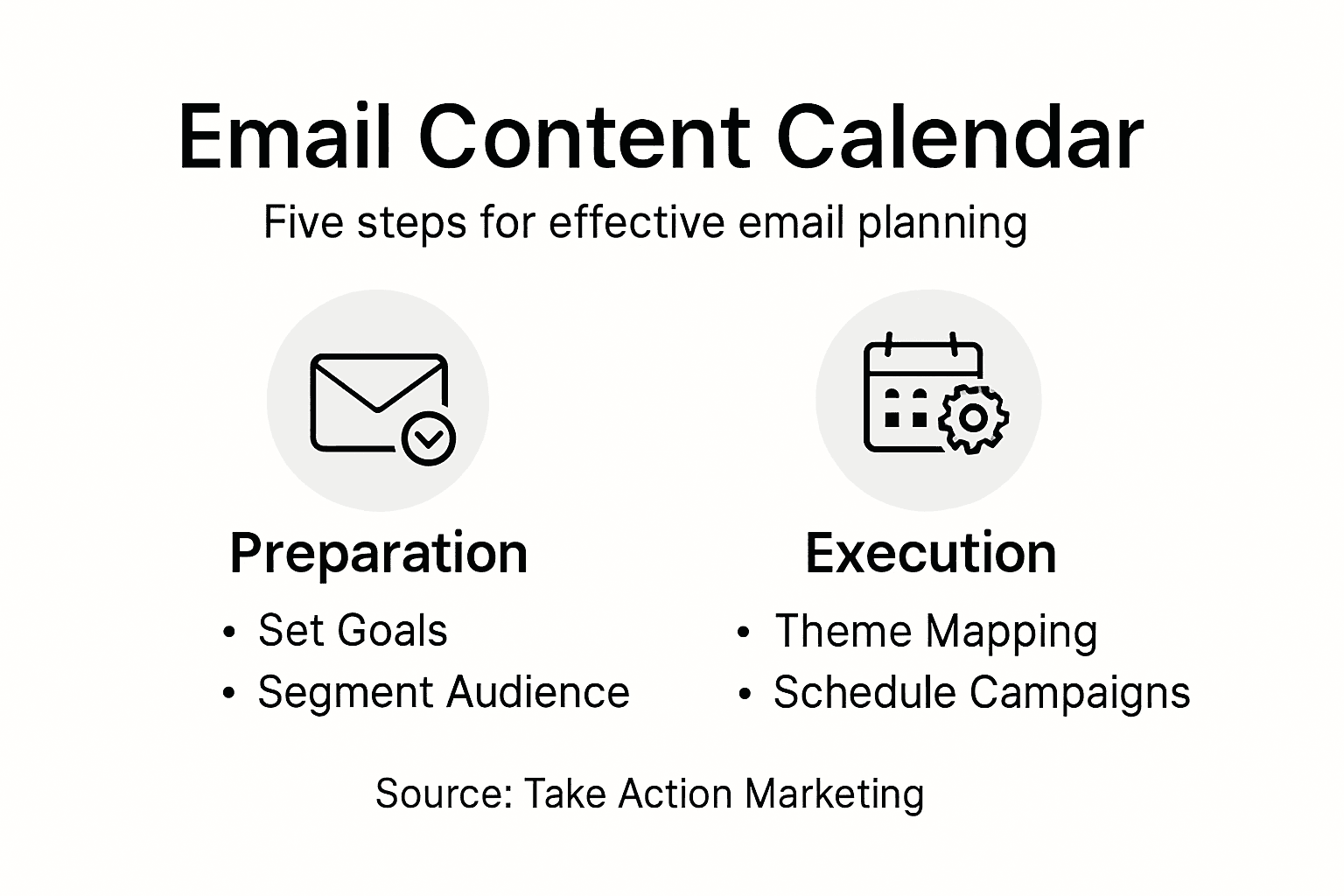
Step 4: Schedule campaigns using your content calendar tool
Transforming your carefully crafted email strategy into a structured timeline requires selecting and mastering the right content calendar tool. The goal is to create a visual roadmap that tracks every email campaign with precision and strategic intent.

Content calendar creation involves more than just plugging in dates. Select a tool that offers flexibility, visibility, and integration capabilities. Consider these essential features when choosing your content calendar platform:
Use this reference to compare essential features of popular content calendar tools:
| Feature | Strategic Value | Typical Tool Example |
|---|---|---|
| Cloud accessibility | Enables remote teamwork | Google Calendar |
| Drag-and-drop scheduling | Simplifies campaign planning | Trello |
| Color-coded tracking | Visualizes campaign categories | Asana |
| Integration options | Syncs email platforms | ClickUp, Monday.com |
| Performance dashboard | Monitors campaign success | HubSpot, Mailchimp |
- Cloud accessibility for team collaboration
- Drag-and-drop scheduling functionality
- Color-coded campaign tracking
- Campaign performance dashboard
- Integration with email marketing platforms
- Automated reminder and notification systems
Plan your campaign workflow by breaking down each email campaign into distinct stages. This might include ideation, content creation, design, approval, scheduling, and performance tracking. Establish clear timelines for each stage to maintain consistency and prevent last-minute rushes.
Implementing a structured content calendar can improve marketing team productivity by up to 40% and reduce campaign deployment errors.
Pro tip: Schedule buffer time between campaign stages to accommodate unexpected revisions and maintain a stress-free workflow.
Step 5: Review and refine your calendar for optimal results
Regularly assessing and optimizing your email marketing content calendar is crucial for maintaining its effectiveness and alignment with your evolving business goals. A dynamic approach ensures your strategy remains responsive and impactful.
Work life balance tips can help you establish a consistent review process that doesn’t overwhelm your team. Implement a systematic evaluation method by conducting monthly or quarterly content calendar audits that focus on these key performance indicators:
- Email engagement rates
- Conversion metrics
- Subscriber growth
- Click-through percentages
- Segment-specific performance
- Revenue generated per campaign
Track performance trends across your email campaigns to identify what resonates with your audience. Look for patterns in subject lines, content types, send times, and segmentation strategies that consistently deliver strong results. Be prepared to pivot and adjust your calendar based on these insights.
Continuous refinement of your email marketing strategy can lead to a 25% improvement in overall campaign effectiveness.
Pro tip: Create a standardized review template that makes performance analysis quick and objective, reducing the time spent on manual assessment.
Elevate Your Email Marketing with a Strategic Content Calendar
Creating a content calendar for email marketing is essential to achieve your goals like increasing engagement, recovering abandoned carts, and driving repeat purchases. If you struggle with planning audience segments, mapping key dates, or organizing content pillars, you are not alone. These challenges can lead to missed opportunities and low campaign performance. That is where a dedicated partner can transform your email strategy by combining automation, segmentation, and personalized campaigns tailored specifically to your brand’s unique needs.
Take Action is specialized in helping ecommerce brands harness the power of Klaviyo automation to turn email into a reliable growth channel. Our data-driven, conversion-focused approach ensures your content calendar is perfectly executed with precision and insights that boost open rates, clicks, and revenue. With expert guidance on campaign strategy, email flows such as welcome sequences and abandoned cart recovery, and long-term scaling partnerships, we help you automate customer retention while preserving your brand voice and aesthetic.
Ready to connect the dots from your content calendar to measurable growth?
Discover how a strategic content calendar paired with expert execution can redefine your email marketing success. Visit Take Action now to learn how our tailored services help you build automated, engaging campaigns. Start turning your email marketing calendar into a powerful growth engine today.
Frequently Asked Questions
What are the essential steps to create a content calendar for effective email marketing?
To create a content calendar for effective email marketing, start by assessing your marketing goals and audience segments. Next, collect key dates and campaign opportunities that align with your objectives, then map out your email themes and content pillars. Finally, schedule your campaigns in a digital calendar tool and review your calendar regularly for optimal results.
How can I define my email marketing goals?
To define your email marketing goals, consider what you want to achieve with your campaigns, such as increasing sales, improving customer engagement, or recovering abandoned carts. Clearly outline each objective to guide your content and segmentation strategies. Set measurable targets to track progress over time.
What types of audience segments should I focus on for my email marketing campaigns?
Focus on audience segments based on purchase history, demographics, engagement levels, and specific product interests. This allows you to tailor your email content to meet the unique needs of each group, increasing the effectiveness of your campaigns. Evaluate your customer data regularly to refine these segments.
How often should I review and refine my content calendar?
You should review and refine your content calendar at least once a month or quarterly. Regular assessments of performance metrics will help you identify trends and adjust your strategy accordingly. Aim to improve your campaign effectiveness by 25% through continuous optimization.
What features should I look for in a content calendar tool?
Look for features like cloud accessibility for team collaboration, drag-and-drop scheduling for easy campaign planning, and color-coded tracking for visual organization. Ensure the tool integrates with your email marketing platforms to streamline your workflow. Prioritize tools that offer a performance dashboard to monitor your campaign success.
How can I ensure my email content is timely and relevant?
To ensure your email content is timely and relevant, systematically map out key dates and events that can inspire your campaigns. Create a master calendar that identifies cultural holidays, industry events, and customer milestones, and plan your content in advance to take advantage of these opportunities.
Recommended
- Master Content Calendar Creation for eCommerce Success | Take Action Blog | Take Action
- 10 Creative Content Ideas for Newsletters to Boost Engagement | Take Action Blog | Take Action
- How to Repurpose Content for Ecommerce Email Success | Take Action Blog | Take Action
- Content Marketing Explained: Strategies, Types, and Impact | Take Action Blog | Take Action