

How to Repurpose Content for Ecommerce Email Success
Over eighty percent of American marketers say they struggle to turn their best content into effective emails that drive real engagement. In a crowded digital world, email remains a powerful tool, but finding the right mix of strategy and personalization is not always simple. This step by step guide gives you a clear method for turning high performing content into results driven email campaigns, helping you reach your audience with messages they actually want to read.
Table of Contents
- Step 1: Identify High-Performing Content Assets
- Step 2: Segment Audiences For Targeted Messaging
- Step 3: Adapt Content For Email Campaigns
- Step 4: Automate Repurposed Content Distribution
- Step 5: Measure Engagement And Optimize Results
Quick Summary
| Key Point | Explanation |
|---|---|
| 1. Identify high-performing content | Analyze metrics like engagement and conversion to select valuable existing content for repurposing into email campaigns. |
| 2. Segment audiences effectively | Use customer data dimensions to create tailored audience segments for precise, targeted email messaging. |
| 3. Adapt existing content for emails | Transform high-performing content into engaging email formats using concise language and compelling designs. |
| 4. Automate distribution for efficiency | Use automation tools to streamline content distribution, ensuring timely delivery to relevant audience segments. |
| 5. Measure and optimize engagement | Continuously analyze key performance metrics to refine emails and enhance audience engagement strategies. |
Step 1: Identify High-Performing Content Assets
Repurposing content starts with understanding which of your existing materials have already demonstrated significant audience engagement and impact. This process involves strategically analyzing your content library to pinpoint assets that can be transformed into compelling email marketing materials.
To effectively identify high-performing content, dive into your analytics platforms and examine metrics like page views, time on page, social shares, and conversion rates. Analyzing citation patterns can help organizations recognize influential content assets, providing deeper insights into what resonates with your audience. Look for blog posts, videos, infographics, or podcast episodes that have generated substantial interaction.
Pro tip: Pay special attention to content that addresses specific customer pain points or provides unique solutions. These pieces often translate seamlessly into email campaign materials. When evaluating potential assets, consider not just quantitative metrics but also qualitative factors like audience comments, customer feedback, and alignment with your current marketing objectives.
As you compile your list of top-performing content, prepare to reimagine these assets for email marketing. The next step involves strategically transforming these proven materials into email friendly formats that will capture your subscribers’ attention.
Step 2: Segment Audiences for Targeted Messaging
Successful email marketing hinges on delivering the right message to the right people at the right time. Audience segmentation enables you to divide people into subgroups based on specific criteria, allowing for more personalized and effective communication strategies.
To effectively segment your audience, start by examining multiple dimensions of customer data. Psychographic segmentation helps categorize consumers based on psychological characteristics, which goes beyond basic demographics to understand deeper motivations and behaviors. Consider factors like purchase history, engagement levels, browsing behavior, geographic location, and customer lifecycle stage. For ecommerce brands, this might mean creating segments such as first-time buyers, repeat customers, high-value purchasers, and customers who have abandoned their carts.
Pro tip: Leverage your email marketing platform’s segmentation tools to create dynamic groups that automatically update based on customer interactions. This approach ensures your messaging remains relevant and timely. By crafting targeted emails that speak directly to each segment’s unique characteristics and needs, you’ll significantly improve open rates, click-through rates, and overall email marketing performance.
As you refine your audience segments, prepare to develop tailored content that resonates with each group’s specific interests and preferences. The next step involves designing email campaigns that speak directly to these carefully defined audience segments.
Step 3: Adapt Content for Email Campaigns
Transforming your existing high-performing content into compelling email campaigns requires strategic thinking and creative adaptation. Repurposing content allows you to maintain effectiveness while reaching audiences through different channels, ensuring your valuable insights continue to engage potential customers.
Start by breaking down your original content into digestible email friendly formats. This might mean converting a comprehensive blog post into a series of short, punchy paragraphs, extracting key statistics or insights, or creating visually appealing graphics that highlight the most important information. Qualitative evaluation of content assets helps identify pieces that can be successfully adapted for email marketing, focusing on material that provides genuine value to your specific audience segments.

Pro tip: Always optimize your adapted content for email consumption by using clear, concise language, adding compelling subject lines, and incorporating strong calls to action. Consider the visual hierarchy of your email design, ensuring that the most critical information stands out and encourages recipients to click through to the full content.
As you refine your adapted content, prepare to design email campaigns that seamlessly integrate these repurposed assets while maintaining your brand voice and driving meaningful engagement.
Step 4: Automate Repurposed Content Distribution
Streamlining your content distribution process requires strategic automation that ensures your repurposed materials reach the right audience at the optimal time. Advanced stochastic optimization algorithms can enhance targeted message delivery, allowing ecommerce brands to maximize their email marketing efficiency.
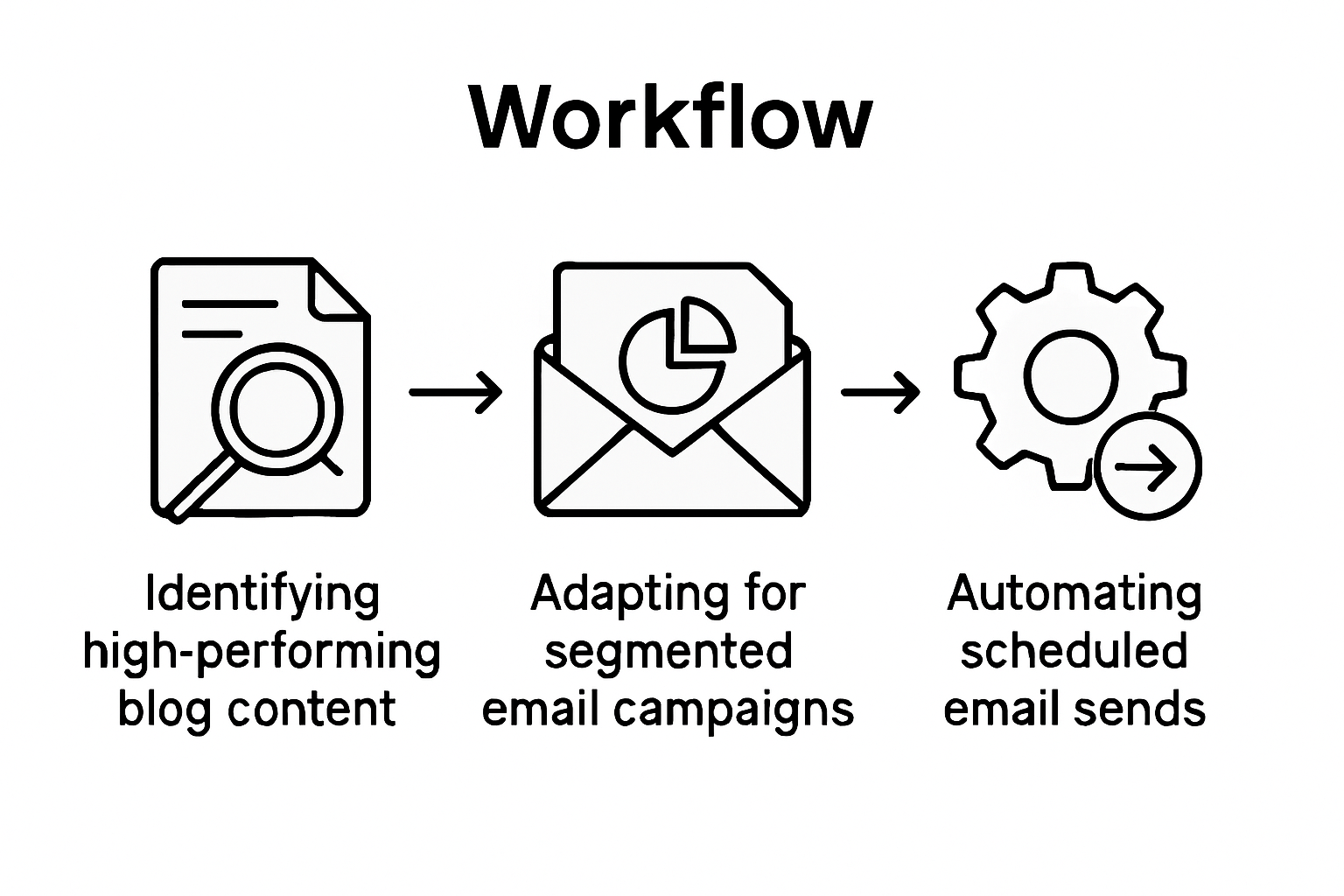
Leverage your email marketing platform’s automation tools to create intelligent workflows that systematically distribute your repurposed content. Market segmentation techniques can dramatically improve campaign performance through precise audience targeting, enabling you to schedule and send emails based on specific customer behaviors, engagement levels, and segment characteristics. Set up triggered email sequences that automatically send tailored content to different audience groups, ensuring each subscriber receives the most relevant repurposed materials at the most opportune moments.
Pro tip: Implement a content distribution matrix that maps your repurposed assets to specific audience segments, creating a dynamic system that continuously adapts and learns from customer interactions. Monitor key performance metrics like open rates, click through rates, and conversion data to refine your automated distribution strategy over time.
As you establish your automated content distribution system, prepare to track and analyze its performance, making data driven adjustments that continually improve your email marketing effectiveness.
Step 5: Measure Engagement and Optimize Results
Tracking the performance of your repurposed email content requires a comprehensive approach to understanding audience interactions and response patterns. Analyzing audience characteristics provides crucial insights into communication strategy effectiveness, enabling you to continuously refine your email marketing approach.
Focus on key performance indicators that reveal the true impact of your repurposed content. Examine metrics such as open rates, click through rates, conversion rates, time spent reading, and scroll depth to gauge how different audience segments respond to your adapted materials. Use advanced email marketing analytics tools to create detailed reports that break down engagement by segment, content type, and sending time. This granular approach allows you to identify which repurposed content resonates most strongly with specific audience groups.
Pro tip: Implement a systematic testing framework that continuously experiments with different content formats, subject lines, and sending times. Create A/B testing scenarios that compare variations of your repurposed content to understand exactly what drives maximum engagement. Regularly review your performance data and be prepared to make swift, data driven adjustments to your email marketing strategy.
As you develop a deeper understanding of your audience engagement, you will transform your email marketing from a static communication channel into a dynamic, responsive marketing tool that consistently delivers value to your subscribers.
Unlock the Full Potential of Your Ecommerce Email Content
Struggling to turn your high-performing content into email campaigns that truly engage your audience Can you confidently segment and automate your email efforts to maximize revenue and retention The article “How to Repurpose Content for Ecommerce Email Success” highlights key challenges like audience segmentation, content adaptation, and automation that a lot of ecommerce brands face today. You need to transform your best assets into personalized, well-timed email workflows that drive action and build lasting customer relationships.
At Take Action, we specialize in exactly that Our expert team combines human insight with AI-driven solutions to automate your email flows including welcome series, abandoned cart recovery, and post-purchase engagement. We focus on increasing open and click rates by applying strategic segmentation and optimizing your content for maximum impact. This means turning your proven content into dynamic campaigns that hit the right inbox at the right moment.
Why wait to elevate your email marketing When you partner with Take Action you gain a dedicated ally to scale your brand’s email revenue through data-driven automation and targeted messaging adapted from your existing content. Take the next step to grow smarter Explore our solutions and see how we can help you automate retention, recover abandoned carts, and diversify your revenue streams today.
Frequently Asked Questions
What is the first step to repurpose content for ecommerce email marketing?
To successfully repurpose content, start by identifying high-performing assets from your existing materials. Analyze your content library for metrics like page views and conversion rates to discover which pieces resonate most with your audience.
How can I segment my audience for better email targeting?
Segmenting your audience involves dividing them into subgroups based on specific criteria like purchasing behavior and engagement levels. This allows you to create tailored email campaigns that speak directly to each group’s unique interests, potentially improving your open and click-through rates by up to 30%.
What content formats work best for email campaigns?
Content formats like short paragraphs, key statistics, and visually appealing graphics are ideal for email campaigns. Adapt your existing high-performing content into these formats to ensure it’s engaging and easy to consume for your subscribers.
How can I automate the distribution of repurposed content?
You can automate your content distribution by using workflows in your email marketing platform to deliver tailored emails based on customer behavior. Set up triggered sequences that send specific repurposed materials automatically, ensuring timely contact with your audience as they interact with your brand.
What metrics should I track to measure engagement with my email content?
Focus on key performance indicators like open rates, click-through rates, and conversion rates to gauge your email content’s success. Regularly review these metrics to refine your approach and make data-driven adjustments that can enhance your overall email marketing effectiveness.
How often should I test different email content formats?
Implement a systematic testing framework to experiment with various email formats and subject lines on a regular basis. Aim for A/B testing scenarios every month to identify which content combinations resonate best with your audience, enabling continuous improvement over time.
Recommended
- 7 Best Blog Post Formats for Ecommerce Success | Take Action Blog | Take Action
- Master Content Calendar Creation for eCommerce Success | Take Action Blog | Take Action
- 7 Essential Ecommerce Marketing Strategies for Growth | Take Action Blog | Take Action
- How to Plan Content for Scalable Ecommerce Growth | Take Action Blog | Take Action