

Importance of Customer Testimonials for Ecommerce Brands
Over 90 percent of American shoppers trust customer testimonials as much as recommendations from friends. In the crowded world of ecommerce, these authentic experiences play a vital role in helping buyers sort through endless product claims and find real value. By exploring what makes American testimonials so persuasive, you will see how honest customer feedback can transform hesitation into confident purchasing decisions.
Table of Contents
- Defining Customer Testimonials In Ecommerce
- Types Of Customer Testimonials That Drive Trust
- How Testimonials Influence Conversion Rates
- Best Practices For Collecting Effective Testimonials
- Avoiding Common Pitfalls With Testimonials
Key Takeaways
| Point | Details |
|---|---|
| Importance of Customer Testimonials | Testimonials provide authentic feedback that enhances trust and influences purchasing decisions in Ecommerce. |
| Types of Effective Testimonials | Video testimonials are highly impactful, while written testimonials provide detailed insights; both serve specific purposes. |
| Conversion Rate Influence | Well-curated testimonials can significantly increase conversion rates, making strategic placement vital. |
| Best Practices for Collection | A systematic approach to collecting testimonials, including verification and diversity, enhances credibility and buyer confidence. |
Defining Customer Testimonials in Ecommerce
Customer testimonials represent direct, authentic feedback from consumers who have purchased and experienced a product or service within an ecommerce environment. These powerful communication tools serve as critical social proof mechanisms that help potential buyers understand the real-world performance and value of products. When a customer shares their genuine experience, they provide insights that go far beyond traditional marketing messaging.
In the digital marketplace, online testimonials are the most convenient source for customers to confirm product quality and features, significantly influencing purchasing decisions. These firsthand accounts help build trust by presenting unfiltered perspectives from actual users. Unlike branded content, testimonials carry inherent credibility because they emerge from real consumer experiences, making them tremendously influential in the pre-purchase decision-making process.
Key Characteristics of Effective Ecommerce Testimonials:
- Authentic and specific descriptions of product usage
- Detailed explanation of benefits or problem-solving capabilities
- Personal narratives that potential buyers can relate to
- Verifiable details that demonstrate genuine customer experience
- Clear representation of product’s real-world performance
Customer testimonials function as social proof, transforming abstract product descriptions into tangible, relatable experiences. These communications represent consumer experiences where individuals share their perceptions after using a product or service, providing potential buyers with crucial insights that help reduce purchase uncertainty.
Pro Tip: Content Collection Strategy: Develop a systematic approach to collecting customer testimonials by creating post-purchase surveys, offering incentives for detailed feedback, and making the submission process as simple and straightforward as possible.
Understanding these testimonials requires recognizing their dual purpose: they serve both informational and emotional functions, helping potential customers visualize themselves successfully using a product while simultaneously building brand trust through transparent, user-generated content.
Types of Customer Testimonials That Drive Trust
Customer testimonials are not a one-size-fits-all communication tool, but rather a diverse array of authentic experiences that can powerfully influence purchasing decisions. Understanding the various types of testimonials helps ecommerce brands strategically leverage these trust-building narratives to connect with potential customers.
Video Testimonials offer the most immersive and compelling form of customer feedback. Seeing a real person share their genuine experience creates an emotional connection that written text cannot replicate. These visual narratives allow potential buyers to see authentic reactions, body language, and hear the enthusiasm in a customer’s voice.
Written Testimonials remain a cornerstone of social proof, with two-sided argumentation significantly increasing their perceived helpfulness and trustworthiness. By presenting balanced perspectives that highlight both positive aspects and potential limitations, these testimonials appear more credible and authentic. Potential customers appreciate honest, nuanced feedback that doesn’t seem overly scripted or manipulated.
Key Types of Customer Testimonials:
- Video testimonials with real customer experiences
- Written reviews with detailed product insights
- Case studies demonstrating tangible problem-solving
- Social media recommendations and comments
- Influencer endorsements with personal stories
Credible online reviews characterized by authenticity and informativeness are crucial in driving customer engagement and trust. These testimonials go beyond simple praise, providing potential buyers with actionable insights about product performance, durability, and real-world application.
Pro Tip: Strategic Collection Method: Design a multi-channel testimonial collection approach that makes providing feedback easy, incentivizes detailed responses, and allows customers to share their experiences through their preferred communication method.
Successful ecommerce brands understand that diverse, authentic testimonials create a comprehensive narrative that helps potential customers visualize their own potential success with a product, ultimately reducing purchase hesitation and building brand credibility.
Here’s a comparison of different testimonial types and their unique strengths in ecommerce:
| Testimonial Type | Emotional Impact | Information Depth | Best Use Case |
|---|---|---|---|
| Video Testimonial | Very High | Moderate to Detailed | Building strong emotional trust |
| Written Testimonial | Moderate | Highly Detailed | Clarifying product pros and cons |
| Case Study | Moderate | Deep and Analytical | Demonstrating complex solutions |
| Social Media Review | Moderate to High | Brief but Current | Showcasing up-to-date user feedback |
| Influencer Endorsement | High | Varies | Amplifying reach with personal touch |
How Testimonials Influence Conversion Rates
Testimonials are far more than simple customer feedback; they are powerful psychological triggers that directly impact purchasing decisions and conversion rates. These authentic narratives bridge the gap between potential customers’ uncertainties and the confidence needed to complete a transaction, transforming browsing into buying.
The psychological mechanism behind testimonial effectiveness is rooted in social proof and trust-building. Customer testimonials play a crucial role in influencing consumer purchase decisions, with customer engagement acting as a critical mediating variable. When potential buyers see genuine experiences from others, they perceive reduced risk and increased reliability of the product or service.
Key Conversion Impact Factors of Testimonials:
- Reduce purchase anxiety
- Provide third-party validation
- Demonstrate real-world product performance
- Create emotional connection with potential buyers
- Address potential customer objections proactively
Testimonials significantly influence repurchase intentions by enhancing brand trust, which translates directly into improved conversion rates. Ecommerce brands that strategically showcase diverse, authentic customer experiences can see substantial increases in their sales performance. The more relatable and specific the testimonial, the more powerful its potential to convert hesitant browsers into committed buyers.
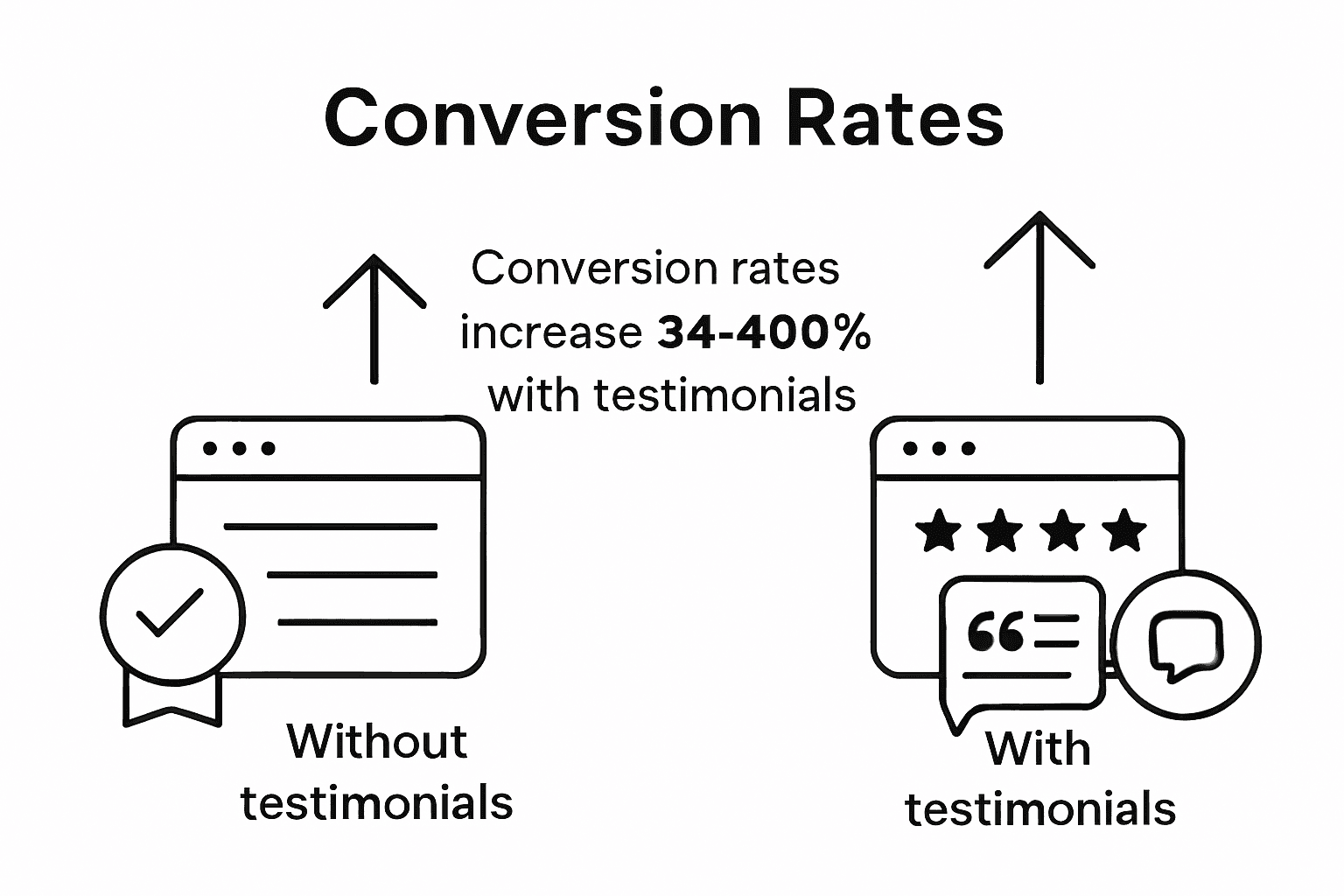
Statistically, websites featuring customer testimonials can experience conversion rate increases ranging from 34% to 400%, depending on implementation quality. This dramatic range underscores the transformative potential of well-curated customer feedback.
Pro Tip: Strategic Placement Method: Position testimonials strategically near key conversion points like product descriptions, pricing sections, and checkout pages to maximize their psychological impact and reduce last-minute purchase hesitations.
Successful ecommerce brands understand that testimonials are not just decorative elements but sophisticated conversion optimization tools that speak directly to potential customers’ deepest purchasing motivations.
Best Practices for Collecting Effective Testimonials
Collecting impactful customer testimonials requires a strategic, nuanced approach that goes beyond simply asking customers to share their experiences. The most successful ecommerce brands understand that effective testimonial collection is an art form that balances authenticity, depth, and strategic presentation.
To collect effective testimonials, ecommerce platforms should focus on facilitating credible and useful reviews that significantly enhance customer trust and engagement. This means creating an environment that encourages honest, detailed feedback while making the submission process as seamless and inviting as possible.
Key Strategies for Testimonial Collection:
- Create multiple easy submission channels
- Provide clear guidelines for feedback
- Offer incentives for detailed responses
- Implement user-friendly review platforms
- Follow up with personalized feedback requests
Encouraging two-sided argumentation in customer reviews, where both positive and negative aspects are presented, can increase their perceived helpfulness. This approach demonstrates transparency and builds deeper trust with potential customers. By allowing customers to share nuanced experiences, brands create more credible and compelling narratives that resonate with potential buyers.
Technological tools can streamline the testimonial collection process, with automated email campaigns, targeted survey links, and integrated review platforms making it easier than ever to gather meaningful customer insights. The key is creating a frictionless experience that makes customers feel valued and heard.

Pro Tip: Feedback Amplification Method: Design a multi-stage testimonial request process that begins immediately after purchase, follows up after product usage, and provides multiple submission formats to accommodate different customer preferences.
Successful testimonial collection is not about volume, but about capturing authentic, detailed experiences that genuinely reflect the value of your product and connect emotionally with potential customers.
Avoiding Common Pitfalls With Testimonials
Testimonial strategies can quickly backfire when brands fail to understand the nuanced dynamics of authentic customer feedback. Navigating the complex landscape of customer reviews requires a sophisticated approach that balances transparency, credibility, and strategic presentation.
Overly emotional language in testimonials can significantly diminish their perceived helpfulness and trustworthiness, creating a counterproductive effect that undermines the intended goal of building consumer confidence. Brands must carefully curate testimonials to maintain a balanced, authentic tone that resonates with potential customers without seeming manipulative or exaggerated.
Critical Testimonial Pitfalls to Avoid:
- Using generic or obviously fabricated reviews
- Displaying only overwhelmingly positive feedback
- Neglecting to verify the authenticity of testimonials
- Overlooking diversity in customer experiences
- Failing to update testimonials regularly
Ensuring the credibility and usefulness of online reviews is crucial for maintaining customer trust and engagement. This means implementing rigorous verification processes, encouraging genuine feedback, and presenting a transparent representation of customer experiences that reflects the true value of your product or service.
Modern consumers are sophisticated and can quickly detect inauthentic or manipulated testimonials. Sophisticated brands understand that true social proof comes from genuine, nuanced feedback that demonstrates both the strengths and potential limitations of their offerings.
Pro Tip: Authenticity Verification Method: Implement a multi-step verification process for testimonials, including contact verification, purchase history confirmation, and optional video or detailed written submissions to ensure genuine, credible customer feedback.
Successful testimonial strategies transform customer experiences into powerful, trustworthy narratives that speak directly to potential buyers’ needs and concerns.
This summary highlights common testimonial mistakes and effective ways to avoid them:
| Common Mistake | Negative Outcome | How to Avoid |
|---|---|---|
| Generic or fake reviews | Loss of trust, customer churn | Use verification and authenticity |
| Overly positive only feedback | Perceived manipulation | Display balanced reviews |
| Lack of testimonial diversity | Missed market segments | Feature diverse experiences |
| Outdated testimonials | Appearing out of touch | Regularly update with new content |
| No verification process | Risk of false information | Implement multi-step verification |
Elevate Your Ecommerce Growth with Authentic Customer Testimonials and Strategic Email Marketing
Customer testimonials are essential for building trust and increasing conversions as demonstrated in the article. Yet collecting, verifying, and leveraging these genuine customer voices can be challenging. Many ecommerce brands struggle to turn authentic feedback into lasting relationships and increased revenue. Take Action specializes in bridging this gap by seamlessly integrating customer testimonials into automated, targeted email campaigns that amplify social proof and drive engagement.
By combining the power of user-generated content with data-driven email marketing strategies you can reduce purchase anxiety, nurture customer loyalty, and recover abandoned carts with precision. Our expertise in Klaviyo automations allows your brand to turn post-purchase testimonials into ongoing personalized conversations that boost lifetime value and brand trust.
Experience the impact of aligning your testimonials with conversion-focused emails crafted by specialists who understand ecommerce psychology and technology.

Harness the proven power of customer testimonials alongside expert email marketing. Visit Take Action today to discover how you can automate testimonial-driven campaigns and scale your ecommerce brand faster. Get started now and transform social proof into measurable growth through automation, segmentation, and strategic flows designed uniquely for your business. Learn more at Take Action and step into a new era of ecommerce success.
Frequently Asked Questions
What are customer testimonials in ecommerce?
Customer testimonials are authentic feedback from consumers who have purchased and used a product or service, providing insights into the product’s performance and value.
How do testimonials influence purchasing decisions?
Testimonials provide social proof that helps reduce potential buyers’ anxiety, create trust, and demonstrate real-world product benefits, ultimately influencing their decision to purchase.
What types of testimonials are most effective for ecommerce brands?
Effective testimonial types include video testimonials, written reviews, case studies, social media comments, and influencer endorsements, each offering unique strengths in building trust and authenticity.
What are some best practices for collecting customer testimonials?
Best practices include creating easy submission channels, offering incentives for detailed feedback, encouraging balanced reviews that present both pros and cons, and using technological tools to streamline the process.
Recommended
- What Is Social Proof? Complete Guide for Ecommerce Brands | Take Action Blog | Take Action
- Complete Guide to the Importance of Social Proof | Take Action Blog | Take Action
- Mastering Brand Positioning Strategies for Ecommerce Success | Take Action Blog | Take Action
- Business Ethics: Why They Matter for Ecommerce Brands | Take Action Blog | Take Action