

Improving Customer Engagement with Klaviyo Automation
Every ecommerce team faces the challenge of turning abandoned carts into loyal customers without overwhelming inboxes or missing key moments. Targeted messaging becomes possible when you use audience segmentation to understand the unique traits and behaviors within your customer base. With Klaviyo’s automation and AI-driven personalization, you can deliver communications that feel timely and relevant, driving engagement and conversion while building lasting relationships.
Table of Contents
- Step 1: Assess Audience Segments For Targeted Messaging
- Step 2: Implement Automated Flows For Key Touchpoints
- Step 3: Personalize Campaign Content To Boost Relevance
- Step 4: Optimize Timing And Frequency For Maximum Impact
- Step 5: Analyze Engagement Metrics And Refine Strategies
Quick Summary
| Key Insight | Explanation |
|---|---|
| 1. Understand Your Audience Segments | Break down customer data into distinct groups to deliver targeted messaging that resonates effectively. |
| 2. Utilize Automated Customer Flows | Implement automated email and SMS sequences for key touchpoints to enhance engagement and foster relationships. |
| 3. Personalize Your Campaign Content | Move beyond basic personalization by using data-driven insights to create relevant communications tailored to individual preferences. |
| 4. Optimize Messaging Timing and Frequency | Analyze customer behaviors to determine ideal times and frequency for sending messages, preventing fatigue and boosting engagement. |
| 5. Regularly Analyze Engagement Metrics | Monitor and assess key performance metrics to refine strategies, ensuring continual improvement in marketing effectiveness. |
Step 1: Assess Audience Segments for Targeted Messaging
Understanding your customer base through strategic audience segmentation allows you to craft personalized marketing messages that resonate more effectively. By breaking down your customer database into meaningful groups, you can deliver targeted communications that drive engagement and conversion.
To assess audience segments effectively, start by collecting and analyzing comprehensive customer data across multiple dimensions:
-
Demographic Information
- Age ranges
- Geographic location
- Income levels
- Education background
-
Behavioral Characteristics
- Purchase history
- Website interaction patterns
- Email engagement rates
- Product preferences
-
Psychographic Attributes
- Personal interests
- Lifestyle choices
- Values and motivations
- Brand affinities
Using a structured customer segmentation methodology helps transform raw data into actionable insights. The goal is to create distinct customer profiles that enable hyper-personalized messaging strategies.
Here’s a quick overview of key segmentation types and their marketing value:
| Segmentation Type | Main Focus | Marketing Value |
|---|---|---|
| Demographic | Age, location, income | Tailors messaging by group |
| Behavioral | Actions, responses | Increases relevance |
| Psychographic | Interests, values, lifestyle | Deepens emotional appeal |
Effective segmentation turns generic marketing into precisely targeted communication that speaks directly to each customer’s unique needs and preferences.
Pro tip: Regularly update your segmentation models as customer behaviors evolve, ensuring your targeted messaging remains relevant and impactful.
Step 2: Implement Automated Flows for Key Touchpoints
Klaviyo provides powerful tools to create automated email and SMS journeys that transform how you engage with customers across critical touchpoints. By strategically designing automated workflows, you can deliver personalized messages that connect with customers at exactly the right moment.
To implement effective automated flows, focus on these essential customer journey stages:
-
Welcome Series
- First purchase acknowledgment
- Brand introduction
- Initial value proposition
-
Abandoned Cart Flows
- Immediate cart abandonment reminder
- Follow-up incentive emails
- Urgency-driven messaging
-
Post-Purchase Sequences
- Order confirmation
- Shipping updates
- Product usage tips
- Feedback request
Leveraging AI-driven multichannel marketing allows you to optimize communication across email, SMS, and other platforms. This approach ensures your messaging remains consistent and contextually relevant.
Successful automated flows transform transactional interactions into meaningful customer relationships that drive long-term engagement and loyalty.
Pro tip: Continuously test and refine your automated flows by analyzing performance metrics and customer interaction data to maintain peak relevance and effectiveness.
Step 3: Personalize Campaign Content to Boost Relevance
Mastering email personalization strategies transforms generic communications into targeted experiences that deeply resonate with your customers. By moving beyond basic name insertions, you can create sophisticated campaigns that speak directly to individual customer needs and preferences.
To effectively personalize your campaign content, leverage these key approaches:
-
Data-Driven Segmentation
- Analyze purchase history
- Track website interactions
- Monitor engagement patterns
- Identify customer lifecycle stages
-
Dynamic Content Customization
- Product recommendations
- Behavior-based messaging
- Timing optimization
- Contextual incentives
-
Advanced Personalization Techniques
- AI-powered content generation
- Predictive behavior modeling
- Individualized journey mapping
- Preference-based communication
Klaviyo’s AI-powered personalization tools enable you to create hyper-relevant messages that adapt to each customer’s unique profile and interactions.
Truly personalized marketing transforms transactional communications into meaningful conversations that build lasting customer relationships.
Pro tip: Regularly audit and refresh your personalization strategy by analyzing engagement metrics and customer feedback to ensure continued relevance and effectiveness.
Step 4: Optimize Timing and Frequency for Maximum Impact
Deliver marketing messages with precision by implementing AI-driven sending strategies that dynamically adapt to each customer’s unique engagement patterns. Understanding and respecting your audience’s communication preferences is key to maintaining high engagement and preventing message fatigue.
To optimize your campaign timing and frequency, consider these strategic approaches:
-
Data-Driven Timing
- Analyze individual customer open times
- Track historical engagement patterns
- Identify peak responsiveness windows
- Adjust send times dynamically
-
Frequency Management
- Set communication limits per customer
- Implement smart sending rules
- Monitor unsubscribe and engagement rates
- Balance communication frequency
-
Channel Optimization
- Determine preferred communication channels
- Distribute messages across email, SMS, push notifications
- Respect individual communication preferences
- Use multi-channel approach strategically
The smart sending capabilities help prevent over-communication by intelligently spacing and targeting your marketing messages.
Effective message timing transforms routine communications into anticipated, welcome interactions that customers actually look forward to receiving.
Pro tip: Conduct periodic customer preference surveys to validate and refine your timing and frequency strategies, ensuring your communication remains relevant and welcomed.
Step 5: Analyze Engagement Metrics and Refine Strategies
Transform your marketing performance by mastering real-time analytics and insights that reveal the true impact of your email campaigns. Understanding these metrics allows you to make data-driven decisions that continuously improve customer engagement and marketing effectiveness.
To systematically analyze and refine your marketing strategies, focus on these critical metrics:
-
Performance Baseline Metrics
- Open rates
- Click-through rates
- Conversion percentages
- Revenue per campaign
-
Behavioral Tracking
- Customer interaction patterns
- Segment response rates
- Time spent engaging
- Progression through marketing funnel
-
Advanced Refinement Techniques
- A/B testing email variants
- Comparative campaign analysis
- Audience segment performance
- Multi-touch attribution tracking
The comprehensive reporting dashboards enable you to dig deep into campaign performance, uncovering nuanced insights that drive strategic improvements.
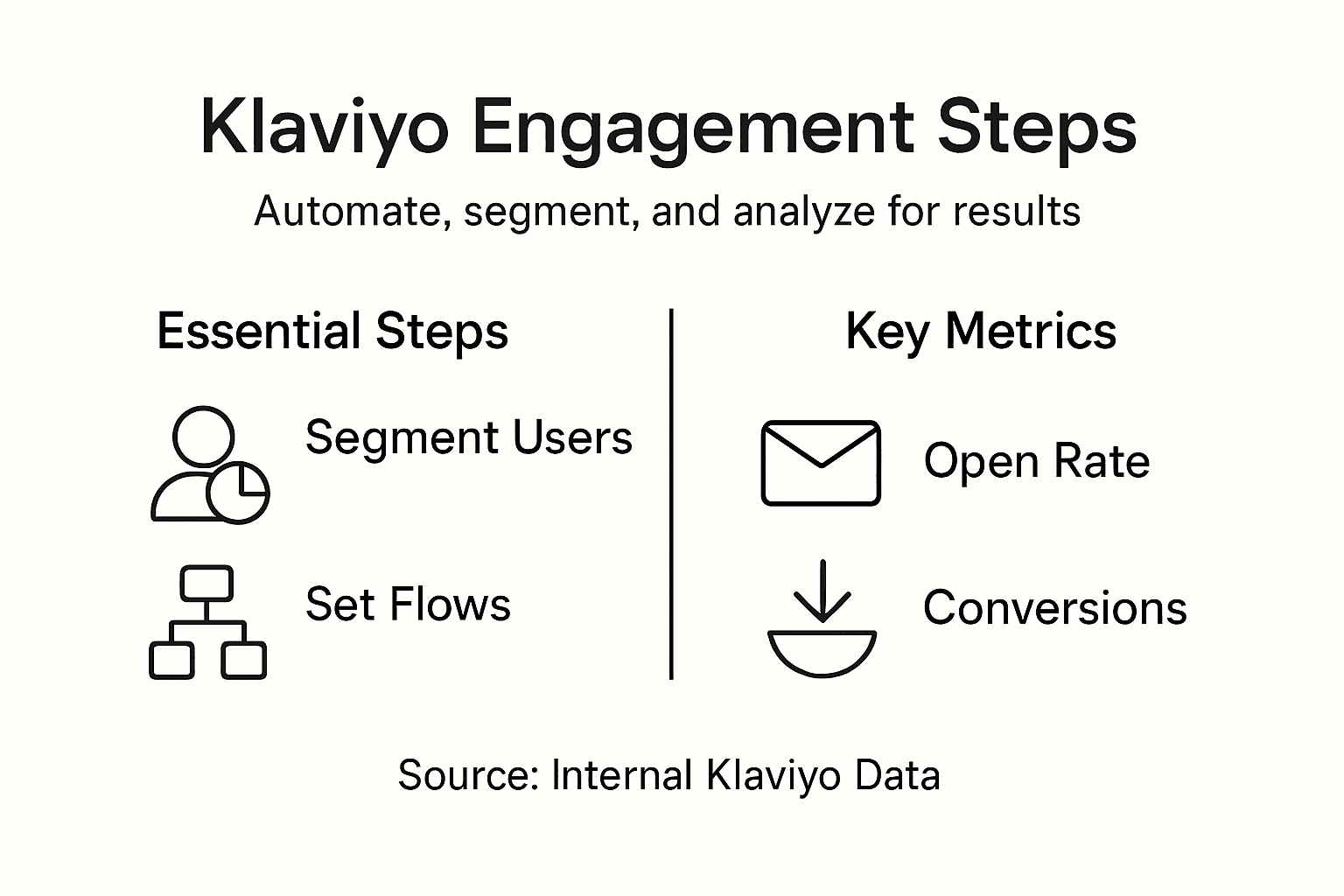
This table summarizes five essential marketing metrics and their strategic importance:
| Metric | What It Measures | Why It Matters |
|---|---|---|
| Open Rate | Email opens | Gauges subject line value |
| Click-Through Rate | Link clicks | Tracks message engagement |
| Conversion Rate | Purchases/actions | Shows campaign impact |
| Revenue per Campaign | Earnings per blast | Identifies profit drivers |
| Unsubscribe Rate | Opt-outs | Signals engagement issues |
Metrics are not just numbers - they are the storytellers of your marketing journey, revealing opportunities for growth and connection.
Pro tip: Schedule monthly metric review sessions to identify trends, celebrate successes, and rapidly iterate on strategies that are not delivering optimal results.
Unlock the True Power of Klaviyo Automation for Your Brand
The challenge of transforming raw data into personalized, high-impact customer engagement requires more than just the right tools. This article guides you through crucial steps like audience segmentation, AI-driven timing, and dynamic content personalization, all vital to overcoming common pain points such as low open rates, abandoned carts, and inconsistent messaging. If you are seeking proven strategies to automate welcome series, abandoned cart flows, and post-purchase sequences that really convert, it is time to elevate your approach.
At Take Action, we specialize in turning Klaviyo’s automation features into a powerful growth engine. Our team blends human expertise with AI-driven insights to craft strategic campaigns that align perfectly with your brand voice. Experience increased open rates, recover more abandoned carts, and boost your revenue beyond paid ads through expertly crafted automations tailored for ecommerce and online brands.
Ready to transform your email marketing into a primary growth channel and build lasting customer loyalty?
Boost your results now by partnering with Take Action. Discover how our automated email flow setups and data-driven retention strategies deliver measurable growth tailored to your unique audience. Visit us today and start turning engagement challenges into opportunity.
Frequently Asked Questions
How can I use Klaviyo automation to improve customer engagement?
You can use Klaviyo automation by creating targeted email and SMS workflows that align with key customer touchpoints in their journey. Start by setting up flows for welcome messages, abandoned cart reminders, and post-purchase follow-ups to enhance customer interaction and retention.
What types of customer segments should I focus on for targeted messaging in Klaviyo?
Focus on demographic segments, behavioral characteristics, and psychographic attributes to drive engagement. Collect data on age, location, purchase history, and interests to create tailored messages that resonate with your specific audience.
How do I personalize my campaigns using Klaviyo’s automation features?
Personalize your campaigns by leveraging data-driven insights to customize content based on individual customer behaviors and preferences. For example, use their dynamic content features to recommend products aligned with previous purchases or site interactions.
What metrics should I analyze to measure the effectiveness of my Klaviyo automation?
You should analyze open rates, click-through rates, and conversion percentages to gauge your campaigns’ success. Regularly review these metrics to identify trends and make adjustments that can enhance customer engagement within 30 days.
How often should I update my Klaviyo automated workflows?
You should review and update your Klaviyo automated workflows regularly, ideally every month, to account for changing customer behaviors and preferences. This practice helps ensure your messaging remains relevant and impactful over time.
Recommended
- How to Boost Engagement with Klaviyo Email Automation | Take Action Blog | Take Action
- Understanding the Benefits of Email Automation | Take Action Blog | Take Action
- 7 Examples of Automated Workflows for Ecommerce Brands | Take Action Blog | Take Action
- Marketing Automation Checklist for Ecommerce Growth Success | Take Action Blog | Take Action
- Klaviyo transactional emails - pros and cons