

Landing Page vs Homepage – Boost Email Conversions
More than 60 percent of American ecommerce brands miss conversion opportunities by confusing landing pages with homepages. For marketers using Klaviyo, this difference can make or break an email campaign. Knowing when to send customers to a distraction-free landing page versus a broad homepage shapes every click, lead, and sale. This guide reveals how refining your page strategies transforms subscriber engagement and customer retention across global markets.
Table of Contents
- Defining Landing Page And Homepage Roles
- Distinguishing Features And Best Uses
- Optimizing For Email Conversion And Retention
- Common Mistakes And What To Avoid
- Selecting The Right Page For Your Strategy
Key Takeaways
| Point | Details |
|---|---|
| Homepage Functionality | Homepages provide an overview of a brand and facilitate user navigation through multiple sections and links. |
| Landing Page Precision | Landing pages are crafted with a single goal in mind, focusing on specific campaigns to drive conversions. |
| Email Marketing Optimization | Dedicated landing pages for email campaigns ensure consistent messaging and improve conversion rates by maintaining focus. |
| Strategic Page Selection | Selecting the right page type—homepage or landing page—depends on campaign goals and user intent for maximum effectiveness. |
Defining Landing Page and Homepage Roles
Understanding the fundamental differences between landing pages and homepages is crucial for ecommerce brands seeking to optimize their digital marketing strategies. While both serve important roles in digital communication, they function quite differently. A homepage acts as a comprehensive digital storefront, introducing your brand, offering broad navigation, and providing an overview of your business. In contrast, a landing page is a targeted conversion tool designed with a singular, laser-focused objective.
Homepages typically feature multiple sections, navigation menus, and links to various areas of your website. They welcome visitors, showcase your brand identity, and help users explore different sections of your site. Professional marketing analyses reveal that homepages aim to facilitate broad user discovery and engagement, presenting a holistic view of your brand’s offerings, values, and potential customer pathways.
Landing pages, however, operate with surgical precision. These standalone web pages are meticulously crafted for specific marketing campaigns, each designed to drive a single, clear action. Whether capturing email addresses, promoting a special offer, or encouraging product purchases, landing pages eliminate distractions and focus entirely on converting visitors. Unlike homepages with multiple navigation options, landing pages typically feature minimal design elements, a compelling headline, concise benefits, social proof, and a prominent call-to-action button.
Pro Tip for Ecommerce Success: Develop distinct landing pages for each marketing campaign, ensuring each page has a crystal-clear objective and removes all unnecessary navigation elements that might dilute your conversion potential.
Here’s a streamlined comparison of landing pages versus homepages for ecommerce brands:
| Aspect | Homepage | Landing Page |
|---|---|---|
| Primary Objective | Brand overview, navigation hub | Single conversion goal |
| User Navigation | Multiple paths and options | Minimal, focused navigation |
| Ideal Use Case | Brand introduction, product discovery | Campaign-driven conversions |
| Design Complexity | Rich, multi-section layout | Simplified, distraction-free |
| Measurement Focus | Engagement, time on site | Immediate conversions (signups, sales) |
Distinguishing Features and Best Uses
Understanding the nuanced characteristics of landing pages and homepages is critical for developing targeted digital marketing strategies that drive conversions. Structural differences between these page types reveal distinct strategic purposes, with each serving unique roles in guiding potential customers through their purchasing journey. Homepages function as comprehensive digital gateways, providing visitors with a broad overview of a brand’s identity, offerings, and potential exploration paths.
Landing pages, in contrast, are precision-engineered conversion machines. Advanced marketing research demonstrates that these specialized pages are designed with singular, laser-focused objectives. They typically feature streamlined designs with minimal navigation options, compelling headlines, concise value propositions, and prominent call-to-action buttons. Where homepages invite exploration, landing pages demand specific user actions—whether signing up for a newsletter, downloading a resource, or completing a purchase.

The strategic deployment of these page types depends on specific marketing goals. Homepages excel at brand storytelling, providing comprehensive navigation, and introducing a company’s full range of products or services. They serve as digital headquarters, offering multiple entry points and encouraging user discovery. Landing pages, however, shine in targeted campaigns, paid advertising, email marketing initiatives, and scenarios requiring immediate, measurable conversions. By removing distractions and focusing user attention, landing pages can dramatically improve campaign performance and conversion rates.
Pro Tip for Marketing Precision: Create dedicated landing pages for each unique marketing campaign, ensuring a 1:1 match between ad messaging and page content to maximize conversion potential and reduce bounce rates.
Optimizing for Email Conversion and Retention
Dedicated landing pages can dramatically transform email marketing performance, offering a precise mechanism for capturing and converting subscriber interest. Unlike generic homepages that provide broad information, email-specific landing pages create a seamless transition from email communication to conversion opportunity. Email retention becomes significantly more achievable when marketers design pages that maintain consistent messaging, visual design, and a singular, compelling call-to-action.
The strategic alignment between email content and landing page design is crucial for maintaining subscriber engagement. Sophisticated email marketing approaches emphasize creating landing pages that mirror the email’s promise, aesthetic, and emotional trigger. This consistency reduces cognitive friction, helping subscribers feel they’ve landed exactly where they expected. Key elements include matching headline language, using similar color schemes, and ensuring the value proposition presented in the email is immediately reinforced on the landing page.
Successful email-driven landing pages require meticulous attention to conversion psychology. They must eliminate potential distractions, streamline the user journey, and provide clear, immediate value. This means removing complex navigation, focusing on a single conversion goal, and using persuasive elements like social proof, urgent messaging, and simplified form designs. By treating each landing page as a precision instrument for capturing subscriber interest, brands can transform email interactions from passive communication into active conversion opportunities.
Pro Tip for Email Marketing Success: Develop a 1:1 matching strategy between your email campaigns and landing pages, ensuring that every visual and textual element creates a consistent, trust-building experience that guides subscribers seamlessly toward your desired conversion action.
Common Mistakes and What to Avoid
Landing pages frequently suffer from design and strategic errors that dramatically undermine their conversion potential. Conversion killers emerge through multiple channels—cluttered layouts, overwhelming navigation, and misaligned messaging that confuse and frustrate potential subscribers. The most critical mistake ecommerce brands make is treating landing pages like traditional websites, loading them with unnecessary information that dilutes the primary conversion goal.
Multiple conversion-blocking mistakes can emerge in page design and functionality. Comprehensive landing page research reveals that excessive form fields, unclear value propositions, and inconsistent messaging significantly reduce user engagement. Brands often overwhelm potential subscribers by requesting too much information upfront, using complex language, or failing to immediately communicate the unique benefit of their offer. Mobile responsiveness remains another critical area where many landing pages fail, with slow-loading or poorly formatted mobile experiences instantly driving away potential conversions.
Effective landing pages require ruthless simplification and laser-focused design. This means eliminating distractions, using clear and compelling headlines, incorporating social proof elements, and ensuring a direct, frictionless path to conversion. Visual hierarchy becomes crucial—guiding the user’s eye toward the primary call-to-action, using strategic whitespace, and creating a design that feels both professional and approachable. Successful landing pages anticipate and address potential user hesitations through strategic placement of testimonials, security indicators, and concise benefit statements that build immediate trust.
Pro Tip for Landing Page Optimization: Conduct regular A/B testing on your landing pages, focusing on single variable changes like headline wording, button color, or form length to incrementally improve conversion rates and understand your specific audience’s preferences.
Selecting the Right Page for Your Strategy
Strategic page selection is critical for maximizing marketing campaign effectiveness, demanding a nuanced understanding of specific campaign objectives and user intent. Campaign goals fundamentally drive the decision between landing pages and homepages, with each serving distinctly different strategic purposes. Ecommerce brands must carefully evaluate their current marketing priorities, audience readiness, and desired user actions to determine the most appropriate page type.
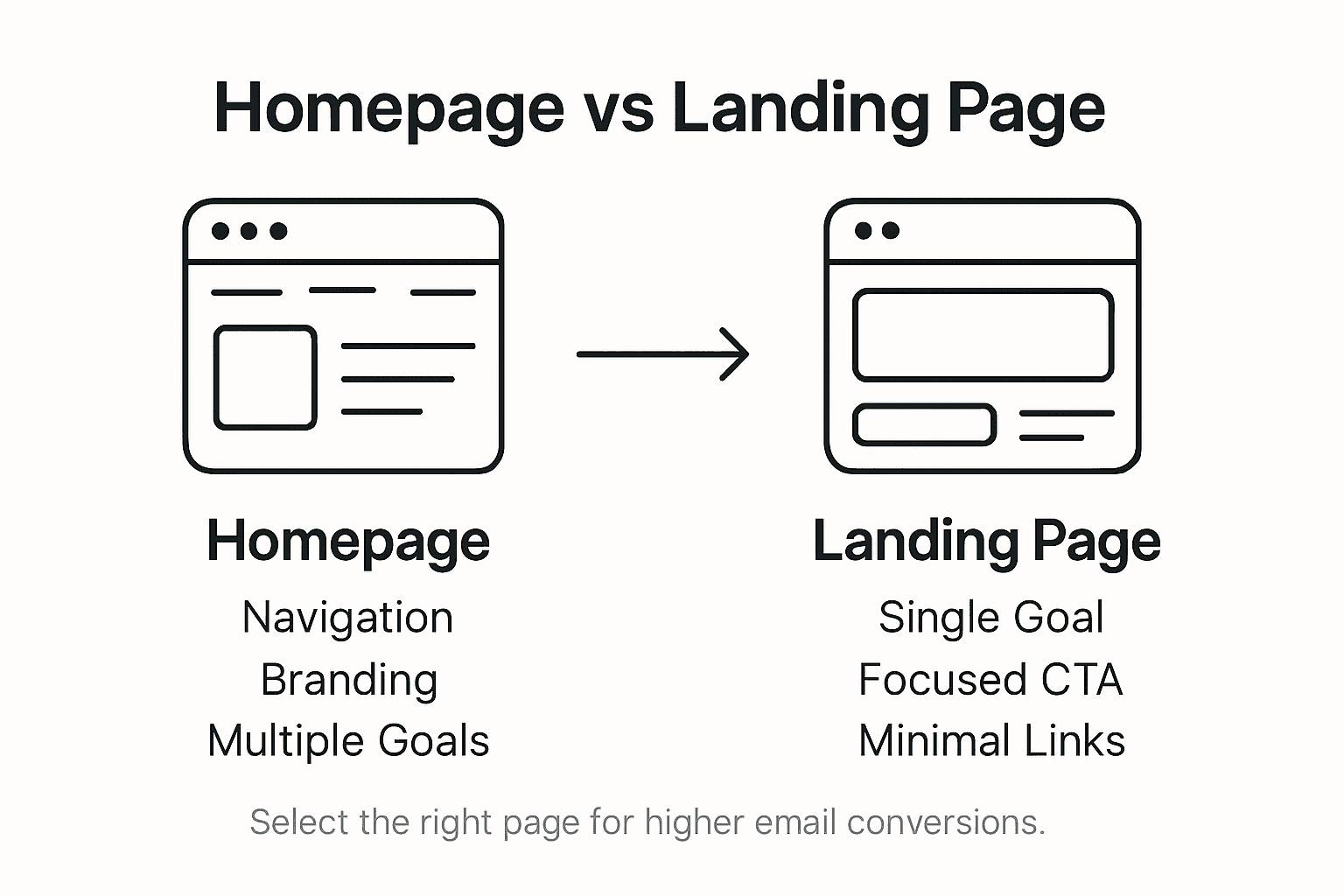
The selection process involves analyzing multiple strategic dimensions. Professional marketing frameworks recommend choosing landing pages for targeted, conversion-specific scenarios such as email campaigns, paid advertisements, or specific product promotions. These pages excel when the goal is immediate action—capturing emails, driving product purchases, or generating specific lead interactions. Homepages, conversely, work best for broader brand discovery, providing comprehensive navigation, and supporting users at various stages of their exploration and decision-making journey.
Successful page selection requires understanding the nuanced differences in user psychology and engagement. Landing pages thrive on specificity and urgency, using focused messaging, minimal navigation, and clear calls-to-action that guide users toward a single objective. Homepages operate as multifunctional digital entry points, accommodating diverse user intents, offering broader context about the brand, and supporting exploration across different product lines or service offerings. The key is matching page design precisely with the intended user experience and specific campaign objectives.
Pro Tip for Strategic Page Selection: Create a decision matrix that maps your specific campaign goals, target audience characteristics, and desired user actions to help quickly determine whether a landing page or homepage will most effectively drive your marketing objectives.
Use this reference table to quickly identify when to select a homepage or a landing page based on campaign goals:
| Campaign Scenario | Best Page Type | Rationale |
|---|---|---|
| New product launch | Landing page | Drives direct purchase or signup |
| Paid advertising (PPC, social) | Landing page | Matches ad message, boosts conversion |
| Brand awareness or storytelling | Homepage | Showcases identity and offerings |
| Seasonal promotions (short-term) | Landing page | Focused, time-bound conversion aim |
| Re-engagement of lapsed visitors | Landing page | Directs to a targeted offer |
| General customer education | Homepage | Provides full context and resources |
Unlock Higher Email Conversions with Precision Landing Pages
The article highlights a common challenge for ecommerce brands: boosting email conversions by designing focused landing pages that align perfectly with campaign messaging. You understand the frustration of generic homepages failing to create a seamless transition from email to action. The key is crafting landing pages that eliminate distractions, maintain consistent messaging, and drive immediate conversions—exactly what every growing brand needs in a competitive marketplace.
At Take Action, we specialize in translating these proven principles into actionable email marketing strategies that maximize your revenue and customer retention. Our expertise in Klaviyo automation lets us create data-driven, conversion-focused landing pages paired with strategic email flows like abandoned cart recovery and post-purchase engagement. By leveraging automation and segmentation, we help brands build emotional connections while streamlining the customer journey from inbox to purchase.
Ready to transform your email campaigns into powerful conversion engines
Explore how Take Action’s landing page optimization and email marketing services can elevate your ecommerce brand. Don’t leave conversions to chance. Visit https://take-action.agency now and start turning your email list into your most profitable growth channel.
Frequently Asked Questions
What is the main difference between a landing page and a homepage?
A landing page is designed for a specific conversion goal with minimal navigation, while a homepage provides a broad overview of the brand and multiple navigation options.
How can landing pages improve email conversion rates?
Landing pages tailored for email campaigns create a seamless transition between the email’s message and the conversion action, enhancing user engagement and driving specific actions like sign-ups or purchases.
What are some common mistakes to avoid when creating a landing page?
Common mistakes include cluttered designs, excessive navigation, unclear value propositions, and failing to align the messaging with the campaign goal, all of which can detract from the user experience and reduce conversions.
When should I use a landing page instead of a homepage?
Use a landing page for specific marketing campaigns, such as paid advertising or email promotions, where the goal is to drive immediate action. A homepage works best for broad brand engagement and exploration.
Recommended
- How to Increase Conversions: Boost Sales with Proven Tactics | Take Action Blog | Take Action
- 7 Conversion Rate Optimization Tips for Ecommerce Success | Take Action Blog | Take Action
- 7 Creative Newsletter Design Inspiration Ideas for Brands | Take Action Blog | Take Action
- Take Action — Email Marketing & Retention Agency