

List Segmentation: Boosting Ecommerce Email Engagement
Most American ecommerce brands see up to 760 percent higher revenue from segmented campaigns compared to general blasts. With so many choices in the inbox, customers expect messages tailored to their interests and behaviors. Effective list segmentation unlocks relevant email automation in Klaviyo, helping marketing managers build stronger retention while engaging the right people with each message.
Table of Contents
- What Is List Segmentation in Ecommerce
- Types of List Segmentation Strategies
- How Segmentation Improves Email Performance
- Real-World Use Cases in Klaviyo
- Common Mistakes and How to Avoid Them
Key Takeaways
| Point | Details |
|---|---|
| Segmented Email Campaigns | List segmentation allows ecommerce brands to create personalized marketing strategies that resonate with customer behaviors and preferences. |
| Types of Segmentation | Strategies include demographic, geographic, psychographic, and behavioral segmentation, each providing unique insights into customer engagement. |
| Impact on Performance | Effective segmentation can significantly enhance email performance, leading to higher open rates, click-through rates, and conversion rates. |
| Avoid Common Mistakes | Brands must ensure that segments are meaningful and actionable, avoiding over-fragmentation or reliance on superficial data. |
What Is List Segmentation in Ecommerce
List segmentation is a strategic marketing approach that transforms how ecommerce businesses connect with their customers by dividing their email lists into distinct groups based on specific characteristics and behaviors. Unlike traditional mass email campaigns, market segmentation allows brands to craft highly personalized communication strategies that resonate with individual customer needs.
At its core, list segmentation involves breaking down your customer database into meaningful subgroups defined by shared attributes such as purchase history, engagement levels, demographic information, or specific browsing behaviors. This granular approach enables marketers to design targeted campaigns that speak directly to each segment’s unique preferences. For instance, a segment of first-time buyers might receive different messaging compared to loyal repeat customers who have made multiple purchases.
The power of list segmentation lies in its ability to dramatically improve email marketing performance. By splitting potential customers into precise groups, brands can dramatically increase relevance, which translates into higher open rates, increased click-through rates, and ultimately, improved conversion rates. Ecommerce businesses using sophisticated segmentation strategies can expect more engaged customers who feel understood and valued.
Pro tip: Start by analyzing your existing customer data and create 3-5 initial segments based on clear, measurable criteria like total spend, purchase frequency, or product categories to begin your segmentation journey.
Types of List Segmentation Strategies
List segmentation strategies in ecommerce are diverse and powerful, allowing businesses to slice their customer base into meaningful groups that enable hyper-targeted marketing approaches. Market segmentation frameworks typically break down into four primary categories: demographic, geographic, psychographic, and behavioral segmentation, each offering unique insights into customer preferences and potential engagement strategies.
Demographic segmentation involves categorizing customers based on measurable population characteristics such as age, gender, income level, education, and occupation. This approach helps brands craft messaging that resonates with specific population segments. Geographic segmentation takes this further by dividing customers according to location data, enabling businesses to customize campaigns based on regional preferences, climate considerations, or local buying patterns. Psychographic segmentation delves deeper into customer motivations, segmenting audiences by lifestyle, values, personality traits, and interests - providing a more nuanced understanding of potential customer behavior.

Behavioral segmentation represents perhaps the most actionable approach for ecommerce businesses, focusing on actual customer actions and interactions with a brand. This strategy identifies distinct consumer groups based on purchase history, website browsing behavior, email engagement levels, product preferences, and loyalty status. By tracking metrics like frequency of purchases, average order value, and product categories explored, marketers can create highly personalized communication strategies that speak directly to each segment’s unique characteristics and potential future actions.
Pro tip: Begin your segmentation journey by analyzing your existing customer data and prioritizing 2-3 behavioral segments that show the most significant revenue potential or engagement differences.
The following table summarizes the main segmentation strategies and their business benefits:
| Segmentation Type | Key Characteristics | Typical Data Used | Impact on Marketing |
|---|---|---|---|
| Demographic | Age, gender, income | Census, surveys | Tailors messaging |
| Geographic | Location, region | Address, IP data | Localizes offers |
| Psychographic | Values, lifestyle | Surveys, analytics | Inspires engagement |
| Behavioral | Purchase behavior | Transaction logs | Drives conversions |
How Segmentation Improves Email Performance
Email segmentation represents a transformative strategy for ecommerce businesses seeking to dramatically enhance their marketing performance. Personalized content strategies enable brands to move beyond generic mass messaging, creating targeted communications that speak directly to specific customer groups with unprecedented precision and relevance.
The performance improvements from effective segmentation are substantial and measurable. By dividing email lists into granular segments, businesses can create highly targeted messages that resonate with specific customer characteristics, resulting in significant gains across key email marketing metrics. Open rates typically increase as recipients receive content more closely aligned with their interests, while click-through rates surge when messaging feels personally crafted. This targeted approach reduces message fatigue and minimizes the risk of customers feeling bombarded with irrelevant marketing communications.
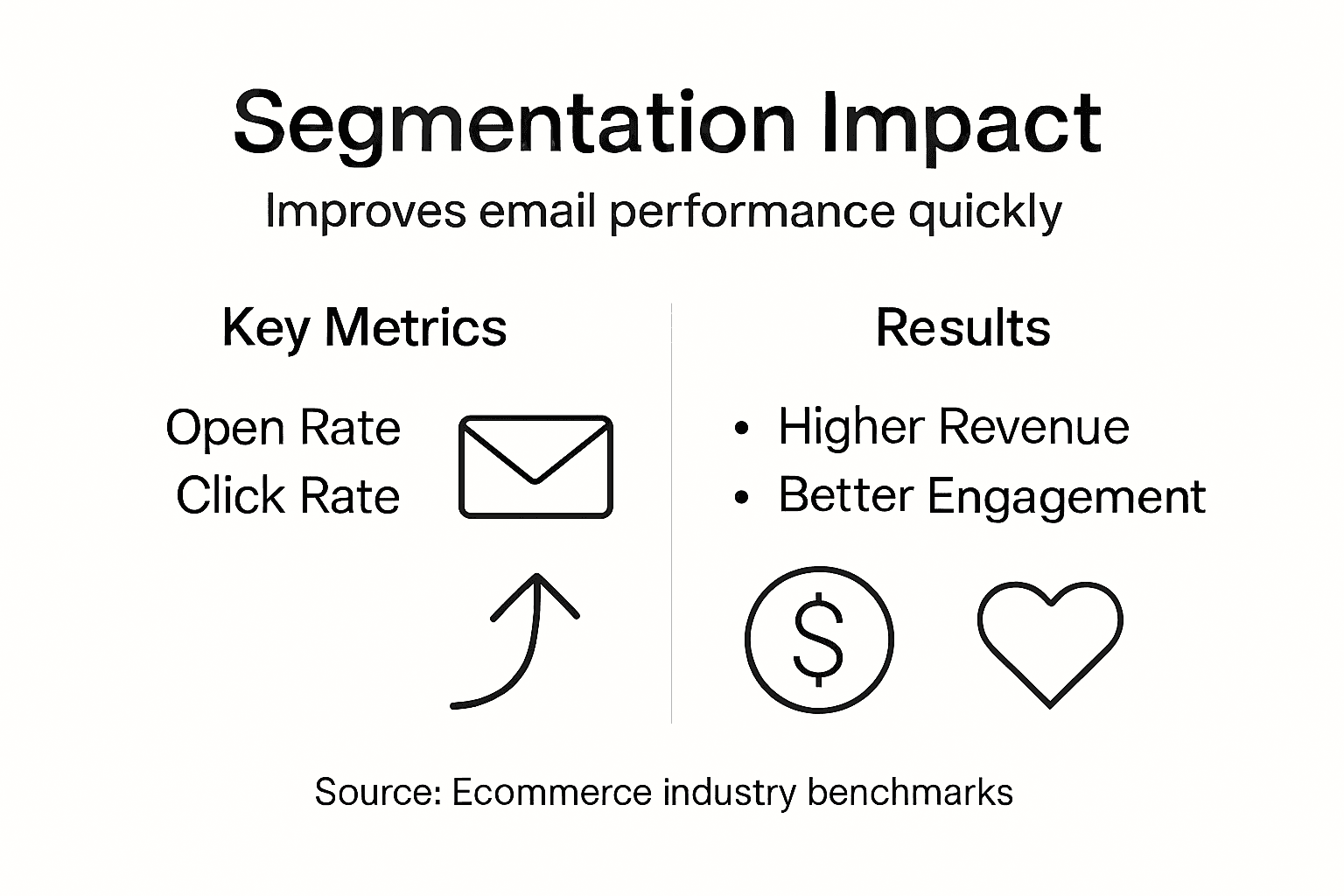
Moreover, customer segmentation techniques allow marketers to optimize their email strategies by understanding and anticipating customer behaviors. Sophisticated segmentation enables precise targeting based on purchase history, engagement levels, demographic information, and predicted future actions. This approach transforms email from a generic broadcast medium into a personalized communication channel, driving higher conversion rates and improving overall customer experience. Ecommerce brands can strategically design email campaigns that not only capture attention but also guide customers through carefully crafted conversion paths tailored to their specific needs and preferences.
Pro tip: Start with three core segmentation criteria and gradually refine your approach by tracking key performance metrics like open rates, click-through rates, and conversion values for each customer segment.
Here’s how segmentation can affect key email marketing metrics:
| Metric | Without Segmentation | With Segmentation |
|---|---|---|
| Open Rate | Lower, generic | Higher, targeted |
| Click-Through | Unfocused content | Relevant links |
| Conversion Rate | Limited engagement | Improved sales |
Real-World Use Cases in Klaviyo
Marketing automation platforms offer ecommerce businesses unprecedented opportunities to create targeted, personalized customer experiences. Klaviyo stands out by providing sophisticated tools that transform raw customer data into actionable marketing strategies, enabling brands to design intelligent, responsive communication flows that adapt to individual customer behaviors and preferences.
Specific use cases demonstrate the platform’s power across multiple marketing scenarios. Abandoned cart recovery represents a prime example, where Klaviyo automatically triggers personalized email sequences when customers leave items unpurchased. These automated flows can include dynamic product recommendations, time-sensitive discounts, and urgency-driven messaging that dramatically increase conversion rates. Another powerful application involves creating post-purchase email sequences that nurture customer relationships, providing shipping updates, product care instructions, and complementary product suggestions based on the customer’s specific purchase history.
Beyond standard email automation, AI-powered marketing solutions enable sophisticated cross-channel campaigns that seamlessly integrate email, SMS, and push notifications. Ecommerce brands can now develop intricate customer journeys that respond in real-time to individual interactions, tracking revenue attribution and optimizing message timing across multiple platforms. This approach allows businesses to create highly personalized experiences that feel intuitive and contextually relevant to each customer, moving far beyond traditional batch-and-blast marketing strategies.
Pro tip: Implement a progressive segmentation strategy by starting with 3-5 core segments and gradually refining your approach based on actual engagement and conversion data.
Common Mistakes and How to Avoid Them
Segmentation strategies can quickly become ineffective when marketers fall into common traps that undermine their potential impact. Market segmentation studies reveal that many ecommerce brands struggle with creating meaningful customer segments that drive real business value. The most critical error is treating segmentation as a purely data-driven exercise, overlooking the nuanced human behaviors and motivations that truly distinguish different customer groups.
One fundamental mistake involves over-fragmenting customer lists into segments so narrow that they become statistically insignificant or operationally impractical. Brands often create microsegments that look impressive on spreadsheets but prove impossible to target effectively. Another frequent misstep is selecting segmentation variables that fail to capture meaningful differences in customer behavior. For example, using demographic data alone without considering purchasing patterns or engagement levels can lead to superficial and ineffective segmentation strategies.
Segmentation and targeting principles emphasize the importance of creating segments that are not just data-driven but strategically aligned with business objectives. Successful segmentation requires a holistic approach that combines quantitative data with qualitative insights. This means going beyond simple categorization and developing a deep understanding of customer motivations, pain points, and potential value. Ecommerce brands must continuously validate and refine their segments, ensuring they remain relevant and actionable as customer behaviors evolve.
Pro tip: Conduct quarterly segment performance reviews to assess the effectiveness of your current segmentation strategy, looking beyond basic metrics to understand the actual revenue and engagement impact of each customer group.
Transform Your Ecommerce Email Marketing with Precision Segmentation
Understanding how list segmentation elevates your email marketing is just the first step. The real challenge is turning those insights into actionable strategies that boost engagement, recover abandoned carts, and grow revenue consistently. If you find yourself struggling with over-complicated segments or lack the time to analyze data deeply, you are not alone. Ecommerce brands need a partner who can translate behavioral, demographic, and psychographic data into personalized automated flows that get results.
At Take Action, we specialize in helping ecommerce businesses leverage Klaviyo’s powerful automation tools combined with advanced segmentation techniques to increase open rates, click-throughs, and conversions. Our expert team crafts email flows like welcome series, abandoned cart recovery, and post-purchase sequences tailored to your unique customer segments so you can turn email into your primary growth engine with confidence.
Elevate your email marketing without the guesswork by teaming up with professionals who understand the nuances of behavioral segmentation and personalized automation. Start creating data-driven campaigns that speak directly to your customers’ needs and drive measurable results now.
Explore how our campaign strategy and automation expertise can revitalize your email performance.
Ready to turn segmentation insights into higher revenue and deeper customer connections Let Take Action be your dedicated partner in scaling your ecommerce brand with powerful Klaviyo automations. Connect with us today and start maximizing your email marketing potential.
Frequently Asked Questions
What is list segmentation in ecommerce?
List segmentation in ecommerce is a marketing strategy that divides a customer database into distinct groups based on specific characteristics and behaviors, allowing businesses to craft personalized communication strategies that resonate with individual customer needs.
What are the different types of list segmentation strategies?
The main types of list segmentation strategies include demographic, geographic, psychographic, and behavioral segmentation. Each type offers unique insights into customer preferences and behaviors, enabling more targeted marketing campaigns.
How does segmentation improve email marketing performance?
Segmentation improves email marketing performance by creating targeted messages that resonate with specific customer groups, leading to higher open rates, increased click-through rates, and better conversion rates because customers receive content that aligns with their interests.
What common mistakes should be avoided in email segmentation?
Common mistakes in email segmentation include over-fragmenting customer lists into impractically small groups and using irrelevant segmentation variables. It’s important to ensure segments are meaningful and strategically aligned with business objectives.
Recommended
- Benefits of Segmentation: Unlocking Email Revenue Growth | Take Action Blog | Take Action
- Why Segmentation Matters for Ecommerce Growth | Take Action Blog | Take Action
- Email Segmentation Strategies for Ecommerce Growth | Take Action Blog | Take Action
- Increasing Website Visibility for Ecommerce Growth Success | Take Action Blog | Take Action
- 7 Smart Ways to Find Affordable Evening Dresses Online - DressMeUpNY
- How to Shop Men’s Fashion Online for the Best Styles – Vellure Homme