

Marketing Automation Checklist for Ecommerce Growth Success
Nearly 90 percent of ecommerce businesses struggle to turn scattered data into actionable insights. Without a clear process for connecting customer information, marketing efforts often fall flat or miss key opportunities. By learning how to audit, segment, automate, personalize, and optimize your data and messaging, you can transform routine email campaigns into powerful engines for engagement and sales that truly stand out in a crowded market.
Table of Contents
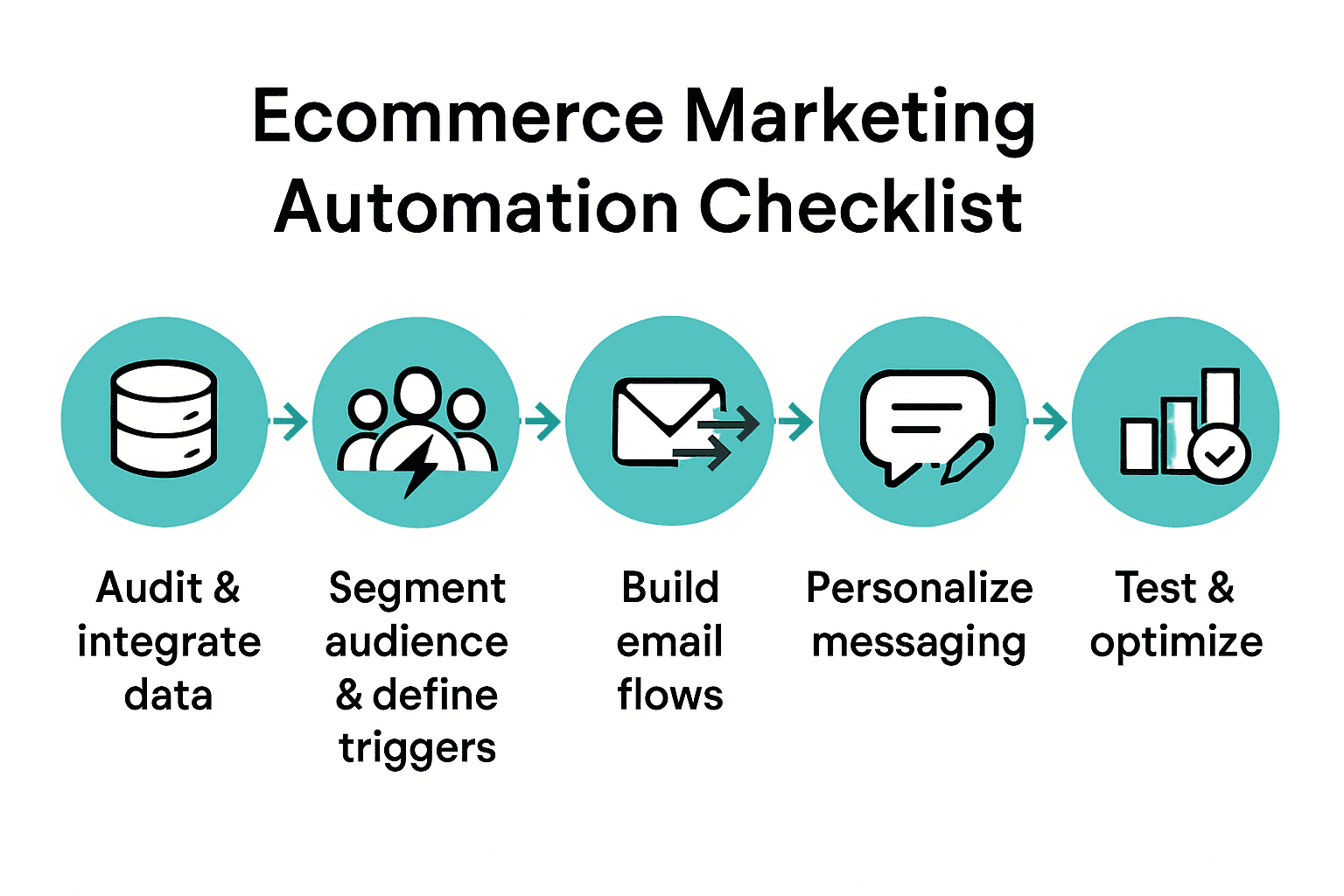
- Step 1: Audit And Integrate Your Data Sources
- Step 2: Segment Audience And Define Key Triggers
- Step 3: Build And Automate Essential Email Flows
- Step 4: Personalize Messaging To Match Brand Voice
- Step 5: Test, Analyze, And Optimize Performance
Quick Summary
| Key Point | Explanation |
|---|---|
| 1. Audit and integrate data sources | Identify and consolidate all data streams for a unified customer view. This helps improve marketing operations and customer relationship management. |
| 2. Segment audience meaningfully | Divide customers into core segments based on behavior and preferences, helping tailor your marketing strategies for better engagement. |
| 3. Build automated email flows | Create essential email workflows to engage customers throughout their journey, ensuring relevant and timely communication. |
| 4. Personalize messages to brand voice | Develop messaging that reflects your brand identity and resonates with target audiences for more effective interactions. |
| 5. Test and optimize marketing performance | Establish KPIs and use A/B testing to refine automation strategies based on data insights, enhancing future marketing efforts. |
Step 1: Audit and Integrate Your Data Sources
In this crucial step, you’ll strategically map and consolidate your ecommerce data sources to create a unified view of your customer interactions and business performance. According to research from arxiv.org, integrating data from multiple sources is essential for enhancing marketing operations and customer relationship management.
Start by identifying all your current data streams tracking customer behavior. These typically include your ecommerce platform, email marketing software, customer support systems, payment processors, and website analytics tools. List each source and note the specific types of data they capture. Your goal is to understand how these systems currently operate independently and where potential integration opportunities exist.
Next, evaluate the data quality and compatibility across these sources. Look for consistent identifiers like customer email addresses or unique customer IDs that can help you link information across platforms. Pay special attention to potential data gaps or inconsistencies that might prevent smooth integration. For instance, check if your abandoned cart data in Klaviyo matches the transaction records in your payment system.
A pro tip when auditing your data sources is to create a comprehensive mapping document that tracks data types, collection methods, and potential integration points. This visual reference will be invaluable as you move toward creating a more streamlined marketing automation ecosystem. By carefully auditing and preparing to integrate your data sources, you’re setting the foundation for more intelligent, personalized customer experiences that can dramatically improve your ecommerce performance.
With your data sources mapped and assessed, you’re now ready to explore the technical methods of connecting these platforms and creating a unified customer view.
Step 2: Segment Audience and Define Key Triggers
In this critical step, you will transform your customer data into powerful segmentation strategies that drive personalized marketing experiences. According to Wikipedia, audience segmentation involves dividing your consumer market into sub-groups based on shared characteristics, enabling more targeted and effective marketing approaches.
Begin by analyzing your existing customer data to identify meaningful segmentation criteria. Look beyond basic demographics and explore psychographic elements like purchasing behaviors, engagement levels, and customer lifecycle stages. Wikipedia suggests categorizing consumers based on psychological attributes such as values, attitudes, and lifestyles for more nuanced marketing strategies.
Define specific triggers that will activate personalized marketing workflows for each segment. These triggers might include actions like first purchase, repeat purchase frequency, cart abandonment, product category preferences, or engagement with previous email campaigns. Create clear rules for each segment that determine when and how automated marketing messages will be delivered.
A pro tip is to start with 3 to 5 core segments rather than attempting to create too many granular categories. This approach allows you to develop more focused and meaningful automation strategies without overwhelming your marketing systems.

With your audience segments and key triggers established, you are now prepared to design targeted automation workflows that speak directly to each customer group’s unique characteristics and preferences.
Step 3: Build and Automate Essential Email Flows
In this pivotal step, you will design and implement a comprehensive set of automated email workflows that strategically engage customers throughout their purchasing journey. According to research from JETIR, automation techniques can significantly improve customer engagement and operational efficiency by streamlining marketing workflows.
Start by identifying the critical email flows that are essential for your ecommerce business. These typically include welcome series, abandoned cart recovery, post purchase follow up, winback campaigns, and browse abandonment sequences. For each flow, map out the specific triggers that will initiate the email sequence and define the number of emails and content strategy for each touchpoint.
When building these email flows, focus on creating personalized and contextually relevant messaging that speaks directly to the customer’s current stage in their journey. IJSR emphasizes the importance of integrating various marketing systems to enhance the efficiency and effectiveness of automated communication strategies.
A pro tip is to implement a progressive profiling approach in your email flows. This means gradually collecting more information about customers through each interaction, allowing you to create increasingly sophisticated and targeted communications over time.
With your essential email flows built and automated, you are now ready to monitor their performance and continuously refine your approach to maximize customer engagement and conversion rates.
Step 4: Personalize Messaging to Match Brand Voice
In this crucial stage, you will craft automated messaging that authentically represents your brand’s unique personality and resonates deeply with your target audience. Research from IJRAR emphasizes the importance of integrating data to create personalized marketing messages that maintain brand consistency and enhance customer engagement.
Begin by developing a comprehensive brand voice guide that outlines your communication style, tone, key messaging pillars, and linguistic nuances. Consider how your brand sounds across different customer touchpoints whether playful and energetic, sophisticated and professional, or warm and conversational. Use this guide as a reference point when creating email templates, automation sequences, and personalized content to ensure every communication feels cohesive and true to your brand identity.
Leverage customer data and segmentation insights to further personalize your messaging. According to IJIRMPS, effective data integration enables marketing strategies that reflect brand voice while improving customer relationships and loyalty. This means tailoring your language, recommendations, and content based on individual customer behaviors, preferences, and lifecycle stages.
A pro tip is to create a brand voice matrix that maps different communication styles to specific customer segments and interaction types. This will help your team maintain consistency while allowing for nuanced personalization across various marketing automation workflows.
With your messaging personalized and aligned with your brand voice, you are now prepared to create more meaningful and resonant customer interactions that drive engagement and loyalty.
Step 5: Test, Analyze, and Optimize Performance
In this final step, you will transform your marketing automation strategy from static to dynamic by implementing a rigorous testing and optimization process. According to research from MDPI, integrating data analytics into marketing strategies is crucial for understanding and improving performance metrics that drive business growth.
Begin by establishing a comprehensive set of key performance indicators (KPIs) that will serve as your primary measurement tools. These should include metrics like conversion rates, email open rates, click through rates, revenue per email, and customer lifetime value. Use A/B testing methodologies to systematically experiment with different elements of your marketing automation workflows such as subject lines, email content, send times, and personalization approaches.
Continuously analyze the data collected from your tests to uncover actionable insights. Preprints emphasizes the importance of integrating analytics to enhance customer insights and optimize performance. Create a regular review cycle where you examine performance data monthly or quarterly, identifying trends, successful strategies, and areas requiring improvement.
A pro tip is to develop a performance optimization dashboard that provides real time visibility into your key metrics. This will help your team quickly identify and respond to changes in customer behavior and marketing effectiveness.
With a robust testing and optimization framework in place, you are now equipped to create a data driven marketing automation strategy that evolves alongside your business and customer needs.
Unlock Your Ecommerce Growth with Expert Marketing Automation
The article highlights how ecommerce brands often struggle to unify fragmented data sources, create meaningful customer segments, and build effective automated email flows that truly resonate with their audience. Key pain points like abandoned carts, inconsistent messaging, and difficulty personalizing at scale can stall growth and hurt customer loyalty. If you want to transform your email marketing into a powerful, conversion-focused channel that understands your brand voice and adapts dynamically through rigorous testing, this is where expert help makes all the difference.
At Take Action, we specialize in turning these exact challenges into opportunities by combining human expertise with AI-driven insights. Whether you need to automate essential flows on Klaviyo, segment your audience with precision, or craft personalized messages that reflect your brand’s unique personality, our team is ready to build and scale your automated customer engagement. Start increasing open rates, recovering lost revenue, and turning email into your primary growth engine today.
Ready to take the complicated out of marketing automation and turn your email into a relentless growth driver?
Explore how our tailored strategies can accelerate your ecommerce success at Take Action. Discover more about our email flow setup services and how we apply data-driven segmentation to maximize your ROI. Your next level of ecommerce growth begins here.
Frequently Asked Questions
How do I audit my ecommerce data sources for marketing automation?
Begin by listing all current data streams that track customer behavior, such as your ecommerce platform and email marketing software. Evaluate the data quality and identify integration opportunities, ensuring you can link information using consistent identifiers like customer email addresses.
What are effective audience segmentation strategies for ecommerce marketing?
To create effective audience segments, analyze customer data beyond demographics by exploring purchase behaviors and engagement levels. Start with 3 to 5 core segments based on shared characteristics, which allows for targeted automation workflows without overcomplicating your strategies.
What essential email flows should I automate for my ecommerce business?
Automate crucial email flows such as welcome series, cart recovery, and post-purchase follow-ups. For each flow, define triggers and content strategies to ensure your emails effectively engage customers at different stages of their purchasing journey.
How can I personalize my marketing messages in an automated workflow?
Craft personalized messaging that reflects your brand voice by developing a brand voice guide. Use customer data and segment insights to tailor language and content, ensuring that every interaction resonates with the recipient’s preferences and behaviors.
What key performance indicators (KPIs) should I track for my marketing automation efforts?
Focus on KPIs like conversion rates, email open rates, and revenue per email to gauge your automation performance. Establish a regular review cycle, such as monthly, to analyze these metrics and identify trends for continual improvement.
How can I test and optimize my automated marketing workflows?
Implement A/B testing to experiment with elements like subject lines and email content within your workflows. Analyze the results regularly to uncover insights and adjust your strategies, aiming for improvements of around 20% in key engagement metrics.
Recommended
- 7 Essential Ecommerce Marketing Strategies for Growth | Take Action Blog | Take Action
- 7 Must-Read Business Book Recommendations for Ecommerce Growth | Take Action Blog | Take Action
- 7 Conversion Rate Optimization Tips for Ecommerce Success | Take Action Blog | Take Action
- 7 Essential Steps in the Email Marketing Checklist for Growth | Marketing Car Blog
- 6 Steps to Build a Scalable Marketing Automation System | Go Online Now